Within Portugal Belief Panics
Why Portugal Escaped the Great Witch Hunts
Portugal avoided Europe's largest witch hunts, yet the Lisbon trials of 1559 reveal how accusation and authority could still produce deadly panic.
On this page
- Magic, superstition and the Portuguese Inquisition
- The Lisbon witch trials of 1559 60
- Why the panic failed to become nationwide
Page outline Jump by section
Introduction
Portugal never experienced the vast, sustained witch hunts that devastated parts of central Europe, yet it was not free from fear of witchcraft. Belief in harmful magic, curses, healing rituals and dealings with evil spirits was widespread, and both secular and religious authorities prosecuted people accused of magical offences. The country’s most dramatic episode came in Lisbon in 1559–1560, when a cluster of accusations escalated into the largest witch panic in Portuguese history. Six women were ultimately executed, and a wider investigation followed, but the panic quickly subsided instead of becoming a nationwide campaign. Historians regard the Lisbon trials as the exception that proves the rule: Portugal accepted the possibility of witchcraft, but its legal institutions generally resisted the demonological theories that drove the mass witch hunts elsewhere in Europe.[tufts.edu]dl.tufts.eduDigital Library Microsoft WordTufts Digital LibraryMicrosoft Word - Bruxaria Without the Sabbath in Portugal.docxJune 7, 2026…

Why Portugal feared magic but avoided mass witch hunts
Early modern Portuguese society distinguished between everyday magical practices and the elaborate vision of an organised satanic conspiracy that became influential in parts of Germany, Switzerland, France and Scotland. Ordinary people sought fortune-tellers, healers and charm-makers, while neighbours accused one another of harmful spells, love magic or curses. These beliefs generated prosecutions, but they rarely developed into claims that thousands of witches belonged to a secret cult serving the Devil.[Tufts Digital Library]dl.tufts.eduDigital Library Microsoft WordTufts Digital LibraryMicrosoft Word - Bruxaria Without the Sabbath in Portugal.docxJune 7, 2026…
The Portuguese Inquisition, established in 1536, certainly prosecuted magical practices, yet its priorities differed from many secular courts elsewhere in Europe. It devoted far more attention to religious conformity, particularly suspected secret Judaism among converted families, heresy and prohibited books. When dealing with alleged magic, inquisitors often treated claims with caution, preferring to punish superstition, fraud or improper religious practice rather than embrace spectacular stories of witches attending nocturnal gatherings or participating in continent-wide satanic conspiracies.[Tufts Digital Library]dl.tufts.eduDigital Library Microsoft WordTufts Digital LibraryMicrosoft Word - Bruxaria Without the Sabbath in Portugal.docxJune 7, 2026…
This relative restraint did not mean leniency. Accused people could still face imprisonment, flogging, banishment or public humiliation, and lengthy incarceration itself could prove fatal. Nevertheless, compared with many neighbouring regions, Portugal executed remarkably few people for witchcraft over the following two centuries.[Wikipedia]WikipediaWitch trials in PortugalWitch trials in Portugal
The Lisbon witch trials of 1559–1560
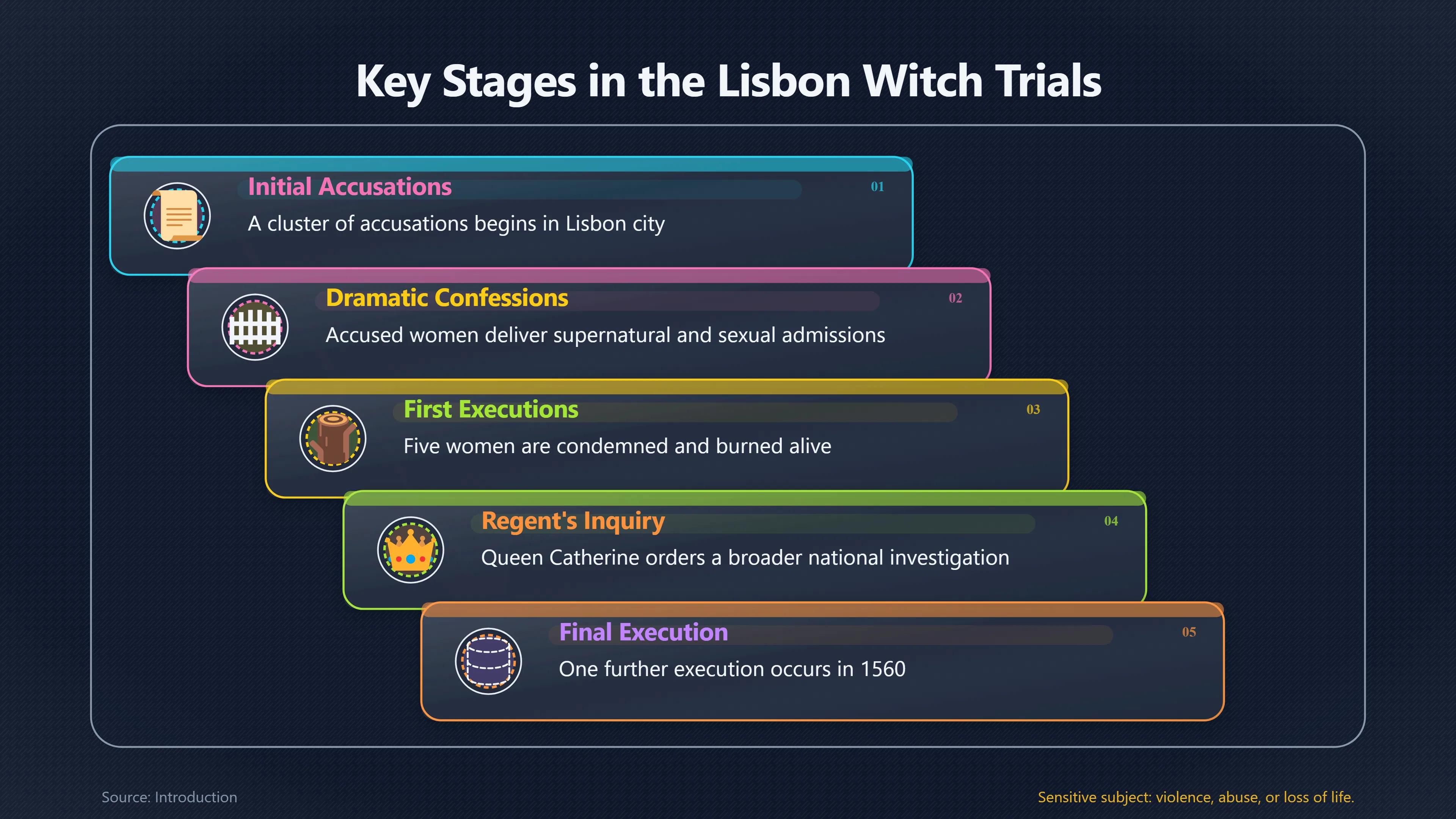
The Lisbon trials stand apart because they briefly resembled the large-scale witch persecutions seen elsewhere in Europe. Conducted by secular authorities rather than the Inquisition, the proceedings centred on several women accused of witchcraft who delivered dramatic confessions after arrest. According to surviving records, these confessions included sexual relations with the Devil, supernatural meetings, infanticide and other accusations that closely matched the demonological literature circulating across Europe. Five women were condemned and burned alive.[Wikipedia]WikipediaLisbon witch trialLisbon witch trial
Rather than ending the matter, the executions intensified public concern. The scale of the accusations prompted Queen Catherine, acting as regent during the minority of King Sebastian, to order a broader investigation into witchcraft across Portugal. The inquiry identified twenty-seven additional suspects, and one further execution followed in 1560, while others received punishments including imprisonment, whipping or banishment. Even so, the panic never expanded into the sustained chain reaction seen in many other European states.[Wikipedia]WikipediaLisbon witch trialLisbon witch trial
Modern historians approach the confessions with considerable caution. Like many early modern witch trials across Europe, they emerged within a judicial environment where imprisonment, interrogation and the threat of torture could produce extraordinary admissions. The fantastic claims therefore reveal as much about contemporary expectations of witchcraft as they do about the beliefs or actions of the accused themselves.[Tufts Digital Library]dl.tufts.eduDigital Library Microsoft WordTufts Digital LibraryMicrosoft Word - Bruxaria Without the Sabbath in Portugal.docxJune 7, 2026…
Why the panic failed to spread
The Lisbon prosecutions might have become the beginning of a much larger campaign, yet several factors prevented that outcome.
First, Portugal lacked a deeply rooted judicial commitment to the full demonological model of organised witch conspiracies. While belief in magic remained common, officials were generally less willing than many northern European courts to accept elaborate stories of sabbaths, mass conspiracies and systematic Devil worship as established fact.[Tufts Digital Library]dl.tufts.eduTufts Digital LibraryPDF | Bruxaria Without the Sabbath in Portugal. | ID: kd17d410m | Tufts Digital Library…
Second, responsibility gradually shifted towards the Portuguese Inquisition. Although modern readers often assume inquisitions intensified witch hunting, Portugal presents a more complicated picture. Once the Holy Office assumed clearer jurisdiction over witchcraft cases, prosecutions continued but executions became exceptionally uncommon because inquisitors tended to apply stricter evidential standards and favoured other punishments.[Wikipedia]WikipediaWitch trials in PortugalWitch trials in Portugal
Third, institutional priorities mattered. Resources were concentrated on offences viewed as more dangerous to Catholic orthodoxy than alleged witchcraft. This reduced the likelihood that local accusations would develop into nationwide judicial campaigns.[Tufts Digital Library]dl.tufts.eduDigital Library Microsoft WordTufts Digital LibraryMicrosoft Word - Bruxaria Without the Sabbath in Portugal.docxJune 7, 2026…
What later records reveal about Portuguese witchcraft accusations
Although Portugal escaped mass witch hunts, accusations never disappeared. Inquisitorial records from the seventeenth century show many investigations into magical practitioners, especially women who offered healing, divination, love charms or protection against curses. These cases reveal urban social networks in which magical knowledge circulated as practical services rather than evidence of organised satanic religion. For many poorer women, such knowledge also formed part of their economic survival.[Taylor & Francis Online]tandfonline.comTaylor & Francis OnlineFull article: Unveiling non-elite female knowledge: accusations of witchcraft and social networks in seventeenth-c…
The records also demonstrate that accusations reflected broader social tensions. Women living on the margins of society, migrants and people with uncertain reputations were especially vulnerable to denunciation. Historians therefore interpret many Portuguese witchcraft cases as disputes over trust, reputation and neighbourhood relationships rather than evidence of coherent underground cults.[Taylor & Francis Online]tandfonline.comTaylor & Francis OnlineFull article: Unveiling non-elite female knowledge: accusations of witchcraft and social networks in seventeenth-c…
Myths and misunderstandings
Several persistent misconceptions surround Portugal’s witch history.[Wikipedia]WikipediaWitch trials in PortugalWitch trials in Portugal
Portugal had no witch trials. This is incorrect. Hundreds of people faced investigation for magical offences, and the Lisbon trials remain one of Europe’s better-documented sixteenth-century witch persecutions, even if they were unusually limited in scale.[Wikipedia]WikipediaWitch trials in PortugalWitch trials in Portugal
The Portuguese Inquisition drove the country’s worst witch hunt. The opposite is closer to the historical evidence. The 1559 Lisbon executions were carried out by secular authorities. Historians generally argue that the later dominance of the Inquisition actually helped prevent Portugal from developing the sustained execution campaigns seen elsewhere.[Wikipedia]WikipediaLisbon witch trialLisbon witch trial
Portuguese people did not believe in witches. Belief in harmful magic was widespread. The difference lay not in popular belief but in how legal authorities interpreted and prosecuted those beliefs. Many accusations concerned healing, charms, curses or fortune-telling rather than participation in an organised satanic conspiracy.[Taylor & Francis Online]tandfonline.comTaylor & Francis OnlineFull article: Unveiling non-elite female knowledge: accusations of witchcraft and social networks in seventeenth-c…

Why the Lisbon trials remain historically important
The Lisbon witch trials illustrate how collective fear can erupt even within a legal culture that was comparatively sceptical of large-scale witch conspiracies. For a brief moment, familiar ingredients of the wider European witch craze—dramatic confessions, official investigations, public executions and fears of hidden evil—appeared in Portugal. Yet the episode also demonstrates how institutional choices can limit rather than amplify a panic.
Instead of becoming the foundation for generations of escalating witch hunts, the Lisbon trials remained an isolated crisis. Portugal continued to prosecute magical practices, but it never embraced the sustained persecution that claimed tens of thousands of lives elsewhere in Europe. For historians, this contrast makes Portugal an important comparative case: it shows that widespread belief in witchcraft alone was not enough to produce a continent-wide pattern of mass executions. Judicial culture, political priorities and standards of evidence proved just as significant in determining whether fear became a national panic.[tufts.edu]dl.tufts.eduDigital Library Microsoft WordTufts Digital LibraryMicrosoft Word - Bruxaria Without the Sabbath in Portugal.docxJune 7, 2026…
Amazon book picks
Further Reading
Books and field guides related to Why Portugal Escaped the Great Witch Hunts. Use these as the next step if you want deeper reading beyond the article.
The witch-hunt in early modern Europe
Essential comparative history of European witch hunts.


Witchcraft in Europe,
Primary sources illuminate early modern witchcraft prosecutions.
Endnotes
1.
Source: dl.tufts.edu
Title: Digital Library Microsoft Word
Link:https://dl.tufts.edu/downloads/qj72pj687
Source snippet
Tufts Digital LibraryMicrosoft Word - Bruxaria Without the Sabbath in Portugal.docxJune 7, 2026...
Published: June 7, 2026
2.
Source: Wikipedia
Title: Lisbon witch trial
Link:https://en.wikipedia.org/wiki/Lisbon_witch_trial
3.
Source: dl.tufts.edu
Link:https://dl.tufts.edu/concern/pdfs/kd17d410m
Source snippet
Tufts Digital LibraryPDF | Bruxaria Without the Sabbath in Portugal. | ID: kd17d410m | Tufts Digital Library...
4.
Source: Wikipedia
Title: Witch trials in Portugal
Link:https://en.wikipedia.org/wiki/Witch_trials_in_Portugal
5.
Source: youtube.com
Title: The Portuguese Inquisition | Full History
Link:https://www.youtube.com/watch?v=eWt8HdsbDIA
Source snippet
Europe's Witch Trials: Context for Salem Part 1...
6.
Source: novaresearch.unl.pt
Link:https://novaresearch.unl.pt/en/publications/unveiling-non-elite-female-knowledge-accusations-of-witchcraft-an/
Source snippet
non-elite female knowledge: accusations of witchcraft and social networks in seventeenth-century Lisbon - Universidade NOVA de LisboaJuly...
7.
Source: tandfonline.com
Link:https://www.tandfonline.com/doi/full/10.1080/09612025.2025.2535054
Source snippet
Taylor & Francis OnlineFull article: Unveiling non-elite female knowledge: accusations of witchcraft and social networks in seventeenth-c...
8.
Source: tandfonline.com
Link:https://www.tandfonline.com/doi/full/10.1080/09612025.2025.2535054?af=R
Source snippet
Vol 0, No 0 - Get AccessJuly 17, 2025 — 183 Views 0 CrossRef citations to date 0 Altmetric Research Article UNVEILING NON-ELITE FEMALE KN...
Published: July 17, 2025
Additional References
9.
Source: youtube.com
Link:https://www.youtube.com/watch?v=plN6onTiJpw
Source snippet
The Witch-Hunt in Early Modern Europe: A Discussion with Brian Levack...
10.
Source: youtube.com
Title: Europe’s Witch Trials: Context for Salem Part 1
Link:https://www.youtube.com/watch?v=oY–nodAvU8
Source snippet
A History of Witchcraft and Magic in Europe Part 7: The Early Modern Witch Trials...
11.
Source: portal.amelica.org
Link:https://portal.amelica.org/ameli/journal/84/844994005/html/
Source snippet
construção da figura das feiticeiras como identidades de gênero no universo do Tribunal do Santo Ofício português (século XVI)September 1...
12.
Source: scielo.pt
Link:https://scielo.pt/scielo.php?pid=S1645-64322012000100002&script=sci_arttext
13.
Source: repositorio.ufba.br
Link:https://repositorio.ufba.br/handle/ri/32047
14.
Source: novaresearch.unl.pt
Link:https://novaresearch.unl.pt/en/publications/estrat%C3%A9gias-femininas-para-solucionar-problemas-amorosos-processo/
15.
Source: everything.explained.today
Link:https://everything.explained.today/Witch_trials_in_Portugal/
16.
Source: revista.ufrr.br
Title: br Satanismo e bruxaria na inquisição portuguesa | Textos e Debates
Link:https://revista.ufrr.br/textosedebates/article/view/8016
17.
Source: youtube.com
Title: The Witch-Hunt in Early Modern Europe: A Discussion with Brian Levack
Link:https://www.youtube.com/watch?v=eSvFMkcO2d4
18.
Source: novaresearch.unl.pt
Title: pt The Portuguese Inquisition: night and fog
Link:https://novaresearch.unl.pt/en/publications/linquisition-portugaise-nuit-et-brouillard/
Topic Tree