Within Poland
Why Miracle Crowds Alarmed Communist Poland
Reports of weeping images and Marian apparitions drew huge crowds that communist authorities treated as challenges to state control.
On this page
- The reported tears at Lublin Cathedral
- How devotion and rumour drew mass gatherings
- State surveillance and Catholic institutional caution
Page outline Jump by section
Introduction
During the communist era in Poland, reports of miracles could become much more than religious events. They sometimes attracted enormous crowds whose very existence challenged the state’s claim to control public life. A rumour that a sacred image had wept, or that the Virgin Mary had appeared, could spread rapidly through word of mouth, drawing tens of thousands of pilgrims before the authorities could contain the situation. Communist officials typically dismissed such reports as superstition, fraud or deliberate political provocation, while the Catholic Church often responded more cautiously than many believers expected, investigating claims rather than immediately endorsing them. The result was a distinctive form of collective behaviour in which religious devotion, rumour, state surveillance and political tension all interacted.

The reported tears at Lublin Cathedral
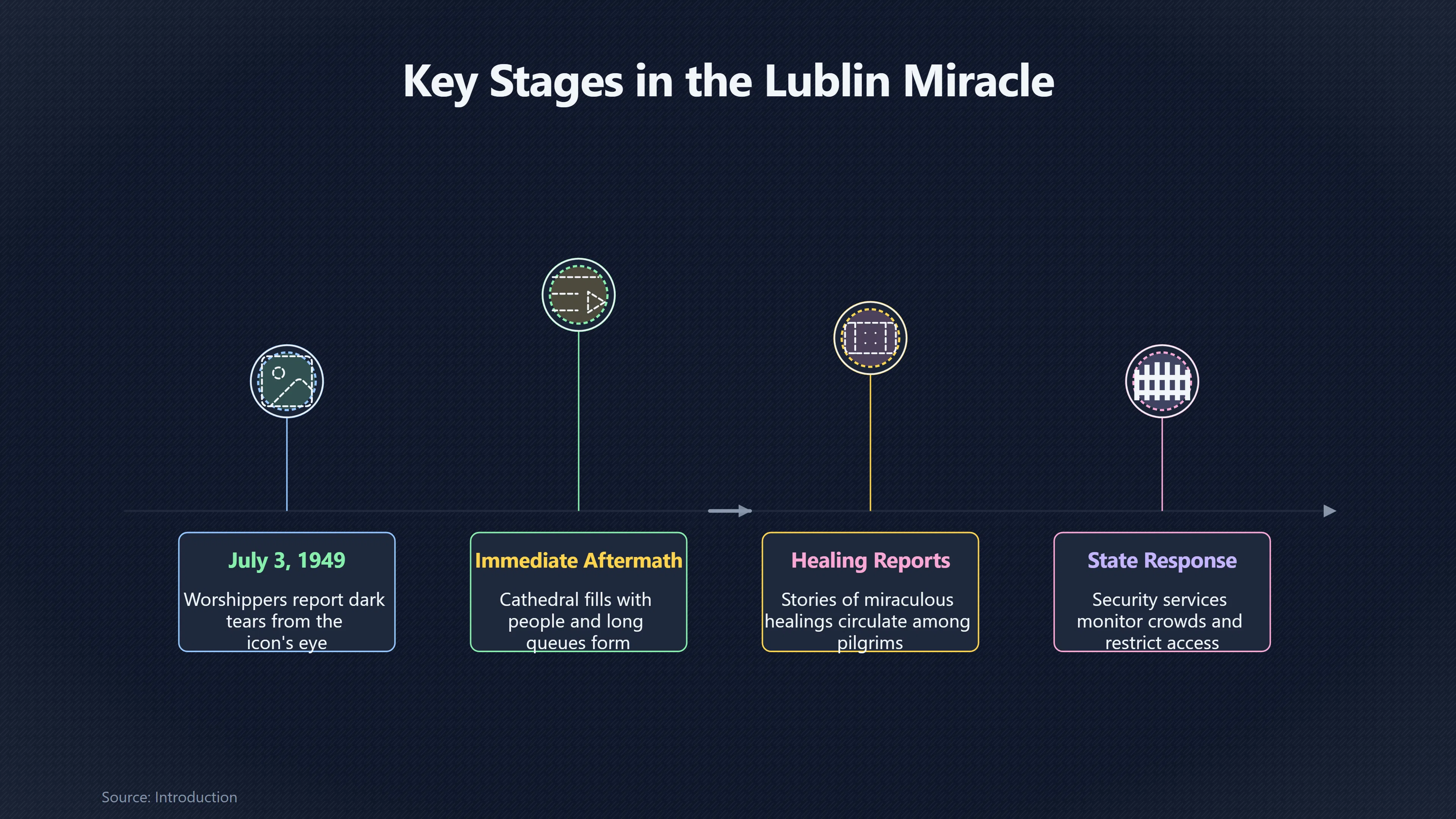
The best-known example was the so-called “Lublin Miracle” of July 1949. On 3 July, worshippers in Lublin Cathedral reported seeing dark tears running from the eye of a copy of the icon of Our Lady of Częstochowa. Witnesses described scenes of intense emotion as people knelt, wept and prayed. Within hours the cathedral was packed, and by the following morning queues stretched far beyond the building. Reports of miraculous healings quickly circulated alongside the original story, encouraging even larger numbers of pilgrims to travel to the city.[repozytorium.uwb.edu.pl]repozytorium.uwb.edu.plSociological aspect of miracles and apparitions in contemporary PolandJuly 10, 2017…
The timing mattered enormously. Poland was entering one of the harshest phases of Stalinism, when the communist authorities were intensifying pressure on the Catholic Church, one of the few national institutions that remained outside direct Party control. Many believers interpreted the reported tears as a sign that the Virgin Mary shared the suffering of Poland and offered spiritual encouragement during persecution. For officials, however, the crowds represented something much more dangerous than private religious belief: they were spontaneous mass gatherings that escaped state organisation and demonstrated the Church’s continuing ability to mobilise society.[edu.pl]repozytorium.amu.edu.plThe Weeping Virgin Mary and the Smiling Comrade Stalin. Polish Catholics and Communists in 1949…
Communist newspapers quickly portrayed the incident as a manufactured deception organised by reactionary clergy. Security services monitored the crowds closely, while the authorities attempted to restrict access and discourage further pilgrimage. One fatal crush during the gatherings heightened official anxiety, although later accounts differ over its exact causes, with some historians noting allegations that the disorder may have been worsened by security intervention.[MDPI]mdpi.comConstructing Mary through Pilgrimages: Lived Catholic Mariology in Poland | MDPIConstructing Mary through Pilgrimages: Lived Catholic Mariology in Poland | MDPI…
How devotion and rumour drew mass gatherings
The Lublin events illustrate how miracle crowds developed under communist rule. Most participants were not responding to newspaper reports but to personal testimony. Family members, neighbours and fellow parishioners passed on stories that they or someone they trusted had seen the tears or experienced a healing. As these accounts spread, each new arrival became another potential witness, reinforcing the expectation that something extraordinary was happening.[repozytorium.uwb.edu.pl]repozytorium.uwb.edu.plOpen source on edu.pl.
Several factors helped these gatherings grow:
- Religious networks connected parishes across the country long before modern social media.
- Word of mouth spread faster than official denials because trusted acquaintances carried the news.
- Pilgrimage traditions meant that travelling to a sacred site was already a familiar form of Catholic devotion.
- Political circumstances encouraged believers to interpret unusual religious events through the experience of communist repression rather than as isolated supernatural claims.[edu.pl]repozytorium.amu.edu.plThe Weeping Virgin Mary and the Smiling Comrade Stalin. Polish Catholics and Communists in 1949…
For historians and sociologists, these episodes are not simply examples of irrational collective belief. They also demonstrate how rumours can become socially powerful when they express widely shared hopes and anxieties. Even people who remained uncertain whether a miracle had actually occurred could feel compelled to visit because “everyone was going” or because they feared missing an event of great religious significance.[repozytorium.uwb.edu.pl]repozytorium.uwb.edu.plSociological aspect of miracles and apparitions in contemporary PolandJuly 10, 2017…

Why communist authorities saw miracle crowds as a political problem
The communist state did not fear only the miracle claim itself. It feared what the crowds revealed about society.
Official ideology presented the Party as the organiser of public life and scientific progress. A spontaneous pilgrimage involving thousands of people contradicted that image. It showed that religious loyalties could still mobilise large sections of the population independently of Party organisations, trade unions or state-sponsored associations. In practical terms, such gatherings were difficult to supervise and created opportunities for discussion, solidarity and public expressions of faith beyond official control.[edu.pl]repozytorium.amu.edu.plThe Weeping Virgin Mary and the Smiling Comrade Stalin. Polish Catholics and Communists in 1949…
Security services therefore treated miracle reports as potential threats to public order and political stability. Their responses typically combined surveillance, propaganda, restrictions on movement and efforts to portray reported miracles as deliberate frauds engineered by hostile clergy. Rather than debating theological questions, the authorities framed these events as attempts to undermine socialist reconstruction and state authority.[MDPI]mdpi.comConstructing Mary through Pilgrimages: Lived Catholic Mariology in Poland | MDPIConstructing Mary through Pilgrimages: Lived Catholic Mariology in Poland | MDPI…
This pattern continued beyond Lublin. In 1959, for example, reports that a church tower in Warsaw’s Nowolipki district glowed at night led thousands of people to gather, with some claiming to see the Virgin Mary. Once again, both security officials and Church authorities sought to manage the situation, illustrating that miracle crowds remained politically sensitive throughout the communist period.[czasopisma.ipn.gov.pl]czasopisma.ipn.gov.plPamięć i Sprawiedliwość | Pamięć i SprawiedliwośćJune 30, 2017…
Why the Catholic Church was often cautious
Although communist propaganda frequently accused the Church of inventing miracles, the historical record shows a more complicated reality.
Local bishops generally recognised the emotional power of such events but also understood the risks of endorsing an unverified claim. In Lublin, Church leaders quickly established a commission to examine the image and the reported liquid. The investigation’s conclusions were never formally published, and bishops urged believers to maintain order rather than encouraging ever-growing crowds.[repozytorium.uwb.edu.pl]repozytorium.uwb.edu.plSociological aspect of miracles and apparitions in contemporary PolandJuly 10, 2017…
This caution reflected several concerns. Catholic teaching does not require belief in alleged private miracles or apparitions, and Church authorities have long insisted on careful investigation before recognising extraordinary claims. There was also awareness that an unsubstantiated miracle could damage the Church’s credibility or provide the communist government with propaganda material. Consequently, Church leaders often found themselves balancing popular enthusiasm against institutional restraint.[repozytorium.uwb.edu.pl]repozytorium.uwb.edu.plSociological aspect of miracles and apparitions in contemporary PolandJuly 10, 2017…

What these events reveal about collective belief
Miracle crowds under communist rule are sometimes described as episodes of mass hysteria, but that label oversimplifies what happened. The available evidence points instead to a combination of sincere religious devotion, rapidly spreading rumour, political symbolism and social mobilisation.
Participants were not merely reacting to an unexplained physical phenomenon. They were responding to the broader experience of living in a state that sought to limit religious influence while the Catholic Church remained an important source of national identity. The reported miracles became meaningful because many people interpreted them through that political and spiritual context.[edu.pl]repozytorium.amu.edu.plThe Weeping Virgin Mary and the Smiling Comrade Stalin. Polish Catholics and Communists in 1949…
Modern historians therefore tend to study these episodes as moments when belief, authority and public space collided. The remarkable feature was not simply that thousands of people believed a miracle might have occurred, but that an apparently private religious experience could rapidly become a public demonstration beyond the immediate control of either the communist state or the Church hierarchy itself.[ipn.gov.pl]czasopisma.ipn.gov.plPamięć i Sprawiedliwość | Pamięć i SprawiedliwośćJune 30, 2017…
Amazon book picks
Further Reading
Books and field guides related to Why Miracle Crowds Alarmed Communist Poland. Use these as the next step if you want deeper reading beyond the article.
Europe's inner demons
First published 1975. Subjects: Witchcraft, History, Demonology, Church history, Witchcraft, europe.
The witch-hunt in early modern Europe
First published 1987. Subjects: Witchcraft, History, Hexenglaube, Geschichte (1450-1750), Heksenvervolgingen.

Bloodlands
First published 2010. Subjects: Massacres, Genocide, World War, 1939-1945, Holocaust, Jewish (1939-1945), Atrocities.

God's playground, a history of Poland
First published 1981. Subjects: History, Poland, history.
Endnotes
1.
Source: repozytorium.uwb.edu.pl
Title: Sociological aspect of miracles and apparitions in contemporary Poland
Link:https://repozytorium.uwb.edu.pl/jspui/bitstream/11320/5722/1/Marian%20apparitions%20and%20miracles%20in%20Poland.pdf
Source snippet
July 10, 2017...
Published: July 10, 2017
2.
Source: repozytorium.uwb.edu.pl
Link:https://repozytorium.uwb.edu.pl/jspui/bitstream/11320/15441/1/M_Krzywosz_From_orality_to_the_Internet_Transformations_of_religious_communication_in_Polish_miracular_communities.pdf
3.
Source: repozytorium.amu.edu.pl
Link:https://repozytorium.amu.edu.pl/items/ab2e1e8f-302d-4eee-8091-70fa1bde3890
Source snippet
The Weeping Virgin Mary and the Smiling Comrade Stalin. Polish Catholics and Communists in 1949...
4.
Source: mdpi.com
Title: Constructing Mary through Pilgrimages: Lived Catholic Mariology in Poland | MDPI
Link:https://www.mdpi.com/2077-1444/14/11/1420
Source snippet
Constructing Mary through Pilgrimages: Lived Catholic Mariology in Poland | MDPI...
5.
Source: czasopisma.ipn.gov.pl
Link:https://czasopisma.ipn.gov.pl/index.php/pis/article/view/140
Source snippet
Pamięć i Sprawiedliwość | Pamięć i SprawiedliwośćJune 30, 2017...
Published: June 30, 2017
6.
Source: ipn.gov.pl
Title: 146639,Jacek Woloszyn Cud lubelski lipiec 1949 r
Link:https://ipn.gov.pl/pl/historia-z-ipn/146639%2CJacek-Woloszyn-Cud-lubelski-lipiec-1949-r.html
Source snippet
Historia z IPN Instytut Pamięci NarodowejJuly 3, 2026 — JACEK WOŁOSZYN: „CUD LUBELSKI” – LIPIEC 1949 R. BYŁO TO PIERWSZE TAK OGROMNEJ SKA...
Published: July 3, 2026
7.
Source: mdpi.com
Link:https://www.mdpi.com/2077-1444/16/10/1226
Source snippet
But they worked in the popular imagination, leading to an unexpected political outcome (Ventresca 2...
8.
Source: radio.lublin.pl
Link:https://radio.lublin.pl/2025/07/lublin-swietuje-76-rocznice-cudu-lubelskiego/
9.
Source: radio.lublin.pl
Title: Wierni pamiętają. Kolejna rocznica „cudu lubelskiego”
Link:https://radio.lublin.pl/2025/07/wierni-pamietaja-kolejna-rocznica-cudu-lubelskiego/
10.
Source: archiwum.ipn.gov.pl
Link:https://archiwum.ipn.gov.pl/pl/dla-mediow/komunikaty/202961%2CTEKSTAUDIO-75-lat-temu-w-Lublinie-doszlo-do-wydarzenia-ktore-do-dzis-jest-nazywa.html
11.
Source: czasopisma.ipn.gov.pl
Link:https://czasopisma.ipn.gov.pl/index.php/pis/article/view/428
12.
Source: ipn.gov.pl
Link:https://ipn.gov.pl/pl/aktualnosci/2692%2CWyklad-Pawla-Szulca-Cud-Lubelski-w-1949-r-reakcje-na-Pomorzu-Zachodnim-Szczecin-.html
13.
Source: ipn.gov.pl
Title: 224013,Marcin Krzysztofik Boze Cialo 1949 roku w Lublinie
Link:https://ipn.gov.pl/pl/historia-z-ipn/224013%2CMarcin-Krzysztofik-Boze-Cialo-1949-roku-w-Lublinie.html
14.
Source: repozytorium.uwb.edu.pl
Link:https://repozytorium.uwb.edu.pl/jspui/handle/11320/5722
15.
Source: repozytorium.uwb.edu.pl
Link:https://repozytorium.uwb.edu.pl/jspui/handle/11320/15441
16.
Source: repozytorium.uwb.edu.pl
Link:https://repozytorium.uwb.edu.pl/jspui/handle/11320/15441?mode=full
17.
Source: repozytorium.uwb.edu.pl
Link:https://repozytorium.uwb.edu.pl/jspui/handle/11320/6041
18.
Source: repozytorium.uwb.edu.pl
Link:https://repozytorium.uwb.edu.pl/jspui/handle/11320/14702
Additional References
19.
Source: youtube.com
Link:https://www.youtube.com/watch?v=_m8zIkYpIu8
Source snippet
5 Miracles in the Allotments - The Story of Kazimierz Domański (#podcast #crime #Domański)...
20.
Source: youtube.com
Title: Did the Virgin Mary Appear in Poland to Defend the Latin Mass?
Link:https://www.youtube.com/watch?v=JnXuu13ION4
Source snippet
2 A Mother's Tears - 75th Anniversary of the Lublin Miracle...
21.
Source: onet.pl
Link:https://www.onet.pl/styl-zycia/kobietaxl/77-rocznica-cudu-w-lublinie-na-obrazie-maryi-miala-pojawic-sie-lza-material/r3qpmxh%2C30bc1058
Source snippet
rocznica "cudu w Lublinie". Na obrazie Maryi miała pojawić się łza [MATERIAŁ ARCHIWALNY] -July 3, 2026 — 77. ROCZNICA "CUDU W LUBLINIE"...
Published: July 3, 2026
22.
Source: youtube.com
Link:https://www.youtube.com/watch?v=NhVR1oi-fSU
Source snippet
4 A Great Punishment Is Coming Upon You” – Our Lady's Urgent 1943 Warning in Poland...
23.
Source: researchgate.net
Link:https://www.researchgate.net/publication/359101402_From_orality_to_the_Internet_transformations_of_religious_communication_in_Polish_miracular_communities
24.
Source: researchgate.net
Link:https://www.researchgate.net/publication/352536191_The_secret_police_and_the_Marian_apparition_Actions_of_the_Polish_Security_Service_against_the_miracle_of_Zabludow_in_1965
25.
Source: dzieje.pl
Link:https://dzieje.pl/dziedzictwo-kulturowe/autorka-ksiazki-o-cudzie-lubelskim-kosciol-nie-odrzucil-cudu-ale-tez-go-nie
26.
Source: czasopisma.tnkul.pl
Link:https://czasopisma.tnkul.pl/index.php/rt/article/view/1948
27.
Source: ojs.tnkul.pl
Link:https://ojs.tnkul.pl/index.php/rt/article/view/13820
28.
Source: researchgate.net
Link:https://www.researchgate.net/publication/322909058_Sociological_aspect_of_miracles_and_apparitions_in_contemporary_Poland
Topic Tree