Within Sweden's Scares
How Sweden's Witch Panic Became a National Crisis
Between 1668 and 1676, child-led accusations and official commissions turned local witch fears into Sweden's deadliest persecution.
On this page
- From Alvdalen rumours to a national persecution
- Mora, Torsaker and the machinery of execution
- Who was accused and why communities believed
Page outline Jump by section
Introduction
The Great Noise (Swedish: Det stora oväsendet) was the deadliest witch persecution in Swedish history. Between 1668 and 1676, fear that witches were abducting children to the Devil’s gathering at Blåkulla spread from one parish to another until it became a national crisis. Around 280 people were executed during these eight years, accounting for the great majority of all known witchcraft executions in Sweden. The panic was remarkable not only for its scale but also because it relied heavily on the testimony of children, whose stories were accepted by clergy, local courts and, eventually, a royal commission.[si.edu]folklife.si.eduSmithsonian Folklife CenterThe Swedish Witch Trials: How to Confront Dark Heritage | Smithsonian Center for Folklife and Cultural Heritag…
Rather than being a spontaneous outbreak of irrationality, the Great Noise emerged from the interaction of deeply held religious beliefs, local anxieties, judicial procedures and institutional authority. The episode remains one of the clearest examples in European history of how official endorsement can transform scattered rumours into a nationwide persecution.
From Älvdalen rumours to a national persecution
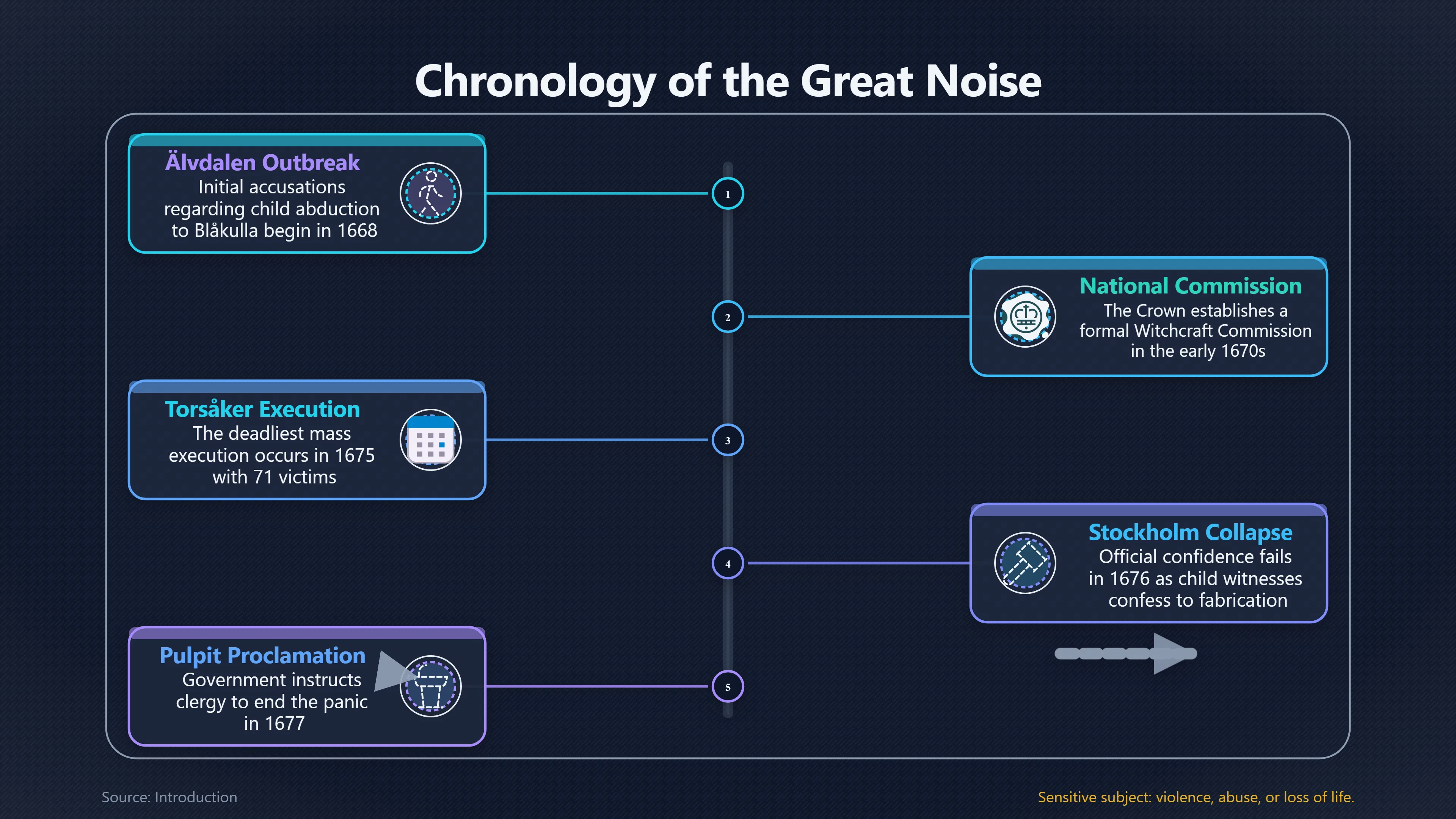
The crisis began in the parish of Älvdalen in Dalarna. In 1668, accusations involving the young shepherd Gertrud Svensdotter and the woman Märet Jonsdotter developed into claims that witches were transporting children through the night to Blåkulla, where they supposedly met Satan, renounced Christianity and took part in forbidden feasts and ceremonies. Although beliefs in witchcraft had existed in Sweden for centuries, this narrative was new in both its detail and emotional force.[si.edu]folklife.si.eduSmithsonian Folklife CenterThe Swedish Witch Trials: How to Confront Dark Heritage | Smithsonian Center for Folklife and Cultural Heritag…
The story spread because neighbouring communities already believed that the Devil actively intervened in everyday life. Parents became frightened by children’s reports, clergy treated those reports as evidence of a genuine spiritual assault, and magistrates opened formal investigations. Each successful prosecution encouraged other communities to look for similar crimes, allowing the panic to travel from parish to parish rather than remaining a local dispute.[wikipedia.org]WikipediaWitch trials in SwedenWitch trials in Sweden
Recognising the growing crisis, the Crown established a national Witchcraft Commission in the early 1670s. Its purpose was partly to standardise investigations, but the commission also legitimised the prosecutions. Instead of calming fears, the existence of a royal investigative body convinced many people that the threat was real.[Wikipedia]WikipediaWitch trials in SwedenWitch trials in Sweden
Mora, Torsåker and the machinery of execution
The first major escalation occurred in Mora. Following the initial accusations in Älvdalen, large numbers of adults were charged with carrying children to Blåkulla. Seventeen death sentences were imposed after review, while many children who claimed to have been taken there were themselves punished through public whipping or running the gauntlet because they were believed to have participated in satanic gatherings, even if unwillingly. The contradictory treatment of children as both victims and offenders illustrates the theological logic that governed the trials.[Wikipedia]WikipediaMora witch trialMora witch trial
As rumours spread into Hälsingland, Ångermanland and other regions, prosecutions became increasingly organised. Local clergy questioned children repeatedly, lists of alleged witches grew longer, and neighbours were encouraged to identify additional suspects. Each confession or accusation reinforced the appearance of a vast conspiracy.[Smithsonian Folklife Center]folklife.si.eduSmithsonian Folklife CenterThe Swedish Witch Trials: How to Confront Dark Heritage | Smithsonian Center for Folklife and Cultural Heritag…
The deadliest single event occurred at Torsåker in 1675. There, 71 people—65 women and six men—were executed after being convicted of witchcraft. It remains the largest mass execution for witchcraft in Swedish history. In some communities the demographic impact was severe, with an exceptionally high proportion of adult women removed from the population in a single day.[si.edu]folklife.si.eduSmithsonian Folklife CenterThe Swedish Witch Trials: How to Confront Dark Heritage | Smithsonian Center for Folklife and Cultural Heritag…
Although women formed the overwhelming majority of those executed, men were not immune. Several were convicted and executed alongside female relatives or neighbours, demonstrating that the central accusation concerned participation in a satanic conspiracy rather than female identity alone.[Wikipedia]WikipediaWitch trials in SwedenWitch trials in Sweden
Who was accused and why communities believed
Most of the accused were ordinary members of their communities rather than social outsiders. Many were middle-aged or elderly women with established family and neighbourhood ties. They were often selected because children named them, after which rumours, local disputes or existing suspicions strengthened the case against them.[Smithsonian Folklife Center]folklife.si.eduSmithsonian Folklife CenterThe Swedish Witch Trials: How to Confront Dark Heritage | Smithsonian Center for Folklife and Cultural Heritag…
The central allegation was not merely harmful magic. Prosecutors claimed that witches systematically recruited children into the Devil’s service by taking them to Blåkulla. This transformed witchcraft from an individual offence into a perceived organised assault on Christian society. Parents therefore believed that failure to investigate accusations placed all children at risk.[Wikipedia]WikipediaWitch trials in SwedenWitch trials in Sweden
Children’s accounts often became increasingly detailed over time. They described flights through the air, banquets, the Devil’s presence and meetings involving neighbours they recognised. Similar stories appeared across distant parishes because witnesses heard one another’s testimony, absorbed familiar narrative patterns and answered questions from adults who already believed such events occurred.[PubMed]pubmed.ncbi.nlm.nih.govChild testimonies during an outbreak of witch hysteria: Sweden 1670-1671 - PubMed…
Why child testimony proved so persuasive
Modern historians do not generally interpret the surviving records as evidence that children simply invented identical stories independently. Instead, they point to a combination of suggestion, memory, social influence and institutional pressure.
A detailed psychological analysis of 809 surviving child testimonies from Rättvik found several important patterns:
- Older children tended to produce more elaborate and internally consistent narratives.
- Children’s statements became increasingly stereotyped through interaction with other children.
- The questioning style used by priests and investigators influenced what children reported.
- Social conformity appears to have shaped testimony as much as individual imagination.[PubMed]pubmed.ncbi.nlm.nih.govChild testimonies during an outbreak of witch hysteria: Sweden 1670-1671 - PubMed…
These findings fit broader historical research showing that the investigations were rarely neutral interviews. Courts often expected particular kinds of answers, and surviving records may not preserve every question, correction or pressure applied during examinations. Historians also note evidence that some records omitted coercive practices or simplified complex interrogations.[Taylor & Francis Online]tandfonline.comTaylor & Francis OnlineWitchcraft Trials in 17th-century Sweden and the Great Northern Swedish Witch Craze of 1668–1678: Studia Neophilol…
This does not mean every child consciously lied. Dreams, frightening stories, religious teaching and repeated questioning could become intertwined until sincerely remembered experiences were difficult to separate from imagination.
Why the panic ended so abruptly
The persecution reached Stockholm in 1676, but the capital also became the place where official confidence began to collapse. Members of the Witchcraft Commission increasingly questioned whether convictions based primarily on children’s testimony were legally and morally defensible.[Wikipedia]WikipediaWitch trials in SwedenWitch trials in Sweden
The turning point came when several child witnesses admitted that they had fabricated or embellished their accusations. Once one confession appeared, others followed, undermining confidence in the entire system of evidence. Officials rapidly abandoned the previous assumption that children’s stories automatically revealed a hidden satanic conspiracy.[Wikipedia]WikipediaWitch trials in SwedenWitch trials in Sweden
In 1677, the government instructed clergy across Sweden to proclaim from the pulpit that the witch panic had ended and to discourage further accusations. Although isolated witchcraft prosecutions continued into the eighteenth century, the nationwide persecution known as the Great Noise was over.[Wikipedia]WikipediaWitch trials in SwedenWitch trials in Sweden
How historians interpret the Great Noise today
Modern scholarship treats the Great Noise as neither simple superstition nor merely an example of “mass hysteria”. Instead, it is understood as a state-backed persecution driven by several reinforcing forces:
- Religious certainty, in which belief in the Devil and witchcraft was accepted by nearly everyone in authority.
- Institutional validation, as courts and royal commissions treated extraordinary accusations as legally credible.
- Social contagion, with children’s stories becoming increasingly standardised through repetition and shared expectations.
- Community pressure, since doubting accusations could appear to endanger children or weaken Christian society.
- Judicial incentives, where each successful prosecution encouraged neighbouring parishes to launch similar investigations.[nih.gov]pubmed.ncbi.nlm.nih.govChild testimonies during an outbreak of witch hysteria: Sweden 1670-1671 - PubMed…
The Great Noise remains culturally important because it demonstrates how fear can become deadly when institutions reward accusation, discourage scepticism and mistake emotionally compelling testimony for reliable evidence. It also stands as Sweden’s clearest historical example of a collective belief becoming a national crisis through the combined authority of church, courts and state.

Amazon book picks
Further Reading
Books and field guides related to How Sweden's Witch Panic Became a National Crisis. Use these as the next step if you want deeper reading beyond the article.
Extraordinary Popular Delusions and the Madness of Crowds
Rating: 4.0/5 from 5 Google Books ratings
Frames the panic as part of broader crowd phenomena.


Endnotes
1.
Source: Wikipedia
Title: Witch trials in Sweden
Link:https://en.wikipedia.org/wiki/Witch_trials_in_Sweden
2.
Source: Wikipedia
Title: Mora witch trial
Link:https://en.wikipedia.org/wiki/Mora_witch_trial
3.
Source: folklife.si.edu
Link:https://folklife.si.edu/magazine/swedish-witch-trials-dark-heritage
Source snippet
Smithsonian Folklife CenterThe Swedish Witch Trials: How to Confront Dark Heritage | Smithsonian Center for Folklife and Cultural Heritag...
4.
Source: hhogman.se
Title: Hogman Genealogy Swedish History
Link:https://www.hhogman.se/history_sweden.htm
Source snippet
Hogman GenealogySwedish History - Hans Högman...
5.
Source: tandfonline.com
Link:https://www.tandfonline.com/doi/abs/10.1080/00393274.2012.668076
Source snippet
Taylor & Francis OnlineWitchcraft Trials in 17th-century Sweden and the Great Northern Swedish Witch Craze of 1668–1678: Studia Neophilol...
6.
Source: pubmed.ncbi.nlm.nih.gov
Link:https://pubmed.ncbi.nlm.nih.gov/7593397/
Source snippet
Child testimonies during an outbreak of witch hysteria: Sweden 1670-1671 - PubMed...
7.
Source: tandfonline.com
Link:https://www.tandfonline.com/doi/full/10.1080/00393274.2012.668076
Source snippet
Taylor & Francis OnlineWitchcraft Trials in 17th-century Sweden and the Great Northern Swedish Witch Craze of 1668–1678: Studia Neophilol...
8.
Source: pubmed.ncbi.nlm.nih.gov
Link:https://pubmed.ncbi.nlm.nih.gov/10829123/
9.
Source: pubmed.ncbi.nlm.nih.gov
Link:https://pubmed.ncbi.nlm.nih.gov/15630789/
10.
Source: pubmed.ncbi.nlm.nih.gov
Link:https://pubmed.ncbi.nlm.nih.gov/12696561/
Additional References
11.
Source: scandinavianhistory.blog
Title: The Witch Trials of Dalarna – Scandinavian History
Link:https://scandinavianhistory.blog/2021/06/20/the-witch-trials-of-dalarna/
Source snippet
June 20, 2021 — 20 juni, 2021 THE WITCH TRIALS OF DALARNA The connection between the witch trials in Salem, USA – those that have been th...
Published: June 20, 2021
12.
Source: acamh.onlinelibrary.wiley.com
Title: j.1469 7610.1995.tb01349.x
Link:https://acamh.onlinelibrary.wiley.com/doi/abs/10.1111/j.1469-7610.1995.tb01349.x
Source snippet
Child Testimonies During an Outbreak of Witch Hysteria: Sweden 1670–1671 - Sjöberg - 1995 - Journal of Child Psychology and Psychiat...
13.
Source: youtube.com
Title: Malin Matsdotter: The Condemned Witch (Occult History Explained)
Link:https://www.youtube.com/watch?v=WfEess9HC64
Source snippet
P3 Historia - Ep#10: Det stora oväsendet - den vansinniga häxjakten...
14.
Source: historicalescapes.se
Title: 350 years since the Great Noise
Link:https://historicalescapes.se/en/350-ar-sedan-det-stora-ovasendet/
Source snippet
German copperplate engraving from 1670. The period of witch hunts in Sweden in the latter...
15.
Source: youtube.com
Title: P3 Historia
Link:https://www.youtube.com/watch?v=tKkjBeW0exA
Source snippet
Sweden's Witch Trials: Uncovering the Great Noise...
16.
Source: youtube.com
Title: The Torsåker Witch Trials | Morbid | Podcast
Link:https://www.youtube.com/watch?v=pbd0wmdjDFw
Source snippet
Malin Matsdotter: The Condemned Witch (Occult History Explained)...
17.
Source: researchgate.net
Link:https://www.researchgate.net/publication/8099786_The_Outbreak_of_Mass_Allegations_of_Satanist_Child_Abuse_in_the_Parish_of_Rattvik_Sweden_1670-71_Two_Texts_by_Gustav_J_Elvius
18.
Source: researchgate.net
Link:https://www.researchgate.net/publication/296728761_The_catechism_effect_Child_testimonies_during_a_17th-century_witch_panic_as_related_to_educational_achievement
19.
Source: researchgate.net
Link:https://www.researchgate.net/publication/12489255_The_catechism_effect_Child_testimonies_during_a_17th-century_witch_panic_as_related_to_educational_achievement
20.
Source: rockdale.se
Link:https://www.rockdale.se/en/upplevelse/walking-in-the-footsteps-of-those-accused-of-witchcraft-mimmikulle/
Topic Tree