Within Italy's Strange Beliefs
Was Tarantism Illness, Ritual or Mass Hysteria?
Tarantism turned distress into a recognised cycle of music, dancing and temporary relief without requiring venom or conscious fakery.
On this page
- What sufferers and communities believed
- Music, movement and socially learned symptoms
- Why modern labels can oversimplify the ritual
Page outline Jump by section
Introduction
Tarantism is one of Italys most unusual historical responses to emotional distress, but it is often misunderstood. For centuries, especially in the Salento region of southern Italy, people believed that the bite of a spider could produce overwhelming physical and emotional symptoms that were relieved only through specific music, dancing and ritual. Modern research has found no evidence that spider venom explains the phenomenon. Instead, historians, anthropologists and psychologists increasingly interpret tarantism as a culturally recognised way of expressing suffering, conflict and psychological strain through performance rather than as simple poisoning, deliberate deception or a straightforward case of “mass hysteria”.[google.com]books.google.comBooks The Land of Remorse: A Study of Southern Italian TarantismGoogle BooksThe Land of Remorse: A Study of Southern Italian Tarantism - Ernesto De Martino - Google BooksJanuary 1, 2005…

Understanding tarantism matters because it challenges modern assumptions about illness and belief. Rather than separating medicine, religion and performance, the ritual combined all three. It created a socially accepted space where peoplemost often women living under difficult economic and social conditionscould express distress in ways their communities recognised and supported.[google.com]books.google.comBooks The Land of Remorse: A Study of Southern Italian TarantismGoogle BooksThe Land of Remorse: A Study of Southern Italian Tarantism - Ernesto De Martino - Google BooksJanuary 1, 2005…
What sufferers and communities believed
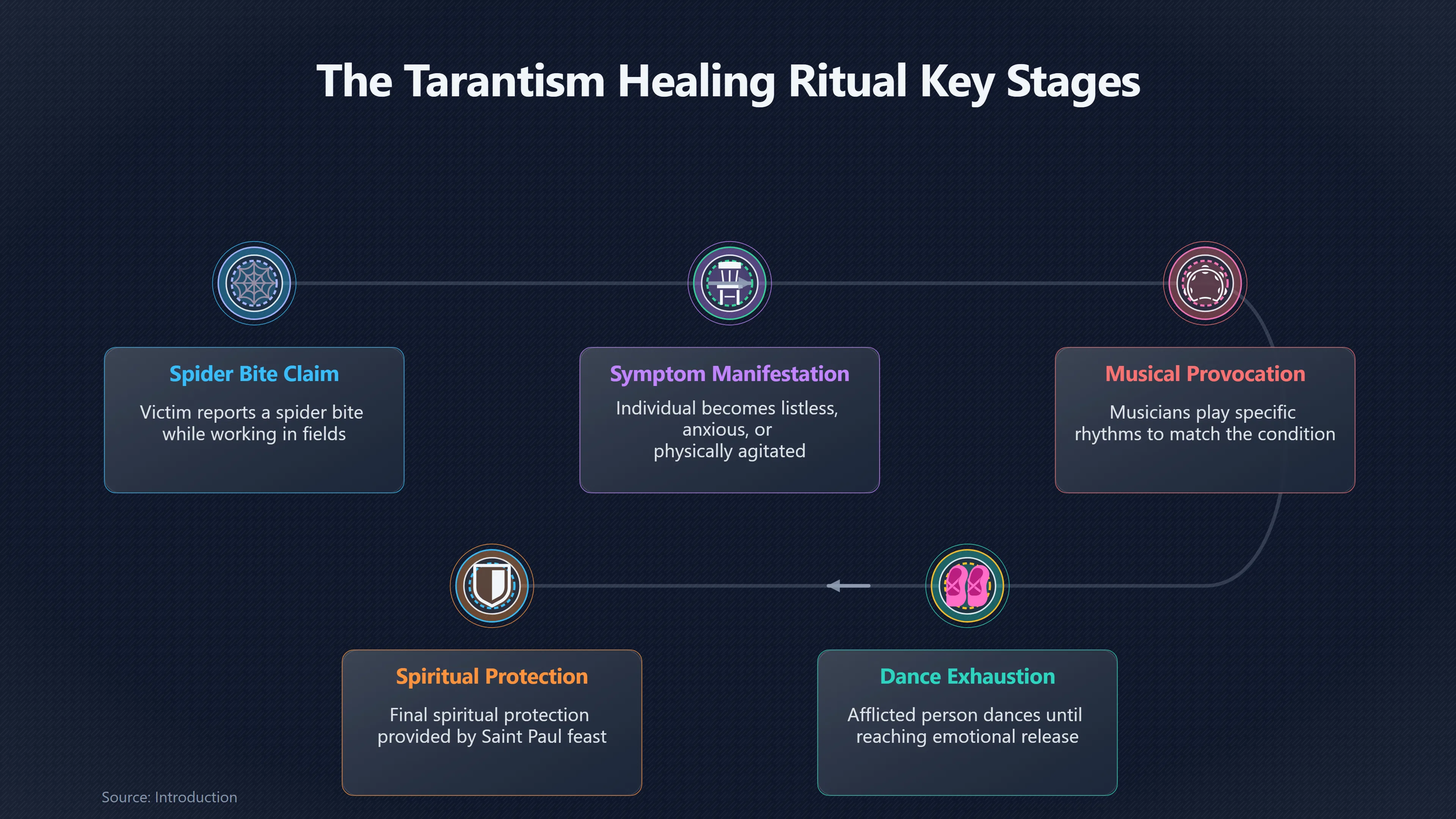
People experiencing tarantism were commonly said to have been bitten by a tarantula or related spider while working in the fields. The supposed victim might become listless, anxious, withdrawn or physically agitated. Rather than treating these symptoms as ordinary illness, families often interpreted them as evidence that the spider’s poison had disturbed both body and spirit. The accepted cure involved musicians performing particular rhythms while the afflicted person danced until reaching exhaustion or emotional release. Recovery was often understood as temporary, meaning the ritual might be repeated in later years.[taylorfrancis.com]taylorfrancis.comOpen source on taylorfrancis.com.
Belief in the spider’s bite gave communities a shared explanation for suffering that might otherwise have seemed mysterious or shameful. The ritual also became linked with the feast of Saint Paul, who was believed to offer the final spiritual protection after the musical performance. This combination of folk medicine and Catholic devotion helped embed tarantism within local culture rather than placing it outside accepted religious life.[google.com]books.google.comBooks The Land of Remorse: A Study of Southern Italian TarantismGoogle BooksThe Land of Remorse: A Study of Southern Italian Tarantism - Ernesto De Martino - Google BooksJanuary 1, 2005…
Importantly, the participants generally did not see themselves as acting in a theatrical performance. For them, the ritual was a genuine response to a real condition, regardless of whether the original cause was actually a spider bite.
Music, movement and socially learned symptoms
The most remarkable feature of tarantism is that the symptoms and their treatment were inseparable. Particular melodies, rhythms and colours were believed to provoke reactions from the afflicted person, who might dance energetically, crawl, cry, laugh or collapse before gradually calming down. Musicians watched carefully, adjusting tempo and style until they found the combination that appeared to “match” the individual sufferer’s condition.[Vilnius University Press]journals.vu.ltOpen source on vu.lt.
This process makes little sense if viewed purely as treatment for venom. It makes far more sense as a culturally learned ritual in which expectations shaped bodily experience. Modern researchers describe tarantism as a “culture-bound syndrome”a form of distress expressed through behaviours that are recognised and understood within a particular society. The symptoms were real to those experiencing them, but they followed patterns learned through local tradition rather than through the effects of spider toxins.[google.com]books.google.comBooks The Land of Remorse: A Study of Southern Italian TarantismGoogle BooksThe Land of Remorse: A Study of Southern Italian Tarantism - Ernesto De Martino - Google BooksJanuary 1, 2005…
The music itself played an active role rather than merely accompanying the event. Ethnomusicologists argue that repetitive rhythms, sustained movement and communal participation created conditions in which emotional tension could be expressed safely. The ritual therefore functioned simultaneously as therapy, religious ceremony and public performance.[cambridge.org]cambridge.orgCambridge University Press & AssessmentThe Contribution of Ernesto de Martino to the Anthropology of Italian Music | Yearbook for Traditi…
Why modern labels can oversimplify the ritual
Describing tarantism simply as mass hysteria risks missing what made it distinctive. Classic episodes of mass psychogenic illness usually involve symptoms spreading rapidly through schools, factories or communities by observation and expectation. Tarantism worked differently.
Instead of a sudden epidemic, it formed a long-established cultural institution with recognised roles, accepted rituals and predictable patterns. Individuals did not merely imitate one another. They entered a shared framework that provided an explanation for distress and an accepted route towards relief. The ritual’s effectiveness depended on participants, musicians, family members and the wider community understanding the same symbolic language.[google.com]books.google.comBooks The Land of Remorse: A Study of Southern Italian TarantismGoogle BooksThe Land of Remorse: A Study of Southern Italian Tarantism - Ernesto De Martino - Google BooksJanuary 1, 2005…
Calling the participants frauds is equally misleading. Anthropological research has consistently argued that people can experience genuine psychological and physical symptoms without conscious deception. The fact that symptoms reflected local beliefs does not make them imaginary. Instead, belief shaped how suffering was experienced, communicated and managed.[google.com]books.google.comBooks The Land of Remorse: A Study of Southern Italian TarantismGoogle BooksThe Land of Remorse: A Study of Southern Italian Tarantism - Ernesto De Martino - Google BooksJanuary 1, 2005…
Distress, gender and social pressure
One of the most influential interpretations comes from the Italian anthropologist Ernesto de Martino, whose extensive fieldwork in Salento during the late 1950s transformed understanding of tarantism. Rather than dismissing it as superstition, he argued that the ritual gave meaning to experiences that otherwise threatened to overwhelm individuals, especially those living in poverty and social isolation.[Google Books]books.google.comBooks The Land of Remorse: A Study of Southern Italian TarantismGoogle BooksThe Land of Remorse: A Study of Southern Italian Tarantism - Ernesto De Martino - Google BooksJanuary 1, 2005…
Many documented sufferers were women whose lives were shaped by hard agricultural labour, restrictive gender expectations and limited opportunities to express anger, grief or frustration publicly. De Martino suggested that the symbolic “spider bite” allowed these conflicts to be externalised. The ritual temporarily suspended ordinary social rules, permitting emotional expression that everyday life discouraged. Once the ceremony ended, participants could return to ordinary social life with renewed stability.[google.com]books.google.comBooks The Land of Remorse: A Study of Southern Italian TarantismGoogle BooksThe Land of Remorse: A Study of Southern Italian Tarantism - Ernesto De Martino - Google BooksJanuary 1, 2005…
This interpretation does not claim that every participant experienced identical problems. Instead, it explains why similar ritual forms repeatedly emerged among people facing comparable social pressures.
From healing ritual to cultural performance
By the second half of the twentieth century, the traditional healing ritual had largely disappeared as southern Italy underwent economic change, improved healthcare and rapid social transformation. Cases of classical tarantism became increasingly rare, even though the music survived.[cswr.hds.harvard.edu]cswr.hds.harvard.eduOpen source on harvard.edu.
Today, the dance style known as pizzica has experienced a major revival through concerts, festivals and cultural heritage projects. Modern performances celebrate regional identity rather than treating participants for spider bites. Some artists and scholars describe this as “neo-tarantism”: a reinterpretation that honours the historical tradition while separating it from its original healing function.[Google Books]books.google.comBooks Ritual, Rapture and Remorse: A Study of Tarantism and Pizzica in SalentoGoogle BooksRitual, Rapture and Remorse: A Study of Tarantism and Pizzica in Salento - Jerri Daboo - Google Books…
This revival illustrates how cultural practices can survive even after the beliefs that originally sustained them have changed.
What tarantism tells us about belief and illness
Tarantism demonstrates that illness cannot always be understood through biology alone. People’s expectations, cultural traditions, religious beliefs and social relationships influence how suffering is experienced and expressed. Modern medicine rejects the idea that spider venom caused the historical phenomenon, yet this does not mean the participants’ pain was unreal.[google.com]books.google.comBooks The Land of Remorse: A Study of Southern Italian TarantismGoogle BooksThe Land of Remorse: A Study of Southern Italian Tarantism - Ernesto De Martino - Google BooksJanuary 1, 2005…
For historians of collective belief, tarantism occupies a distinctive place in Italy’s history. It was neither simply a panic nor merely a theatrical spectacle. Instead, it was a socially recognised mechanism that transformed private distress into communal ritual. Music, movement and shared belief created a framework in which suffering became visible, meaningful and, at least temporarily, manageable. That complexity explains why tarantism continues to attract scholars from anthropology, psychology, religious studies and the history of medicine, and why it remains one of Italy’s most revealing examples of the close relationship between culture, performance and human experience.[google.com]books.google.comBooks The Land of Remorse: A Study of Southern Italian TarantismGoogle BooksThe Land of Remorse: A Study of Southern Italian Tarantism - Ernesto De Martino - Google BooksJanuary 1, 2005…
Amazon book picks
Further Reading
Books and field guides related to Was Tarantism Illness, Ritual or Mass Hysteria?. Use these as the next step if you want deeper reading beyond the article.
Extraordinary Popular Delusions and the Madness of Crowds
Rating: 4.0/5 from 5 Google Books ratings
Offers broader perspective on collective belief and social contagion.
The Land of Remorse: A Study of Southern Italian Tarantism
The classic study of ritual, music and healing in southern Italy.
Endnotes
1.
Source: books.google.com
Title: Books The Land of Remorse: A Study of Southern Italian Tarantism
Link:https://books.google.com/books/about/The_Land_of_Remorse.html?id=d3i1AAAAIAAJ
Source snippet
Google BooksThe Land of Remorse: A Study of Southern Italian Tarantism - Ernesto De Martino - Google BooksJanuary 1, 2005...
Published: January 1, 2005
2.
Source: cswr.hds.harvard.edu
Link:https://cswr.hds.harvard.edu/news/2024/12/10/video-spider-dance-tradition-time-and-healing-southern-italy
3.
Source: cambridge.org
Link:https://www.cambridge.org/core/services/aop-cambridge-core/content/view/F598FEA28770E356B3C113394492A780/S0740155800004653a.pdf/the-contribution-of-ernesto-de-martino-to-the-anthropology-of-italian-music.pdf
Source snippet
Cambridge University Press & AssessmentThe Contribution of Ernesto de Martino to the Anthropology of Italian Music | Yearbook for Traditi...
4.
Source: journal.rais.education
Link:https://journal.rais.education/index.php/raiss/article/view/94
Source snippet
Student, University of Craiova, Romania ABSTRACT Widely known as „folk revival, the tarantism phenomenon (otherwise known a...
5.
Source: books.google.com
Title: Books Ritual, Rapture and Remorse: A Study of Tarantism and Pizzica in Salento
Link:https://books.google.com/books/about/Ritual_Rapture_and_Remorse.html?id=kB49XOwiIloC
Source snippet
Google BooksRitual, Rapture and Remorse: A Study of Tarantism and Pizzica in Salento - Jerri Daboo - Google Books...
6.
Source: youtube.com
Link:https://www.youtube.com/watch?v=YIVtPcDb21U
Source snippet
ITALIAN MUSIC | Briganti di Terra d'Otranto - Tarantella heals a possessed woman in Apulia, ITALY...
7.
Source: taylorfrancis.com
Link:https://www.taylorfrancis.com/chapters/edit/10.4324/9781315090894-11/ritualized-illness-music-therapy-views-tarantism-kingdom-naples-david-gentilcore
8.
Source: journals.vu.lt
Link:https://www.journals.vu.lt/td/en/article/view/28371
Additional References
9.
Source: ojs.unito.it
Link:https://ojs.unito.it/index.php/COSMO/article/view/12176/9930
Source snippet
CC BYATTRAVERSO I CONFINI: ERNESTO DE MARTINO E LE ARTIFLAVIO GEISSHUESLERCRISIS, CULTURE AND CREATIONErnesto De Martinos Ethos...
10.
Source: grotowski.net
Link:https://grotowski.net/publikacje/ritual-rapture-and-remorse-study-tarantism-and-pizzica-salento
Source snippet
November 10, 2020 Jerri Daboo RITUAL, RAPTURE AND REMORSE: A STUDY OF TARANTISM AND PIZZICA IN SALENTO Peter Lang AG, Internationaler...
Published: November 10, 2020
11.
Source: prestomusic.com
Link:https://www.prestomusic.com/books/products/7852885–ritual-rapture-and-remorse-a-study-of-tarantism-and-pizzica-in-salento
Source snippet
March 8, 2010 RITUAL, RAPTURE AND REMORSE: A STUDY OF TARANTISM AND "PIZZICA" IN SALENTO * Author: Daboo, Jerri Image: Ritual, Rapture...
Published: March 8, 2010
12.
Source: trad-culture.ru
Link:https://www.trad-culture.ru/en/article/dance-small-spider-between-ritual-and-disease
Source snippet
Vol. 19. 3 Key words tarantism, ritual, South Italy, spiders mythologem, dance, disease, folklore...
13.
Source: youtube.com
Title: ITALIAN MUSIC | Briganti di Terra d’Otranto
Link:https://www.youtube.com/watch?v=nyVvt3Vf9WI
Source snippet
Chapter 11 Ernesto De Martino: Magic, Tarantism, and the Crisis of Presence...
14.
Source: youtube.com
Title: Chapter 11 Ernesto De Martino: Magic, Tarantism, and the Crisis of Presence
Link:https://www.youtube.com/watch?v=DO73bSSEI7k
Source snippet
THE LAND OF REMORSE by Ernesto De Martino...
15.
Source: academic.oup.com
Link:https://academic.oup.com/illinois-scholarship-online/book/30978/chapter-abstract/263937687
Source snippet
and Tarantella among Catholic Women in Calabria | Ritual Soundings: Women Performers and World Religions | Illinois Scholarship Online |...
16.
Source: youtube.com
Title: THE LAND OF REMORSE by Ernesto De Martino
Link:https://www.youtube.com/watch?v=OLdiE3_2TOM
Source snippet
Ernesto De Martino in The Taranta (1960)...
17.
Source: peterlang.com
Title: Peter Lang Ritual, Rapture and Remorse
Link:https://www.peterlang.com/document/1043707
18.
Source: youtube.com
Link:https://www.youtube.com/watch?v=LhyWobg8nec
Topic Tree