Within North Korea
Is North Korea a Political Religion?
North Korea's leader worship combines sacred history, compulsory ritual, political education and punishment for visible nonconformity.
On this page
- How the Kim family became sacred national figures
- Portraits, monuments and rituals of everyday loyalty
- Private belief, public conformity and the limits of the cult label
Page outline Jump by section
Introduction
North Korea is often described as having a personality cult, but many scholars argue that the country’s system goes beyond the ordinary glorification of political leaders. The Kim family has been presented through myths, rituals, symbols and moral duties that resemble features commonly associated with organised religion, even though North Korea officially promotes atheism. This does not mean that the state is literally a religion, nor that every citizen sincerely accepts its claims. Instead, many researchers describe it as a form of political religion: a political system that borrows religious structures to strengthen authority, encourage loyalty and define national identity.[go.kr]kci.go.krTHE ASCENSION OF THE ORDINARY MAN: HOW THE PERSONALITY CULT OF KIM IL-SUNG WAS CONSTRUCTED (1945–1974)…
Understanding this distinction matters because it explains why portraits, ceremonies, revolutionary stories and displays of loyalty occupy such a central place in everyday life. It also helps explain why public conformity can coexist with private scepticism, fear or simple habit. The question is therefore not whether North Koreans “worship” the Kim family in the same way believers worship a deity, but how the state has constructed a system in which political loyalty is expressed through practices that often resemble sacred devotion.
How the Kim family became sacred national figures
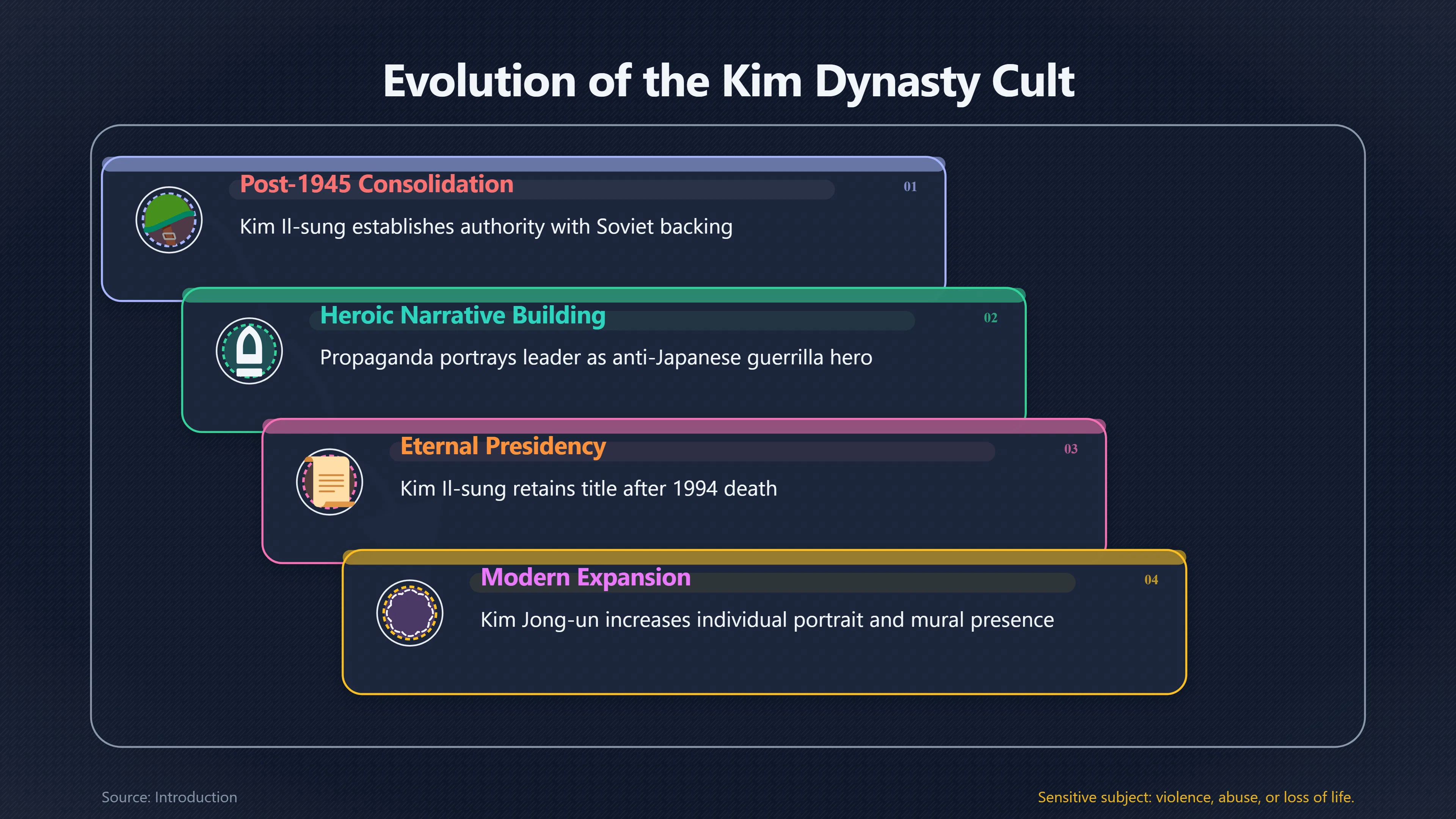
The personality cult surrounding the Kim family was not created overnight. Historians show that it developed gradually after 1945 as Kim Il-sung consolidated power with Soviet backing before increasingly reshaping North Korea around his own authority. Early propaganda portrayed him as a heroic anti-Japanese guerrilla leader. Over subsequent decades, official biographies became increasingly idealised, adding miraculous episodes, flawless leadership and an almost timeless revolutionary destiny.[KCI]kci.go.krTHE ASCENSION OF THE ORDINARY MAN: HOW THE PERSONALITY CULT OF KIM IL-SUNG WAS CONSTRUCTED (1945–1974)…
A crucial feature of this process was transforming a political leader into the symbolic embodiment of the nation itself. Kim Il-sung ceased to be presented merely as a president and instead became the country’s eternal founding father. After his death in 1994, he retained the title of “Eternal President”, allowing political authority to remain connected to him even while power passed to his son. This dynastic succession distinguished North Korea from most other communist states, where personality cults generally faded after a leader’s death.[go.kr]kci.go.krTHE ASCENSION OF THE ORDINARY MAN: HOW THE PERSONALITY CULT OF KIM IL-SUNG WAS CONSTRUCTED (1945–1974)…
Official mythology also connected the ruling family to places invested with national meaning. Mount Paektu, already important within Korean history and folklore, became central to revolutionary storytelling. State narratives associated the Kim family with the mountain’s symbolic purity and presented the revolutionary struggle as the fulfilment of Korea’s historical destiny. Such stories reinforced the idea that political legitimacy flowed through a sacred national lineage rather than ordinary political institutions.[VTechWorks]vtechworks.lib.vt.eduDeconstructing Kimilsungism: A Political and Ideological Analysis of the North Korean Regime…
Some recent historians argue that aspects of this system also drew upon Korea’s earlier Christian culture. Jonathan Cheng, for example, argues that Kim Il-sung’s childhood exposure to Protestant Christianity influenced later revolutionary symbolism, including ideas resembling sacred family lineages, moral commandments and exemplary biographies. This interpretation remains debated, but many scholars agree that the regime deliberately borrowed familiar cultural forms that encouraged reverence rather than merely demanding obedience.[Library Journal]libraryjournal.comLibrary JournalKorean Messiah: Kim Il Sung and the Christian Roots of North Korea’s Personality Cult | Library JournalFebruary 1, 2026…
Portraits, monuments and rituals of everyday loyalty
The Kim personality cult is sustained through repeated public rituals rather than occasional displays.
Portraits of Kim Il-sung and Kim Jong-il have long been required in homes, schools and workplaces. Citizens are expected to maintain them carefully, while public buildings display large official images that become focal points during ceremonies. Major monuments and statues serve as sites for organised visits, floral tributes and commemorative events. These practices resemble civic rituals found elsewhere but occur with unusual regularity and under state supervision.[USCIRF]uscirf.govNORTH KOREANORTH KOREA…
Children encounter these rituals from an early age. Schools teach revolutionary history through idealised accounts of the Kim family, while workplaces hold regular ideological meetings emphasising correct attitudes and behaviour. National holidays celebrate the birthdays of Kim Il-sung and Kim Jong-il as the country’s most important commemorative occasions, marked by mass performances, exhibitions and organised participation.[USCIRF]uscirf.govNORTH KOREANORTH KOREA…
These repeated actions perform several functions simultaneously:
- They remind citizens that loyalty is expected in daily life rather than only during elections or national crises.
- They reinforce shared historical narratives through constant repetition.
- They create visible public conformity, making dissent difficult to detect.
- They transform political ideology into routine social behaviour rather than occasional propaganda.
Researchers therefore argue that ritual itself is one of the regime’s most effective governing tools, regardless of whether participants privately believe every official narrative.[VTechWorks]vtechworks.lib.vt.eduDeconstructing Kimilsungism: A Political and Ideological Analysis of the North Korean Regime…

Why scholars describe it as a political religion
Calling North Korea a political religion does not mean it possesses a supernatural theology comparable to Christianity, Buddhism or Islam. Instead, the phrase highlights structural similarities between organised religion and state ideology.
Commonly identified features include:
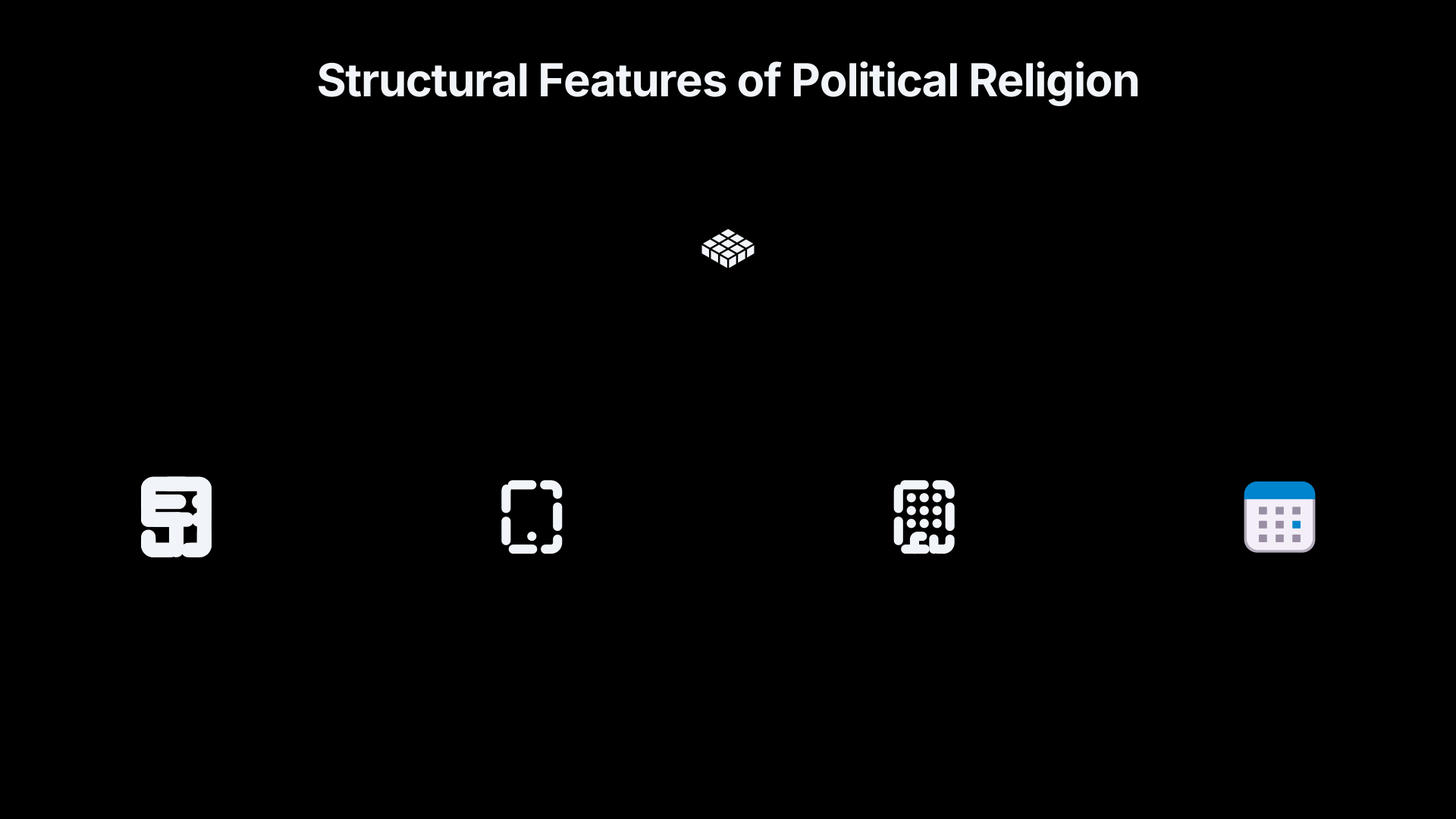
- Sacred founders: Kim Il-sung is presented as the ultimate source of national legitimacy.
- Authoritative texts: Official speeches, revolutionary histories and ideological writings function as unquestionable guides.
- Moral commandments: The state’s “Ten Principles for the Establishment of the One-Ideology System” prescribe absolute loyalty and regulate personal behaviour.
- Pilgrimage-like spaces: Revolutionary sites, statues and museums become places of symbolic devotion.
- Ritual calendars: National anniversaries organise public life around commemorative ceremonies.
- Sacred lineage: Leadership passes through the Kim family as a revolutionary bloodline rather than through open political competition.[uscirf.gov]uscirf.govNORTH KOREANORTH KOREA…
Political scientists emphasise that these similarities help explain the regime’s durability. The state does not simply command obedience through force; it continually reinforces a moral universe in which loyalty becomes an ethical duty and criticism appears equivalent to betrayal of both the nation and its founding history.[VTechWorks]vtechworks.lib.vt.eduDeconstructing Kimilsungism: A Political and Ideological Analysis of the North Korean Regime…
Private belief, public conformity and the limits of the cult label
The term personality cult is widely used in political science, but it can easily create misunderstandings.
It does not imply that every North Korean sincerely accepts miraculous stories about the Kim family. Nor does it suggest that citizens voluntarily joined a movement comparable to a small religious sect.
Instead, available evidence from defectors, human rights investigations and scholarly research points to a far more complicated picture. People’s behaviour may reflect a mixture of genuine patriotism, habit, fear of punishment, social expectation, emotional attachment, career calculation and the practical need to avoid suspicion. Since independent opinion surveys inside North Korea are impossible, measuring private belief remains extremely difficult.[USCIRF]uscirf.govNORTH KOREANORTH KOREA…
This distinction is important because visible behaviour alone cannot reveal sincere conviction. A person who bows before a statue may be expressing heartfelt loyalty, following lifelong custom or simply avoiding potential consequences. Outside observers rarely have enough evidence to distinguish these motivations with confidence.
For this reason, many specialists prefer to analyse the cult as a system of governance rather than as evidence of universal belief.
How Kim Jong-un has reshaped the personality cult
The personality cult has continued to evolve rather than remaining frozen after Kim Il-sung and Kim Jong-il.
During Kim Jong-un’s early years, official imagery often emphasised continuity with his father and grandfather. More recently, however, observers have documented a noticeable increase in portraits, murals, songs, badges and monuments centred specifically on Kim Jong-un himself. New public displays increasingly present him as a leader in his own right rather than solely as heir to the revolutionary dynasty.[apnews.com]apnews.comAP News Kim's portrait is publicly displayed in North KoreaHere's a look at what it meansMay 22, 2024 — A portrait of North Korean leader Kim Jong Un was publicly displayed alongside those of his…
Recent reporting has identified a rapid expansion of large mosaic murals featuring Kim Jong-un across North Korea, alongside growing use of his individual portrait in official settings. Analysts interpret these developments as part of an effort to strengthen his personal legitimacy while preserving the broader dynastic narrative established by his predecessors.[The Times]thetimes.comThese large mosaic portraits, identified in 39 locations including eight provincial capitals, depict Kim smiling in idyllic and powerful…
Although the symbolism changes over time, the underlying mechanism remains consistent: political authority is reinforced through repeated public ritual, carefully managed historical storytelling and visible demonstrations of loyalty.
Why the political religion framework remains useful
Describing North Korea as a political religion is ultimately an analytical tool rather than a literal definition. It helps explain why the regime relies so heavily on ceremonies, myths, sacred places, idealised biographies and moral obligations instead of presenting itself as an ordinary political administration.
At the same time, the framework has limits. It should not obscure the role of surveillance, censorship, punishment and state power. Nor should it encourage the mistaken assumption that all citizens genuinely believe official narratives. The North Korean system combines ideological education with coercion, making outward conformity an unreliable guide to private conviction.
Seen in this light, the Kim personality cult is best understood as a mechanism of governance. It seeks to fuse national history, political authority and everyday ritual into a single moral order, making loyalty appear not merely politically necessary but socially and ethically natural. That combination of myth, symbolism, repetition and coercion is why scholars continue to regard North Korea as one of the clearest modern examples of a state organised around a political religion rather than simply an authoritarian government with extensive propaganda.[go.kr]kci.go.krTHE ASCENSION OF THE ORDINARY MAN: HOW THE PERSONALITY CULT OF KIM IL-SUNG WAS CONSTRUCTED (1945–1974)…


Endnotes
1.
Source: uscirf.gov
Title: NORTH KOREA
Link:https://www.uscirf.gov/sites/default/files/resources/North%20Korea%202013.pdf
Source snippet
NORTH KOREA...
2.
Source: uscirf.gov
Link:https://www.uscirf.gov/publication/kimilsungism-kimjongilism-and-right-freedom-religion-thought-and-conscience-north-korea
3.
Source: kci.go.kr
Link:https://www.kci.go.kr/kciportal/landing/article.kci?arti_id=ART001997977
Source snippet
THE ASCENSION OF THE ORDINARY MAN: HOW THE PERSONALITY CULT OF KIM IL-SUNG WAS CONSTRUCTED (1945–1974)...
4.
Source: vtechworks.lib.vt.edu
Link:https://vtechworks.lib.vt.edu/handle/10919/43585
Source snippet
Deconstructing Kimilsungism: A Political and Ideological Analysis of the North Korean Regime...
5.
Source: libraryjournal.com
Link:https://www.libraryjournal.com/review/korean-messiah-kim-il-sung-and-the-christian-roots-of-north-koreas-personality-cult-100007445
Source snippet
Library JournalKorean Messiah: Kim Il Sung and the Christian Roots of North Korea’s Personality Cult | Library JournalFebruary 1, 2026...
Published: February 1, 2026
6.
Source: apnews.com
Title: AP News Kim’s portrait is publicly displayed in North Korea
Link:https://apnews.com/article/197e63db723e43f76d75cc83d75b4c3c
Source snippet
Here's a look at what it meansMay 22, 2024 — A portrait of North Korean leader Kim Jong Un was publicly displayed alongside those of his...
Published: May 22, 2024
7.
Source: thetimes.co.uk
Link:https://www.thetimes.co.uk/article/kim-jong-un-fostering-personality-cult-with-face-on-party-badges-9zp5m3xq9
Source snippet
Historically, such badges depicted only his predecessors—his father Kim Jong-il and his grandfather Kim Il-sung. This change was noted du...
8.
Source: thetimes.com
Link:https://www.thetimes.com/world/asia/article/north-korea-kim-jong-un-murals-0hm8vxvs0
Source snippet
These large mosaic portraits, identified in 39 locations including eight provincial capitals, depict Kim smiling in idyllic and powerful...
9.
Source: kci.go.kr
Title: ci Sere Arti View.kci
Link:https://www.kci.go.kr/kciportal/ci/sereArticleSearch/ciSereArtiView.kci?sereArticleSearchBean.artiId=ART001997977
Additional References
10.
Source: researchgate.net
Link:https://www.researchgate.net/publication/359798534_In_what_ways_has_the_carefully_crafted_cult_of_personality_around_the_Kim_family_have_perpetuated_this_dynasty%27s_rule_in_North_Korea
Source snippet
ResearchGate(PDF) In what ways has the carefully crafted cult of personality around the Kim family have perpetuated this dynasty’s rule i...
11.
Source: ft.com
Title: Financial Times Korean Messiah
Link:https://www.ft.com/content/46ed0447-43cf-4465-9522-2403fe30997f
Source snippet
The book argues that the regime’s elaborate personality cult mirrors Christian theology, particularly Protestant evangelical traditions...
12.
Source: youtube.com
Title: The God of Pyongyang: How Christianity Built North Korea
Link:https://www.youtube.com/watch?v=I9EPmaV7tDo
Source snippet
Korean Messiah: The Religious and Ideological Roots of North Korea's Personality Cult...
13.
Source: youtube.com
Title: North Korea: The cult that outlasted Stalin and Mao
Link:https://www.youtube.com/watch?v=P2S_TRUAC5w
Source snippet
The God of Pyongyang: How Christianity Built North Korea...
14.
Source: youtube.com
Title: The belief system behind North Korea’s dictatorship
Link:https://www.youtube.com/watch?v=eLHhSK64u6E
Source snippet
North Korea: The cult that outlasted Stalin and Mao...
15.
Source: youtube.com
Title: Inside North Korea’s Religious Cult of Personality
Link:https://www.youtube.com/watch?v=AsYApU60oH4
Source snippet
The belief system behind North Korea's dictatorship...
16.
Source: routledge.com
Link:https://www.routledge.com/Leader-Symbols-and-Personality-Cult-in-North-Korea-The-Leader-State/Lim/p/book/9781315736570
17.
Source: cambridge.org
Link:https://www.cambridge.org/core/journals/journal-of-asian-studies/article/occult-of-personality-koreas-candlelight-protests-and-the-impeachment-of-park-geunhye/477334CE20A83C6824039F9626D355DD
18.
Source: pacificaffairs.ubc.ca
Link:https://pacificaffairs.ubc.ca/book-reviews/leader-symbols-and-personality-cult-in-north-korea-the-leader-state-by-jae-cheon-lim/
19.
Source: mackseyjournal.scholasticahq.com
Title: 39624 the sacred revolution propaganda and personality cult in north korea
Link:https://mackseyjournal.scholasticahq.com/article/39624-the-sacred-revolution-propaganda-and-personality-cult-in-north-korea
Topic Tree