Within Kiribati Belief Panics
Why Onotoa Waited for God
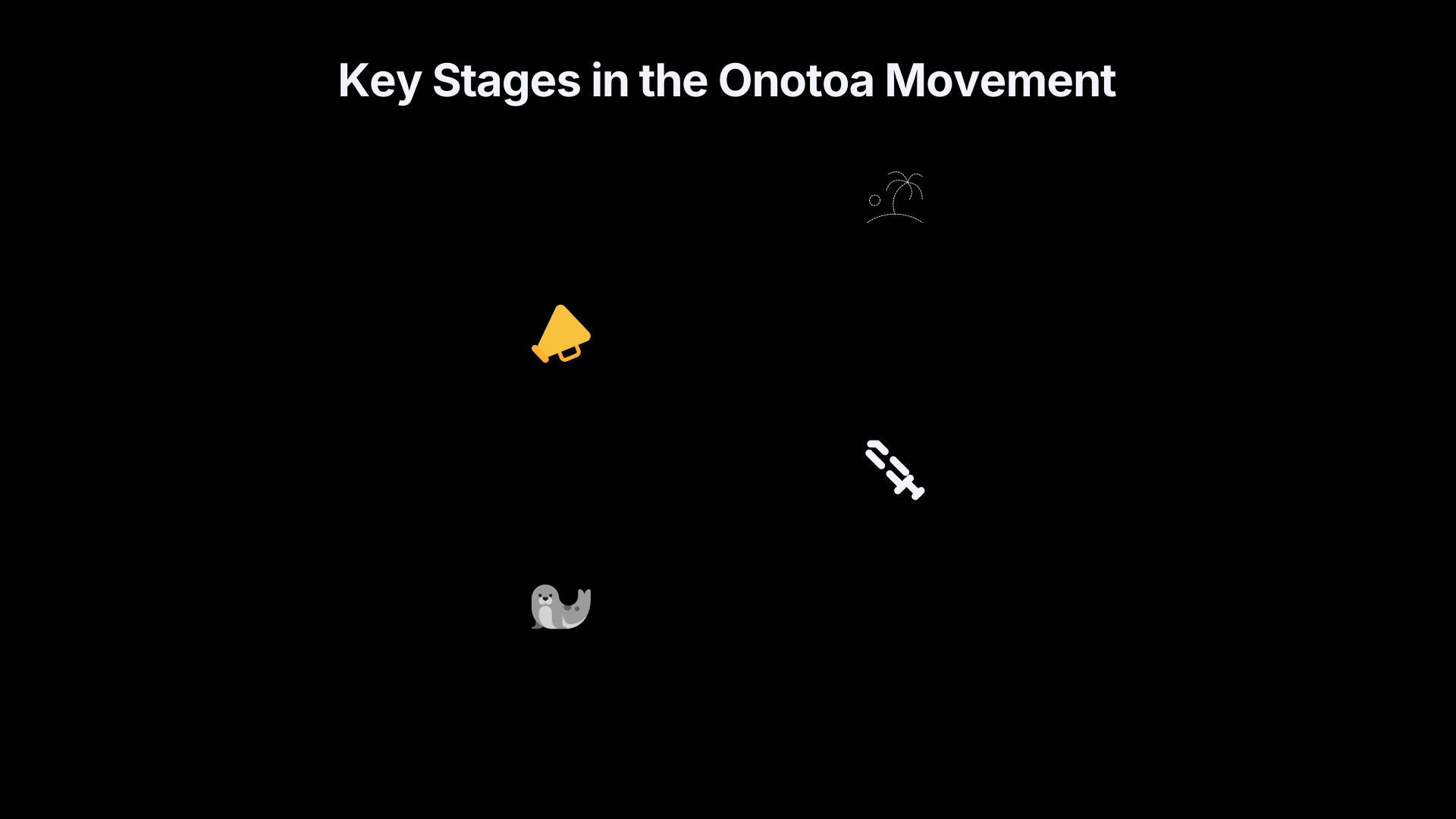
In 1930, Ten Naewa's followers prepared for God's physical arrival and challenged both church and colonial authority on Onotoa.
On this page
- Ten Naewa and the promise of divine arrival
- How prophecy challenged church and colonial rule
- What the surviving evidence can and cannot show
Page outline Jump by section
Introduction
In June 1930, a small religious movement emerged on the atoll of Onotoa in what is now Kiribati. Led by a man named Ten Naewa, it proclaimed that God would soon arrive physically on the island, overturning the existing religious and political order. Followers came to be known as the “Swords of Gabriel”, a name reflecting their belief that they had a special role in preparing for this divine intervention. The movement lasted only a few weeks before colonial authorities suppressed it, yet it has remained one of Kiribati’s best-known examples of a millenarian religious movement—a community expecting an imminent transformation of the world through direct divine action rather than gradual social change. Far from being simply an episode of “mass hysteria”, it combined Christian symbolism, indigenous ideas about authority, and resistance to missionary and colonial control. The surviving evidence is limited and largely comes from colonial records, making careful interpretation essential.[haujournal.org]haujournal.orgOpen source on haujournal.org.
Why Onotoa Waited for God
By 1930, Christianity had become deeply established across the Gilbert Islands, but it had not eliminated local debates over religious authority. Protestant and Catholic missions exercised considerable influence over education, morality and village life, while the British colonial administration relied heavily on recognised church structures and local leaders.
Against this background, Ten Naewa announced that God would descend directly to Onotoa. According to later accounts, he eventually claimed an extraordinary relationship with the divine, describing himself as the “father of God”, while his closest followers became known as the “Swords of Gabriel”. The movement did not reject Christianity outright. Instead, it reworked Christian ideas into a new prophetic vision centred on immediate divine intervention rather than the authority of missionaries or established churches.[Encyclopedia.com]encyclopedia.comCosmology: Oceanic Cosmologies | Encyclopedia.comCosmology: Oceanic Cosmologies | Encyclopedia.com
The expectation was not merely symbolic. Believers prepared for God’s arrival as a real historical event that would soon transform life on the island. Such expectations place the movement within a wider Pacific pattern of millenarian movements, in which communities anticipated an imminent divine renewal during periods of rapid colonial and religious change. Unlike the stereotype of a “cargo cult”, however, the central promise on Onotoa was God’s personal arrival rather than the miraculous appearance of European goods.[Encyclopedia.com]encyclopedia.comCosmology: Oceanic Cosmologies | Encyclopedia.comCosmology: Oceanic Cosmologies | Encyclopedia.com
Ten Naewa and the promise of divine arrival
Very little is known about Ten Naewa’s early life, and most surviving descriptions were written by colonial officials or later historians rather than by his followers themselves. That absence of indigenous written testimony makes it difficult to reconstruct his teachings in full.
Nevertheless, several consistent features appear across the available evidence.
- He claimed direct spiritual authority independent of existing churches.
- He predicted God’s imminent physical arrival on Onotoa.
- His movement organised a distinct body of committed followers known as the Swords of Gabriel.
- His message challenged both missionary authority and the legitimacy of the colonial administration.[haujournal.org]haujournal.orgOpen source on haujournal.org.
Modern anthropologists caution against dismissing these claims simply as irrational prophecy. Across Oceania, prophetic movements often emerged when imported Christianity, indigenous cosmology and colonial rule intersected. Rather than abandoning Christianity, leaders frequently adapted biblical language to express local hopes, anxieties and claims to religious independence. The Onotoa movement fits this broader pattern while remaining distinctive in its emphasis on God’s direct descent to one particular island.[Wiley Online Library]onlinelibrary.wiley.comOnline Library Critique, Vision and Cosmology: Millenarian Ideas in MelanesiaWiley Online LibraryCritique, Vision and Cosmology: Millenarian Ideas in Melanesia - Hirsch - 2024 - Oceania - Wiley Online Library…
How prophecy challenged church and colonial rule
The movement became politically significant because its religious claims also undermined existing institutions.
Missionaries claimed authority through scripture, church organisation and overseas religious networks. Colonial officials depended upon recognised chiefs, magistrates and mission leaders to maintain order. If God was about to appear directly through Ten Naewa’s revelation, those existing authorities could be portrayed as unnecessary or even illegitimate.
From the perspective of the colonial government, this created a governance problem rather than simply a theological disagreement. A movement expecting an imminent supernatural transformation might cease to recognise official leadership or obey colonial regulations. For this reason, the administration intervened quickly, and the movement was effectively dismantled within about a month of its emergence.[HAU Journal]haujournal.orgOpen source on haujournal.org.
This rapid suppression helps explain why relatively little documentation survives. Unlike longer-lived religious movements elsewhere in the Pacific, the Swords of Gabriel had little opportunity to develop institutions, produce written teachings or spread beyond its local setting.

Was this a “cult” or a case of mass hysteria?
Older colonial and missionary accounts sometimes described movements like the Swords of Gabriel as “cults” or grouped them with so-called cargo cults. Modern scholarship uses those labels much more cautiously.
Several distinctions matter.
First, there is little evidence that followers experienced collective panic, hallucinations or the kinds of contagious psychological symptoms associated with mass psychogenic illness.
Second, the movement’s beliefs were organised around coherent prophetic expectations rather than uncontrolled fear. Participants appear to have acted purposefully within a religious framework that made sense to them.
Third, the movement developed in a society undergoing profound social change. Christianity had transformed traditional authority, while colonial administration imposed new political structures. Religious innovation therefore also carried political implications.[haujournal.org]haujournal.orgOpen source on haujournal.org.
For these reasons, historians generally interpret the Swords of Gabriel as a short-lived indigenous Christian movement with millenarian expectations rather than as an example of irrational crowd behaviour.

What the surviving evidence can and cannot show
Understanding the movement is difficult because the historical record is unusually thin.
Most detailed accounts derive from:
- British colonial reports.
- Missionary observations.
- Later historical studies drawing on those records.
- More recent anthropological work comparing archival material with oral traditions from Onotoa.[HAU Journal]haujournal.orgOpen source on haujournal.org.
These sources agree on several core facts:
- the movement appeared on Onotoa in June 1930;
- Ten Naewa led it;
- followers expected God’s physical arrival;
- the group became known as the Swords of Gabriel;
- colonial authorities suppressed it within weeks.[haujournal.org]haujournal.orgOpen source on haujournal.org.
Beyond those broad points, many details remain uncertain. Historians cannot confidently reconstruct the movement’s full theology, estimate precisely how many followers it attracted, or determine how ordinary participants interpreted every aspect of Ten Naewa’s teachings. Recent scholarship therefore treats the episode less as a fully recoverable narrative than as a case showing how different historical sources—official reports, academic histories and local memory—produce different understandings of the same event.[HAU Journal]haujournal.orgOpen source on haujournal.org.
Why the movement still matters
Although it survived for only a short time, the Swords of Gabriel occupies an important place in Kiribati’s religious history because it illustrates how local communities responded creatively to colonial-era Christianity rather than merely accepting or rejecting it.
The movement demonstrates that prophetic expectations could become a form of social and political expression. Waiting for God’s arrival was also a way of questioning who possessed genuine authority on Onotoa: missionaries, colonial officials or a locally inspired prophet.
For that reason, the episode is better understood as a conflict over religious legitimacy and governance than as a simple story of credulous belief. It remains one of the clearest documented examples in Kiribati of a millenarian movement whose challenge to established authority arose through the expectation of an imminent divine transformation rather than through violence or mass panic.[haujournal.org]haujournal.orgOpen source on haujournal.org.
Amazon book picks
Further Reading
Books and field guides related to Why Onotoa Waited for God. Use these as the next step if you want deeper reading beyond the article.

The anthropology of religion, magic, and witchcraft
Explains prophecy and religious movements.

Endnotes
1.
Source: encyclopedia.com
Title: Cosmology: Oceanic Cosmologies | Encyclopedia.com
Link:https://www.encyclopedia.com/environment/encyclopedias-almanacs-transcripts-and-maps/cosmology-oceanic-cosmologies
2.
Source: onlinelibrary.wiley.com
Title: Online Library Critique, Vision and Cosmology: Millenarian Ideas in Melanesia
Link:https://onlinelibrary.wiley.com/doi/full/10.1002/ocea.5414
Source snippet
Wiley Online LibraryCritique, Vision and Cosmology: Millenarian Ideas in Melanesia - Hirsch - 2024 - Oceania - Wiley Online Library...
3.
Source: onlinelibrary.wiley.com
Title: 1467 9809.12056
Link:https://onlinelibrary.wiley.com/doi/10.1111/1467-9809.12056
4.
Source: onlinelibrary.wiley.com
Title: j.1758 6631.1930.tb00049.x
Link:https://onlinelibrary.wiley.com/doi/10.1111/j.1758-6631.1930.tb00049.x
5.
Source: haujournal.org
Link:https://www.haujournal.org/index.php/hau/article/view/2022
6.
Source: doi.org
Title: Critique, Vision and Cosmology: Millenarian Ideas in Melanesia
Link:https://doi.org/10.1002/ocea.5414
Additional References
7.
Source: tandfonline.com
Link:https://www.tandfonline.com/doi/full/10.1080/00223344.2025.2523834
Source snippet
September 9, 2025 — P ROTESTANT I SLANDER M ISSIONARIES IN THE G ILBERT I SLANDS (K IRIBATI) Waiena Tatiree In contemporary Kiribati, the...
Published: September 9, 2025
8.
Source: repository.usp.ac.fj
Title: usp.ac.fj Items where Author is “Uriam, Kambati K.”
Link:https://repository.usp.ac.fj/view/creators/Uriam%3D3AKambati_K%3D2E%3D3A%3D3A.html
Source snippet
where Author is "Uriam, Kambati K." - USP Electronic Research RepositoryMarch 27, 2026 — ITEMS WHERE AUTHOR IS "URIAM, KAMBATI K." | Up a...
Published: March 27, 2026
9.
Source: repository.usp.ac.fj
Title: usp.ac.fj Items where Subject is “CC Archaeology”
Link:https://repository.usp.ac.fj/view/subjects/CC.type.html
Source snippet
where Subject is "CC Archaeology" - USP Electronic Research RepositoryJune 24, 2026 — ITEMS WHERE SUBJECT IS "CC ARCHAEOLOGY" * Home * Ab...
Published: June 24, 2026
10.
Source: repository.usp.ac.fj
Title: usp.ac.fj Items where Author is “Uakeia, Takuia”
Link:https://repository.usp.ac.fj/view/creators/Uakeia%3D3ATakuia%3D3A%3D3A.default.html
Source snippet
where Author is "Uakeia, Takuia" - USP Electronic Research RepositoryJanuary 19, 2026 — USP Electronic Research Repository * Login [Input...
Published: January 19, 2026
11.
Source: academic.oup.com
Title: Academic New Religious Movements | Missions and Empire | Oxford Academic
Link:https://academic.oup.com/book/8372/chapter/154062061
Source snippet
OUP AcademicNew Religious Movements | Missions and Empire | Oxford Academic...
12.
Source: youtube.com
Link:https://www.youtube.com/watch?v=F8IQajoC52U
Source snippet
A Brief History of Kiribati - Paradox of Scale...
13.
Source: tandfonline.com
Link:https://www.tandfonline.com/doi/abs/10.1080/00223344.2025.2523834
14.
Source: researchgate.net
Link:https://www.researchgate.net/publication/401442381_Historicity_and_assemblage_Immaterial_dimensions_of_a_religious_movement_in_Kiribati
15.
Source: smb.museum
Link:https://www.smb.museum/en/museums-institutions/ethnologisches-museum/collection-research/research/songs-and-dance-chants-from-the-pacific-state-of-kiribati/
16.
Source: policycommons.net
Link:https://policycommons.net/artifacts/12635312/arrival-of-missionaries/13533322/
Topic Tree