Within Iraq
Who Gets Blamed for Hidden Magic?
Ideas about hidden magic have repeatedly explained misfortune, but they can also stigmatise minorities such as Sabean-Mandaeans.
On this page
- Protective magic and feared sorcery in ancient Mesopotamia
- Why ancient beliefs were not a continuous witch hunt
- Modern stereotypes targeting Sabean Mandaeans
Page outline Jump by section
Introduction
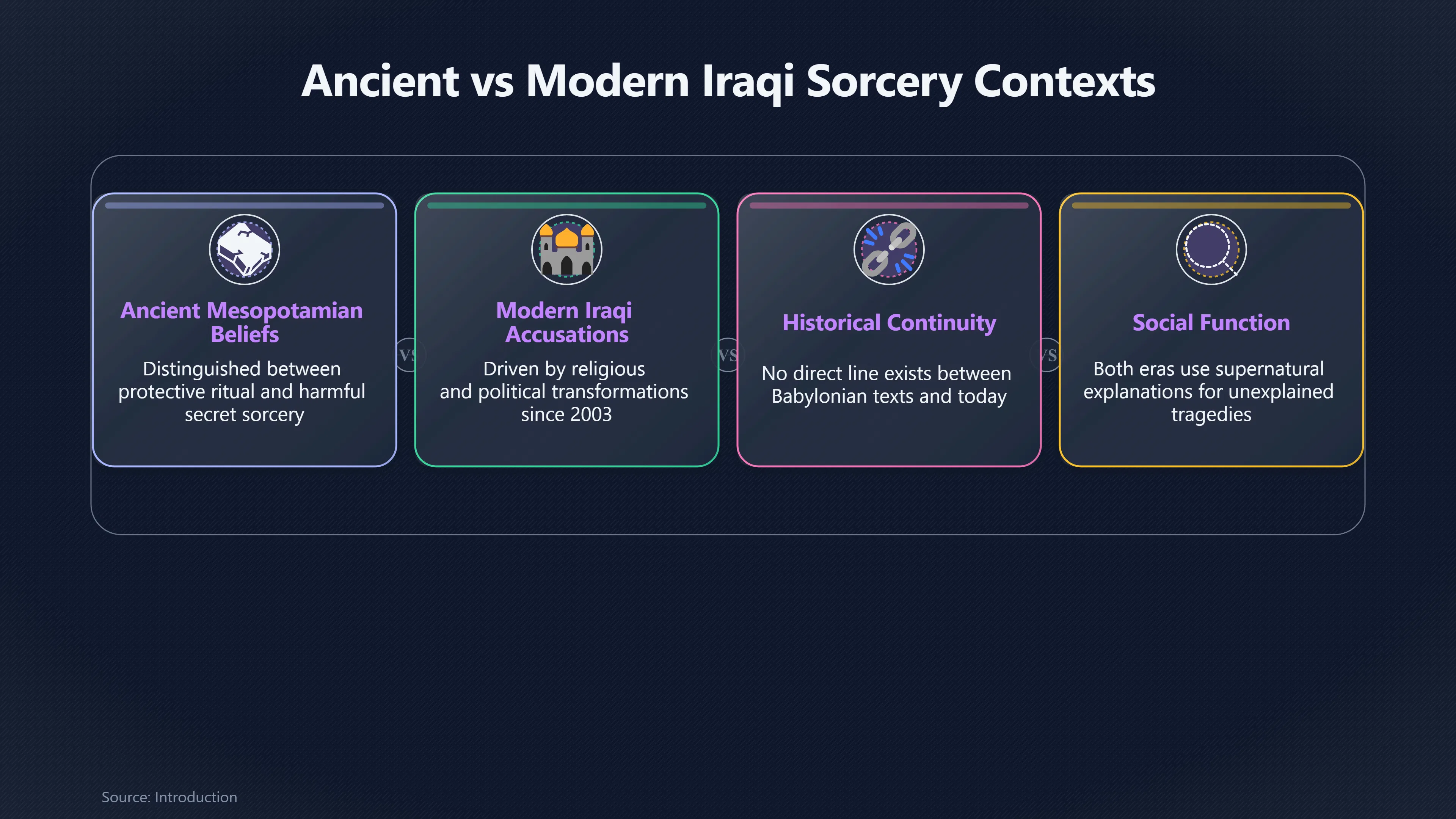
Ideas about hidden magic have a long history in the land that is now Iraq, but the people accused of practising it have changed over time. In ancient Mesopotamia, fears of harmful sorcery existed alongside accepted forms of protective ritual, and surviving texts show a complex religious world rather than a society consumed by continuous witch hunts. In modern Iraq, by contrast, accusations of witchcraft have often fallen on vulnerable religious minorities, especially Sabean-Mandaeans, whose unfamiliar beliefs and rituals have been misunderstood or deliberately misrepresented. These accusations have mattered not because they reflect the actual teachings of those communities, but because they have reinforced exclusion, justified harassment and deepened social suspicion. The story is therefore less about hidden magic than about how fear, rumour and prejudice become attached to minority identities.

Protective magic and feared sorcery in ancient Mesopotamia
Ancient Mesopotamian civilisation left behind thousands of cuneiform tablets dealing with illness, misfortune and supernatural danger. These texts distinguish between protective ritual, carried out by recognised religious specialists, and harmful sorcery, which was imagined as a secret attack by an enemy. Anti-witchcraft rituals sought to identify and neutralise an unseen aggressor through prayers, figurines, purification ceremonies and appeals to the gods. Far from treating all ritual practice as forbidden, Mesopotamian religion accepted many magical techniques as legitimate forms of healing and protection.[Macquarie University]researchers.mq.edu.auperiod - Macquarie UniversityDecember 8, 2022…
The imagined witch was often portrayed through recurring literary stereotypes rather than descriptions of identifiable people. Incantation texts frequently describe the witch as anonymous, hidden or foreign, someone acting secretly to cause illness, infertility or family misfortune. Male and female sorcerers both appear in the texts, although female witches became particularly prominent in later ritual literature. Modern scholars argue that these images reflected cultural anxieties more than records of systematic prosecutions.[Philosophische Fakultät]phil.uni-wuerzburg.dePhilosophische Fakultät Witchesosophische FakultätWitches - Corpus of Mesopotamian Anti-witchcraft Rituals online…
This distinction is important because it shows that ancient Iraq inherited a tradition of explaining some unexplained suffering through supernatural attack without creating the kind of large-scale judicial witch persecutions that later characterised parts of early modern Europe.
Why ancient beliefs were not a continuous witch hunt
It is tempting to imagine a straight line from Babylonian anti-witchcraft texts to modern accusations of sorcery, but historians caution against this interpretation.
Ancient Mesopotamian anti-witchcraft literature survives because scribes copied ritual texts over centuries, not because courts were constantly trying alleged witches. The surviving evidence consists mainly of ritual manuals, prayers and legal concepts rather than extensive records of organised witch trials. Scholars therefore distinguish between a culture that believed harmful magic existed and a society engaged in continuous persecution of supposed witches.[Philosophische Fakultät]phil.uni-wuerzburg.dePhilosophische Fakultät Bibliographyosophische FakultätBibliography - Corpus of Mesopotamian Anti-witchcraft Rituals onlineJanuary 1, 2014…
Modern Iraq has also experienced enormous religious and political transformations through Judaism, Christianity, Islam, the Ottoman period, colonial rule and the modern nation-state. Contemporary accusations of sorcery emerge from these later social and religious contexts rather than from an uninterrupted continuation of ancient Mesopotamian practice.
The ancient material nevertheless demonstrates an enduring human pattern: when illness, economic hardship or unexpected tragedy lacked obvious explanations, invisible supernatural enemies could become persuasive explanations.
Why Sabean-Mandaeans became targets of witchcraft stereotypes
The clearest modern example of witchcraft accusations directed at a religious minority concerns the Sabean-Mandaeans, one of Iraq’s oldest surviving religious communities.
Mandaean religion centres on repeated baptism in flowing water, strict purity rules and a body of sacred literature unfamiliar to most Iraqis. Because relatively few Iraqis have direct knowledge of the faith, rumours have often filled that gap. Researchers studying contemporary attitudes towards the community found that one of the most persistent false stereotypes is the belief that Mandaeans practise witchcraft or black magic, despite the religion explicitly forbidding magical practices.[Babylon Center for Humanities Studies]bcchj.uobabylon.edu.iqBabylon Center for Humanities StudiesThe Mandaeans in Iraq Today: Perceptions, Stereotypes, Prejudices, and Exclusion | Journal Of Babylo…
The stereotype has been reinforced through several mechanisms:
- Lack of accurate information about Mandaean beliefs in schools and public media.
- Misinterpretation of distinctive religious rituals by outsiders.
- Fake social media accounts falsely claiming to represent Mandaean clergy while promoting fabricated stories about magic and other supposed secret practices.
- The tendency to associate unfamiliar minority religions with hidden or dangerous knowledge.[Babylon Center for Humanities Studies]bcchj.uobabylon.edu.iqBabylon Center for Humanities StudiesThe Mandaeans in Iraq Today: Perceptions, Stereotypes, Prejudices, and Exclusion | Journal Of Babylo…
Researchers interviewing Mandaeans found that these accusations exist alongside more positive stereotypes, such as viewing the community as peaceful or skilled goldsmiths. Nevertheless, accusations of sorcery remain among the most damaging because they portray religious difference as a hidden threat rather than simple diversity.[Babylon Center for Humanities Studies]bcchj.uobabylon.edu.iqBabylon Center for Humanities StudiesThe Mandaeans in Iraq Today: Perceptions, Stereotypes, Prejudices, and Exclusion | Journal Of Babylo…
How accusations become social hostility
Witchcraft accusations against minorities rarely remain abstract religious disagreements. They can influence everyday behaviour and contribute to discrimination.
Country reports by the European Union Agency for Asylum note that Sabean-Mandaeans continue to experience negative stereotyping, including accusations of witchcraft and sorcery, alongside wider patterns of discrimination, pressure to conform to Islamic social norms and vulnerability to intimidation.[European Union Agency for Asylum]euaa.europa.euOpen source on europa.eu.
Research and government reporting describe practical consequences that include:
- Concealing aspects of religious identity to avoid unwanted attention.
- Adopting more socially accepted dress or naming practices.
- Limited representation within education, politics and public institutions.
- Greater dependence on tribal protection where state protection is perceived as weak.[GOV.UK]GOV.UKCountry policy and information note: religious minorities, Iraq, September 2024 (accessible) - GOV.UK…
Following the violence that accompanied and followed the 2003 invasion of Iraq, extremist groups exploited these stereotypes. Human rights reporting records accusations of witchcraft alongside allegations of impurity and other rumours that accompanied killings, kidnappings, extortion and forced displacement directed at the community.[Refworld]refworld.orgWorld Directory of Minorities and Indigenous PeoplesWorld Directory of Minorities and Indigenous Peoples - Iraq: Sabian Mandaeans | Refworld…
In this context, accusations of hidden magic functioned less as genuine investigations into supernatural wrongdoing than as a language for portraying an already vulnerable minority as dangerous or morally suspect.
Rumour, fear and the power of hidden explanations
The persistence of witchcraft stereotypes illustrates a broader mechanism found in many societies.
When a minority is poorly understood, ordinary religious practices can be reinterpreted as evidence of secret power. Ritual objects become “magical objects”, sacred texts become “spell books”, and unfamiliar ceremonies become evidence of hidden intentions. Social media can accelerate this process by allowing fabricated stories to circulate far beyond the communities they target.
The Mandaean case also shows that rumours survive even when they directly contradict the religion itself. Scholarly research consistently reports that magic is prohibited within Mandaean teaching, making accusations of organised sorcery a projection by outsiders rather than a description of the faith.[Babylon Center for Humanities Studies]bcchj.uobabylon.edu.iqBabylon Center for Humanities StudiesThe Mandaeans in Iraq Today: Perceptions, Stereotypes, Prejudices, and Exclusion | Journal Of Babylo…
Why this history matters
The history of witchcraft accusations in Iraq is therefore best understood as two related but distinct stories.
Ancient Mesopotamia developed sophisticated beliefs about harmful magic while simultaneously maintaining accepted traditions of protective ritual. Those beliefs reveal how ancient people explained illness and misfortune, but they did not produce an unbroken tradition of organised witch hunting.
Modern Iraq presents a different pattern. Here, accusations of witchcraft have become part of the wider social experience of religious minorities, especially Sabean-Mandaeans. Rather than documenting hidden magical practices, the accusations reveal how ignorance, rumour and prejudice can transform religious difference into perceived supernatural danger.
Seen in this way, witchcraft fears tell us less about magic itself than about the social process of identifying outsiders as the source of unexplained problems. That mechanism links ancient ideas about hidden harm with modern patterns of stereotyping, while reminding us that belief in unseen threats can have very real consequences for the people who become their targets.
Amazon book picks
Further Reading
Books and field guides related to Who Gets Blamed for Hidden Magic?. Use these as the next step if you want deeper reading beyond the article.


Religion in ancient Mesopotamia
Explains the religious setting behind ritual and sorcery beliefs.
Ancient Mesopotamia: portrait of a dead civilization
Provides context for ancient beliefs about ritual and magic.
Endnotes
1.
Source: GOV.UK
Link:https://www.gov.uk/government/publications/iraq-country-policy-and-information-notes/country-policy-and-information-note-religious-minorities-iraq-september-2024-accessible
Source snippet
Country policy and information note: religious minorities, Iraq, September 2024 (accessible) - GOV.UK...
Published: september 2024
2.
Source: refworld.org
Title: World Directory of Minorities and Indigenous Peoples
Link:https://www.refworld.org/reference/countryrep/mrgi/2017/en/64794
Source snippet
World Directory of Minorities and Indigenous Peoples - Iraq: Sabian Mandaeans | Refworld...
3.
Source: researchers.mq.edu.au
Link:https://researchers.mq.edu.au/en/publications/let-the-witch-be-a-sorceress-an-examination-into-the-notions-of-w/
Source snippet
period - Macquarie UniversityDecember 8, 2022...
Published: December 8, 2022
4.
Source: phil.uni-wuerzburg.de
Title: Philosophische Fakultät Witches
Link:https://www.phil.uni-wuerzburg.de/cmawro/magic-witchcraft/witches/
Source snippet
osophische FakultätWitches - Corpus of Mesopotamian Anti-witchcraft Rituals online...
5.
Source: phil.uni-wuerzburg.de
Title: Philosophische Fakultät Bibliography
Link:https://www.phil.uni-wuerzburg.de/cmawro/bibliography/
Source snippet
osophische FakultätBibliography - Corpus of Mesopotamian Anti-witchcraft Rituals onlineJanuary 1, 2014...
Published: January 1, 2014
6.
Source: bcchj.uobabylon.edu.iq
Link:https://bcchj.uobabylon.edu.iq/index.php/bcchj/en/article/view/847
Source snippet
Babylon Center for Humanities StudiesThe Mandaeans in Iraq Today: Perceptions, Stereotypes, Prejudices, and Exclusion | Journal Of Babylo...
7.
Source: euaa.europa.eu
Link:https://www.euaa.europa.eu/country-guidance-iraq-2024/3104-sabean-mandaeans
8.
Source: ojs.journalsdg.org
Link:https://ojs.journalsdg.org/jlss/article/view/777
Source snippet
Negative View of Iraqi Law on the Crimes of Witchcraft and Sorcery | Journal of Law and Sustainable DevelopmentSeptember 13, 2023 — THE N...
Published: September 13, 2023
9.
Source: phil.uni-wuerzburg.de
Title: The short essays pub
Link:https://www.phil.uni-wuerzburg.de/en/cmawro/magic-witchcraft/
Source snippet
& Witchcraft - Corpus of Mesopotamian Anti-witchcraft Rituals onlineCorpus of Mesopotamian Anti-witchcraft Rituals online MAGIC & WITCHCR...
10.
Source: phil.uni-wuerzburg.de
Title: de CMAw Ro
Link:https://www.phil.uni-wuerzburg.de/en/cmawro/
Source snippet
The text editions and transl...
Additional References
11.
Source: kirkuknow.com
Link:https://www.kirkuknow.com/en/news/68966
Source snippet
October 24, 2022 — WITCHCRAFT, PLANET WORSHIP, AND IMPURITY: DECEPTIVELY NEGATIVE STEREOTYPE PORTRAYAL OF MANDEANS * 2022-10-24 Image She...
Published: October 24, 2022
12.
Source: search.mandumah.com
Link:https://search.mandumah.com/Record/1352250
Source snippet
mandumah.comالوصف: The Mandaeans in Iraq Today:THE MANDAEANS IN IRAQ TODAY: PERCEPTIONS, STEREOTYPES, PREJUDICES, AND EXCLUSION العنوان ب...
13.
Source: youtube.com
Title: Unlocking the Secrets of Mesopotamian Magic with Dr. Irving Finkel
Link:https://www.youtube.com/watch?v=THA1Ez_kw0g
Source snippet
Daniel Schwemer | Living in a Precarious World: Magical Rituals from Ancient Mesopotamia...
14.
Source: youtube.com
Link:https://www.youtube.com/watch?v=0L-yuBJoYZY
Source snippet
Iraq's Mandaeans celebrate baptism feast...
15.
Source: youtube.com
Title: The Maqlu Ritual
Link:https://www.youtube.com/watch?v=MH4aksAqpCY
Source snippet
Unlocking the Secrets of Mesopotamian Magic with Dr. Irving Finkel...
16.
Source: youtube.com
Title: Iraq’s Mandaeans celebrate baptism feast
Link:https://www.youtube.com/watch?v=TF_vKco3PHc
Source snippet
The Maqlu Ritual - Invoking the Gods to Destroy Evil Magic...
17.
Source: youtube.com
Link:https://www.youtube.com/watch?v=uOakUi2-fJc
Topic Tree