Within Belgian Belief Scares
Why Beauraing and Banneux Drew Pilgrimage Crowds
Children's visions, pilgrimage crowds and church investigations turned two Belgian villages into enduring centres of Marian devotion.
On this page
- What the children reported
- How expectation and publicity spread
- Why the Church investigated before recognising
Page outline Jump by section
Introduction
The reported Marian apparitions at Beauraing (1932–33) and Banneux (1933) became two of Belgium’s most influential episodes of collective religious belief in the twentieth century. Unlike a moral panic driven by fear, these events centred on hope, healing and devotion. In each case, children claimed to see the Virgin Mary repeatedly, attracting growing crowds of curious onlookers, journalists, clergy and pilgrims. The experiences themselves remained confined to a handful of young visionaries, but belief in their authenticity spread rapidly through personal testimony, newspaper coverage, organised pilgrimage and sustained Church investigation. Today, both villages remain important Catholic pilgrimage destinations. They also offer historians and psychologists a valuable case study in how expectation, publicity and religious culture can transform local reports into enduring national and international movements without requiring everyone present to share the same experience.[OUP Academic]academic.oup.comOUP AcademicBetween the Wars: The Belgian Visionary ‘Epidemic’ | Our Lady of the Nations: Apparitions of Mary in 20th-Century Catholic Eu…
What the children reported
The two Belgian apparition episodes occurred only weeks apart but involved different children and somewhat different messages.
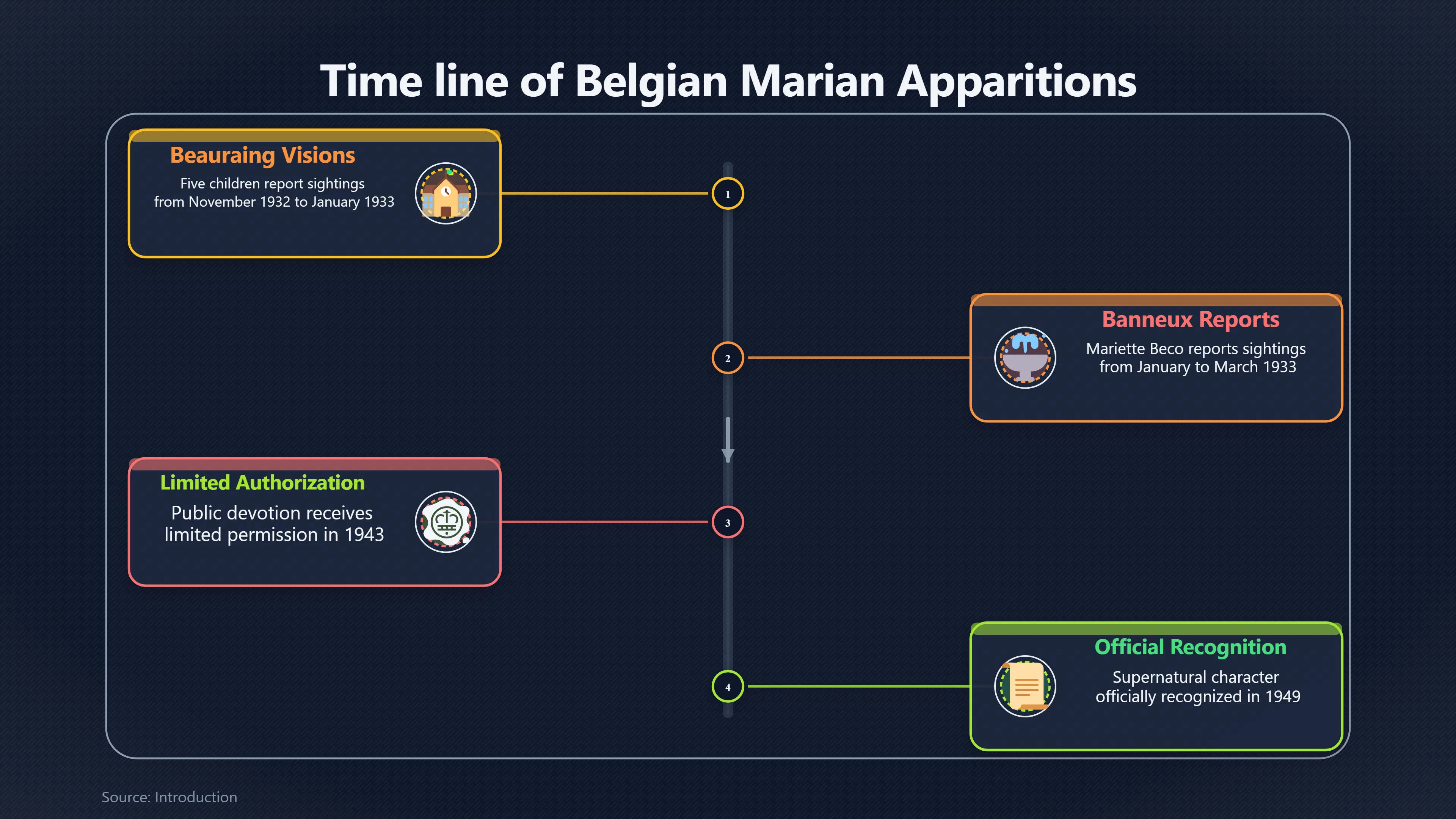
At Beauraing, in the province of Namur, five children—the Voisin and Degeimbre siblings—reported seeing a luminous female figure between 29 November 1932 and 3 January 1933. According to their testimony, the figure appeared 33 times near a convent school, eventually identifying herself as the Virgin Mary and becoming associated with the title “Virgin of the Golden Heart”. The children consistently described her calling for prayer, conversion and the construction of a chapel.[Office du tourisme de Beauraing]beauraingtourisme.bemarian apparitions beauraingOffice du tourisme de BeauraingWhat happened on 29 November 1932 in Beauraing? - Office du tourisme de BeauraingNovember 25, 2024…
Only days after the Beauraing visions ended, a separate series of reports began at Banneux, near Liège. Eleven-year-old Mariette Beco said that the Virgin appeared to her eight times between 15 January and 2 March 1933. Mariette described being led to a spring where the apparition identified herself as the “Virgin of the Poor” and spoke about prayer, suffering and hope for the sick. The spring soon became a focal point for pilgrims seeking spiritual comfort and, in some cases, physical healing.[Banneux Notre-Dame]banneux-nd.beBanneux Notre-Dame Recognition of apparitionsBanneux Notre-DameRecognition of apparitions - Banneux Notre-Dame…
Although the children’s accounts differed in detail, both cases shared important features. The reported visions were repeated over several weeks, involved children rather than adults, conveyed relatively simple religious messages, and took place in public settings where increasing numbers of witnesses observed the children’s behaviour even though they did not necessarily claim to see the apparition themselves.[OUP Academic]academic.oup.comOUP AcademicBetween the Wars: The Belgian Visionary ‘Epidemic’ | Our Lady of the Nations: Apparitions of Mary in 20th-Century Catholic Eu…
How expectation and publicity spread belief
The remarkable growth of both movements cannot be explained simply by the children’s claims. The social environment of early-1930s Belgium helped transform local stories into national religious events.
Belgium remained a deeply Catholic society, but it was also experiencing political tension, economic hardship following the Great Depression and growing concern about secularisation. Many believers viewed Marian devotion as a source of reassurance during an uncertain period. Historian Chris Maunder argues that Belgium experienced a wider “visionary epidemic” during these years, with numerous reported apparitions across the country. Beauraing and Banneux survived while most of the others faded away.[OUP Academic]academic.oup.comOUP AcademicBetween the Wars: The Belgian Visionary ‘Epidemic’ | Our Lady of the Nations: Apparitions of Mary in 20th-Century Catholic Eu…
Publicity played a crucial role. Newspapers reported each new claimed apparition, drawing larger crowds who hoped to witness extraordinary events for themselves. Pilgrims travelled from neighbouring towns, then from across Belgium and beyond. Vendors, clergy, photographers and journalists all became part of the developing pilgrimage culture. Even those who saw nothing unusual often regarded the children’s apparent trance-like behaviour as significant evidence that something extraordinary might be occurring.[Amsterdam University Press Journals]aup-online.comOpen source on aup-online.com.
Expectation also reinforced attendance. Once reports of healings, answered prayers or remarkable experiences began circulating, visitors increasingly arrived hoping for their own spiritual encounter. This does not mean everyone accepted the apparitions as genuine. Many observers remained sceptical, while others attended simply out of curiosity. Nevertheless, repeated gatherings created a shared atmosphere in which belief could spread socially even without universal agreement about what had happened.[Amsterdam University Press Journals]aup-online.comOpen source on aup-online.com.

Why the Church investigated before recognising the apparitions
One common misconception is that the Catholic Church immediately endorsed the children’s claims. In reality, the opposite occurred.
Local bishops established formal investigations that examined the children’s testimony, interviewed witnesses and observed the long-term effects of the reported apparitions. Church authorities sought consistency in the accounts, checked whether the reported messages contradicted Catholic teaching and considered the children’s behaviour over many years rather than making a quick judgement.[Banneux Notre-Dame]banneux-nd.beBanneux Notre-Dame Recognition of apparitionsBanneux Notre-DameRecognition of apparitions - Banneux Notre-Dame…
Recognition came only after lengthy delays.
- At Beauraing, public devotion received limited authorisation in 1943, while the supernatural character of the reported apparitions was officially recognised in 1949.[Office du tourisme de Beauraing]beauraingtourisme.beOffice du tourisme de Beauraing The Beauraing SanctuariesOffice du tourisme de BeauraingThe Beauraing Sanctuaries - Office du tourisme de Beauraing…
- At Banneux, Bishop Louis-Joseph Kerkhofs issued cautious recognitions during the 1940s before giving full approval in 1949 after years of observation and reflection.[Banneux Notre-Dame]banneux-nd.beBanneux Notre-Dame Recognition of apparitionsBanneux Notre-DameRecognition of apparitions - Banneux Notre-Dame…
This slow process reflected the Church’s traditional caution. Official recognition did not declare that every reported miracle associated with the shrines had occurred, nor did it oblige Catholics to believe the apparitions. Instead, it indicated that Church authorities judged the reported events and associated devotion to be compatible with Catholic faith and suitable for public veneration.[Banneux Notre-Dame]banneux-nd.beBanneux Notre-Dame Recognition of apparitionsBanneux Notre-DameRecognition of apparitions - Banneux Notre-Dame…
How historians interpret the episodes
Modern scholars generally distinguish between the children’s reported experiences and the broader social movement that developed around them.
Religious historians study Beauraing and Banneux as examples of how local visionary claims can become enduring pilgrimage centres through cooperation between believers, clergy and pilgrimage organisers. Recent research emphasises that the shrines did not emerge automatically from the visions themselves. They required sustained promotion, infrastructure, devotional practices and institutional support over many years before becoming internationally recognised destinations.[Amsterdam University Press Journals]aup-online.comOpen source on aup-online.com.
From a psychological and sociological perspective, the episodes illustrate mechanisms of contagious belief rather than simple “mass hysteria”. Only a small number of children reported seeing the Virgin, while the much larger crowds participated through expectation, emotional engagement, prayer and interpretation. The social process involved testimony, trust in religious authority, repeated public gatherings and the circulation of stories about healings and answered prayers. Such mechanisms differ from episodes of mass psychogenic illness, where physical symptoms spread through groups, or from moral panics centred on perceived threats.[OUP Academic]academic.oup.comOUP AcademicBetween the Wars: The Belgian Visionary ‘Epidemic’ | Our Lady of the Nations: Apparitions of Mary in 20th-Century Catholic Eu…
The Belgian cases therefore occupy an important middle ground in the history of collective belief. They demonstrate how sincere personal experiences—whatever their ultimate explanation—can generate lasting religious movements without requiring universal visionary experiences or coercion.
Why Beauraing and Banneux still matter
More than ninety years later, Beauraing and Banneux continue to attract pilgrims from Belgium and abroad. Their endurance reflects more than the original reports of visions. The shrines have become places associated with prayer, healing, remembrance and Catholic identity, reinforced by decades of organised pilgrimage and ecclesiastical support. Beauraing was visited by Pope John Paul II in 1985, while both sites continue to host regular religious events.[Sanctuaire Notre-Dame de Beauraing]sanctuairedebeauraing.beSanctuaire Notre-Dame de Beauraing Accueil-enSanctuaire Notre-Dame de BeauraingAccueil-en - Sanctuaire Notre-Dame de Beauraing…
Within Belgium’s wider history of collective belief, these apparitions stand apart from witch persecutions, moral panics or modern health scares. They show how hope can spread through communities as effectively as fear. At the same time, they illustrate the importance of institutions in shaping public belief: media attention drew the crowds, pilgrimage sustained devotion, and lengthy Church investigations determined whether the events would become permanent features of Belgium’s religious landscape rather than short-lived local stories.[OUP Academic]academic.oup.comOUP AcademicBetween the Wars: The Belgian Visionary ‘Epidemic’ | Our Lady of the Nations: Apparitions of Mary in 20th-Century Catholic Eu…
Amazon book picks
Further Reading
Books and field guides related to Why Beauraing and Banneux Drew Pilgrimage Crowds. Use these as the next step if you want deeper reading beyond the article.

The Case for Miracles
Discusses modern miracle claims relevant to pilgrimage traditions.
Visions of the End: Apocalyptic Traditions in the Middle Ages
Provides broader context for visionary experiences.

Miracles
First published 1947. Subjects: Miracles, Nonfiction, Religion & Spirituality, Christianity.
Miracles: The Credibility of the New Testament Accounts
Examines miracle reports and their evaluation.
Endnotes
1.
Source: academic.oup.com
Link:https://academic.oup.com/book/3873/chapter-abstract/145397252
Source snippet
OUP AcademicBetween the Wars: The Belgian Visionary ‘Epidemic’ | Our Lady of the Nations: Apparitions of Mary in 20th-Century Catholic Eu...
2.
Source: aup-online.com
Link:https://www.aup-online.com/content/journals/10.5117/TRAJECTA.2024-2025.1-2.004.OSSE
3.
Source: beauraingtourisme.be
Title: marian apparitions beauraing
Link:https://www.beauraingtourisme.be/en/2024/11/25/marian-apparitions-beauraing/
Source snippet
Office du tourisme de BeauraingWhat happened on 29 November 1932 in Beauraing? - Office du tourisme de BeauraingNovember 25, 2024...
Published: November 25, 2024
4.
Source: sanctuairedebeauraing.be
Title: Sanctuaire Notre-Dame de Beauraing Accueil-en
Link:https://sanctuairedebeauraing.be/accueil-en/
Source snippet
Sanctuaire Notre-Dame de BeauraingAccueil-en - Sanctuaire Notre-Dame de Beauraing...
5.
Source: banneux-nd.be
Title: Banneux Notre-Dame Recognition of apparitions
Link:https://banneux-nd.be/en/recognition-of-apparitions/
Source snippet
Banneux Notre-DameRecognition of apparitions - Banneux Notre-Dame...
6.
Source: beauraingtourisme.be
Title: Office du tourisme de Beauraing The Beauraing Sanctuaries
Link:https://www.beauraingtourisme.be/en/listings/the-beauraing-sanctuaries/
Source snippet
Office du tourisme de BeauraingThe Beauraing Sanctuaries - Office du tourisme de Beauraing...
7.
Source: encyclopedia.com
Link:https://www.encyclopedia.com/science/encyclopedias-almanacs-transcripts-and-maps/beauraing
Source snippet
Beauraing | Encyclopedia.comJune 23, 2026 — BEAURAING views updated BEAURAING Beauraing is a small town in the French-speaking part of Be...
Published: June 23, 2026
8.
Source: banneux-nd.be
Title: Reconnaissance des apparitions
Link:https://banneux-nd.be/fr/reconnaissance-des-apparitions/
9.
Source: banneux-nd.be
Title: Fêtons les 75 ans de la reconnaissance des apparitions!
Link:https://banneux-nd.be/en/fetons-les-75-ans-de-la-reconnaissance-des-apparitions/
10.
Source: banneux-nd.be
Title: 75ème anniversaire de la reconnaissance des Apparitions
Link:https://banneux-nd.be/en/75eme-anniversaire-de-la-reconnaissance-des-apparitions/
11.
Source: sanctuairedebeauraing.be
Link:https://sanctuairedebeauraing.be/
12.
Source: sanctuairedebeauraing.be
Title: verhaal van de verschijningen
Link:https://sanctuairedebeauraing.be/verhaal-van-de-verschijningen/
Additional References
13.
Source: hozana.org
Title: Five children saw the Virgin 33 t
Link:https://hozana.org/en/miracles-and-apparitions/marian-apparitions/beauraing
Source snippet
Beauraing: Apparitions, History, Message, Sanctuary - HozanaJune 9, 2026 — BEAURAING: APPARITIONS, HISTORY, MESSAGE, SANCTUARY The appari...
Published: June 9, 2026
14.
Source: hozana.org
Title: Cinq enfants voient la Vierge à
Link:https://hozana.org/miracles-et-apparitions/apparitions-mariales/beauraing
Source snippet
Beauraing: apparitions, histoire, message, sanctuaire - HozanaJune 6, 2026 — BEAURAING: APPARITIONS, HISTOIRE, MESSAGE, SANCTUAIRE Les...
Published: June 6, 2026
15.
Source: youtube.com
Title: Our Lady of Banneux | Catechism for Kids
Link:https://www.youtube.com/watch?v=KMS_uyhlh4k
Source snippet
This historical overview of the 1932 and 1933 Belgian apparitions provides detailed context on how these events unfolded in Beauraing and...
16.
Source: youtube.com
Title: Apparitions at Beauraing and Banneux Link to Fatima and WWII
Link:https://www.youtube.com/watch?v=aVypX–yhAA
Source snippet
Our Lady of Beauraing: The Golden Heart Apparitions...
17.
Source: cathobel.be
Link:https://www.cathobel.be/2024/05/nous-devons-banneux-a-beauraing-entretien-avec-labbe-leo-palm-recteur-du-sanctuaire-de-la-vierge-des-pauvres/
18.
Source: researchgate.net
Link:https://www.researchgate.net/publication/400134515_Pilgrims_and_promoters_at_Beauraing_and_Banneux_The_evolution_from_apparition_to_pilgrimage_sites
19.
Source: evechedeliege.be
Link:https://www.evechedeliege.be/fr/blog/75-ans-de-reconnaissance-des-apparitions-ca-se-fete-aussi-bien-beauraing-qua-banneux
20.
Source: catholicculture.org
Link:https://www.catholicculture.org/culture/library/view.cfm?recnum=3195
21.
Source: mariedenazareth.com
Link:https://www.mariedenazareth.com/en/marian-encyclopedia/mary-fills-the-world/europe/belgium/beauraing-the-virgin-with-the-golden-heart
22.
Source: dbnl.org
Link:https://www.dbnl.org/tekst/nijh004verz02_01/nijh004verz02_01_0201.php
Topic Tree