Within Suriname
Why Colonial Suriname Criminalised Winti Worship
For nearly a century, colonial law treated Winti practice as a public danger rather than a legitimate Afro-Surinamese religion.
On this page
- What Winti Belief and Practice Involved
- How Missionaries and Officials Defined the Threat
- The Lasting Effects of Criminalisation
Page outline Jump by section
Introduction
For almost a century, Dutch colonial authorities treated Winti, the Afro-Surinamese religion that developed during slavery, not as a legitimate faith but as a threat to public order and Christian civilisation. From the late nineteenth century until 1971, colonial law criminalised practices that officials grouped together as “idolatry”, while missionaries and administrators portrayed Winti ceremonies as morally corrupt, socially dangerous and incompatible with a modern colony. Rather than responding to evidence of organised criminality, this policy reflected a broader colonial moral panic in which African-derived religious traditions were framed as sources of disorder, superstition and resistance. The consequences reached far beyond the courtroom: Winti was driven underground, many families concealed their beliefs, and generations of practitioners experienced their religion as something that had to be hidden rather than openly practised. The Sacred Arts of the Black Atlantic+2ResearchGate[sacredart.caaar.duke.edu]sacredart.caaar.duke.eduThe Sacred Arts of the Black Atlantic Surinamese and Dutch WintiThe Sacred Arts of the Black AtlanticSurinamese and Dutch Winti - The Sacred Arts of the Black Atlantic…
What Winti Belief and Practice Involved
Winti emerged among enslaved Africans and their descendants in Suriname by combining religious traditions from several West African societies under the conditions of slavery. It centres on relationships with a supreme creator, ancestral spirits and other spiritual beings, while ceremonies often involve music, dance, healing, ritual cleansing, divination and spirit possession. There is no single sacred text or central authority, and practices vary between communities and family traditions. The Sacred Arts of the Black Atlantic+2ResearchGate[sacredart.caaar.duke.edu]sacredart.caaar.duke.eduThe Sacred Arts of the Black Atlantic Surinamese and Dutch WintiThe Sacred Arts of the Black AtlanticSurinamese and Dutch Winti - The Sacred Arts of the Black Atlantic…
For practitioners, these rituals addressed illness, grief, family conflict, community harmony and relations with the spiritual world. Colonial observers, however, often interpreted the same ceremonies through a Christian framework that equated African religious practices with “heathenism”, “superstition” or devil worship. This difference in interpretation lay at the heart of later criminalisation: officials regarded religious practices as evidence of social danger rather than expressions of religious identity.[brill.com]brill.comarticle p140 16.xmlWinti in Suriname in: Mission Studies Volume 20 Issue 1 (2003)January 1, 2003…
How Missionaries and Officials Defined the Threat
The campaign against Winti did not arise from a single dramatic incident. Instead, it developed gradually as colonial governments and Christian missions sought to reshape Afro-Surinamese society after centuries of slavery.
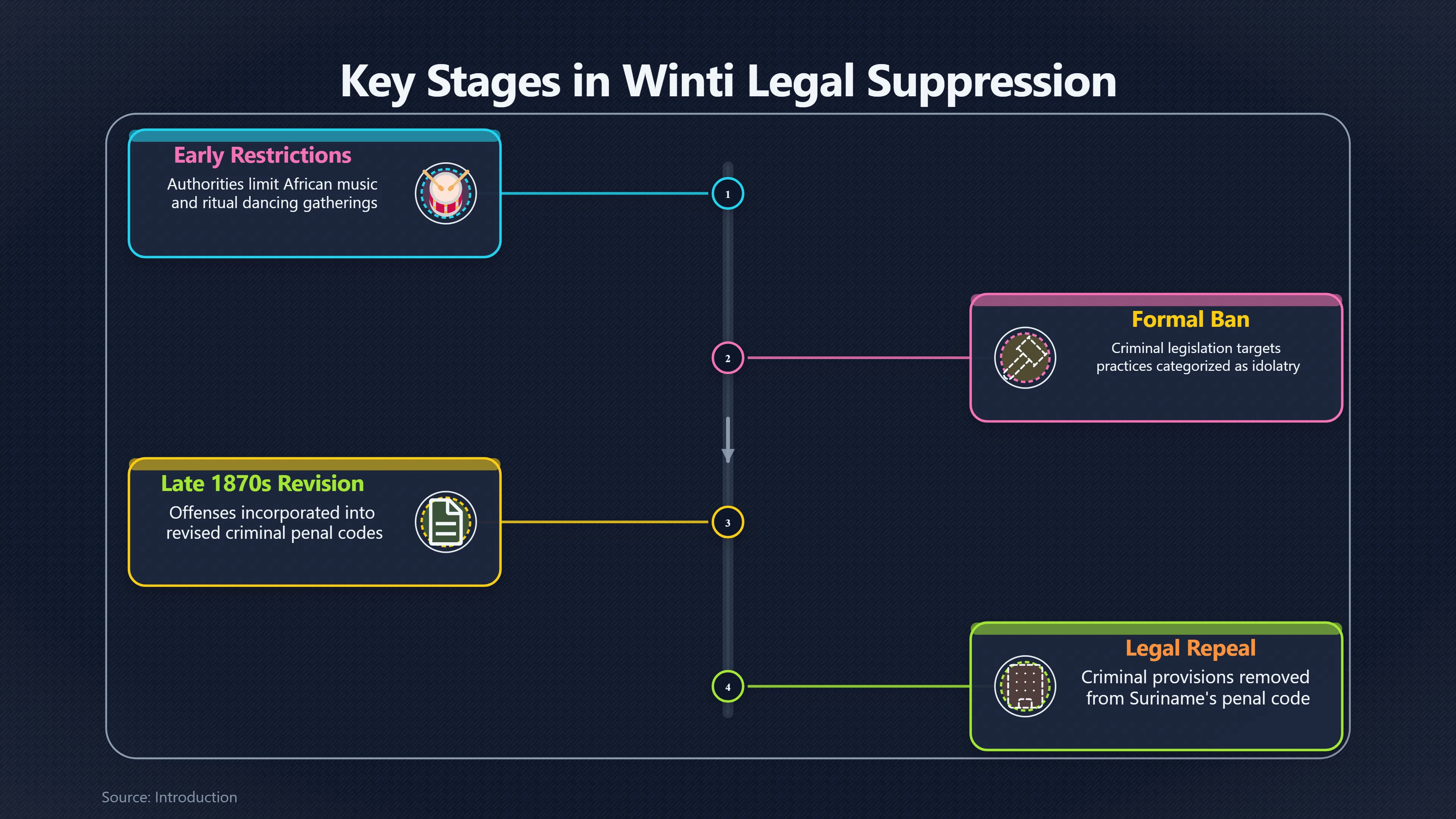
Even before Winti itself was formally prohibited, colonial authorities restricted ceremonies involving African music and dance. Regulations limited drumming, required official permission for gatherings and specifically targeted ritual dances associated with African religious traditions. Officials argued these measures protected public order, while missionaries regarded them as necessary steps towards Christian conversion.[ResearchGate]researchgate.netOpen source on researchgate.net.
After slavery ended in 1863, the colonial administration increasingly viewed the continued survival of African religious practices as evidence that formerly enslaved people had not been sufficiently “civilised”. In this atmosphere, Winti became associated with ideas of backwardness and moral decline rather than cultural continuity. Missionary organisations frequently described conversion to Christianity as liberation from superstition, reinforcing the belief that African-derived religion itself represented a social problem.[brill.com]brill.comarticle p140 16.xmlWinti in Suriname in: Mission Studies Volume 20 Issue 1 (2003)January 1, 2003…
This reflected a classic colonial moral panic. Authorities exaggerated the social dangers posed by a minority religious tradition, treated a broad range of practices as inherently suspect, and justified legal intervention by presenting the religion itself as a threat to civilisation and public morality rather than evaluating individual acts on their merits.
The Winti Ban
The decisive legal step came during the late nineteenth century. Earlier restrictions on ritual dancing were followed by criminal legislation that made practices categorised as “idolatry” punishable under colonial law. Although the legislation did not always name Winti explicitly, both officials and later legal commentary recognised that African-derived religious ceremonies were its primary target. Modern scholarship generally identifies 1874 as the beginning of the formal prohibition, while the offence was subsequently incorporated into revised criminal legislation during the late 1870s. The Sacred Arts of the Black Atlantic+2DBNL[sacredart.caaar.duke.edu]sacredart.caaar.duke.eduThe Sacred Arts of the Black Atlantic Surinamese and Dutch WintiThe Sacred Arts of the Black AtlanticSurinamese and Dutch Winti - The Sacred Arts of the Black Atlantic…
The wording of the law itself was revealing. Rather than defining a specific harmful act, it criminalised broad religious behaviour that officials classified as idolatry. This left considerable room for interpretation, allowing police and administrators to intervene against ceremonies, healers and ritual specialists simply because their activities belonged to Winti traditions.[DBNL]dbnl.orgSigi Wolf Beleving van de christelijke identiteit onder Surinamers, OSO. Tijdschrift voor Surinaamse taalkunde, letterkunde en geschi…
Unlike laws directed at fraud, violence or public disturbance, the offence rested on assumptions about religion itself. The colonial state effectively declared one religious tradition inherently illegitimate while recognising Christian churches and eventually extending legal recognition to Hindu and Muslim communities introduced through indentured labour. Scholars have therefore pointed to unequal treatment of religions as an important feature of Suriname’s colonial legal system.[ResearchGate]researchgate.netOpen source on researchgate.net.
Why Criminalisation Lasted So Long
The prohibition survived for nearly a century because it served several colonial purposes simultaneously.
First, it strengthened missionary influence by encouraging conversion to Christianity while discouraging participation in African religious traditions. Legal pressure and missionary teaching reinforced one another, making public adherence to Winti socially costly even where prosecutions were infrequent.[brill.com]brill.comarticle p140 16.xmlWinti in Suriname in: Mission Studies Volume 20 Issue 1 (2003)January 1, 2003…
Second, officials associated Winti gatherings with concerns about discipline and authority. Since ceremonies brought communities together outside colonial institutions, administrators often regarded them with suspicion regardless of whether they involved any unlawful behaviour.
Finally, the law reflected broader racial ideas common within European colonial rule. African religious traditions were widely characterised as primitive or irrational, assumptions that made legal discrimination appear natural to many officials despite the absence of comparable restrictions on recognised European religious practices.[researchgate.net]researchgate.netOpen source on researchgate.net.
The Lasting Effects of Criminalisation
Although enforcement varied across different periods and regions, the existence of the ban shaped everyday life in important ways.
Many ceremonies moved into private homes or remote locations, limiting public visibility. Families often practised discreetly or blended elements of Christianity and Winti to reduce suspicion. Some practitioners avoided discussing their beliefs outside trusted circles, creating a culture of secrecy that continued long after the law itself disappeared.[researchgate.net]researchgate.netResearch Gate(PDF) Winti and Christianity: A Study in Religious ChangeResearch Gate(PDF) Winti and Christianity: A Study in Religious Change
The stigma also affected public attitudes. Winti became associated in popular discourse with shame, backwardness or criminality, stereotypes reinforced through education, churches and official institutions. These attitudes sometimes survived independently of the legal ban, influencing employment, family relationships and public respectability.
The criminalisation therefore had consequences beyond prosecutions. It altered how generations of Afro-Surinamese understood the public status of their own religious heritage.
Repeal and Changing Attitudes
The prohibition finally ended in 1971, when the relevant criminal provision was removed from Suriname’s penal code. The explanatory memorandum accompanying the repeal stated that the offence no longer suited Surinamese society and was rightly regarded as religious discrimination. This marked an explicit acknowledgement that the earlier legislation had treated one religious community unequally.[DBNL]dbnl.orgSigi Wolf Beleving van de christelijke identiteit onder Surinamers, OSO. Tijdschrift voor Surinaamse taalkunde, letterkunde en geschi…
Legal repeal did not immediately eliminate prejudice, but it opened the way for gradual public rehabilitation. Scholars describe the following decades as a period of cultural revaluation in which Winti increasingly came to be understood as an important element of Afro-Surinamese history rather than merely a colonial-era superstition. The Sacred Arts of the Black Atlantic[sacredart.caaar.duke.edu]sacredart.caaar.duke.eduThe Sacred Arts of the Black Atlantic Surinamese and Dutch WintiThe Sacred Arts of the Black AtlanticSurinamese and Dutch Winti - The Sacred Arts of the Black Atlantic…
Symbolic recognition has continued into the twenty-first century. In 2014, Suriname appointed its first officially recognised Winti priestess as a public official, and Winti marriage ceremonies gained formal recognition through authorised celebrants. These developments illustrate how practices once prosecuted by the colonial state have become part of the country’s recognised religious and cultural heritage. The Sacred Arts of the Black Atlantic[sacredart.caaar.duke.edu]sacredart.caaar.duke.eduThe Sacred Arts of the Black Atlantic Surinamese and Dutch WintiThe Sacred Arts of the Black AtlanticSurinamese and Dutch Winti - The Sacred Arts of the Black Atlantic…
Why Historians See This as a Colonial Moral Panic
Modern historians generally do not argue that colonial authorities invented Winti or misunderstood every aspect of its practices. Instead, they argue that the state transformed a diverse religious tradition into a symbolic threat requiring legal suppression.
Several features fit the broader pattern of a moral panic:
- Religious practices were portrayed as inherently dangerous without distinguishing between peaceful worship and actual criminal conduct.
- Christian moral assumptions were embedded within colonial law and presented as universal standards.
- African cultural practices became linked with fears of disorder, ignorance and resistance to colonial authority.
- The legal response targeted an entire religious tradition rather than specific harmful acts.[researchgate.net]researchgate.netOpen source on researchgate.net.
Seen in this light, the Winti ban illustrates how colonial governments could use criminal law to police cultural identity as well as behaviour. Rather than simply regulating public order, the legislation helped define which religions were considered respectable and which were treated as threats to society.
Today, the history of Winti’s criminalisation remains an important example of how colonial power shaped religious freedom, cultural identity and public memory in Suriname. It also demonstrates that what one generation labels dangerous superstition may later be recognised as an integral part of a nation’s religious and cultural heritage.

Amazon book picks
Further Reading
Books and field guides related to Why Colonial Suriname Criminalised Winti Worship. Use these as the next step if you want deeper reading beyond the article.
The Serpent and the Rainbow
Explores African-derived religious traditions in the Americas.
African religions and philosophy
Provides religious background for Winti's African roots.
The Sacred Arts of the Black Atlantic
Directly relevant to Afro-Atlantic religions including Winti.
Endnotes
1.
Source: researchgate.net
Link:https://www.researchgate.net/publication/310188560_Colonial_Christian_Dominance_and_Religious_Diversity_in_Suriname
2.
Source: dbnl.org
Link:https://www.dbnl.org/tekst/_oso001199401_01/_oso001199401_01_0018.php
Source snippet
Sigi Wolf Beleving van de christelijke identiteit onder Surinamers, OSO. Tijdschrift voor Surinaamse taalkunde, letterkunde en geschi...
3.
Source: researchgate.net
Title: Research Gate(PDF) Winti and Christianity: A Study in Religious Change
Link:https://www.researchgate.net/publication/271696467_Winti_and_Christianity_A_Study_in_Religious_Change
4.
Source: brill.com
Title: article p140 16.xml
Link:https://brill.com/view/journals/mist/20/1/article-p140_16.xml?language=en
Source snippet
Winti in Suriname in: Mission Studies Volume 20 Issue 1 (2003)January 1, 2003...
Published: January 1, 2003
5.
Source: dbnl.org
Link:https://www.dbnl.org/tekst/kemp009gesc02_01/kemp009gesc02_01_0018.php
Source snippet
III. Creolen, Een geschiedenis van de Surinaamse literatuur. Deel 2., Michiel van Kempen - DBNL...
6.
Source: researchgate.net
Title: (PDF) How African-based Winti Belief Helps to Protect Forests in Suriname
Link:https://www.researchgate.net/publication/331810758_How_African-based_Winti_Belief_Helps_to_Protect_Forests_in_Suriname
7.
Source: dbnl.org
Link:https://www.dbnl.org/tekst/_sur001189101_01/_sur001189101_01_0002.php
8.
Source: dbnl.org
Link:https://www.dbnl.org/tekst/_oso001198201_01/_oso001198201_01_0009.php
9.
Source: dbnl.org
Link:https://www.dbnl.org/tekst/benj004ency01_01/benj004ency01_01_0022.php?q=rietblad
10.
Source: dbnl.org
Link:https://www.dbnl.org/tekst/benj004ency01_01/benj004ency01_01_0026.php
11.
Source: dbnl.org
Link:https://www.dbnl.org/tekst/_oso001200201_01/_oso001200201_01_0007.php
12.
Source: dbnl.org
Title: ‘Regel voor regel door tante Jo’s “Winti”’, Eddy van der Hilst
Link:https://www.dbnl.org/titels/titel.php?id=hils003rege01
13.
Source: dbnl.org
Link:https://www.dbnl.org/tekst/benj004ency01_01/benj004ency01_01_0022.php
14.
Source: sacredart.caaar.duke.edu
Title: The Sacred Arts of the Black Atlantic Surinamese and Dutch Winti
Link:https://sacredart.caaar.duke.edu/religions/surinamese-and-dutch-winti/
Source snippet
The Sacred Arts of the Black AtlanticSurinamese and Dutch Winti - The Sacred Arts of the Black Atlantic...
15.
Source: lmpublishers.nl
Link:https://lmpublishers.nl/product/winti/
Additional References
16.
Source: anthrosource.onlinelibrary.wiley.com
Title: Anthro Source Religion: Winti: Een Afroamerikaanse godsdienst in Suriname
Link:https://anthrosource.onlinelibrary.wiley.com/doi/10.1525/aa.1973.75.6.02a00840
Source snippet
Een cultureel‐historische analyse van de religieuze verschijnselen in de Para. CHARLES J. WOODING - PRICE - 1973 - American Anthropologis...
17.
Source: nieuwwij.nl
Title: Hoe het slavernijverleden doorwerkt in kerk en samenleving
Link:https://www.nieuwwij.nl/opinie/hoe-het-slavernijverleden-doorwerkt-in-kerk-en-samenleving/
Source snippet
Nieuw WijJanuary 20, 2025 — Het verbod op het praktiseren van de winti religie werd pas in 1971 uit het koloniale wetboek van strafrecht...
Published: January 20, 2025
18.
Source: afromagazine.nl
Title: Nationaal Winti Instituut NIRASԐ opgericht – Afro Magazine
Link:https://afromagazine.nl/rubriek-missing/nationaal-winti-instituut-niras%D4%91-opgericht/
Source snippet
August 29, 2021 — NATIONAAL WINTI INSTITUUT NIRASԐ OPGERICHT Door mermar Doormermar Volgen: Laatst bijgewerkt: 29-08-21 Image Op 22 juli...
Published: August 29, 2021
19.
Source: infosekolah.net
Link:https://infosekolah.net/nl/Winti
20.
Source: utheses.univie.ac.at
Link:https://utheses.univie.ac.at/detail/16363
21.
Source: winti.baaswaterval.nl
Title: 1874 ging de wet in om winti als afgoderij te betitelen
Link:https://winti.baaswaterval.nl/winti-algemene-vragen/38/1874-ging-de-wet-in-om-winti-als-afgoderij-te-betitelen/3025/
22.
Source: youtube.com
Title: Winti: An Afro-Surinamese Religion for Modern Times
Link:https://www.youtube.com/watch?v=5lrQoqEI9EM
Source snippet
The African Identity of Suriname...
23.
Source: nrc.nl
Title: Schuddend enschreeuwend openbaart zich deslangengeest
Link:https://www.nrc.nl/nieuws/2015/08/22/schuddend-en-schreeuwend-openbaart-zich-de-slangen-1524800-a170774
24.
Source: nature.com
Title: Research Items | Nature
Link:https://www.nature.com/articles/139678a0
25.
Source: uitgeverijdubois.com
Title: Winti: Een Afroamerikaanse godsdienst in Suriname
Link:https://www.uitgeverijdubois.com/product/winti-een-afroamerikaanse-godsdienst-in-suriname/
Topic Tree