Why Witchcraft Accusations Became So Dangerous
The best-documented history of contagious fear and collective belief in the Central African Republic is not a single spectacular “mass hysteria” event.
Page outline Jump by section
Introduction
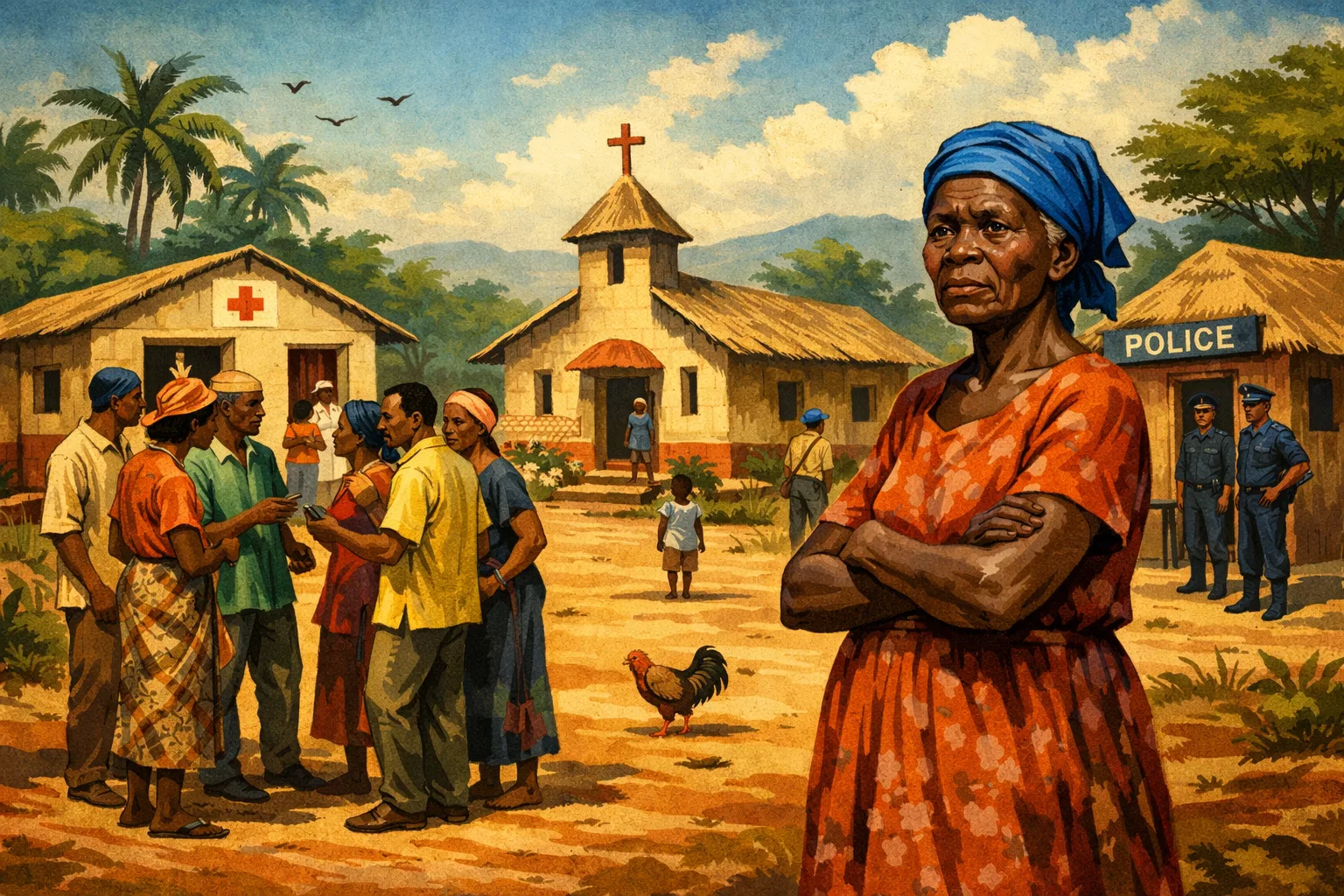
This is more accurately described as a recurring witch panic and system of persecution than as mass psychogenic illness. Belief alone does not explain it. Accusations flourish where healthcare is scarce, sudden death is common, courts are weak and communities are under extreme economic and military pressure. Women, children, older people and socially isolated individuals face the greatest danger. Unusually, the state has reinforced the panic by treating supposed witchcraft as a criminal offence, while militias have exploited accusations to punish enemies and control frightened communities.[Avocats Sans Frontières]asf.becharlatanism and witchcraft is considered a crime under the penal code…. Central African society, but to fight against the “witch hunt”…
When misfortune becomes an accusation
In the Central African Republic, witchcraft accusations commonly provide an explanation for suffering that otherwise appears arbitrary or unbearable. A child dies unexpectedly, several relatives fall ill, a business fails or a household experiences repeated bereavements. Instead of asking only what physical, economic or political forces caused the harm, people may ask who secretly intended it.
Such beliefs are not simply remnants of an isolated “traditional” culture. They coexist with Christianity, Islam, biomedical treatment and modern law. People may visit a clinic, pray in church or mosque and consult a spiritual specialist without seeing any contradiction. The dangerous turning point comes when a broad belief in invisible causation becomes a specific allegation against a named person.
Earlier human-rights reporting found that accusations frequently arose from interpersonal conflicts rather than from organised religious doctrine. Illnesses, including HIV/AIDS during periods when diagnosis and treatment were poorly understood or unavailable, could be attributed to supernatural attack. Trials sometimes relied on neighbours’ testimony, statements from traditional practitioners and objects such as pieces of clothing rather than evidence capable of proving a physical offence.[Wikipedia]WikipediaFreedom of religion in the Central African RepublicFreedom of religion in the Central African Republic
The accusation also changes a community’s understanding of the victim. Ordinary characteristics can be retrospectively treated as signs of guilt. An older woman who is outspoken becomes malicious; an isolated widow becomes suspicious; a child who behaves unusually becomes dangerous. Once that story takes hold, denial may be interpreted as further proof of secretiveness.
Why women, children and older people are targeted
Witch panics are rarely socially random. In the Central African Republic, reporting by United Nations bodies and legal-aid organisations repeatedly identifies women and children as the groups most affected. Older, poor or socially isolated women are particularly exposed. They may have little money for legal representation, few relatives able to protect them and limited authority within household or village disputes.[asf.be]asf.beAvocats Sans FrontièresInternational Women's day: Gender and witchcraft in the…8 Mar 2022 — In the Central African Republic, the prose…
The gender pattern matters because an accusation can function as a tool of domination even when accusers sincerely believe it. It may remove a troublesome relative, settle an inheritance quarrel, punish a woman who resists family authority or explain why a household has suffered misfortune. A United Nations special rapporteur connected violence against women accused of witchcraft with unequal gender relations and the low social status of women.[United Nations Digital Library System]digitallibrary.un.orgited Nations Digital Library SystemA/HRC/14/22/Add.1 General Assembly2 Jun 2010 — violence done to women based on accusations of witchc…
Children face a related but distinct danger. Research on child witchcraft accusations in Central and West Africa describes a pattern in which orphanhood, disability, illness, unusual behaviour or the financial burden of caring for a child can be transformed into evidence of supernatural menace. Family disruption, migration, conflict and poverty weaken the relationships that would normally protect children. Once accused, a child may be beaten, abandoned, subjected to coercive deliverance rituals or driven onto the street.[unicef.org]unicef.orgChildren Accused of WitchcraftChildren Accused of Witchcraft
Evidence specific to the Central African Republic is less complete than for the neighbouring Democratic Republic of the Congo. This distinction is important: dramatic accounts from Kinshasa’s child-witch crisis should not automatically be transferred across the border. Nevertheless, UNICEF and human-rights reporting have documented Central African children being scapegoated, abused or placed at risk through comparable accusations.[ReliefWeb]reliefweb.intscapegoating most vulnerable central african republicScapegoating the most vulnerable in the Central African…12 May 2009 — In CAR, witchcraft is a criminal offense under the pena…
A panic written into criminal law
The most unusual feature of the Central African case is the role of the formal justice system. Rather than limiting prosecution to assault, poisoning, fraud, murder or intimidation, the country’s penal code criminalises vaguely defined practices of charlatanism and witchcraft.
Articles 149 and 150 of the 2009 penal code cover alleged practices said to disturb public order or harm people or property. Legal critics argue that these provisions are dangerously imprecise because they ask courts to judge an offence that cannot be tested using ordinary evidential standards. Before the 2009 code, some witchcraft-related offences could theoretically attract the death penalty; the revised law retained imprisonment and fines.[asf.be]asf.beAvocats Sans FrontièresWitchcraft representations and judicial treatment of the offence…5 Jan 2023 — In the Central African Penal Code…
This creates a profound contradiction. Officials sometimes claim that arresting an accused person protects them from a mob. Yet detention also gives official recognition to the allegation. It tells the community that the state considers supernatural attack a legally provable crime rather than a belief surrounding an unproven accusation.
The consequences are visible in Bimbo women’s prison near Bangui. Legal observers reported that approximately half of the women held there were serving sentences connected with alleged witchcraft at one point in the early 2020s. A separate examination covering January 2020 to June 2021 found that nearly 60 per cent of the women detained there faced such charges, with an average age of about 55. Exact proportions vary by reporting period, but the overall pattern is clear: witchcraft law is not merely symbolic. It fills prison cells with disproportionately older women.[Avocats Sans Frontières]asf.becharlatanism and witchcraft is considered a crime under the penal code…. Central African society, but to fight against the “witch hunt”…
Human-rights experts have therefore urged the authorities to shift the legal target. The state can prosecute beatings, threats, fraud, coercion and murder without attempting to prove that supernatural powers exist. International guidelines similarly distinguish freedom of belief from harmful conduct: people may hold spiritual beliefs, but those beliefs cannot justify torture, expulsion or killing.[OHCHR]ohchr.orgaccusations of witchcraft and ritual attacksaccusations of witchcraft and ritual attacks
How civil war intensified the witch hunt
The violence that began with the Séléka rebellion in 2012 and the retaliatory mobilisation of anti-Balaka groups did not create witchcraft belief. It did, however, make accusations more lethal.
The conflict shattered local authority, displaced communities and placed large areas beyond dependable state control. Predominantly Muslim Séléka forces committed extensive abuses after seizing Bangui in 2013. Anti-Balaka groups, whose members included Christians, followers of local religious traditions and former government loyalists, then carried out retaliatory attacks against Muslim civilians. Although religious identities became markers of danger, analysts warn that the war cannot be reduced to a simple Christian-versus-Muslim struggle; political exclusion, local security, competition for power and cycles of revenge were also central.[ushmm.org]ushmm.orgOpen source on ushmm.org.
Within that environment, witchcraft allegations became another weapon. A leaked United Nations investigation reported in 2015 that anti-Balaka fighters had kidnapped people accused of witchcraft and subjected some to public torture, burning or burial alive. Commanders were accused of using fear of supernatural harm to impose authority, extract money and eliminate people who lacked protection.[Reuters]reuters.comWitch burning rebels stoke Central African Republic violenceWitch burning rebels stoke Central African Republic violence
These episodes show why the word “panic” is useful but incomplete. The perpetrators were not necessarily overwhelmed by an uncontrollable collective delusion. Some may have believed the accusations; others appear to have manipulated existing fears deliberately. Witchcraft discourse could turn private violence into apparently legitimate punishment. A killing was presented not as an act of militia terror but as the defence of a community against an invisible enemy.
Conflict also increased the supply of unexplained tragedy. Families experienced sudden deaths, disappearances, hunger, displacement and disease. Medical services and trusted institutions collapsed. Under such conditions, supernatural explanation can offer an emotionally satisfying answer: suffering has an author, misfortune has a pattern and the community can supposedly restore safety by identifying the culprit.
Rumour, evidence and the machinery of belief
Witchcraft accusations spread through a familiar social chain. A disturbing event produces uncertainty. Someone proposes a hidden cause. A respected relative, diviner, neighbour, pastor, militia member or local official supports the suspicion. Earlier incidents are then reinterpreted to fit it. By the time the allegation reaches a court or armed group, the accumulated repetition can look like independent confirmation even when every version descends from the same rumour.
Several forces make this process difficult to stop:
- Misfortune demands an explanation. Where laboratory tests, reliable diagnoses and official investigations are unavailable, supernatural causation can appear no less plausible than distant medical or legal explanations.
- Fear rewards conformity. Defending an accused person can expose the defender to suspicion. Silence therefore creates a false appearance of unanimous belief.
- Authority transforms rumour. An arrest, interrogation or militia hearing gives an allegation institutional weight, even if no verifiable evidence exists.
- Confession may be coerced. Beatings, threats, exhaustion and promises of release can produce admissions that are later treated as proof.
- The accusation solves practical conflicts. It can remove a dependent relative, settle a quarrel, justify seizure of property or redirect anger away from powerful actors.
This is close to what sociologists call a moral panic: a person or category is presented as a hidden threat to the social order, the danger is amplified through repetition, and exceptional punishment becomes acceptable. Yet Central African witch persecution is not only a media-driven scare of the kind familiar in wealthier countries. Much of it circulates through families, villages, armed networks and local justice rather than mass broadcasting.
Nor should every accusation be called “mass hysteria”. That phrase can imply irrational emotional contagion without acknowledging who benefits, who is targeted and how law and violence sustain the belief. “Witchcraft accusation”, “witch panic”, “collective persecution” or “mob justice” are usually more precise.
Religion can inflame fear or interrupt it
It would be misleading to identify witchcraft persecution with one religion. Beliefs about harmful invisible forces may appear within Christian, Muslim and local spiritual frameworks, sometimes blended together. Individual religious figures can reinforce accusations, particularly when illness or disruptive behaviour is interpreted as possession or supernatural attack. However, other clergy and faith organisations have opposed such violence, sheltered people at risk and challenged the portrayal of the civil war as an inevitable religious conflict.
During the crisis, Catholic, evangelical and Muslim leaders formed an interfaith platform that travelled, mediated and publicly rejected communal retaliation. Its work demonstrated that religious authority could be used to calm fear rather than authenticate it.[KAICIID]kaiciid.orgOpen source on kaiciid.org.
This complicates the casual use of the word “cult”. Anti-Balaka militias sometimes used amulets, ritual protections and claims of supernatural invulnerability, but they were fragmented armed networks rather than a single apocalyptic sect. Describing them merely as a “cult” would obscure their political origins, community-defence claims, criminal economies and changing military alliances.
The same caution applies to healers and deliverance ministries. Some practitioners may exploit frightened families, but the category includes varied forms of religious and medical authority. The central issue is not whether an outsider considers a belief strange. It is whether an accusation leads to coercion, fraudulent extraction, imprisonment, assault or exclusion.
What has changed, and what has not
Central African and international organisations have increasingly framed witchcraft persecution as a human-rights and gender-justice problem rather than a debate over whether supernatural powers are real. Legal-aid projects have represented accused women and children, documented discriminatory prosecutions and pressed for reform of the penal code. United Nations officials have also called for investigations into mob violence and urged authorities to prevent accusations from destroying social cohesion.[Avocats Sans Frontières]asf.beAvocats Sans FrontièresInternational Women's day: Gender and witchcraft in the…8 Mar 2022 — In the Central African Republic, the prose…
There have been signs of practical intervention. A 2024 United Nations report stated that the peacekeeping mission MINUSCA had helped reduce some revenge cases involving witchcraft accusations. Such local prevention matters because danger often develops before a formal complaint reaches a court: mediators may need to secure an accused person’s safety, separate a medical emergency from a supernatural allegation and discourage retaliatory mobilisation.[United Nations]un.orgOpen source on un.org.
Yet the underlying pressures remain severe. Much of the country continues to experience insecurity, poverty, inadequate healthcare and weak access to justice. UNICEF reported in 2024 that Central African children faced exceptionally high levels of overlapping deprivation, including malnutrition and poor access to medical care. These conditions do not automatically cause witchcraft accusations, but they sustain the uncertainty, bereavement and family strain in which scapegoating thrives.[Reuters]reuters.comCentral African Republic's children are world's most deprived, UNICEF saysCentral African Republic's children are world's most deprived, UNICEF says
Legal reform is therefore necessary but insufficient. Repealing or narrowing witchcraft offences would stop courts from validating unprovable claims. Effective protection also requires functioning clinics, child welfare, support for older women, credible investigations of suspicious deaths and practical alternatives for families facing disability, mental distress or economic collapse.
Why this history matters
The Central African Republic shows how collective fear becomes durable when belief, social inequality and institutional power reinforce one another. A rumour does not have to persuade everyone. It only needs enough authority behind it to make resistance dangerous.
The victims are often people already treated as burdens or outsiders. Their persecution reveals the hidden social work performed by an accusation: it explains tragedy, identifies a culprit, draws a line between the supposedly safe community and its imagined internal enemy, and gives violence the appearance of moral necessity.
This is why the country’s witchcraft cases should not be reduced to colourful superstition or filed away as an exotic survival from the past. They belong to the broader history of moral panics, scapegoating and contagious belief. The mechanism is widely recognisable even when the supernatural language differs: uncertainty creates fear, fear searches for an agent, authority validates suspicion, and punishment is mistaken for protection.
The most important distinction is therefore between belief and harm. People can interpret illness, fate and spiritual danger in many ways. The panic begins when an untestable explanation becomes a public charge, and when neighbours, militias or courts decide that a vulnerable human being must suffer to make everyone else feel safe.
Amazon book picks
Further Reading
Books and field guides related to Why Witchcraft Accusations Became So Dangerous. Use these as the next step if you want deeper reading beyond the article.

The Penguin book of witches
Provides historical context for witchcraft accusations and persecution.

African religions and philosophy
Introduces religious worldviews that shape beliefs about witchcraft.
Endnotes
1.
Source: reliefweb.int
Title: scapegoating most vulnerable central african republic
Link:https://reliefweb.int/report/central-african-republic/scapegoating-most-vulnerable-central-african-republic
Source snippet
Scapegoating the most vulnerable in the Central African...12 May 2009 — In CAR, witchcraft is a criminal offense under the pena...
Published: May 2009
2.
Source: Wikipedia
Title: Freedom of religion in the Central African Republic
Link:https://en.wikipedia.org/wiki/Freedom_of_religion_in_the_Central_African_Republic
3.
Source: prison-insider.com
Title: Accusations, charges and convictions for these offences are numerous
Link:https://www.prison-insider.com/en/articles/republique-centrafricaine-sorcellerie
Source snippet
Prison InsiderCentral African Republic: witchcraft28 Jul 2023 — The penal code nevertheless criminalises certain practices of witchcraft...
4.
Source: unicef.org
Title: Children Accused of Witchcraft
Link:https://www.unicef.org/nigeria/media/1326/file/%20Children-accused-of-witchcraft-in-Africa.pdf.pdf
5.
Source: unhcr.org
Link:https://www.unhcr.org/4d346eab9.pdf
6.
Source: mdpi.com
Link:https://www.mdpi.com/2077-1444/14/1/23
7.
Source: reliefweb.int
Title: human rights committee considers report central african republic
Link:https://reliefweb.int/report/central-african-republic/human-rights-committee-considers-report-central-african-republic
8.
Source: ohchr.org
Title: accusations of witchcraft and ritual attacks
Link:https://www.ohchr.org/sites/default/files/2022-12/PAP-Guidelines-EN.pdf
9.
Source: ohchr.org
Link:https://www.ohchr.org/en/special-procedures/ie-albinism/witchcraft-and-human-rights
10.
Source: clingendael.org
Title: Central African republic
Link:https://www.clingendael.org/sites/default/files/pdfs/CAR_Report.pdf
11.
Source: reuters.com
Title: Witch burning rebels stoke Central African Republic violence
Link:https://www.reuters.com/article/world/witch-burning-rebels-stoke-central-african-republic-violence-idUSKBN0TF038/
12.
Source: reliefweb.int
Title: witch burning rebels stoke central african republic violence
Link:https://reliefweb.int/report/central-african-republic/witch-burning-rebels-stoke-central-african-republic-violence
13.
Source: kaiciid.org
Link:https://www.kaiciid.org/node/23946/printable/print
14.
Source: kaiciid.org
Link:https://www.kaiciid.org/what-we-do/we-work-regionally/africa/our-work-central-african-republic
15.
Source: ohchr.org
Link:https://www.ohchr.org/en/press-releases/2018/02/central-african-republic-peace-process-and-human-rights-are-indivisible
16.
Source: reuters.com
Title: Central African Republic’s children are world’s most deprived, UNICEF says
Link:https://www.reuters.com/world/africa/central-african-republics-children-are-worlds-most-deprived-unicef-says-2024-07-02/
17.
Source: data.unhcr.org
Link:https://data.unhcr.org/fr/news/10384
18.
Source: unhcr.org
Link:https://www.unhcr.org/in/sites/en-in/files/legacy-pdf/4d346eab9.pdf
19.
Source: ohchr.org
Link:https://www.ohchr.org/en/press-releases/2009/10/human-rights-committee-considers-situation-central-african-republic
20.
Source: uprdoc.ohchr.org
Link:https://uprdoc.ohchr.org/uprweb/downloadfile.aspx?file=EnglishTranslation&filename=530
21.
Source: uprdoc.ohchr.org
Link:https://uprdoc.ohchr.org/uprweb/downloadfile.aspx?file=EnglishTranslation&filename=616
22.
Source: ohchr.org
Title: highlights4 may2009
Link:https://www.ohchr.org/en/hr-bodies/upr/highlights4-may2009
23.
Source: tbinternet.ohchr.org
Title: Download Draft.aspx
Link:https://tbinternet.ohchr.org/_layouts/15/TreatyBodyExternal/DownloadDraft.aspx?key=kREr%2FCgNw4fNZ2EyC6MZLlX5WUUlKi%2F4yv8kEuqMhDlslvAvC+kL4+F6Eg+YGlsf
24.
Source: docstore.ohchr.org
Title: Files Handler.ashx
Link:https://docstore.ohchr.org/SelfServices/FilesHandler.ashx?enc=1ciuLgBGPzYxpeHlSk3l%2B8TEU%2Fu2zEVZooCF3dGdObBBNck4PuSLCyCXj8D8FuaRU76zdbDUYKFNGE5UfKYcUc8BI28DTzQ4cn0Urkqjhwo%3D
25.
Source: ohchr.org
Title: human rights council holds separate interactive dialogues situation
Link:https://www.ohchr.org/en/statements-and-speeches/2020/10/human-rights-council-holds-separate-interactive-dialogues-situation
26.
Source: docstore.ohchr.org
Link:https://docstore.ohchr.org/SelfServices/FilesHandler.ashx?enc=x4xSNDRQ1bZQt1j%2B%2B%2FYEFq99xhRf8yG6PcMyyIKbBlgq9P%2FDexf5SeOi0ycNdHW29qmnEiaNRnCU%2Bls4ofxJUQ%3D%3D
27.
Source: ohchr.org
Link:https://www.ohchr.org/en/press-releases/2009/10/human-rights-council-discusses-reports-extrajudicial-summary-or-arbitrary
28.
Source: Wikipedia
Title: Witchcraft in Africa
Link:https://en.wikipedia.org/wiki/Witchcraft_in_Africa
29.
Source: Wikipedia
Title: Witchcraft accusations against children in Africa
Link:https://en.wikipedia.org/wiki/Witchcraft_accusations_against_children_in_Africa
30.
Source: Wikipedia
Title: Anti balaka
Link:https://en.wikipedia.org/wiki/Anti-balaka
31.
Source: Wikipedia
Title: Modern witch hunts
Link:https://en.wikipedia.org/wiki/Modern_witch_hunts
32.
Source: Wikipedia
Title: Central African Republic
Link:https://en.wikipedia.org/wiki/Central_African_Republic
33.
Source: reliefweb.int
Title: a history of a collapse foretold?
Link:https://reliefweb.int/report/central-african-republic/central-african-republic-history-collapse-foretold
34.
Source: reliefweb.int
Title: breaking spell responding witchcraft accusations against children
Link:https://reliefweb.int/report/angola/breaking-spell-responding-witchcraft-accusations-against-children
35.
Source: 2021-2025.state.gov
Title: central african republic
Link:https://2021-2025.state.gov/reports/2021-report-on-international-religious-freedom/central-african-republic/
36.
Source: state.gov
Title: Central African Republic
Link:https://www.state.gov/reports/2022-country-reports-on-human-rights-practices/central-african-republic
37.
Source: state.gov
Title: Central African Republic
Link:https://www.state.gov/reports/2023-country-reports-on-human-rights-practices/central-african-republic
38.
Source: reuters.com
Title: nigerian aid groups help children accused witchcraft rebuild lives 2025 11 13
Link:https://www.reuters.com/world/africa/nigerian-aid-groups-help-children-accused-witchcraft-rebuild-lives-2025-11-13/
39.
Source: reuters.com
Title: witchcraft accusations ghana could be banned by new law 2023 07 28
Link:https://www.reuters.com/world/africa/witchcraft-accusations-ghana-could-be-banned-by-new-law-2023-07-28/
40.
Source: unicef.org
Title: Addressing Child Protection Case Studies ESA 2021 rev
Link:https://www.unicef.org/esa/media/8881/file/Addressing-Child-Protection-Case-Studies-ESA-2021-rev.pdf
41.
Source: asf.be
Link:https://asf.be/the-penalisation-of-charlatanism-and-witchcraft-practices-an-obstacle-to-the-realisation-of-the-rights-of-women-and-minors-in-the-central-african-republic/
Source snippet
charlatanism and witchcraft is considered a crime under the penal code.... Central African society, but to fight against the “witch hunt”...
42.
Source: asf.be
Link:https://asf.be/witchcraft-representations-and-judicial-treatment-of-the-offence-of-charlatanism-and-witchcraft-practices-in-car/
Source snippet
Avocats Sans FrontièresWitchcraft representations and judicial treatment of the offence...5 Jan 2023 — In the Central African Penal Code...
43.
Source: asf.be
Link:https://asf.be/international-womens-day-gender-and-witchcraft-in-the-central-african-republic-fighting-discrimination-against-women-and-children/
Source snippet
Avocats Sans FrontièresInternational Women's day: Gender and witchcraft in the...8 Mar 2022 — In the Central African Republic, the prose...
44.
Source: digitallibrary.un.org
Link:https://digitallibrary.un.org/record/683672/files/A_HRC_14_22_Add.1-EN.pdf
Source snippet
ited Nations Digital Library SystemA/HRC/14/22/Add.1 General Assembly2 Jun 2010 — violence done to women based on accusations of witchc...
45.
Source: ushmm.org
Link:https://www.ushmm.org/genocide-prevention/countries/central-african-republic/political-and-ethnic-violence
46.
Source: un.org
Link:https://www.un.org/sexualviolenceinconflict/wp-content/uploads/2024/10/WPS.pdf
47.
Source: docs.un.org
Link:https://docs.un.org/en/CEDAW/C/CAF/Q/%201-5/Add.1
48.
Source: digitallibrary.un.org
Link:https://digitallibrary.un.org/record/797541/files/A_70_93-EN.pdf
49.
Source: digitallibrary.un.org
Link:https://digitallibrary.un.org/record/657502/files/A_HRC_WG.6_5_L.1-EN.pdf
50.
Source: digitallibrary.un.org
Title: A HRC WG.6 5 CAF 2 EN
Link:https://digitallibrary.un.org/record/650639/files/A_HRC_WG.6_5_CAF_2-EN.pdf
51.
Source: digitallibrary.un.org
Link:https://digitallibrary.un.org/record/683748/?ln=zh_CN
52.
Source: digitallibrary.un.org
Link:https://digitallibrary.un.org/record/683748/files/A_HRC_14_24_Add.5-ES.pdf
53.
Source: globalr2p.org
Title: central african republic
Link:https://www.globalr2p.org/countries/central-african-republic/
Additional References
54.
Source: youtube.com
Title: Witchcraft Among The Azande | Disappearing Worlds (Full Documentary) | Timelines
Link:https://www.youtube.com/watch?v=yiGSpr1_ixI
Source snippet
The Witchcraft Among the Azande (African Warrior Tribe Documentary)...
55.
Source: youtube.com
Title: ‘Witchcraft’ in Africa: Many women find it hard to prove innocence
Link:https://www.youtube.com/watch?v=wV0ubcWkC4k
Source snippet
Witchcraft Among The Azande | Disappearing Worlds (Full Documentary) | Timelines...
56.
Source: youtube.com
Title: Accused of Witchcraft and Murder: The British Farmer’s Tale
Link:https://www.youtube.com/watch?v=vOLHvIc_6Qw
Source snippet
'Witchcraft' in Africa: Many women find it hard to prove innocence...
57.
Source: govinfo.gov
Link:https://www.govinfo.gov/content/pkg/CPRT-112JPRT66165/html/CPRT-112JPRT66165-VolumeI.htm
58.
Source: youtube.com
Title: The Witchcraft Among the Azande (African Warrior Tribe Documentary)
Link:https://www.youtube.com/watch?v=jwhVFmW7lYA
Source snippet
Central African Republic: Fragility and poverty...
59.
Source: researchgate.net
Link:https://www.researchgate.net/publication/254585542_Conflict_between_State_Legal_Norms_and_Norms_Underlying_Popular_Beliefs_Witchcraft_in_Africa_as_a_Case_Study
60.
Source: mcgill.ca
Link:https://www.mcgill.ca/humanrights/files/humanrights/liora_amsellem_-_accusations_of_witchcraft_against_children_in_the_democratic_republic_of_congo_and_the_law.pdf
61.
Source: europarl.europa.eu
Link:https://www.europarl.europa.eu/RegData/etudes/note/join/2013/433714/EXPO-DROI_NT%282013%29433714_EN.pdf
62.
Source: ijcv.org
Link:https://www.ijcv.org/index.php/ijcv/article/view/3076/epub
63.
Source: humanists.international
Link:https://humanists.international/wp-content/uploads/2020/11/Report-to-ACHPR67_Witchcraft.pdf
Topic Tree
Follow this branch
Related pages 192
- Antigua and Barbuda
- Argentina Belief Scares
- Azerbaijan Belief
- Bahrain Beliefs
- North Korea
- +187 more in sidebar