When Fear Became Power in El Salvador
El Salvador does not have a well-documented national history of spectacular “mass hysteria” outbreaks comparable to famous dancing plagues or large school fainting epidemics.
Page outline Jump by section
Introduction
These episodes must be separated carefully. The violence of gangs was real; so were rural grievances in 1932 and the suffering created by state repression. Calling everything “hysteria” would erase genuine threats and political responsibility. The more useful question is how fear, rumour, religious imagery and official storytelling shaped whom Salvadorans trusted, blamed or punished.
Why El Salvador’s record looks different
Research on El Salvador reveals few securely documented episodes of mass psychogenic illness: outbreaks in which groups develop real physical symptoms, such as fainting or paralysis, without an identified toxic or infectious cause. Nor is there strong evidence of organised national witch trials on the European model. The country’s collective-belief history is instead embedded in conquest, authoritarian government, civil conflict, religious change and criminal violence.
This distinction matters because several different phenomena are easily confused:
- Folklore preserves stories about witches, spirits, miracles and supernatural protection without necessarily producing persecution.
- Religious devotion can gather crowds around an image, shrine or reported apparition without becoming a destructive movement.
- Moral panic occurs when a genuine or alleged threat is represented as so pervasive and monstrous that exceptional punishment appears necessary.
- Political terror uses fear deliberately, often by depicting opponents as agents of an existential conspiracy.
- Mass psychogenic illness concerns socially contagious symptoms and should not be used as a vague label for any intense public emotion.
In El Salvador, the clearest recurring pattern is not imaginary danger replacing reality, but real social conflict being simplified into a frightening story about an entire category of people.
Conquest turned Indigenous religion into forbidden belief
Before Spanish rule, the territory contained Nahua, Lenca, Maya and other Indigenous communities with their own sacred landscapes, ritual specialists and systems of healing. Colonial authorities and missionaries interpreted many of these practices through Christian categories such as idolatry, superstition, sorcery or the work of the devil. That language did more than describe religious difference: it helped justify the dismantling of Indigenous institutions and the replacement of local sacred authority with colonial rule.
The surviving evidence is uneven. Much of what is known about pre-conquest belief was recorded by Spanish observers whose accounts were shaped by the purpose of conversion. Modern scholars therefore treat such descriptions cautiously rather than reading every reference to sacrifice, sorcery or demons as a neutral report. Material evidence and critical ethnohistory show that the Nahua population of western and central El Salvador had a complex religious culture connected to the wider Mesoamerican world, not a simple system of “devil worship”.[Wikipedia]WikipediaPipil peoplePipil people
There is no clear Salvadoran equivalent of the sustained witch-hunting courts found in parts of early modern Europe. The deeper pattern was broader: colonial power classified non-Christian ceremonies and healers as errors to be suppressed. Practices could nevertheless survive through adaptation. Indigenous sacred places, seasonal customs and community ceremonies were sometimes incorporated into Catholic festivals, producing forms of devotion that were neither entirely pre-colonial nor simply imposed from above.
This history also warns against treating every modern healer, spirit belief or protective ritual as evidence of a “cult”. In rural societies where formal medical care was limited, religious specialists and traditional remedies often met ordinary needs. Hostile labels may tell us more about the authority making the accusation than about the people accused.
The 1932 rebellion became an existential “communist” threat
The most consequential panic-like episode in Salvadoran history developed around the peasant and Indigenous rebellion of January 1932 and the massacre that followed. The uprising emerged amid severe rural inequality, falling coffee prices, unemployment, land conflict and political repression. Communist organisers were involved, but historians have challenged older official accounts that portrayed the rebellion simply as a foreign-directed communist plot. Indigenous community networks, local grievances and rivalries were also important.[JSTOR]jstor.orgIndians, the Military and the Rebellion of 1932 in El Salvadorby E Ching · 1998 · Cited by 77 — Communism, the Comintern and the Reb…
After rebels attacked several western towns, the military rapidly regained control. Government forces then killed thousands of people, many of them Indigenous peasants who had taken no demonstrated part in the revolt. Estimates vary widely, often ranging from roughly 10,000 to 30,000 or more, because records are incomplete and the killings were not subjected to a reliable contemporary investigation. What is not seriously disputed is that the punishment greatly exceeded the armed threat once the rebellion had been suppressed.[wikipedia.org]WikipediaLa MatanzaFebruary 18, 2006 — La Matanza (Spanish for "The Massacre") refers to a communist-indigenous rebellion that took place in El Salvador bet…
The regime’s account presented communism as an infection capable of destroying religion, property, family and national order. That framing compressed several groups into one enemy: communist activists, landless peasants, labour organisers and Indigenous communities. Appearance, clothing, language and place of residence could become markers of suspicion. Fear of communism therefore operated not merely as a reaction to an uprising but as a licence for collective punishment.
The episode should not be reduced to “mass hysteria”. There had been a genuine rebellion, people were killed by insurgents, and elites had material reasons to fear land redistribution. The panic lay in the leap from a limited, poorly armed uprising to the claim that a whole social population represented an existential conspiracy. The state’s response turned political anxiety into mass killing.
The aftermath reinforced the message. Indigenous survivors often concealed language, dress and identity to avoid attention. Research on the decline of the Nawat language identifies the massacre and subsequent discrimination as major forces behind cultural silence and assimilation.[ResearchGate]researchgate.netResearch Gate(PDF) Revitalizing indigenous languages: the case of PipilResearchGate(PDF) Revitalizing indigenous languages: the case of Pipil…March 1, 2003 — 16 Mar 2015 — Revitalizing indigenous languages…
For decades, official memory celebrated the crushing of communism, while many families remembered the dead privately. Public commemorations and Indigenous demands for recognition became more visible only much later. The dispute over 1932 is therefore also a dispute about collective memory: whether the event is described as the defeat of a dangerous revolution, a peasant uprising followed by indiscriminate repression, or an Indigenous massacre with genocidal features.[Sage Journals]journals.sagepub.comOpen source on sagepub.com.
Miracle traditions made catastrophe meaningful
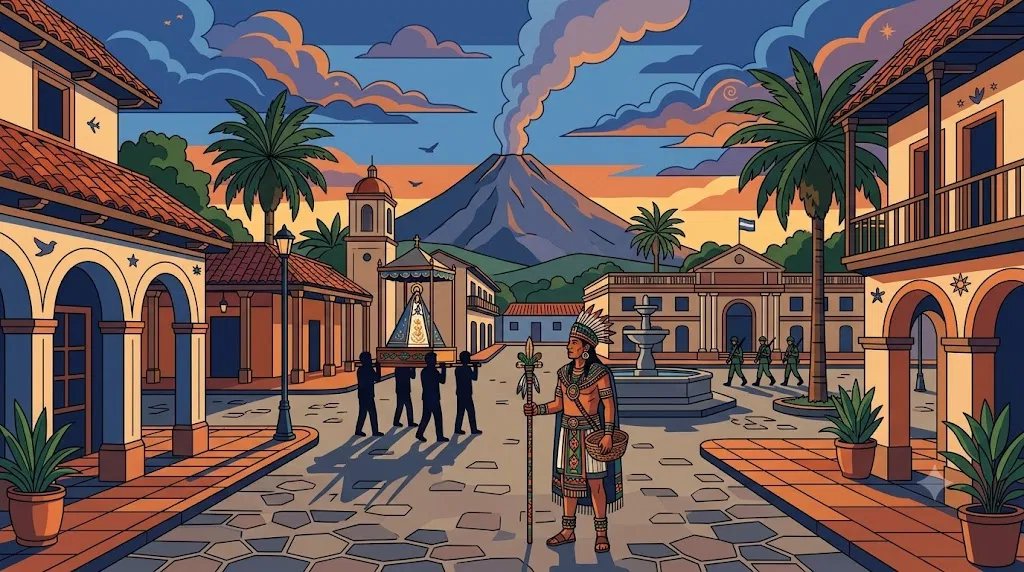
El Salvador’s religious history also contains powerful stories of miraculous protection. The best-known surrounds the image of Our Lady of Peace in San Miguel. According to local tradition, during the Chaparrastique volcano’s destructive activity in 1787, residents brought the image towards the danger and prayed for protection. The lava was then said to have changed direction, while a palm-shaped cloud appeared above the volcano. The story became embedded in the image’s iconography and in annual public devotion.[aleteia.org]aleteia.orgVirgin Mary Our Lady of Peace of San Miguel, patronVirgin Mary Our Lady of Peace of San Miguel, patron
The episode illustrates how miracle traditions grow. A frightening natural event is followed by survival; religious ritual gives that survival a shared explanation; annual ceremonies then preserve the account across generations. The result is not simply a claim about volcanic geology. It is a civic story in which the community survives because it acts together, repents and seeks protection.
Available devotional sources present the change in the lava flow as miraculous. They do not provide enough contemporary scientific or archival evidence to establish exactly what observers saw, when each element entered the tradition, or how the eruption developed physically. It is therefore more accurate to describe the miracle as a durable local belief than as a verified interruption of natural processes.
Reported Marian appearances near San Sebastián in the 1980s occupy a still more uncertain category. Later devotional accounts claim that a group of witnesses saw the Virgin at a rural chapel, but accessible documentation is dominated by recent religious websites, social-media posts and videos rather than contemporary investigations, diocesan records or independent reporting.[facebook.com]facebook.comOpen source on facebook.com.
That does not demonstrate that witnesses were dishonest. Memories can be sincere while remaining historically difficult to verify. Expectations, prayer, crowd attention, ambiguous light and later retelling can all influence how extraordinary experiences are perceived and remembered. Without stronger records, the event belongs to the history of local devotion and oral testimony, not to a confidently established case of collective vision or mass delusion.
Gang fear became a modern moral panic
From the late twentieth century onwards, gangs became the dominant figures of public fear in El Salvador. MS-13 and Barrio 18 were not invented enemies. They exercised territorial control, committed murders and extortion, displaced residents and imposed severe restrictions on everyday life. Any account that treats concern about them as merely irrational would misrepresent the experience of affected communities.
Yet scholars have also shown that media and political discourse transformed a complex problem into a moral drama. Youth gangs were depicted not only as criminal organisations but as an alien, almost absolute evil threatening the nation’s moral fabric. Research on the early “iron fist” policies argues that this moral panic was a central part of how repressive responses gained support.[jstor.org]jstor.orgOpen source on jstor.org.
This framing encouraged several distortions. Tattoos, clothing, neighbourhood, age or poverty could be treated as signs of criminal identity. Structural causes—including displacement caused by the civil war, deportation from the United States, weak institutions, lack of work and social exclusion—received less attention than images of monstrous young men. Security policy became a performance of force: military patrols, mass arrests, prison expansion and highly publicised displays of detainees.
The first major “iron fist” programmes did not eliminate gangs. Studies instead linked them to prison overcrowding, harder gang organisation and abuse by security forces. Fear nevertheless made repeated crackdowns politically attractive because visible punishment offered a simple answer to a frightening and complicated problem.[nih.gov]pmc.ncbi.nlm.nih.govOpen source on nih.gov.
The state of exception
After 87 people were killed during a surge of violence in late March 2022, the government declared a state of exception and began an enormous detention campaign. The crackdown coincided with a dramatic reduction in reported homicides and with widespread public perceptions that streets and neighbourhoods had become safer. These outcomes explain why the policy has retained strong domestic support; fear of gangs was rooted in years of genuine victimisation, not manufactured from nothing.[GOV.UK]assets.publishing.service.gov.ukUK El Salvador: Fear of gangsUK El Salvador: Fear of gangs
The danger of moral-panic reasoning appears when suspicion replaces individual evidence. Human-rights organisations have documented arbitrary arrests, deaths in custody, alleged torture, enforced disappearances and prosecutions offering limited opportunity for individual defence. Police interviewed by Human Rights Watch described pressure to meet arrest targets and cases based on unverified accusations, fabricated evidence or tattoos unrelated to gangs.[amnesty.org]amnesty.orgInternational El Salvador: A thousand days into the state of emergencyInternational El Salvador: A thousand days into the state of emergency
The government also restricted the reproduction of gang messages in the media, saying such measures were necessary to prevent criminal propaganda. Journalists and rights groups warned that broadly written rules could inhibit legitimate reporting.[aljazeera.com]aljazeera.comAl Jazeera El Salvador criminalises showing gang-related messagesAl Jazeera El Salvador criminalises showing gang-related messages
The central argument is therefore not that gangs were imaginary. It is that the category of “gang member” became elastic enough to absorb people who were merely young, poor, tattooed, denounced by an informant or living in a stigmatised district. A real emergency created conditions in which the demand for total security could override the question of whether each arrested person had actually committed a crime.
Religion can rescue, discipline and exclude
Evangelical Christianity occupies an unusual position in the gang story. Conversion has sometimes provided gang members with one of the few socially recognised routes out of criminal life. Churches can offer protection, discipline, emotional support and a new identity. Gang leaders have reportedly been more willing to accept a member’s departure when it is presented as a sincere religious transformation.
This is not usually a “cult” phenomenon. It is a form of religious conversion operating where state rehabilitation is weak. Yet it can also carry strict behavioural demands. Reporting from San Francisco Gotera prison found that evangelical conversion helped former gang members renounce violence while reinforcing hostility towards gay prisoners, who faced danger both from gang codes and from conservative religious teaching.[Time]time.comInside a Prison Cell for Gay Former Gang Members in El SalvadorInside a Prison Cell for Gay Former Gang Members in El Salvador
The example shows why simple labels fail. A church may be a route out of lethal violence for one person and a source of exclusion for another. Religious discipline can create solidarity, but claims of moral purification can also divide people into the redeemed and the irredeemable.
What these episodes reveal
El Salvador’s history of contagious fear is chiefly a history of enemy-making under extreme pressure. Colonial authorities reclassified Indigenous religion as dangerous error. The military regime of 1932 merged communists, peasants and Indigenous people into a single subversive threat. Modern security politics often collapses gang leaders, coerced recruits and merely suspected young residents into one criminal category.
Miracle stories follow a different path. They bind communities together by turning survival into sacred memory. Their historical importance does not depend upon treating every supernatural claim as literal fact. They show how people facing volcanoes, war or insecurity seek patterns of protection and meaning.
The most useful test is therefore not whether Salvadorans were “hysterical”. It is to ask what evidence existed, who controlled the public story, whether a threat was individualised or generalised, and what happened to those placed outside the circle of trust. In El Salvador, collective belief has sometimes offered comfort and social repair. At other moments, collective fear has helped turn neighbours into suspects and exceptional violence into an apparently necessary defence of the nation.

Amazon book picks
Further Reading
Books and field guides related to When Fear Became Power in El Salvador. Use these as the next step if you want deeper reading beyond the article.

The Righteous Mind
First published 2012. Subjects: Political psychology, Social psychology, Ethics, Religious Psychology, nyt:combined-print-and-e-book-nonf...
The massacre at El Mozote
First published 1994. Subjects: Politics and government, Massacres, History, El salvador, politics and government, El salvador, history.
Why Nations Fail
First published 2012. Subjects: Revolutions, Economic development, Economics, Social policy, Poverty.

The Devil's Highway
First published 2004. Subjects: Social aspects, Crimes against, Human smuggling, Illegal aliens, Social conditions.
Endnotes
1.
Source: Wikipedia
Title: Pipil people
Link:https://en.wikipedia.org/wiki/Pipil_people
2.
Source: Wikipedia
Title: Spanish conquest of El Salvador
Link:https://en.wikipedia.org/wiki/Spanish_conquest_of_El_Salvador
3.
Source: jstor.org
Link:https://www.jstor.org/stable/158450
Source snippet
Indians, the Military and the Rebellion of 1932 in El Salvadorby E Ching · 1998 · Cited by 77 — Communism, the Comintern and the Reb...
4.
Source: Wikipedia
Title: La Matanza
Link:https://en.wikipedia.org/wiki/La_Matanza
Source snippet
February 18, 2006 — La Matanza (Spanish for "The Massacre") refers to a communist-indigenous rebellion that took place in El Salvador bet...
Published: February 18, 2006
5.
Source: ebsco.com
Title: el salvadors military massacres civilians
Link:https://www.ebsco.com/research-starters/history/el-salvadors-military-massacres-civilians
Source snippet
El Salvador's Military Massacres Civilians | HistoryEl Salvador's Military Massacres Civilians. Date January-February, 1932. The mas...
6.
Source: researchgate.net
Title: Research Gate(PDF) Revitalizing indigenous languages: the case of Pipil
Link:https://www.researchgate.net/publication/273459878_Revitalizing_indigenous_languages_the_case_of_Pipil_in_El_Salvador
Source snippet
ResearchGate(PDF) Revitalizing indigenous languages: the case of Pipil...March 1, 2003 — 16 Mar 2015 — Revitalizing indigenous languages...
Published: March 1, 2003
7.
Source: aleteia.org
Title: Virgin Mary Our Lady of Peace of San Miguel, patron
Link:https://aleteia.org/2018/01/14/mary-will-find-her-way-into-your-life-with-creativity-and-persistence/
8.
Source: sites.google.com
Title: Sites Mary APParitions
Link:https://sites.google.com/a/udayton.edu/maryapparitions/el-salvador/our-lady-of-peace
9.
Source: Wikipedia
Title: Nuestra Señora de la Paz (El Salvador)
Link:https://es.wikipedia.org/wiki/Nuestra_Se%C3%B1ora_de_la_Paz_%28El_Salvador%29
10.
Source: facebook.com
Link:https://www.facebook.com/cecilia.castellanos.999855/posts/aqui-en-el-salvador-se-apareci%C3%B3-la-virgen-maria-a-unas-80-personas-en-el-a%C3%B1o-198/122305305488240322/
11.
Source: forosdelavirgen.org
Title: milagro el salvador
Link:https://www.forosdelavirgen.org/milagro-el-salvador/
12.
Source: facebook.com
Title: aqui en la ermita de la esperanza se apareció la virgen maria en el año 1984habí
Link:https://www.facebook.com/cecilia.castellanos.999855/posts/aqui-en-la-ermita-de-la-esperanza-se-apareci%C3%B3-la-virgen-maria-en-el-a%C3%B1o-1984hab%C3%AD/122305833248240322/
13.
Source: jstor.org
Link:https://www.jstor.org/stable/25548280
14.
Source: pmc.ncbi.nlm.nih.gov
Link:https://pmc.ncbi.nlm.nih.gov/articles/PMC9250991/
15.
Source: assets.publishing.service.gov.uk
Title: UK El Salvador: Fear of gangs
Link:https://assets.publishing.service.gov.uk/media/69399f45e447374889cd909f/SLV_CPIN_Fear_of_gangs.pdf
16.
Source: amnesty.org
Title: International El Salvador: A thousand days into the state of emergency
Link:https://www.amnesty.org/en/latest/news/2024/12/el-salvador-mil-dias-regimen-excepcion-modelo-seguridad-a-costa-derechos-humanos/
17.
Source: time.com
Title: Inside a Prison Cell for Gay Former Gang Members in El Salvador
Link:https://time.com/5936075/el-salvador-gangs-unforgivable-documentary/
18.
Source: Wikipedia
Title: List of mass panic cases
Link:https://en.wikipedia.org/wiki/List_of_mass_panic_cases
19.
Source: Wikipedia
Title: Satanic panic
Link:https://en.wikipedia.org/wiki/Satanic_panic
20.
Source: Wikipedia
Link:https://en.wikipedia.org/wiki/QAnon
21.
Source: Wikipedia
Title: List of Marian apparitions
Link:https://en.wikipedia.org/wiki/List_of_Marian_apparitions
22.
Source: Wikipedia
Link:https://en.wikipedia.org/wiki/MS-13
23.
Source: Wikipedia
Link:https://es.wikipedia.org/wiki/Apocalipticismo
24.
Source: Wikipedia
Title: Virgen de los Milagros
Link:https://es.wikipedia.org/wiki/Virgen_de_los_Milagros
25.
Source: jstor.org
Link:https://www.jstor.org/stable/3662836
26.
Source: jstor.org
Link:https://www.jstor.org/stable/4286196
27.
Source: jstor.org
Link:https://www.jstor.org/stable/645632
28.
Source: jstor.org
Link:https://www.jstor.org/stable/483321
29.
Source: jstor.org
Link:https://www.jstor.org/stable/656292
30.
Source: jstor.org
Link:https://www.jstor.org/stable/2649350
31.
Source: jstor.org
Link:https://www.jstor.org/stable/23358978
32.
Source: jstor.org
Link:https://www.jstor.org/content/pdf/oa_book_monograph/j.ctt9qg53g
33.
Source: jstor.org
Link:https://www.jstor.org/stable/644261
34.
Source: jstor.org
Link:https://www.jstor.org/stable/23917579
35.
Source: jstor.org
Link:https://www.jstor.org/stable/41799593
36.
Source: facebook.com
Link:https://www.facebook.com/MatthewSantoroVideos/posts/the-day-an-entire-girls-school-fainted-mysteriously/1567707731382100/
37.
Source: facebook.com
Link:https://www.facebook.com/seedtalksfb/posts/uncover-the-history-of-witchcraft-and-how-the-witch-was-used-to-control-and-puni/1041743188363918/
38.
Source: facebook.com
Link:https://www.facebook.com/WSYRNews/posts/a-strange-incident-wherein-six-students-at-a-high-school-in-the-philippines-bega/1693938766067517/
39.
Source: facebook.com
Title: between 1986 and 1996 a series of murders spread fear across costa rica a dark c
Link:https://www.facebook.com/ulacitcostarica/posts/between-1986-and-1996-a-series-of-murders-spread-fear-across-costa-rica-a-dark-c/1262077255960158/
40.
Source: facebook.com
Link:https://www.facebook.com/groups/1167983149927065/posts/7540994689292514/
41.
Source: facebook.com
Link:https://www.facebook.com/uCatholic/posts/over-one-million-people-witnessed-this-miracle-of-the-virgin-mary-from-1968-to-1/1451848176968905/
42.
Source: facebook.com
Title: 250000 people saw the virgin mary the most documented apparition in history zeit
Link:https://www.facebook.com/61582434374577/posts/250000-people-saw-the-virgin-mary-the-most-documented-apparition-in-history-zeit/122116351611081145/
43.
Source: facebook.com
Link:https://www.facebook.com/frontline/posts/salvadoran-president-nayib-bukele-built-his-reputation-on-being-extremely-tough-/1336305305019615/
44.
Source: facebook.com
Title: la gran aparición ocurrió el 21 de febrero de 1984 ese día muchas personas afirm
Link:https://www.facebook.com/cecilia.castellanos.999855/posts/la-gran-aparici%C3%B3n-ocurri%C3%B3-el-21-de-febrero-de-1984-ese-d%C3%ADa-muchas-personas-afirm/122310662648240322/
45.
Source: facebook.com
Link:https://www.facebook.com/SNTParaguay/videos/presunta-posesi%C3%B3n-demon%C3%ADaca-en-escuela-agr%C3%ADcola-causa-alarma%EF%B8%8F-posesi%C3%B3n-demon%C3%ADaca/1517739062236879/
46.
Source: facebook.com
Link:https://www.facebook.com/Teledos/posts/tl2-por-d%C3%A9cadas-la-leyenda-de-el-cenicero-ha-marcado-la-historia-de-panchimalco-/1320597506771439/
47.
Source: facebook.com
Link:https://www.facebook.com/TeleamazonasEcuador/posts/esta-posesi%C3%B3n-demon%C3%ADaca-asust%C3%B3-a-m%C3%A1s-de-uno-lom%C3%A1svisto2017/10156103271604114/
48.
Source: facebook.com
Link:https://www.facebook.com/kathya.carranza/posts/-el-pocito-una-historia-que-contar-san-sebasti%C3%A1n-san-vicenteel-salvador-1983-fot/10161348550456143/
49.
Source: facebook.com
Link:https://www.facebook.com/NoticiasCaracol/posts/viral-la-silueta-de-una-persona-que-algunos-afirman-es-bruja-aparece-sobre-la-co/979256867575423/
50.
Source: amnesty.org
Link:https://www.amnesty.org/ar/wp-content/uploads/2024/08/AMR2983642024ENGLISH.pdf
51.
Source: amnesty.org
Link:https://www.amnesty.org/en/wp-content/uploads/2024/01/AMR2974232023ENGLISH.pdf
52.
Source: amnesty.org
Link:https://www.amnesty.org/en/location/americas/central-america-and-the-caribbean/el-salvador/report-el-salvador/
53.
Source: amnesty.org
Title: el salvador two years emergency rule
Link:https://www.amnesty.org/en/latest/news/2024/03/el-salvador-two-years-emergency-rule/
54.
Source: amnesty.org
Link:https://www.amnesty.org/en/wp-content/uploads/2025/04/AMR0192592025ENGLISH.pdf
55.
Source: amnesty.org
Title: el salvador reformas ninez y adolescencia
Link:https://www.amnesty.org/en/latest/news/2025/02/el-salvador-reformas-ninez-y-adolescencia/
56.
Source: amnesty.org
Link:https://www.amnesty.org/en/wp-content/uploads/2025/04/WEBPOL1085152025ENGLISH.pdf
57.
Source: amnesty.org
Link:https://www.amnesty.org/fr/wp-content/uploads/2023/06/AMR0168092023ENGLISH.pdf
58.
Source: amnesty.org
Link:https://www.amnesty.org/en/wp-content/uploads/2025/10/POL3204262025ENGLISH.pdf
59.
Source: ebsco.com
Link:https://www.ebsco.com/research-starters/communication-and-mass-media/satanic-panic
60.
Source: history.com
Title: what was satanic panic 1980s
Link:https://www.history.com/articles/what-was-satanic-panic-1980s
61.
Source: researchgate.net
Link:https://www.researchgate.net/publication/292145151_Deconstructing_a_Modern_Witch_Hunt_Satanic_Cults_Ritual_Abuse_and_Moral_Panic
62.
Source: researchgate.net
Title: 240460934 Indians the Military and the Rebellion of 1932 in El Salvador
Link:https://www.researchgate.net/publication/240460934_Indians_the_Military_and_the_Rebellion_of_1932_in_El_Salvador
63.
Source: journals.sagepub.com
Link:https://journals.sagepub.com/doi/10.1177/0094582X251395605
64.
Source: tandfonline.com
Link:https://www.tandfonline.com/doi/abs/10.1080/09614520701628121
65.
Source: youth4peace.info
Link:https://www.youth4peace.info/files/system/files/2018-04/1.%20tp_mano%20dura_rob%20muggah.pdf
66.
Source: hrw.org
Title: el salvador police officers speak out about abuses
Link:https://www.hrw.org/news/2025/06/27/el-salvador-police-officers-speak-out-about-abuses
67.
Source: hrw.org
Title: el salvador widespread abuses under state emergency
Link:https://www.hrw.org/news/2022/12/07/el-salvador-widespread-abuses-under-state-emergency
68.
Source: aljazeera.com
Title: Al Jazeera El Salvador criminalises showing gang-related messages
Link:https://www.aljazeera.com/news/2022/4/6/el-salvador-criminalises-showing-gang-related-messages-in-media
69.
Source: theguardian.com
Title: el salvador press censorship gang law
Link:https://www.theguardian.com/world/2022/apr/06/el-salvador-press-censorship-gang-law
70.
Source: hrw.org
Title: el salvador sweeping new laws endanger rights
Link:https://www.hrw.org/news/2022/04/08/el-salvador-sweeping-new-laws-endanger-rights
71.
Source: hrw.org
Title: el salvador
Link:https://www.hrw.org/world-report/2025/country-chapters/el-salvador
72.
Source: hrw.org
Title: el salvador
Link:https://www.hrw.org/world-report/2026/country-chapters/el-salvador
73.
Source: pmc.ncbi.nlm.nih.gov
Link:https://pmc.ncbi.nlm.nih.gov/articles/PMC11023688/
74.
Source: americanarchive.org
Title: el salvador
Link:https://americanarchive.org/exhibits/newshour-cold-war/el-salvador
75.
Source: journals.sagepub.com
Link:https://journals.sagepub.com/doi/abs/10.1177/00207640221111265
76.
Source: gmanetwork.com
Link:https://www.gmanetwork.com/regionaltv/news/109681/26-students-in-cdo-faint-after-alleged-mass-hysteria/story/
77.
Source: theguardian.com
Title: carol morley the falling mass hysteria is a powerful group activity
Link:https://www.theguardian.com/film/2015/mar/29/carol-morley-the-falling-mass-hysteria-is-a-powerful-group-activity
78.
Source: catalog.hathitrust.org
Link:https://catalog.hathitrust.org/Record/000205762
Additional References
79.
Source: cambridge.org
Link:https://www.cambridge.org/core/journals/journal-of-latin-american-studies/article/hector-lindofuentes-erik-ching-and-rafael-a-laramartinez-remembering-a-massacre-in-el-salvador-the-insurrection-of-1932-roque-dalton-and-the-politics-of-historical-memory-albuquerque-nm-university-of-new-mexico-press-2007-pp-xviii411-2995-pb/2C623193936DCBD935F5BD71F8079145
Source snippet
BG PETERSON · 2008 —... communist causality thesis. The evidence suggests that the Partido... Remembering a Massacre in El S...
80.
Source: cipdh.gob.ar
Title: conmemoracion de la masacre indigena de 1932
Link:https://www.cipdh.gob.ar/memorias-situadas/en/lugar-de-memoria/conmemoracion-de-la-masacre-indigena-de-1932/
Source snippet
massacre as symbol of fight against communism. The indigenous community remembered the victims through family ceremonies until 2005. In J...
81.
Source: youtube.com
Link:https://www.youtube.com/watch?v=xV8brbypVqA
Source snippet
Massacre in El Salvador (full documentary) | FRONTLINE + ProPublica + RetroReport (Aired 2021)...
82.
Source: youtube.com
Title: The history of MS-13, from El Salvador to the U.S
Link:https://www.youtube.com/watch?v=QbvBg5Y8CaU
Source snippet
The Murder of US Churchwomen in El Salvador That Exposed a Government Coverup | Retro Report...
83.
Source: youtube.com
Link:https://www.youtube.com/watch?v=03XyXFHCMQM
Source snippet
El Salvador: A Carceral State of Terror...
84.
Source: academia.edu
Link:https://www.academia.edu/4593752/Of_Women_and_Witches_A_Case_Study_in_Moral_Panics
85.
Source: instagram.com
Link:https://www.instagram.com/reel/DG-Nol0p7I-/
86.
Source: historysnob.com
Link:https://www.historysnob.com/war-and-historical-events/20-famous-examples-of-moral-panic
87.
Source: karolinum.cz
Link:https://karolinum.cz/data/clanek/2116/IBAP_42_2008.89-106.pdf
88.
Source: howtoperu.com
Link:https://howtoperu.com/a-classic-case-of-mass-hysteria-in-tarapoto-peru/
Topic Tree
Follow this branch
Related pages 192
- Antigua and Barbuda
- Argentina Belief Scares
- Azerbaijan Belief
- Bahrain Beliefs
- North Korea
- +187 more in sidebar