Within Palau Beliefs
Was Palau's Modekngei Really a Cult?
Palau's record shows why unfamiliar religions should not be confused with cult abuse, collective delusion or mass psychogenic illness.
On this page
- What cult, panic and mass hysteria mean
- Why Palau lacks a documented classic outbreak
- How outsider labels shaped later interpretations
Page outline Jump by section
Introduction
Palau is not known for documented episodes of mass hysteria, witch panics, satanic scares or destructive apocalyptic cults. Instead, the country’s historical record raises a different question: how should outsiders describe an unfamiliar indigenous religion that emerged during colonial rule? The movement most often discussed is Modekngei, a Palauan religion founded in the early twentieth century. It has sometimes been portrayed as a “cult”, an anti-colonial conspiracy or a socially dangerous movement, yet the surviving evidence does not support equating it with coercive cult abuse, mass psychogenic illness or collective delusion. Modern scholarship increasingly treats Modekngei as a durable religious tradition whose history was shaped as much by colonial interpretation as by its own beliefs and practices.[ProQuest]proquest.comPro Quest Modekngei: A New Religion in Belau, MicronesiaModekngei: A New Religion in Belau, Micronesia - ProQuest…
Understanding this distinction matters because Palau demonstrates how the language of “cult”, “mass hysteria” and “fanaticism” can obscure rather than clarify historical events. The strongest lesson from the evidence is not that Palau experienced a classic panic, but that later readers should be cautious about repeating labels created by colonial administrators, missionaries and outside observers.
What do “cult”, “moral panic” and “mass hysteria” actually mean?
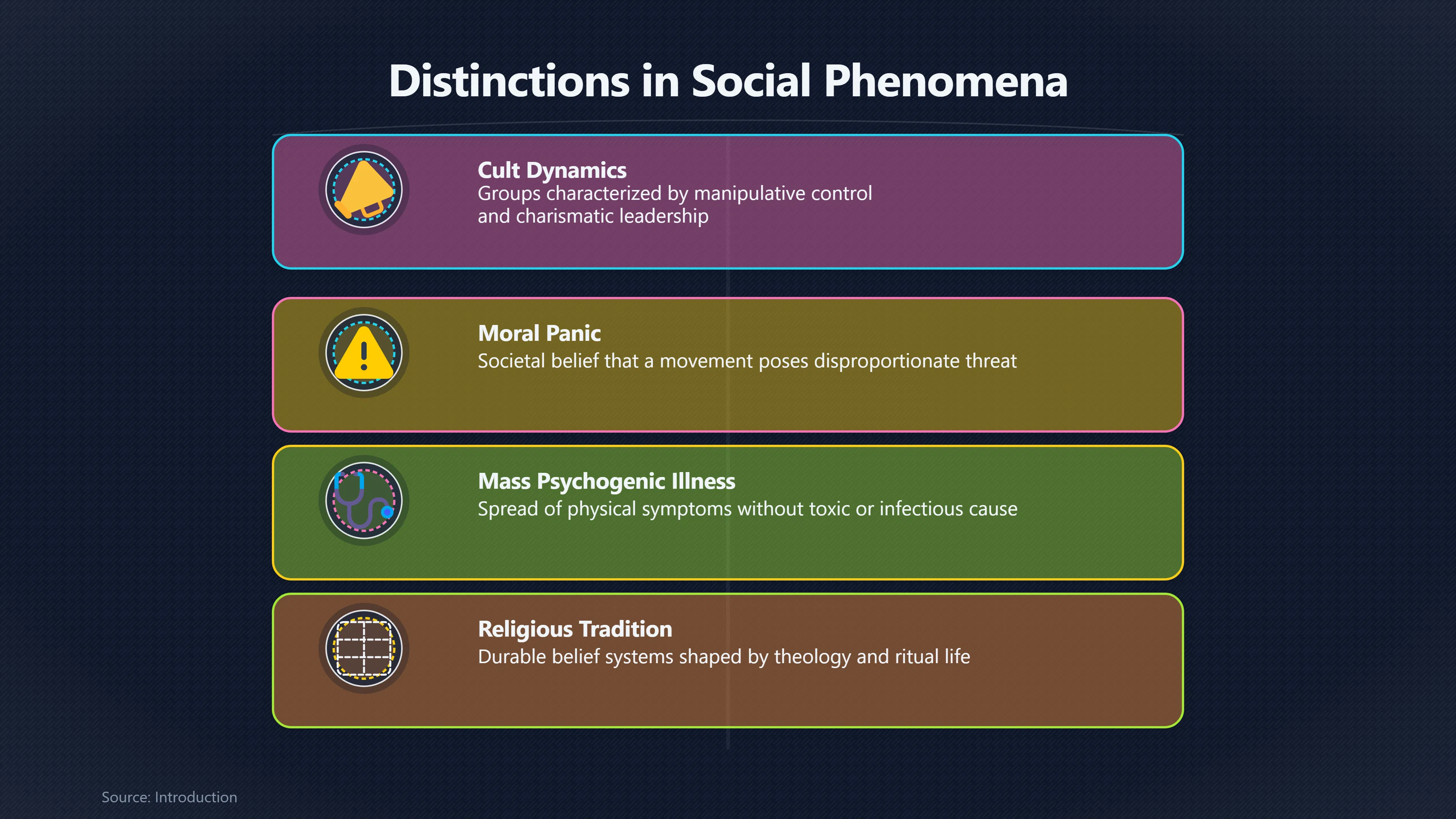
These terms are often used interchangeably in popular writing, but they describe different phenomena.
A cult, in everyday language, usually implies a manipulative or abusive group centred on extreme control by charismatic leaders. In academic religious studies, however, the word has long been recognised as controversial because it has frequently been applied to unfamiliar minority religions rather than to groups that actually display coercive behaviour.
A moral panic occurs when a society comes to believe that a person, movement or behaviour represents a major threat out of proportion to the available evidence. Politicians, religious leaders or the media may amplify these fears.
Mass psychogenic illness (sometimes historically called “mass hysteria”) refers to the spread of genuine physical symptoms without an identifiable toxic or infectious cause. Modern researchers emphasise that these episodes involve real distress and are distinct from fraud, collective madness or unusual religious belief. They also caution that the diagnosis has often reflected cultural assumptions as much as medical evidence.[cambridge.org]cambridge.orgCambridge University Press & AssessmentTarantism, dancing mania and demonopathy: the anthro-political aspects of ‘mass psychogenic illnes…
These distinctions are important because none fits Palau’s historical record particularly well.
Why Palau lacks a documented classic outbreak
Unlike some countries with well-documented witch persecutions, school fainting epidemics or satanic panics, Palau has no securely documented national episode that historians widely recognise as a classic case of mass psychogenic illness or moral panic.
This absence should not be mistaken for missing research. Rather, the surviving documentary record simply points elsewhere. Searches through colonial histories, anthropological studies and religious scholarship consistently identify Modekngei as the country’s principal case involving contested religious interpretation, but they do not reveal evidence for large-scale contagious illness, nationwide demon scares or persecution driven by rumours comparable with better-known international examples.[ProQuest]proquest.comPro Quest Modekngei: A New Religion in Belau, MicronesiaModekngei: A New Religion in Belau, Micronesia - ProQuest…
It is also important not to import evidence from neighbouring regions. Papua New Guinea, parts of Melanesia and other Pacific societies have experienced documented sorcery accusations, religious violence or panic episodes, but those histories belong to different social and political settings. Geographic proximity alone is not evidence that Palau shared the same experiences.
Was Modekngei really a cult?
The historical evidence suggests that the answer depends largely on who was doing the labelling.
Early outside observers often struggled to classify Modekngei because it combined indigenous Palauan spirituality with Christian ideas, sacred songs, healing practices and communal worship. To administrators accustomed to distinguishing sharply between recognised churches and indigenous religious traditions, the movement could appear politically suspicious or socially unconventional.
Some earlier scholars also framed Modekngei primarily as an anti-colonial movement disguised as religion. More recent research by Machiko Aoyagi challenges that interpretation by drawing extensively on Palauan testimony and religious traditions preserved within the movement itself. Rather than treating religion as a cover for politics, Aoyagi argues that Modekngei should first be understood as a genuine religious tradition whose theology, ritual life and sacred songs deserve to be studied on their own terms.[ProQuest]proquest.comPro Quest Modekngei: A New Religion in Belau, MicronesiaModekngei: A New Religion in Belau, Micronesia - ProQuest…
That does not mean the movement never became involved in political disputes. Religious movements frequently intersect with struggles over land, authority and colonial power. But political conflict is not, by itself, evidence that a movement was a coercive cult.
Equally important, there is no well-supported historical evidence that Modekngei systematically practised the kinds of coercive isolation, organised abuse or catastrophic violence that typically define destructive cults in contemporary discussion.
How outsider labels shaped later interpretations
One reason Modekngei attracted suspicion lies in who wrote most of Palau’s surviving historical sources.
Much of the documentary record comes from:
- colonial officials concerned with maintaining order;
- Christian missionaries competing for converts;
- visiting anthropologists and ethnographers;
- later foreign researchers working from archival material.
Each group observed the movement through different assumptions and priorities.
Colonial governments often regarded rapidly growing indigenous religious movements as possible centres of resistance, even when direct evidence for organised rebellion was limited. Missionaries could interpret the continued presence of traditional spiritual practices as evidence of religious error or syncretism. Anthropologists, meanwhile, frequently classified communities according to theoretical categories that reflected the intellectual fashions of their own time.
Modern historians have become increasingly cautious about accepting those categories at face value. Similar reassessments have occurred elsewhere in former colonial territories, where movements once dismissed as irrational cults or outbreaks of hysteria have later been reinterpreted as complex responses to colonial disruption, cultural change and political uncertainty.[Springer]link.springer.com‘Mass Hysteria’ in the Wake of Decolonisation | Springer Nature LinkSpringer‘Mass Hysteria’ in the Wake of Decolonisation | Springer Nature Link…
Palau fits this broader pattern without providing evidence for a genuine mass-hysteria episode.
Missing evidence is itself an important finding
Historical research does not always produce dramatic stories. Sometimes the most reliable conclusion is that the evidence for a popular claim is weak.
For Palau, several observations stand out:
- there is no well-documented national witch panic;
- there is no recognised epidemic of mass psychogenic illness;
- there is no widely supported evidence that Modekngei functioned as a destructive cult in the modern sense;
- most claims about social danger came through outsiders interpreting an unfamiliar indigenous religion.
This does not prove that every historical account is complete. Archival gaps are common in Pacific history, especially where oral traditions remained more important than written records. But responsible historical writing distinguishes between “evidence has been lost” and “evidence has never been demonstrated”. At present, the latter better describes many sensational claims sometimes repeated about Palau.
What Palau contributes to the wider history of cult scares
Palau’s significance lies less in spectacular events than in the caution it offers historians.
The country’s best-documented religious movement illustrates how unfamiliar beliefs can acquire labels such as “cult”, “fanatic” or “dangerous sect” long before careful evidence is gathered. Later scholarship has shown the value of returning to indigenous voices, oral traditions and religious practice rather than relying exclusively on administrative reports.
For readers interested in the history of collective belief, Palau therefore offers an important reminder. Not every unusual religion represents a cult, not every official suspicion reflects genuine danger, and not every contested belief should be explained as mass hysteria. Sometimes the central historical story is the evolution of the labels themselves—and how those labels reveal the assumptions of the people who created them.
Amazon book picks
Further Reading
Books and field guides related to Was Palau's Modekngei Really a Cult?. Use these as the next step if you want deeper reading beyond the article.
Imagined communities
Provides context for nationalism, colonialism and identity shaping religious movements.
Cults in Our Midst
Helps readers distinguish coercive cults from minority religions such as Modekngei.

The Psychology of Pandemics
Useful background on panic, fear and collective belief without conflating them with religion.

"Crazy" therapies
Helps readers distinguish coercive cults from minority religions such as Modekngei.
Endnotes
1.
Source: proquest.com
Title: Pro Quest Modekngei: A New Religion in Belau, Micronesia
Link:https://www.proquest.com/scholarly-journals/modekngei-new-religion-belau-micronesia/docview/201679283/se-2
Source snippet
Modekngei: A New Religion in Belau, Micronesia - ProQuest...
2.
Source: cambridge.org
Link:https://www.cambridge.org/core/journals/psychological-medicine/article/abs/tarantism-dancing-mania-and-demonopathy-the-anthropolitical-aspects-of-mass-psychogenic-illness/A2C2EF387B94BC12E4BBB526B5443534
Source snippet
Cambridge University Press & AssessmentTarantism, dancing mania and demonopathy: the anthro-political aspects of ‘mass psychogenic illnes...
3.
Source: pmc.ncbi.nlm.nih.gov
Link:https://pmc.ncbi.nlm.nih.gov/articles/PMC4988490/
4.
Source: link.springer.com
Title: ‘Mass Hysteria’ in the Wake of Decolonisation | Springer Nature Link
Link:https://link.springer.com/chapter/10.1057/978-1-137-60095
Source snippet
Springer‘Mass Hysteria’ in the Wake of Decolonisation | Springer Nature Link...
5.
Source: cambridge.org
Link:https://www.cambridge.org/core/journals/british-journal-of-political-science/article/abs/bureaucracy-and-incumbent-violence-colonial-administration-and-the-origins-of-the-mau-mau-emergency-in-kenya/71BFD4B561ED9840461578F6E59B3BA9
6.
Source: youtube.com
Link:https://www.youtube.com/watch?v=XJSbtydSiAo
Source snippet
Modekngei | Wikipedia audio article...
7.
Source: youtube.com
Title: Modekngei | Wikipedia audio article
Link:https://www.youtube.com/watch?v=SG6YRFc_dWw
Source snippet
Belau Modekngei School - Talk Show...
8.
Source: academic.oup.com
Link:https://academic.oup.com/hawaii-scholarship-online/book/18329/chapter/176368237
Additional References
9.
Source: academic.oup.com
Link:https://academic.oup.com/jhmas/article-pdf/70/1/105/5086160/jrt055.pdf
Source snippet
Kagwa, East African Psychiatry, and the Gisu | Journal of the History of Medicine and Allied Sciences | Oxford AcademicNovember 4, 2013 —...
Published: November 4, 2013
10.
Source: pubmed.ncbi.nlm.nih.gov
Link:https://pubmed.ncbi.nlm.nih.gov/24191308/
Source snippet
Kagwa, East african psychiatry, and the Gisu - PubMedJanuary 1, 2015 — FULL TEXT LINKS Silverchair Information Systems Free PMC article F...
Published: January 1, 2015
11.
Source: youtube.com
Title: What Is a Cult? How High-Control Religious Groups Manipulate Belief
Link:https://www.youtube.com/watch?v=yKkagm4J0Yk
Source snippet
Smithsonian - Vitarelli - Modekngei Smithsonian - Vitarelli - Modekngei (Part 1) TMC Palau (TMC 38)...
12.
Source: academic.oup.com
Link:https://academic.oup.com/jhmas/article-abstract/70/1/105/750583
Source snippet
Kagwa, East African Psychiatry, and the Gisu | Journal of the History of Medicine and Allied Sciences | Oxford AcademicNovember 4, 2013 —...
Published: November 4, 2013
13.
Source: pulotu.com
Link:https://pulotu.com/culture/palau
14.
Source: natlib.govt.nz
Link:https://natlib.govt.nz/records/20979632?i%5Bsubject%5D%5B%5D=Missions&i%5Bsubject%5D%5B%5D=Papua+New+Guinea&tab=cart
15.
Source: cir.nii.ac.jp
Link:https://cir.nii.ac.jp/crid/1390282680781758080?lang=en
16.
Source: history.ox.ac.uk
Link:https://www.history.ox.ac.uk/node/15871
17.
Source: hsmt.ox.ac.uk
Link:https://www.hsmt.ox.ac.uk/publication/144515/scopus
18.
Source: youtube.com
Title: Belau Modekngei School
Link:https://www.youtube.com/watch?v=QjNpWL2oNvA
Source snippet
What Is a Cult? How High-Control Religious Groups Manipulate Belief...
Topic Tree