Within Serbian Panics
Who Was Punished When Witchcraft Was Feared?
Serbia's witchcraft history centres on local accusations, vulnerable women and the state's uneven effort to criminalise persecution.
On this page
- How misfortune became proof of harmful magic
- Why healers and older women became targets
- How state law redefined the real offender
Page outline Jump by section
Introduction
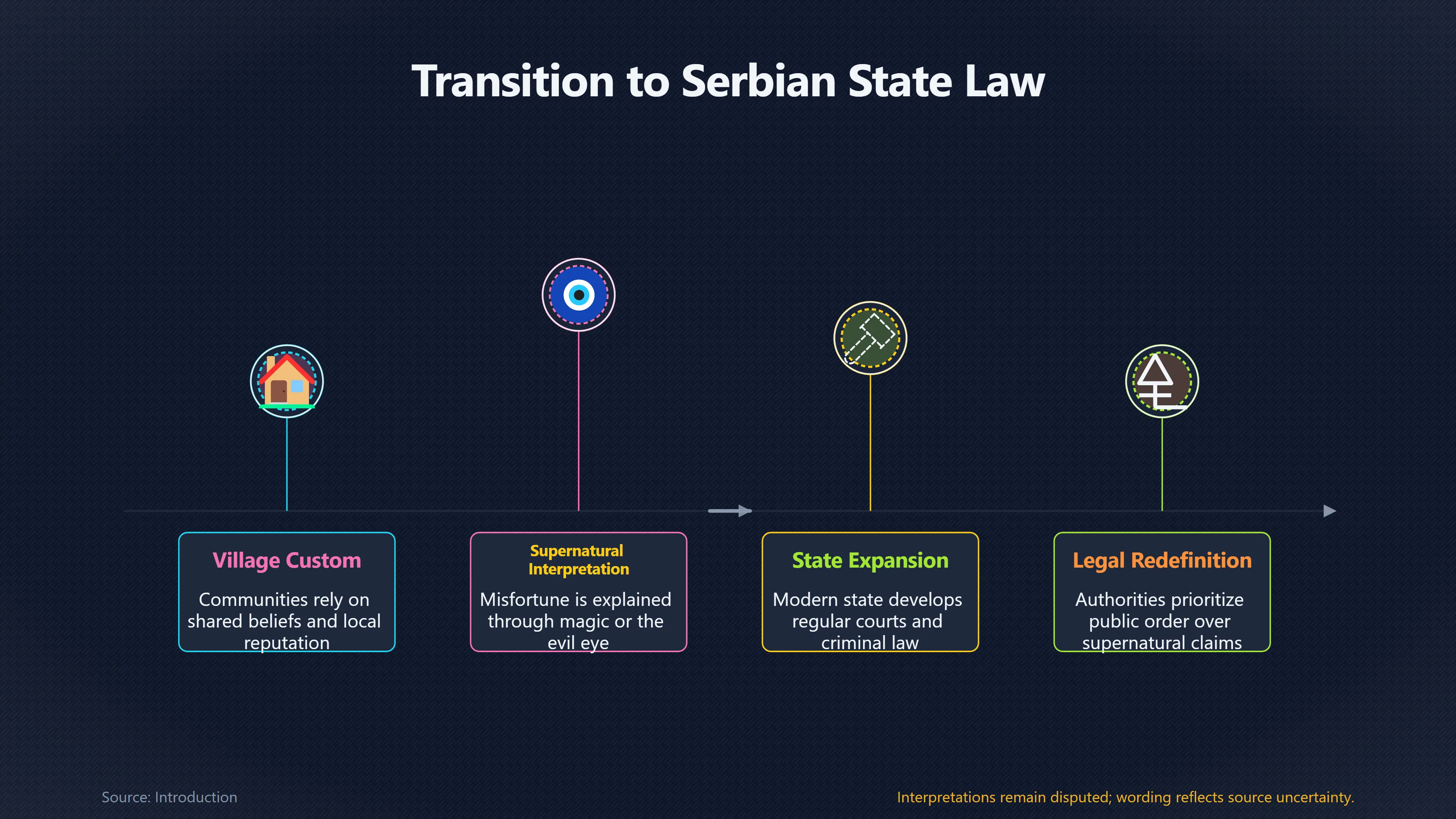
Serbia’s history of witchcraft accusations differs markedly from the large-scale witch hunts associated with parts of Central and Western Europe. Rather than producing sustained campaigns of formal witch trials, accusations in Serbian communities were usually local, directed at neighbours, older women or people believed to possess harmful supernatural knowledge. The most important long-term change was therefore not the rise of spectacular prosecutions, but the gradual transfer of authority from village custom to state law. As the modern Serbian state expanded during the nineteenth century, officials increasingly treated violence against alleged witches as the real crime, while courts became less willing to recognise witchcraft itself as a legal offence. This shift illustrates how governments attempted to replace customary justice with a legal system based on evidence rather than supernatural belief.[ceeol.com]ceeol.comCEEO LArticle Detail…

Who Was Punished When Witchcraft Was Feared?
In rural Serbian society, unexplained illness, livestock deaths, failed harvests and family misfortune could all become evidence that someone had used harmful magic. Such accusations rarely emerged at random. They usually appeared after long-standing neighbourhood disputes, family tensions or repeated episodes of bad luck. Instead of requiring proof in the modern legal sense, suspicion often rested on reputation, coincidence and shared local beliefs.
Unlike regions of Europe that experienced organised witch persecutions under specialised courts, Serbian accusations generally remained community affairs. The person suspected of causing harm was more likely to face intimidation, exclusion, beating or other forms of informal punishment than a lengthy judicial process. This reflected the relatively limited reach of state institutions across much of the region for long periods, particularly under Ottoman rule, where local customary practices often remained influential.[ceeol.com]ceeol.comCEEO LArticle Detail…
The absence of major witch-hunting campaigns should not be mistaken for an absence of fear. Belief that harmful magic could damage health, fertility or property remained widespread, but responses were usually handled within villages rather than through the machinery of the state.
How Misfortune Became Proof of Harmful Magic
Witchcraft accusations worked because they offered an explanation when ordinary experience seemed inadequate. If several illnesses followed a quarrel with a neighbour, or repeated losses affected one household while another prospered, supernatural attack became a plausible interpretation within the prevailing culture.
Several features encouraged accusations:
- repeated unexplained deaths within a family;
- sudden disease affecting livestock;
- crop failures after personal disputes;
- unusual behaviour attributed to curses or the “evil eye”;
- rumours linking an individual to previous episodes of misfortune.
These accusations were socially meaningful rather than random. Historians of European witchcraft have repeatedly shown that local conflicts, envy, inheritance disputes and damaged relationships often mattered more than formal theology. Serbian evidence fits this broader pattern, although without generating the same scale of judicial persecution seen elsewhere in Europe.[DOI]doi.orgCrime and the Law | Springer Nature LinkCrime and the Law | Springer Nature LinkJanuary 1, 2007…
Why Healers and Older Women Became Targets
Women appeared disproportionately among those suspected of witchcraft, especially elderly widows, socially isolated women and individuals associated with healing or folk remedies. Their knowledge of herbs, charms or protective rituals could make them respected in everyday life while simultaneously exposing them to suspicion if misfortune later struck.
Modern historians caution against romantic images of persecuted “wise women”. Most accused women were not professional healers, and many had no unusual knowledge at all. Instead, they became convenient targets because they already occupied vulnerable positions within village society. Reputation mattered enormously. Once someone acquired a reputation for possessing dangerous powers, later accidents could reinforce existing suspicions.
In Serbian communities, women involved in childbirth, healing or protective rituals sometimes occupied this ambiguous position. The same practices that neighbours sought in times of need could later be interpreted as evidence of harmful magic if circumstances changed.[routledge.com]routledge.comWitchcraft Mythologies and PersecutionsWitchcraft Mythologies and Persecutions - 1st Edition - Éva Pócs - G…

How State Law Redefined the Real Offender
The most significant transformation came during the nineteenth century as the autonomous Serbian state developed regular courts and criminal law.
Court records from the period demonstrate that accusations of witchcraft did not disappear immediately. Instead, judges increasingly faced cases in which communities had already acted against alleged witches. Legal authorities became less interested in determining whether supernatural harm had actually occurred and more concerned with maintaining public order and preventing violence. Research into Serbian legal history shows that customary rules, church traditions and emerging state law often coexisted uneasily during this transitional period, producing inconsistent decisions before a more uniform legal system gradually emerged.[ceeol.com]ceeol.comCEEO LArticle Detail…
This represented an important reversal in responsibility:
- under customary thinking, the alleged witch was viewed as the source of danger;
- under expanding state law, assaulting, abusing or unlawfully punishing another person increasingly became the punishable offence;
- judges sought evidence of actual criminal acts rather than accepting supernatural accusations as proof.
The transition was uneven. Rural beliefs often survived long after legislation changed, and communities sometimes continued to treat suspected witches according to customary expectations. Nevertheless, the authority to decide guilt steadily shifted away from village consensus and towards formal courts.

Why Serbia Experienced Fewer Formal Witch Trials
Serbia never developed the extensive system of organised witch prosecutions that characterised parts of the Holy Roman Empire, Switzerland or Scotland. Several historical circumstances help explain this difference.
Political authority was fragmented across different periods of Ottoman and Habsburg influence, limiting the emergence of a unified legal campaign against witches. Orthodox religious traditions also developed differently from regions where demonological theories about pacts with the Devil became closely intertwined with criminal prosecution. While belief in harmful magic certainly existed, it was less frequently transformed into large-scale judicial hunts.[Die Welt der Habsburger]habsburger.netDie Welt der Habsburger In league with the devil | Die Welt der HabsburgerDie Welt der Habsburger In league with the devil | Die Welt der Habsburger
Instead, supernatural fears were more likely to appear through village customs, folk medicine, protective rituals and occasional local punishments than through repeated executions ordered by central authorities.
Why the Shift to Law Matters
The movement from village punishment to legal adjudication changed more than courtroom procedure. It altered who possessed the authority to define truth.
Under customary practice, community belief itself could function as evidence. Reputation, rumour and shared expectations carried considerable weight. As state institutions strengthened, courts increasingly demanded observable acts, identifiable victims and legally recognised offences. Witchcraft ceased to provide an acceptable legal explanation for misfortune, even though belief in magic often remained part of everyday culture.
This transition also reduced opportunities for collective violence. Instead of encouraging communities to identify and punish supposed witches, the developing legal system increasingly treated vigilante action, assault and coercion as offences against public order. The change therefore marked a broader shift from communal justice rooted in supernatural belief towards governance based on evidence, procedure and state authority.[ceeol.com]ceeol.comCEEO LArticle Detail…
Amazon book picks
Further Reading
Books and field guides related to Who Was Punished When Witchcraft Was Feared?. Use these as the next step if you want deeper reading beyond the article.

The witch-hunt in early modern Europe
Covers patterns of persecution, legal processes, and regional differences relevant to Serbia's distinct experience.
Witches and Neighbors
Focuses on local communities, neighbourly conflict, and social tensions behind accusations.

The witch
Explains how accusations developed, who was targeted, and how legal systems changed over time.

Europe's inner demons
Explores the intellectual origins of witch beliefs and persecution that shaped later European attitudes.
Endnotes
1.
Source: ceeol.com
Title: CEEO L
Link:https://www.ceeol.com/search/article-detail?id=414375
Source snippet
Article Detail...
2.
Source: vrhovnojt.gov.rs
Title: History | Public Prosecution | Organization | RJT
Link:https://www.vrhovnojt.gov.rs/en%3Aen/organization/public-prosecution/history
3.
Source: routledge.com
Title: Witchcraft Mythologies and Persecutions
Link:https://www.routledge.com/Witchcraft-Mythologies-and-Persecutions/Pocs-Klaniczay/p/book/9789637326875
Source snippet
Witchcraft Mythologies and Persecutions - 1st Edition - Éva Pócs - G...
4.
Source: doi.org
Title: Crime and the Law | Springer Nature Link
Link:https://doi.org/10.1057%2F9780230593480_9
Source snippet
Crime and the Law | Springer Nature LinkJanuary 1, 2007...
Published: January 1, 2007
5.
Source: habsburger.net
Title: Die Welt der Habsburger In league with the devil | Die Welt der Habsburger
Link:https://www.habsburger.net/en/chapter/league-devil
6.
Source: publishing.ub.uni-muenchen.de
Link:https://publishing.ub.uni-muenchen.de/index.php/oplmu/catalog/book/101
Additional References
7.
Source: journals.sagepub.com
Title: Despite the brutality of these witch hunts, magical healing pract
Link:https://journals.sagepub.com/doi/10.1177/13675494221074715
Source snippet
history: Magical healing and revolutionary care in Rural Serbia and Macedonia - Christina Novakov-Ritchey, 2023March 10, 2022 — A woman c...
Published: March 10, 2022
8.
Source: seecheck.org
Title: no the last witch in europe was not burned in serbia in 1803
Link:https://seecheck.org/index.php/2024/09/17/no-the-last-witch-in-europe-was-not-burned-in-serbia-in-1803/
Source snippet
SEE CheckSeptember 17, 2024 — In Serbia, it was not until the early 19th century that Karadjordje’s Criminal Code (adopted in 1807) prohi...
Published: September 17, 2024
9.
Source: wildwitchherbs.com
Title: Across Croatia, Serbia, and Bosnia, belie
Link:https://wildwitchherbs.com/balkan-witchcraft-croatia-vs-serbia-vs-bosnia/
Source snippet
Balkan Witchcraft by Region: Croatia vs Serbia vs Bosnia | Wild Witch HerbsJanuary 20, 2026 — BALKAN WITCHCRAFT BY REGION: CROATIA VS SER...
Published: January 20, 2026
10.
Source: youtube.com
Link:https://www.youtube.com/watch?v=6nxzZbmd6HU
Source snippet
Scholastics and Inquisitors - Foundations of the Witch Trials...
11.
Source: youtube.com
Title: Scholastics and Inquisitors
Link:https://www.youtube.com/watch?v=MI3Q2ShVKJY
Source snippet
The Brutal Witch Trials in Germany | Witches: Truth Behind the Trials...
12.
Source: youtube.com
Title: Europe’s Witch Trials: Deadlier Than Salem
Link:https://www.youtube.com/watch?v=Bt1dlKN_LF0
Source snippet
Fall Asleep to the ENTIRE Story of the European Witch Hunts — The Age of Fear and Accusation...
13.
Source: youtube.com
Title: The Truth Behind Serbia’s Notorious Witchcraft Subculture
Link:https://www.youtube.com/watch?v=XKN8WxSoGns
Source snippet
Europe's Witch Trials: Deadlier Than Salem...
14.
Source: cambridge.org
Link:https://www.cambridge.org/core/journals/slavic-review/article/abs/ordeal-by-water-swimming-of-witches-in-the-east-slavic-world/162145AE9F57EC23F3D5E46D8D3A8831
15.
Source: degruyterbrill.com
Link:https://www.degruyterbrill.com/document/doi/10.1515/9786155211508-015/html
16.
Source: dergipark.org.tr
Link:https://dergipark.org.tr/en/pub/balkar/article/858586
Topic Tree