When Fear Became Persecution in Austria
Austria’s history of collective fear is not a single story of irrational crowds. It is a series of episodes in which supernatural beliefs, rumours, political interests and genuine abuse became entangled.
Page outline Jump by section
Introduction
The most important distinction is therefore between imagined conspiracies and documented harm. The Salzburg witch trials and the destruction of medieval Vienna’s Jewish community were persecutions built around unsupported allegations. The Friedrichshof commune, by contrast, involved offences established in court. Austria’s later “sect” debate sits uneasily between these poles: it offered help to worried families, but critics argued that sweeping labels could stigmatise harmless religious minorities. Together, these cases show how fear becomes dangerous when authorities treat suspicion as proof—or when deference to a charismatic leader prevents real evidence from being heard.
When rumours became state persecution
Long before modern talk of dangerous “cults”, Austrian authorities confronted minorities through stories about hidden rituals and secret enemies. These accusations were not harmless folklore. They supplied a moral justification for confiscation, expulsion and killing.
The destruction of medieval Jewish Vienna
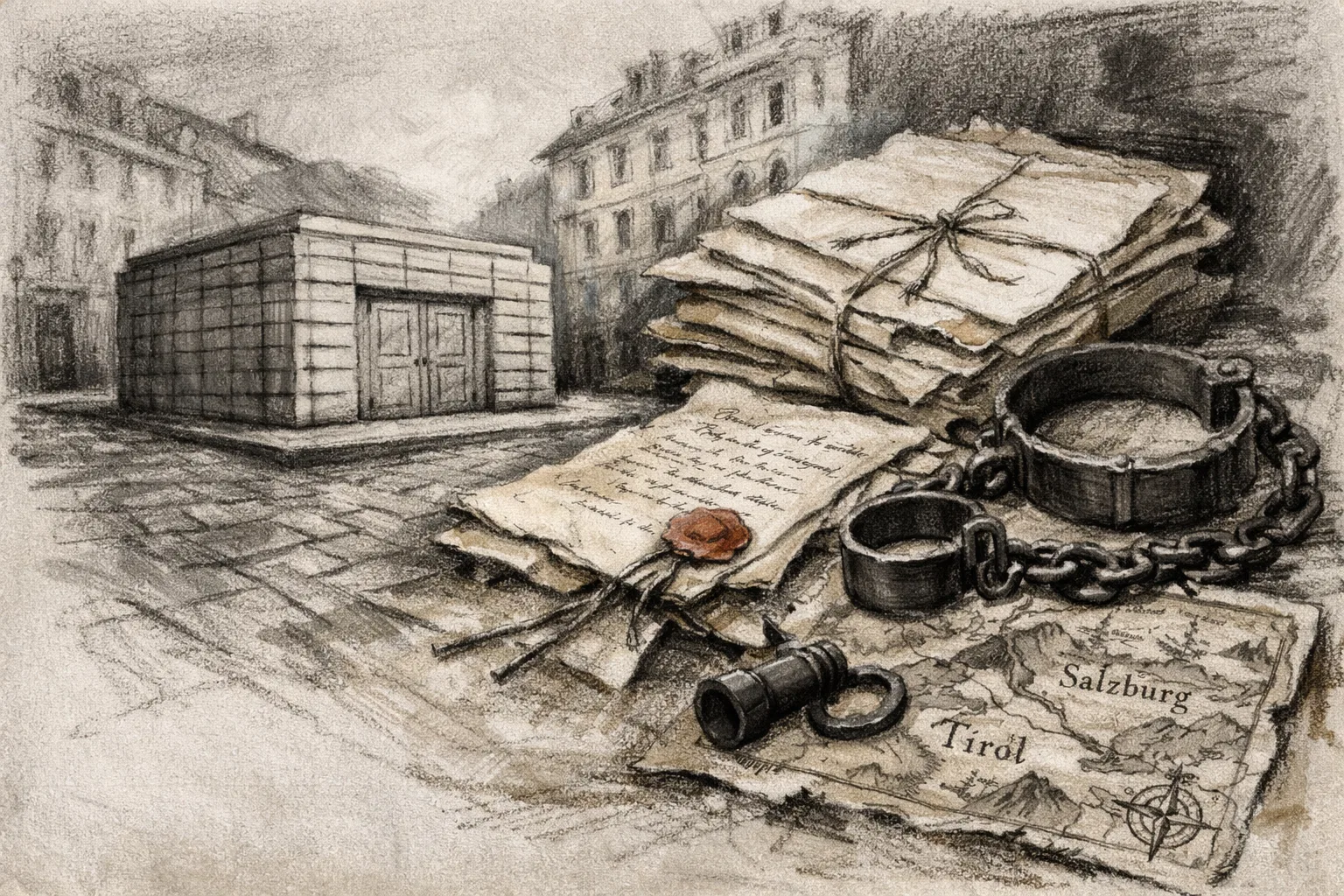
The most devastating medieval example was the persecution of Austria’s Jewish communities in 1420–21, commonly known as the Vienna Gesera. Duke Albert V ordered arrests and expulsions amid accusations that Jews had collaborated with the Hussites, desecrated the Christian Eucharist and committed ritual crimes. Vienna’s Jewish community was destroyed, its synagogue demolished and its surviving members expelled; about 200 Jewish men and women were reportedly burned, while hundreds of others were driven from Vienna and Lower Austria. The ruins of the medieval synagogue beneath Vienna’s Judenplatz are now preserved as material evidence of the community that was eliminated.[ikg-wien.at]ikg-wien.atabout the jewish community of viennaHorizonAbout the Jewish Community of Vienna17 Nov 2022 — The Vienna Gesera in 1421 brought the Jewish community in the Middle Ages to a t…
Host-desecration and ritual-murder stories belonged to a wider European tradition of antisemitic conspiracy beliefs. The “blood libel” falsely claimed that Jews murdered Christians for religious purposes, despite Judaism’s prohibition on consuming blood. Such tales spread because they converted social tension into a vivid narrative: an apparently ordinary minority was imagined to conceal monstrous rites. Austrian Jews faced versions of this accusation before the Vienna Gesera. In Krems in the late thirteenth century, for example, poorer Jews were tortured and executed after a ritual-crime allegation, while wealthier members of the community obtained protection through payment.[ushmm.org]encyclopedia.ushmm.orgHolocaust EncyclopediaBlood Libel: History and ImpactBlood Libels in the Middle Ages… The earliest references to blood libel charges a…
Calling these events a “panic” must not obscure the organised character of the violence. The stories may have circulated socially, but rulers and courts converted them into policy. Confiscated property and cancelled debts gave authorities and local beneficiaries material incentives, while religious language portrayed persecution as defence of Christian society. What began as rumour therefore became a state-directed assault on a vulnerable population.
The episode also illustrates why historians distinguish collective belief from collective delusion. People may sincerely have believed stories about sacrilege, but sincerity does not make an accusation evidentially sound. The surviving record points to inherited antisemitic mythology, political convenience and coercive punishment—not to a secret Jewish ritual conspiracy.
How witch fear took hold
Austria was not the largest centre of European witch-hunting, and prosecutions varied sharply between territories. Yet its history includes several unusually revealing cases: an early attempt to manufacture a witch panic in Innsbruck, the mass prosecution of poor young people in Salzburg, and the execution of a teenage servant shortly before Austrian rulers curtailed witch trials.
Innsbruck resisted an inquisitor
In 1485, the Dominican inquisitor Heinrich Kramer arrived in Innsbruck claiming authority to investigate witchcraft. He preached that destructive witches were active in the community, encouraged denunciations and prosecuted several women, including Helena Scheuberin. His case against her blended allegations of harmful magic with intrusive questions about sexual behaviour. A representative of the Bishop of Brixen objected that Kramer’s questioning was improper, and the proceedings collapsed rather than expanding into a large local hunt.[jstor.org]jstor.orgThe "Malleus Maleficarum" and the construction of witchcraftThe "Malleus Maleficarum" and the construction of witchcraft
The Innsbruck case matters because it reverses the popular image of an unstoppable medieval “witch craze”. Kramer attempted to create urgency, define an enemy and present himself as the expert able to uncover it. Local legal and church authorities nevertheless challenged his methods. Scheuberin’s prosecution shows that panics require more than a persuasive agitator: they also depend on institutions willing to accept his framework.
Kramer later became associated with a hugely influential demonological manual that portrayed witchcraft as an organised, largely female conspiracy against Christianity. The Innsbruck failure may have strengthened his determination to defend this worldview in print. Yet the trial record itself demonstrates that contemporaries were capable of rejecting both his evidence and his sexualised assumptions. Witch belief was widespread, but it was never uniform or uncontested.
Salzburg’s hunt for the “Sorcerer Jackl”
Austria’s most notorious witch prosecution began in the Prince-Archbishopric of Salzburg in 1675. After Barbara Koller was arrested for theft and sorcery, torture produced claims about her son, Jakob Koller, who became known as the “Sorcerer Jackl”. Authorities imagined him as the leader of a mobile band of beggars and young people trained in witchcraft, theft and service to the Devil. Although the supposedly central figure was never captured, denunciations and interrogations generated an expanding network of alleged accomplices.[academia.edu]academia.eduOpen source on academia.edu.
The Salzburg trials were unusual because most of those targeted were male, poor and young. Surviving accounts differ slightly over totals, but approximately 140 people were executed and close to 200 were arrested between 1675 and 1690. Many of the victims were beggars, itinerant labourers, adolescents or children. This was therefore not simply a campaign against stereotypical elderly female healers. It was also a drive against people regarded as disorderly, rootless and difficult to control.[academia.edu]academia.eduOpen source on academia.edu.
The imagined conspiracy grew through the machinery of prosecution. Torture encouraged prisoners to repeat the authorities’ language and name others. Each confession then appeared to confirm that the conspiracy was larger than previously thought. The inability to catch Jackl did not weaken the theory; it made him seem more elusive and powerful. In this kind of closed system, missing evidence could itself be interpreted as evidence of supernatural concealment.
Economic and social pressures helped make the story persuasive. War, hardship and changing attitudes towards organised begging increased hostility towards mobile poor people. Religious authorities in the Counter-Reformation state were also concerned with discipline, confession and doctrinal conformity. Demonology translated these everyday anxieties into a cosmic struggle: poverty became evidence of criminality, association became membership of a satanic network, and the vulnerability of children made them easier—not harder—to implicate.
The Salzburg episode is sometimes described as one of Europe’s final great witch hunts. Its lasting significance lies less in the number of executions than in the victims’ social profile. The trials reveal how a supernatural panic could function as a campaign of social cleansing against people already viewed as troublesome or disposable.
Maria Pauer and the late survival of witch prosecution
In 1749, Maria Pauer, a teenage domestic servant, was blamed for unexplained noises and moving objects in a household in Mühldorf, then under Salzburg rule. She was imprisoned and subjected to an exhaustive interrogation, reportedly involving hundreds of questions. Her mother and another woman were also drawn into the case. Pauer eventually confessed under conditions of prolonged confinement and was executed in Salzburg on 6 October 1750; her body was burned after beheading. She is generally identified as the last woman executed for witchcraft in territory that now forms Austria.[Wikipedia]WikipediaMaria PauerMaria Pauer
Pauer’s case appeared at a time when educated administrators were increasingly sceptical about witchcraft evidence. Historians caution, however, against telling a simple story in which enlightened rulers suddenly “cured” society of superstition. The end of witch trials involved changes in legal review, standards of proof, central state control and attitudes towards confession as much as a straightforward victory of reason over belief.[PubMed]pubmed.ncbi.nlm.nih.govOpen source on nih.gov.
In 2009, the Archbishop of Salzburg publicly described Pauer’s prosecution as a judicial killing and asked forgiveness for the Church’s part in it. That acknowledgement reflects a broader change in commemoration. Accused witches are increasingly remembered not as mysterious figures from folklore but as people destroyed by courts that converted hearsay, forced confession and unexplained misfortune into capital evidence.[Wikipedia]WikipediaMaria PauerMaria Pauer
A commune where the danger was real
Historical panics warn against believing dramatic accusations without proof. They do not mean that manipulative or abusive groups are imaginary. Austria’s Friedrichshof commune provides a crucial counterexample because serious harm was established through testimony and criminal proceedings.
The commune was founded in the 1970s by Viennese Actionist artist Otto Muehl. It rejected private property, conventional marriage and the nuclear family, while promoting communal living, collective child-rearing and sexual liberation. At its height, Friedrichshof attracted hundreds of residents. Supporters initially regarded it as an experiment in overcoming bourgeois repression; former members later described an increasingly hierarchical community centred on Muehl’s authority.[getty.edu]getty.eduOpen source on getty.edu.
The problem was not merely that the commune held unusual beliefs. Accounts of Friedrichshof describe a ranked social structure, compulsory or pressurised therapeutic practices and a leader who claimed special authority over personal relationships. Ideals of liberation could therefore be used to weaken privacy, family autonomy and the ability to refuse. The case demonstrates why eccentricity alone is a poor measure of danger: the relevant questions concern power, consent, accountability and the treatment of children.
In 1991, Muehl was sentenced to seven years in prison for sexual offences against minors and drug-related crimes. Reuters later described the convictions as involving rape and abuse of children living in the commune. Muehl issued an apology in 2010 acknowledging that he had abused his authority and violated young people, although earlier statements had minimised or denied responsibility.[getty.edu]getty.eduOpen source on getty.edu.
Friedrichshof is often labelled a “cult”, but the word can conceal as much as it reveals. It may suggest that the group’s alternative lifestyle or artistic ideology was itself the crime. A more precise description is an authoritarian commune in which concentrated power, sexual access and weak external oversight enabled abuse. That wording separates documented conduct from hostility towards unconventional communities in general.
The aftermath has also produced a dispute over cultural memory. Muehl remained an important figure in histories of Viennese Actionism, and Austrian museums continued to exhibit his work. Protests surrounding such exhibitions have asked whether institutions can present the art without marginalising those harmed by the artist and the community he controlled. The controversy is not a revival of irrational panic; it is a conflict over how evidence of abuse should alter public commemoration.[Art Newspaper]theartnewspaper.comanger as viennas new actionism museum shows child abusers artanger as viennas new actionism museum shows child abusers art
Why Austria created a state office for “sect” concerns
From the 1970s onwards, Western Europe experienced growing anxiety about new religious movements, alternative therapies and charismatic communities. Highly publicised tragedies involving groups elsewhere—alongside family disputes over conversion and fears of “brainwashing”—encouraged the idea that hidden organisations were recruiting and psychologically controlling ordinary people.
Austria developed an extensive network of church, private and public bodies offering information about groups described as “sects”. In 1998, legislation established the Federal Office for Sect Issues. Its official task is to collect information and advise the public where there is reason to suspect that a group or cult-like activity threatens legally protected interests. The office presents itself as non-denominational and concerned with harmful behaviour rather than the mere existence of an unconventional belief system.[Bundeskanzleramt Österreich]bundeskanzleramt.gv.atBundeskanzleramt Österreich Federal Office for Cult AffairsBundeskanzleramt Österreich Federal Office for Cult Affairs
This approach addresses a real need. Families may require informed help when someone is being financially exploited, isolated, threatened or subjected to coercive control. The Friedrichshof case shows the cost of assuming that every warning is prejudice. A public body can also provide an alternative to sensational media coverage or unqualified “deprogrammers”.
At the same time, Austria’s anti-sect system has drawn sustained criticism. Religious-liberty advocates and representatives of minority movements have argued that state-supported offices sometimes reproduce loaded categories, treat recognised churches more favourably than newer groups and damage reputations without establishing criminal wrongdoing. Reports submitted through bodies connected with the Organization for Security and Co-operation in Europe have accused Austria of maintaining an unusually dense anti-sect infrastructure and of fostering discrimination against minority religions. These submissions represent advocacy positions rather than neutral judicial findings, but they identify a genuine civil-liberties problem: an information service can become a source of stigma when its classifications are vague.[OSCE]cdn.osce.orgOpen source on osce.org.
Academic study of new religious movements generally avoids using “cult” as a catch-all explanation. The category can combine very different organisations: small esoteric circles, strict but non-violent religions, commercial self-help systems, authoritarian communes and groups responsible for serious crimes. Membership itself is not evidence of manipulation, and people join unfamiliar movements for many of the same reasons that they enter established religions or political organisations—community, meaning, identity, healing or dissatisfaction with ordinary life. Scholarly criticism of the “cult” label therefore does not require denying abuse. It asks that allegations be tested through specific evidence rather than inferred from unfamiliar theology.[univie.ac.at]rw-ktf.univie.ac.atInstitut für Religionswissenschaft Religion in AustriaInstitut für Religionswissenschaft Religion in Austria
A useful distinction is between belief-centred suspicion and conduct-centred assessment. Belief-centred suspicion asks whether a group seems strange, secretive or socially unpopular. Conduct-centred assessment asks whether leaders control members’ money, movement, medical care, sexual choices or contact with relatives; whether children are protected; whether consent is meaningful; and whether complaints can be raised without punishment. The second approach is better able to detect genuine danger without turning religious difference into presumed guilt.

What Austria’s cases teach us
Austria’s most important episodes do not support a simple claim that frightened societies periodically “go mad”. They show identifiable mechanisms through which fear acquires authority.
A hidden-enemy story simplifies disorder. Medieval ritual accusations explained religious conflict by imagining secret Jewish crimes. Witch prosecutions transformed illness, theft, poverty and unexplained household events into evidence of diabolical organisation. Modern anti-cult rhetoric can similarly present every unconventional movement as part of one method of psychological conquest.
Institutions determine whether fear becomes destructive. Heinrich Kramer failed in Innsbruck because other authorities challenged his procedure. The Salzburg prosecutions expanded because courts accepted torture-generated denunciations. The Vienna Gesera became catastrophic because a ruler turned inherited antisemitic mythology into coordinated state violence.
Interrogation can manufacture confirmation. Witch trials repeatedly produced the evidence they expected to find. Prisoners were asked questions based on demonological scripts, pressured to confess and required to identify accomplices. The resulting statements were treated as independent proof, even though they arose from the same coercive process.
Marginal people carry the greatest risk. Salzburg’s beggars and children, Maria Pauer as a young servant, and Vienna’s Jewish minority lacked the political power to resist accusations. Panic is rarely socially neutral: it follows existing lines of poverty, religion, gender, age and legal exclusion.
Real abuse requires precision, not disbelief. Friedrichshof warns against reacting to past moral panics by dismissing all allegations involving closed groups. The appropriate safeguard is evidence: named conduct, credible testimony, fair investigation and legal accountability. Broad labels are unreliable both ways. They can condemn innocent minorities, but they can also allow defenders of an abusive leader to portray every complaint as an attack on alternative culture.
Austria’s record is therefore best understood as a history of contested credibility. Who was believed—the frightened neighbour, the inquisitor, the accused woman, the child, the charismatic leader or the former member—often mattered as much as the original claim. The lasting lesson is not that extraordinary beliefs automatically produce violence. It is that violence becomes more likely when suspicion is rewarded, dissent is suppressed and institutions stop distinguishing accusation from proof.
Amazon book picks
Further Reading
Books and field guides related to When Fear Became Persecution in Austria. Use these as the next step if you want deeper reading beyond the article.


The Penguin book of witches
Introduces original sources on European witch persecutions.
Endnotes
1.
Source: wien.info
Link:https://www.wien.info/en/see-do/discover-vienna/jewish-vienna/museum-judenplatz-352772
Source snippet
Judenplatz ViennaOn display are the religious, cultural and social living conditions of Vienna's Jews in the Middle Ages, through to thei...
2.
Source: aejm.org
Link:https://www.aejm.org/site/wp-content/uploads/2014/07/Martha-Keil_Facts-Projections-Voids.-Milestones-of-Austrian-Jewish-History_Keynote-2012.pdf
Source snippet
MILESTONES OF AUSTRIAN JEWISH HISTORYViennese Gesera, disaster, of 1421. 200 wealthy Jews, men and women, were... As Felicitas Heima...
3.
Source: jstor.org
Title: The “Malleus Maleficarum” and the construction of witchcraft
Link:https://www.jstor.org/stable/j.ctt155jgrj
4.
Source: brill.com
Title: Document 11 Record of the Proceedings against
Link:https://brill.com/display/book/9789004423800/BP000023.xml?srsltid=AfmBOoryfuCpdlP5jlJWUtdV0VGPYXib0nN00WF8YIME8MSpQDpeUPfi
5.
Source: academia.edu
Link:https://www.academia.edu/9123656/Account_for_the_rise_of_witch_hunting_in_Salzburg_Austria_in_the_late_seventeenth_century
6.
Source: Wikipedia
Title: Zaubererjackl witch trials
Link:https://en.wikipedia.org/wiki/Zaubererjackl_witch_trials
7.
Source: Wikipedia
Title: Maria Pauer
Link:https://en.wikipedia.org/wiki/Maria_Pauer
8.
Source: getty.edu
Link:https://www.getty.edu/research/collections/collection/113YK3
9.
Source: Wikipedia
Title: Otto Muehl
Link:https://en.wikipedia.org/wiki/Otto_Muehl
10.
Source: reuters.com
Title: viennese artist and convicted paedophile otto muehl dies id USBRE94Q0CL
Link:https://www.reuters.com/article/world/viennese-artist-and-convicted-paedophile-otto-muehl-dies-idUSBRE94Q0CL/
11.
Source: cdn.osce.org
Link:https://cdn.osce.org/sites/default/files/f/documents/6/f/169031.pdf
12.
Source: cdn.osce.org
Link:https://cdn.osce.org/sites/default/files/f/documents/8/4/186876.pdf
13.
Source: odihr.osce.org
Link:https://odihr.osce.org/sites/default/files/f/documents/7/c/27023.pdf
14.
Source: Wikipedia
Title: Satanic panic
Link:https://en.wikipedia.org/wiki/Satanic_panic
15.
Source: Wikipedia
Title: List of mass panic cases
Link:https://en.wikipedia.org/wiki/List_of_mass_panic_cases
16.
Source: Wikipedia
Title: List of UFO religions
Link:https://en.wikipedia.org/wiki/List_of_UFO_religions
17.
Source: Wikipedia
Title: Witch trials in the early modern period
Link:https://en.wikipedia.org/wiki/Witch_trials_in_the_early_modern_period
18.
Source: Wikipedia
Title: Blood libel
Link:https://en.wikipedia.org/wiki/Blood_libel
19.
Source: Wikipedia
Title: Mass psychogenic illness
Link:https://en.wikipedia.org/wiki/Mass_psychogenic_illness
20.
Source: Wikipedia
Title: Freedom of religion in Austria
Link:https://en.wikipedia.org/wiki/Freedom_of_religion_in_Austria
21.
Source: Wikipedia
Title: Friedrichshof Commune
Link:https://en.wikipedia.org/wiki/Friedrichshof_Commune
22.
Source: Wikipedia
Title: List of satanic ritual abuse allegations
Link:https://en.wikipedia.org/wiki/List_of_satanic_ritual_abuse_allegations
23.
Source: Wikipedia
Title: Our Lady of Absam
Link:https://en.wikipedia.org/wiki/Our_Lady_of_Absam
24.
Source: Wikipedia
Title: Vienna Gesera
Link:https://en.wikipedia.org/wiki/Vienna_Gesera
25.
Source: Wikipedia
Title: Helena Scheuberin
Link:https://en.wikipedia.org/wiki/Helena_Scheuberin
26.
Source: 2021-2025.state.gov
Link:https://2021-2025.state.gov/reports/2017-report-on-international-religious-freedom/austria/
27.
Source: 2009-2017.state.gov
Link:https://2009-2017.state.gov/j/drl/rls/irf/2004/35439.htm
28.
Source: history.com
Title: what was satanic panic 1980s
Link:https://www.history.com/articles/what-was-satanic-panic-1980s
29.
Source: academia.edu
Link:https://www.academia.edu/21732719/Freedom_of_Religion_or_Belief_Anti_Sect_Movements_and_State_Neutrality_A_Case_Study_FECRIS
30.
Source: jstor.org
Link:https://www.jstor.org/stable/153669
31.
Source: jstor.org
Link:https://www.jstor.org/stable/44504013
32.
Source: encyclopedia.com
Title: ufo religions
Link:https://www.encyclopedia.com/environment/encyclopedias-almanacs-transcripts-and-maps/ufo-religions
33.
Source: youtube.com
Title: Jewish Vienna | VIENNA/NOW Tours
Link:https://www.youtube.com/watch?v=z_YNWzdqyG8
34.
Source: ikg-wien.at
Title: about the jewish community of vienna
Link:https://www.ikg-wien.at/en/about-the-jewish-community-of-vienna
Source snippet
HorizonAbout the Jewish Community of Vienna17 Nov 2022 — The Vienna Gesera in 1421 brought the Jewish community in the Middle Ages to a t...
35.
Source: geschichte.univie.ac.at
Link:https://geschichte.univie.ac.at/de/node/30987
Source snippet
Geschichte der Universität WienAnti-Semitism at the University of Vienna | 650 plus8 Nov 2024 — The early history of academic anti-Semiti...
36.
Source: encyclopedia.ushmm.org
Link:https://encyclopedia.ushmm.org/content/en/article/blood-libel
Source snippet
Holocaust EncyclopediaBlood Libel: History and ImpactBlood Libels in the Middle Ages... The earliest references to blood libel charges a...
37.
Source: history.washu.edu
Title: career medieval accusation age science
Link:https://history.washu.edu/news/career-medieval-accusation-age-science
Source snippet
Department of HistoryThe Career of a Medieval Accusation in an Age of Science13 Apr 2020 — Students of Jewish-Christian relations in the...
38.
Source: streetroots.org
Title: sorcerer jackl
Link:https://www.streetroots.org/culture/2021/10/06/sorcerer-jackl/
39.
Source: ingrids-block.at
Title: Witch hunts
Link:https://ingrids-block.at/en/news/die-hexenjagd/
40.
Source: pubmed.ncbi.nlm.nih.gov
Link:https://pubmed.ncbi.nlm.nih.gov/21180204/
41.
Source: theartnewspaper.com
Title: anger as viennas new actionism museum shows child abusers art
Link:https://www.theartnewspaper.com/2024/04/29/anger-as-viennas-new-actionism-museum-shows-child-abusers-art
42.
Source: bundeskanzleramt.gv.at
Title: Bundeskanzleramt Österreich Federal Office for Cult Affairs
Link:https://www.bundeskanzleramt.gv.at/en/agenda/youth/counselling-and-information/federal-office-on-sect-issues.html
43.
Source: parliament.vic.gov.au
Title: federal office of cult affairs austria presentation
Link:https://www.parliament.vic.gov.au/48e69f/contentassets/a605b091def14f808b6278b32eee6b1b/federal-office-of-cult-affairs-austria_presentation.pdf
44.
Source: rw-ktf.univie.ac.at
Title: Institut für Religionswissenschaft Religion in Austria
Link:https://rw-ktf.univie.ac.at/fileadmin/user_upload/i_religionswiss/RiA3Review_Pokorny_3__Mayer.pdf
45.
Source: europarl.europa.eu
Title: European Parliament Cults in Europe
Link:https://www.europarl.europa.eu/workingpapers/cito/w10/page1_en.htm
46.
Source: pace.coe.int
Link:https://pace.coe.int/files/11521/html
47.
Source: researchers.mq.edu.au
Title: satans empire the panic over ritual abuse in australia
Link:https://researchers.mq.edu.au/en/publications/satans-empire-the-panic-over-ritual-abuse-in-australia/
48.
Source: pursuit.unimelb.edu.au
Title: unimelb.edu.au The book that taught us to think of witches as women
Link:https://pursuit.unimelb.edu.au/articles/the-book-that-taught-us-to-think-of-witches-as-women
49.
Source: pmc.ncbi.nlm.nih.gov
Link:https://pmc.ncbi.nlm.nih.gov/articles/PMC3536509/
50.
Source: facebook.com
Link:https://www.facebook.com/groups/437670709576932/posts/25053230900927571/
Additional References
51.
Source: spotlight.anumuseum.org.il
Link:https://spotlight.anumuseum.org.il/austria/middle-ages/persecution/
Source snippet
Jewish SpotlightPersecution | Jewish Communities of AustriaBlood Libel Although Papal bulls and Christian authorities tried to protect th...
52.
Source: youtube.com
Title: Vienna: A Jewish story of resilience and rupture
Link:https://www.youtube.com/watch?v=QCNZpXaksc8
Source snippet
2 «Zauberbubenprozesse» | Die Kindermorde von Salzburg...
53.
Source: gei.de
Link:https://www.gei.de/fileadmin/gei.de/pdf/publikationen/Schriftenreihe/fulltext/SRfulltext124.pdf
54.
Source: historysnob.com
Link:https://www.historysnob.com/war-and-historical-events/20-chilling-cases-mass-hysteria-throughout-history
55.
Source: researchgate.net
Link:https://www.researchgate.net/publication/313714001_Apocalypse_in_Early_UFO_and_Alien-Based_Religions_Christian_and_Theosophical_Themes
56.
Source: foref-europe.org
Link:https://foref-europe.org/blog/category/anti-cult-movement/
57.
Source: worldjewishcongress.org
Link:https://www.worldjewishcongress.org/en/about/communities/AT
58.
Source: reddit.com
Link:https://www.reddit.com/r/AskHistorians/comments/12jvlg0/did_people_actually_worry_about_the_occult_during/
59.
Source: reddit.com
Link:https://www.reddit.com/r/exjw/comments/1j12yzm/doomsday_cults_through_the_centuries/
60.
Source: facebook.com
Link:https://www.facebook.com/newsroomgy/posts/over-20-schoolgirls-from-the-dora-secondary-school-on-the-soesdyke-linden-highwa/2655988208011529/
Topic Tree
Follow this branch
Related pages 192
- Antigua and Barbuda
- Argentina Belief Scares
- Azerbaijan Belief
- Bahrain Beliefs
- North Korea
- +187 more in sidebar