Within Vincentian Panics
Was the Shaker Scare Really Mass Hysteria?
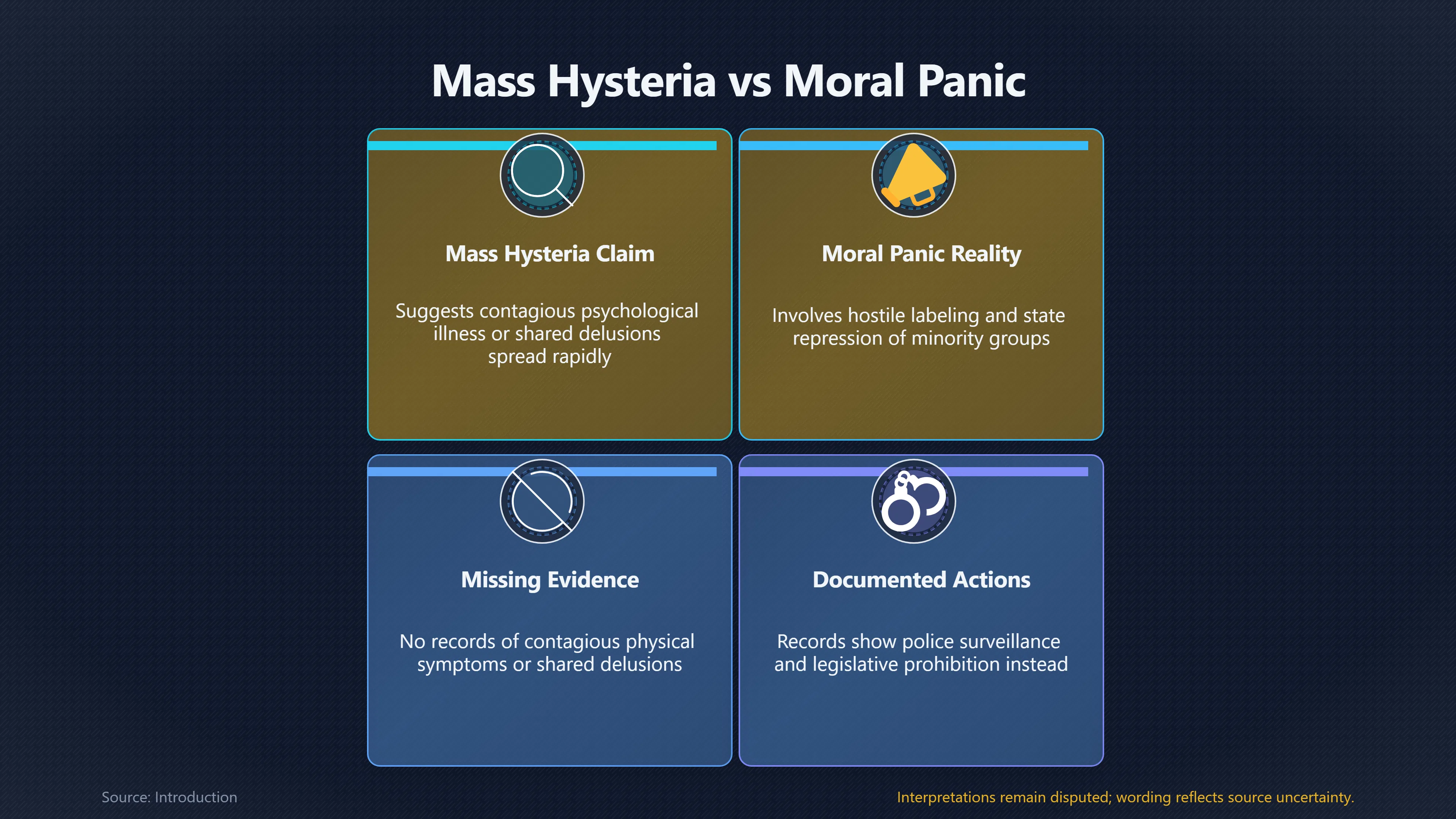
The Shaker controversy was a state-led moral panic, not a documented outbreak of contagious illness or shared delusion.
On this page
- What mass hysteria would require
- Why the Shaker campaign fits moral panic better
- Race, class and colonial ideas of respectable religion
Page outline Jump by section
Introduction
The historical evidence from Saint Vincent and the Grenadines points much more strongly to a moral panic than to an episode of mass hysteria. The best-known case is the colonial campaign against the religious community then known as the Shakers, today generally called the Spiritual Baptists. Officials, missionaries and sections of the colonial elite portrayed their worship as a danger to public order, morality and civilisation, leading to legal prohibition in 1912. What is missing from the historical record is equally important: there is no convincing evidence of a population-wide outbreak of contagious psychological illness, shared delusions or unexplained physical symptoms. Instead, the available evidence shows a sustained process of hostile labelling, racialised assumptions and state repression directed at a minority religious movement.[gla.ac.uk]gla.ac.ukUniversity of GlasgowUniversity of Glasgow - Schools - School of Humanities | Sgoil nan Daonnachdan - Research in the School of Humanitie…
Was the Shaker Scare Really Mass Hysteria?
The answer is probably not, at least according to the way historians, psychologists and sociologists use the term.
Mass hysteria—more accurately described today as mass psychogenic illness when physical symptoms are involved—normally requires evidence that people rapidly developed shared beliefs or symptoms through social contagion rather than through an identifiable external cause. Classic examples involve schools, factories or communities where unexplained fainting, paralysis or panic spread from person to person without a corresponding physical illness.
The Vincentian case does not resemble that pattern. Contemporary records describe officials, clergy and newspapers condemning the movement’s worship, while members themselves consistently understood shaking, trance, visions and spirit possession as accepted parts of their Christian religious experience rather than involuntary illness or collective delusion. The conflict lay between competing interpretations of the same behaviour, not between reality and a psychologically contagious false belief.[gla.ac.uk]gla.ac.ukUniversity of GlasgowUniversity of Glasgow - Schools - School of Humanities | Sgoil nan Daonnachdan - Research in the School of Humanitie…
Nor is there evidence that wider Vincentian society suddenly came to believe an impossible claim through contagious fear. Instead, colonial authorities gradually developed and reinforced a narrative that the movement threatened respectable society, eventually translating that narrative into legislation.
What Mass Hysteria Would Require
If historians were describing the Shaker controversy as mass hysteria, the documentary record would normally contain evidence such as:
- widespread unexplained physical illness spreading through communities;
- rapidly shared delusional beliefs detached from ordinary political or religious disputes;
- psychological contagion affecting participants regardless of prior religious commitment;
- medical investigations identifying no underlying social or legal conflict but suggesting psychogenic transmission.
Those features are largely absent from the surviving evidence.
Instead, the surviving sources focus on investigations, prosecutions, missionary criticism, police surveillance and legislation. The central issue was whether expressive Afro-Caribbean Christianity should be recognised as legitimate religion or suppressed as disorderly behaviour. That is a political and cultural conflict rather than a documented outbreak of collective psychological illness.[gla.ac.uk]gla.ac.ukUniversity of GlasgowUniversity of Glasgow - Schools - School of Humanities | Sgoil nan Daonnachdan - Research in the School of Humanitie…

Why the Campaign Fits Moral Panic Better
The concept of moral panic describes situations in which authorities or influential groups portray a practice or minority as posing a disproportionate threat to society’s values, requiring exceptional control.
Several features of the Vincentian campaign fit this model.
First, ordinary religious practices were reinterpreted as evidence of danger. Worship involving rhythmic movement, shaking, drumming, visions and spirit possession was presented by critics as proof of irrationality, immorality or social disorder rather than understood within the movement’s own theology. Methodist reports, for example, described the movement using language of insanity, delusion and superstition.[University of Glasgow]gla.ac.ukUniversity of GlasgowUniversity of Glasgow - Schools - School of Humanities | Sgoil nan Daonnachdan - Research in the School of Humanitie…
Second, a public inquiry reportedly concluded that the Shakers should not be recognised as a religion but treated as a public nuisance. That judgement shifted disagreement over worship into the sphere of policing and criminal law. The resulting Shakerism Prohibition Ordinance of 1912 authorised prosecution of practitioners, with penalties including fines, imprisonment and hard labour.[University of Glasgow]gla.ac.ukUniversity of GlasgowUniversity of Glasgow - Schools - School of Humanities | Sgoil nan Daonnachdan - Research in the School of Humanitie…
Third, the legal response exceeded the handling of ordinary public-order complaints. Rather than relying on general laws against noise or disorderly conduct, colonial authorities enacted legislation specifically targeting one religious community. Later colonies adopted closely related legislation, demonstrating how official perceptions of danger travelled through the British Caribbean.[gla.ac.uk]gla.ac.ukUniversity of GlasgowUniversity of Glasgow - Schools - School of Humanities | Sgoil nan Daonnachdan - Research in the School of Humanitie…
Finally, later historical research has generally interpreted the campaign as part of wider colonial efforts to define which forms of worship counted as “proper” religion and which could be dismissed as superstition or disorder.[University of Edinburgh Research]research.ed.ac.ukUniversity of Edinburgh ResearchObeah acts: Producing and policing the boundaries of religion in the Caribbean - University of Edinburgh…
Race, Class and Colonial Ideas of Respectable Religion
Understanding why the panic developed requires looking beyond religion alone.
The movement emerged among Black Vincentians whose forms of worship combined Christianity with African-Caribbean religious traditions. Their services included emotional prayer, bodily movement, healing, dreams and spirit-led practices that differed sharply from the restrained worship favoured by colonial officials and established Protestant churches.[University of Glasgow]gla.ac.ukUniversity of GlasgowUniversity of Glasgow - Schools - School of Humanities | Sgoil nan Daonnachdan - Research in the School of Humanitie…
These differences became entangled with colonial assumptions about civilisation, race and class. African-derived religious expression was often associated with “superstition”, “primitive” customs or disorder, while European forms of Christianity were treated as the norm against which legitimacy was measured.
Scholars examining anti-obeah legislation and the Shaker prohibition argue that colonial governments actively created legal boundaries separating recognised religion from practices labelled as magic, superstition or witchcraft. This process was not merely descriptive; it helped justify unequal treatment under colonial law and reinforced ideas that Afro-Caribbean culture required regulation.[University of Edinburgh Research]research.ed.ac.ukUniversity of Edinburgh ResearchObeah acts: Producing and policing the boundaries of religion in the Caribbean - University of Edinburgh…
The label “Shaker” itself illustrates this process. Although followers often referred to themselves as the Converted, colonial authorities preserved the outsider’s label in legislation, while later generations increasingly adopted the name Spiritual Baptist as part of the struggle for religious recognition.[WorldCat]search.worldcat.orgOpen source on worldcat.org.

Why This Distinction Matters
Calling the episode “mass hysteria” risks implying that participants themselves were victims of psychological contagion or irrational collective belief.
The historical evidence supports a different interpretation.
The Spiritual Baptists were practising an identifiable religious tradition with established rituals and beliefs. The extraordinary claims about danger came primarily from external observers—colonial officials, missionaries and sections of the press—rather than from a psychologically contagious movement within the wider population. Their worship was controversial because it challenged prevailing ideas of respectable religion, authority and social order, not because it produced a documented epidemic of delusion or unexplained illness.[gla.ac.uk]gla.ac.ukUniversity of GlasgowUniversity of Glasgow - Schools - School of Humanities | Sgoil nan Daonnachdan - Research in the School of Humanitie…
For that reason, historians generally find the language of moral panic, religious persecution and colonial social control far more useful than the language of mass hysteria when explaining the Shaker controversy in Saint Vincent and the Grenadines. The episode remains significant because it demonstrates how governments can transform cultural anxiety into legal repression, especially where race, class and religious difference intersect.[ed.ac.uk]research.ed.ac.ukUniversity of Edinburgh ResearchObeah acts: Producing and policing the boundaries of religion in the Caribbean - University of Edinburgh…
Amazon book picks
Further Reading
Books and field guides related to Was the Shaker Scare Really Mass Hysteria?. Use these as the next step if you want deeper reading beyond the article.
Extraordinary Popular Delusions and the Madness of Crowds
Rating: 4.0/5 from 5 Google Books ratings
Provides historical context for claims about collective irrationality.

Folk devils and moral panics
Explains moral panic, the central framework for interpreting the Shaker scare.
Endnotes
1.
Source: academic.oup.com
Link:https://academic.oup.com/book/49720/chapter/422514862
Source snippet
OUP AcademicComparative History of the Converted Religion | Journeys to the Spiritual Lands: The Natural History Of A West Indian Religio...
2.
Source: search.worldcat.org
Link:https://search.worldcat.org/title/Against-toleration-%3A-Britain%27s-persecution-of-the-Spiritual-Baptists/oclc/1437986173
3.
Source: academic.oup.com
Link:https://academic.oup.com/tcbh/article-abstract/32/3/371/5859195
Source snippet
1968–9 | Modern British History | Oxford AcademicJune 18, 2020 — Journal Article MORAL PANIC IN THE INDUSTRIAL TOWN: TEENAGE ‘DEVIANCY’ A...
Published: June 18, 2020
4.
Source: academic.oup.com
Title: isbn 9780195128451 book part 10
Link:https://academic.oup.com/book/49720/chapter/422514862/chapter-pdf/52528245/isbn-9780195128451-book-part-10.pdf
5.
Source: academic.oup.com
Link:https://academic.oup.com/book/49720/chapter-abstract/422514862
6.
Source: gla.ac.uk
Link:https://www.gla.ac.uk/schools/humanities/research/historyresearch/researchprojects/grenadaheritage/banningthespiritualbaptistfaith/
Source snippet
University of GlasgowUniversity of Glasgow - Schools - School of Humanities | Sgoil nan Daonnachdan - Research in the School of Humanitie...
7.
Source: research.ed.ac.uk
Link:https://www.research.ed.ac.uk/en/publications/obeah-acts-producing-and-policing-the-boundaries-of-religion-in-t/
Source snippet
University of Edinburgh ResearchObeah acts: Producing and policing the boundaries of religion in the Caribbean - University of Edinburgh...
8.
Source: gla.ac.uk
Title: University of Glasgow
Link:https://www.gla.ac.uk/schools/humanities/research/historyresearch/researchprojects/grenadaheritage/
9.
Source: gla.ac.uk
Title: University of Glasgow
Link:https://www.gla.ac.uk/myglasgow/equalitydiversity/students/faith/
10.
Source: gla.ac.uk
Title: University of Glasgow
Link:https://www.gla.ac.uk/myglasgow/equalitydiversity/staff/faith/
11.
Source: gla.ac.uk
Title: University of Glasgow
Link:https://www.gla.ac.uk/subjects/theology/
Additional References
12.
Source: researchgate.net
Title: Research Gate(PDF) The Spiritual Baptist Religion
Link:https://www.researchgate.net/publication/333159626_The_Spiritual_Baptist_Religion
Source snippet
(PDF) The Spiritual Baptist ReligionMay 16, 2019 — Article PDF Available THE SPIRITUAL BAPTIST RELIGION * April 2019 * Caribbean Quarterl...
Published: May 16, 2019
13.
Source: cambridge.org
Link:https://www.cambridge.org/core/journals/studies-in-church-history/article/welfare-state-within-the-state-the-saint-vincent-de-paul-society-in-glasgow-18481920/8AA9F973CF655E88859D118F479EB313
Source snippet
The Welfare State within the State: The Saint Vincent de Paul Society in Glasgow, 1848–1920 | Studies in Church History | Cambridge CoreM...
14.
Source: obeahhistories.org
Title: shouters prohibition ordinance
Link:https://obeahhistories.org/shouters-prohibition-ordinance/
Source snippet
Obeah HistoriesShouters Prohibition Ordinance Trinidad 1917 | Obeah Histories...
15.
Source: newbeaconbooks.com
Link:https://www.newbeaconbooks.com/caribbean-fiction/from-shakers-to-spiritual-baptists-the-struggle-for-survival-of-the-shakers-of-st-vincent-and-the-grenadines
16.
Source: thevincentian.com
Link:https://thevincentian.com/from-shakers-to-spiritual-baptists-p26424-112.htm
17.
Source: georgetownsvgrevisited.co.uk
Link:https://www.georgetownsvgrevisited.co.uk/religions.php
18.
Source: nalis.gov.tt
Link:https://www.nalis.gov.tt/resources/tt-content-guide/baptist-liberation-day/
19.
Source: youtube.com
Title: 25 Cases of Mass Hysteria That Defy Explanation
Link:https://www.youtube.com/watch?v=Js8pYoFJZj0
Source snippet
When the '80s Thought EVERYTHING Was Satanic...
20.
Source: youtube.com
Title: Moral Panics (SOCIOLOGY)
Link:https://www.youtube.com/watch?v=cgku2eurXac
Source snippet
25 Cases of Mass Hysteria That Defy Explanation...
21.
Source: youtube.com
Title: When the ’80s Thought EVERYTHING Was Satanic
Link:https://www.youtube.com/watch?v=r6NojB9f87M
Source snippet
Spiritual Baptist from St Vincent...
Topic Tree