Within South Africa
How Witchcraft Accusations Become Collective Violence
Witchcraft accusations can turn illness, death and family conflict into collective certainty, persecution and lethal violence.
On this page
- Who is accused and why
- How suspicion becomes public certainty
- Belief, violence and legal protection
Page outline Jump by section
Introduction
Witchcraft accusations in South Africa are not simply expressions of supernatural belief. They are a social mechanism through which unexplained illness, sudden death, failed harvests, financial hardship or family conflict can be transformed into certainty about who is to blame. In some communities, these accusations have led to intimidation, banishment, assault and murder, particularly against older women. At the same time, millions of South Africans distinguish clearly between respect for traditional healing and the harmful practice of publicly accusing neighbours of causing misfortune through witchcraft. Modern law reflects that distinction by treating accusations that incite violence as a serious public safety issue rather than validating claims of supernatural guilt.[journals.co.za]journals.co.zaWitchcraft and witchcraft-related violence in AmaZizi chiefdom of kwaZangashe, Eastern Cape | HTS: Theological StudiesJune 22, 2022…
Rather than asking whether witchcraft is “real”, historians, sociologists and legal scholars examine how accusations spread, why particular people become targets, and how fear hardens into collective action. This approach helps explain why periods of economic stress, bereavement or social change can produce outbreaks of persecution even when no objective evidence exists against those accused.
Who is accused and why?
In South Africa, accusations rarely arise at random. They usually emerge after a community experiences a misfortune that demands an explanation but lacks an obvious cause. The death of a child, repeated illness, livestock losses, unemployment, relationship breakdown or unexpected prosperity may all trigger rumours that someone is secretly responsible through supernatural means.[Journals.co.za]journals.co.zaWitchcraft and witchcraft-related violence in AmaZizi chiefdom of kwaZangashe, Eastern Cape | HTS: Theological StudiesJune 22, 2022…
Research across rural communities has identified several recurring patterns.
- Older women are especially vulnerable. Widows, women living alone, or elderly people with limited family protection are frequently accused, partly because age-related illness, dementia or unusual behaviour can be interpreted through existing beliefs about witchcraft rather than medical explanations.[ResearchGate]researchgate.netOpen source on researchgate.net.
- Social outsiders become convenient targets. Individuals who are poor, socially isolated, childless, disabled or involved in long-running disputes may be viewed with suspicion.
- Personal grievances become supernatural claims. Jealousy over land, inheritance, employment, business success or family disagreements can be reframed as evidence that a rival has acquired wealth or influence through occult means.
- Periods of uncertainty increase vulnerability. Communities facing poverty, unemployment or rapid social change may become more receptive to explanations that identify a human agent behind otherwise uncontrollable events.[ResearchGate]researchgate.netOpen source on researchgate.net.
Researchers emphasise that these accusations are social judgements rather than evidence-based investigations. Interview studies consistently report that alleged witches are rarely confronted with verifiable proof of wrongdoing.[ResearchGate]researchgate.netOpen source on researchgate.net.
How suspicion becomes public certainty
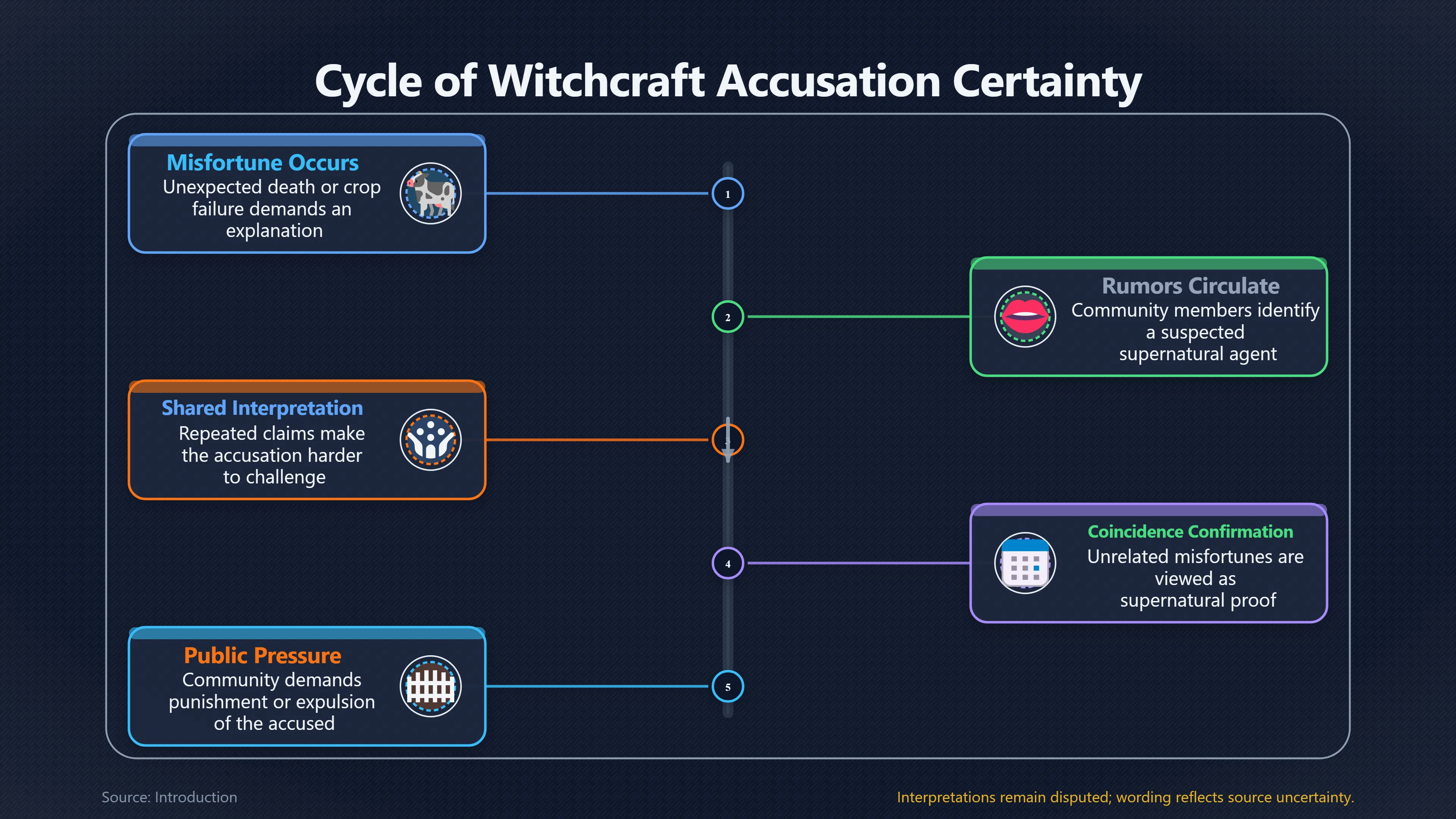
A defining feature of witchcraft accusations is that ordinary uncertainty gradually becomes shared certainty.
The process often begins with an unexpected event—a death after illness, repeated crop failure or a run of family tragedies. Friends and relatives search for meaning, and rumours begin circulating that someone has been seen behaving suspiciously, possesses unusual knowledge or has a history of conflict with the affected family.
Once several respected community members repeat the same explanation, the accusation can become increasingly difficult to challenge. Every unrelated misfortune appears to confirm the original claim, while contradictory evidence is dismissed as deception or further proof of hidden supernatural power.
This creates a self-reinforcing cycle:
- A serious misfortune demands explanation.
- Rumours identify a suspected witch.
- More people repeat the accusation.
- Everyday coincidences are interpreted as confirmation.
- Public pressure builds for punishment or expulsion.
- Violence becomes framed as community protection rather than criminal behaviour.
Social scientists note that this resembles other forms of collective blame. The important mechanism is not shared hallucination but shared interpretation: once a community agrees on a cause, alternative explanations become increasingly difficult to accept.[Journals.co.za]journals.co.zaWitchcraft and witchcraft-related violence in AmaZizi chiefdom of kwaZangashe, Eastern Cape | HTS: Theological StudiesJune 22, 2022…
Why rumours can become violence
The most dangerous stage occurs when accusation is treated as established fact.
Victims may be publicly shamed, forced from their homes, have their property destroyed or face physical attack. Some are killed by relatives or neighbours who believe they are removing the source of continued misfortune. In other cases, fear of becoming the next target discourages witnesses from defending the accused.
Studies from the Eastern Cape and other rural areas describe elderly women living under constant fear, avoiding social gatherings and limiting everyday activities because ordinary misunderstandings can suddenly escalate into allegations of witchcraft. Verbal abuse and social isolation often precede physical violence.[Journals.co.za]journals.co.zaWitchcraft and witchcraft-related violence in AmaZizi chiefdom of kwaZangashe, Eastern Cape | HTS: Theological StudiesJune 22, 2022…
Researchers also caution against assuming that everyone in these communities accepts the accusations. Many neighbours reject violence, traditional leaders often disagree among themselves, and families may be divided over whether accusations should be believed at all. The conflict therefore reflects competing interpretations within communities rather than unanimous acceptance of supernatural claims.[Journals.co.za]journals.co.zaWitchcraft and witchcraft-related violence in AmaZizi chiefdom of kwaZangashe, Eastern Cape | HTS: Theological StudiesJune 22, 2022…
Belief, traditional healing and misunderstanding
One common misunderstanding is that belief in traditional healing automatically leads to witchcraft accusations.
In reality, these are distinct issues.
Traditional healers occupy recognised cultural roles in many South African communities and may provide herbal medicine, counselling or spiritual guidance. Publicly accusing another person of secretly causing illness or death through witchcraft is something different, and many traditional healers reject violence carried out in the name of identifying witches. Legal and scholarly debates have long distinguished between recognising traditional health practices and preventing accusations that endanger lives.[NWU Repository]repository.nwu.ac.zaNWU RepositoryIs the Traditional Health Practitioners Act (No 22 of 2007) in conflict with the Witchcraft Suppression Act (No 3 of 1957)…
Modern researchers therefore avoid treating African belief systems as inherently violent. Instead, they focus on the social conditions that make accusations persuasive, including poverty, grief, inequality, weak trust in institutions and unresolved family conflict.[Journals.co.za]journals.co.zaWitchcraft and witchcraft-related violence in AmaZizi chiefdom of kwaZangashe, Eastern Cape | HTS: Theological StudiesJune 22, 2022…
Legal protection and the state’s response
South African law has increasingly treated witchcraft accusations as a matter of protecting victims rather than endorsing supernatural claims.
Historically, the Witchcraft Suppression Act of 1957 criminalised various activities connected with accusing people of witchcraft or presenting oneself as possessing certain supernatural powers. Although parts of the legislation have been criticised as outdated and inconsistent with constitutional protections for religious freedom and cultural practice, its provisions against publicly identifying someone as a witch reflected a practical concern: such accusations could lead directly to assault or murder. Reform debates have centred on preserving protection for victims while removing provisions seen as discriminatory towards legitimate traditional religious or healing practices.[NWU Repository]repository.nwu.ac.zaNWU RepositoryIs the Traditional Health Practitioners Act (No 22 of 2007) in conflict with the Witchcraft Suppression Act (No 3 of 1957)…
Academic studies and interviews with victims argue that legal protection remains uneven in practice. Elderly women interviewed in rural communities frequently reported feeling that authorities did not always intervene quickly enough to prevent intimidation or repeated harassment. Researchers recommend stronger policing, community education and greater support for vulnerable older people.[ResearchGate]researchgate.netOpen source on researchgate.net.
Why this pattern remains important
Witchcraft accusations remain an important part of South Africa’s history of collective fear because they reveal how communities cope with uncertainty. Rather than accepting that illness, death or economic hardship may have complex or unknown causes, people under intense pressure sometimes seek a morally satisfying explanation centred on an identifiable individual.
The pattern is significant not because it demonstrates supernatural forces, but because it demonstrates the power of collective belief to reshape social relationships. Once a neighbour becomes seen as the cause of misfortune, ordinary legal standards of evidence can be displaced by rumour, repetition and community pressure.
For historians and social scientists, this makes witchcraft accusations one of the clearest examples of how the search for blame can transform private suspicion into public certainty—and, in the worst cases, into persecution and lethal violence.[journals.co.za]journals.co.zaWitchcraft and witchcraft-related violence in AmaZizi chiefdom of kwaZangashe, Eastern Cape | HTS: Theological StudiesJune 22, 2022…
Amazon book picks
Further Reading
Books and field guides related to How Witchcraft Accusations Become Collective Violence. Use these as the next step if you want deeper reading beyond the article.
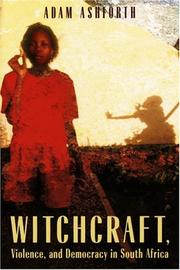
Witchcraft, Violence, and Democracy in South Africa
Direct examination of witchcraft accusations and violence.
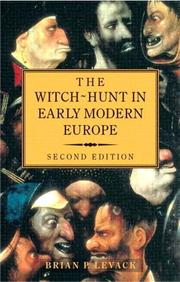
The witch-hunt in early modern Europe
Helps readers compare persecution patterns across societies.

Endnotes
1.
Source: journals.co.za
Link:https://journals.co.za/doi/10.4102/hts.v78i3.7108
Source snippet
Witchcraft and witchcraft-related violence in AmaZizi chiefdom of kwaZangashe, Eastern Cape | HTS: Theological StudiesJune 22, 2022...
Published: June 22, 2022
2.
Source: researchgate.net
Link:https://www.researchgate.net/publication/361115474_The_lived_experiences_of_elderly_women_accused_of_witchcraft_in_a_rural_community_in_South_Africa
3.
Source: journals.co.za
Link:https://journals.co.za/doi/10.17159/sacq.n74.21358
Source snippet
Custom, culture and crime: A restorative justice response to culturally motivated crimes in South Africa: SA Crime Quarterly: Vol 2025, N...
4.
Source: journals.co.za
Link:https://journals.co.za/doi/pdf/10.10520/EJC53585
5.
Source: journals.co.za
Link:https://journals.co.za/doi/10.10520/EJC27417
6.
Source: repository.nwu.ac.za
Link:https://repository.nwu.ac.za/items/8c9178da-3816-4f81-9f50-bc089e500abc
Source snippet
NWU RepositoryIs the Traditional Health Practitioners Act (No 22 of 2007) in conflict with the Witchcraft Suppression Act (No 3 of 1957)...
7.
Source: hrw.org
Title: south africa
Link:https://www.hrw.org/world-report/2026/country-chapters/south-africa
8.
Source: hrw.org
Title: south africa
Link:https://www.hrw.org/world-report/2024/country-chapters/south-africa
Additional References
9.
Source: cambridge.org
Link:https://www.cambridge.org/core/journals/international-journal-of-legal-information/article/witchcraft-accusations-and-the-tort-of-defamation-in-anglophone-africa/22930E9DEDD422B529CE891441433B33
Source snippet
April 3, 2024 — WITCHCRAFT ACCUSATIONS AND THE TORT OF DEFAMATION IN ANGLOPHONE AFRICA Published online by Cambridge University Press: 03...
Published: April 3, 2024
10.
Source: journals.ac.za
Link:https://www.journals.ac.za/index.php/pins/article/view/6618
Source snippet
July 6, 2024 — “BURN THE WITCH”: THE IMPACT OF THE FEAR OF WITCHCRAFT ON SOCIAL COHESION IN SOUTH AFRICA AUTHORS * Yaseen Ally Nelson Man...
Published: July 6, 2024
11.
Source: paganrightsalliance.org
Title: a legal review of south africas 1957 witchcraft suppression act 2007 2025
Link:https://paganrightsalliance.org/a-legal-review-of-south-africas-1957-witchcraft-suppression-act-2007-2025/
Source snippet
A legal review of South Africa’s 1957 Witchcraft Suppression Act (2007 – 2025) – South African Pagan Rights AllianceOctober 9, 2025 — It...
Published: October 9, 2025
12.
Source: hrw.org
Title: south africa compounds legacy apartheid older people
Link:https://www.hrw.org/report/2023/06/27/government-failing-me-too/south-africa-compounds-legacy-apartheid-older-people
Source snippet
“This Government is Failing Me Too”: South Africa Compounds Legacy of Apartheid for Older People | HRWJune 27, 2023 — Image: Nozala Ndoya...
Published: June 27, 2023
13.
Source: youtube.com
Link:https://www.youtube.com/watch?v=jClhOegbedo
Source snippet
Witch-Hunting in Modern South Africa with Damon Leff...
14.
Source: youtube.com
Title: Killing of women accused of witchcraft in the E Cape worrying
Link:https://www.youtube.com/watch?v=wcNb0q1_9LE
Source snippet
Calls for Dementia education following murder in Kimberley...
15.
Source: youtube.com
Title: Calls for Dementia education following murder in Kimberley
Link:https://www.youtube.com/watch?v=1xafOHeBuHI
Source snippet
SOUTH AFRICA: WITCHES HAVE BECOME VICTIMS OF VIOLENT CRIMES...
16.
Source: youtube.com
Title: Witch-Hunting in Modern South Africa with Damon Leff
Link:https://www.youtube.com/watch?v=1ZbJt9xUzEo
Source snippet
Killing of women accused of witchcraft in the E Cape worrying...
17.
Source: scielo.org.za
Link:https://scielo.org.za/scielo.php?pid=S1015-60462015000200003&script=sci_abstract&tlng=en
18.
Source: scielo.org.za
Link:https://scielo.org.za/scielo.php?pid=S2305-08532015000300012&script=sci_arttext
Topic Tree