Within Czech Panics
How the Communist State Manufactured Hidden Enemies
Communist authorities manufactured hidden enemies and manipulated public belief through coerced confessions, propaganda and attacks on religion.
On this page
- The Slansky conspiracy spectacle
- The Cihost miracle and state repression
- Propaganda, fear and apparent unanimity
Page outline Jump by section
Introduction
After the Communist takeover of Czechoslovakia in 1948, the state did not simply suppress opposition. It also sought to manufacture belief. Through carefully staged political trials, relentless propaganda and attacks on religious authority, the regime presented imaginary conspiracies as established fact and demanded that citizens publicly accept them. The resulting atmosphere was not a spontaneous moral panic but a state-directed system of controlled belief in which confessions extracted under coercion, newspaper campaigns and public rituals reinforced one another. These episodes remain central to understanding how authoritarian governments can transform suspicion into official truth and make dissent appear both dangerous and isolated.
Rather than relying only on censorship or police power, the Communist leadership attempted to create the appearance of unanimous conviction. The best-known examples are the Slánský show trial of 1952 and the state’s response to the alleged miracle at Číhošť, both of which demonstrate how political authority reshaped public understanding of reality itself.[nacr.cz]nacr.czNational Archives…
The Slánský conspiracy spectacle
The most famous Communist conspiracy trial in Czechoslovakia was the prosecution of Rudolf Slánský, formerly General Secretary of the Communist Party, together with thirteen other senior officials in November 1952. The defendants were accused of leading an elaborate “anti-state conspiracy centre” supposedly combining espionage, sabotage, treason, Zionism, Trotskyism and Western intelligence links into a single hidden plot. The accusations were deliberately broad enough to explain every political or economic difficulty as the work of secret enemies rather than failures of government.[nacr.cz]nacr.czNational Archives…
Modern archival evidence leaves little doubt that the trial was fabricated. Prisoners endured prolonged interrogation, psychological pressure and physical abuse until they memorised detailed confessions written to fit a predetermined script. Soviet advisers closely supervised both the investigation and the presentation of the case. During the public hearings, defendants repeated rehearsed admissions of guilt and accepted their sentences, creating the illusion that the conspiracy had exposed itself. Eleven defendants were executed, while three received life imprisonment.[nacr.cz]nacr.czNational Archives…
The proceedings were never intended merely to punish individuals. They were designed as political theatre. Radio broadcasts, newsreels and newspapers presented the trial as overwhelming proof that enemies had infiltrated the highest levels of the Party. Because the confessions appeared to come from the accused themselves, the regime could claim that no reasonable person could doubt the conspiracy’s existence. This inversion—treating coerced confession as the strongest possible evidence—became one of the defining features of Stalinist justice.
An additional feature of the Slánský trial was its antisemitic language. Although the Communist regime officially condemned antisemitism, many of the accused were Jewish, and official propaganda increasingly linked alleged conspirators with “Zionism” and international Jewish networks. Historians regard this as part of a wider Soviet-inspired campaign that blended political repression with ethnic prejudice while avoiding explicit adoption of Nazi racial ideology.[nacr.cz]nacr.czNational Archives…
The Číhošť miracle and state repression
Political control also extended to religion. One of the clearest examples was the state’s response to the events at the village of Číhošť in December 1949, where worshippers reported seeing a crucifix move during Mass led by the parish priest Josef Toufar.
Instead of treating the reports as a matter of religious belief or local testimony, Communist authorities immediately interpreted them as evidence of organised fraud. The secret police arrested Toufar, subjected him to brutal interrogation and attempted to force him to confess that he had engineered the supposed miracle as part of a conspiracy against the socialist state. He died in custody in February 1950 from injuries sustained during interrogation.
The authorities then produced propaganda material claiming to expose the “trick” behind the event. Films and newspaper articles presented the case as proof that the Catholic Church manipulated believers through deception. The purpose was not simply to discredit one priest but to undermine the wider moral authority of the Church at a time when the regime was tightening control over religious life.
Later investigations after the fall of Communism found no credible evidence that Toufar had staged the event. Instead, the episode is now widely understood as an example of political persecution in which a disputed religious occurrence became an excuse for a broader campaign against independent religious institutions.
Propaganda, fear and apparent unanimity
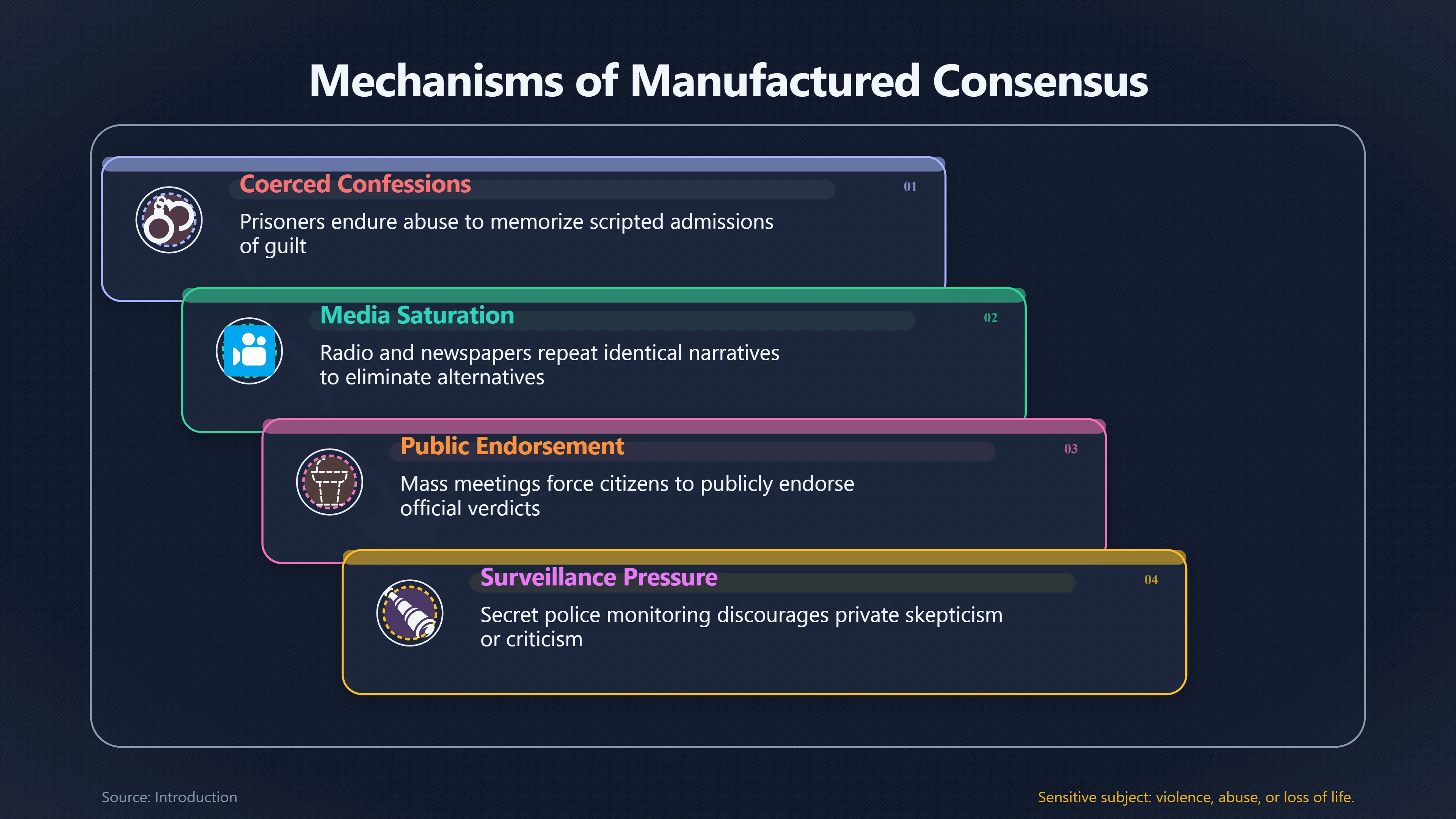
The Communist state’s success depended less on persuading everyone than on making disagreement appear impossible.
Several mechanisms worked together:
- Coerced confessions allowed fabricated accusations to appear self-confirming.
- State-controlled newspapers, radio and cinema repeated identical narratives until alternative interpretations virtually disappeared from public view.
- Mass meetings and workplace resolutions encouraged citizens to endorse official verdicts publicly, making silence or scepticism appear suspicious.
- Secret police surveillance discouraged private criticism because people could never be certain who might report them.
- Attacks on religious organisations portrayed independent moral authorities as fronts for foreign conspiracies.
This combination produced what historians sometimes describe as manufactured consensus. Many citizens privately doubted official claims, yet public conformity created the impression that belief was universal. In turn, that appearance encouraged further conformity, producing a cycle in which fear reinforced apparent agreement.
Why conspiracy trials mattered politically
The fabricated conspiracies served several political purposes beyond eliminating rivals.
First, they explained economic failures and political tensions without questioning Communist leadership. If production targets were missed or public dissatisfaction increased, hidden saboteurs could be blamed instead of flawed policies.
Second, they disciplined Party members. The Slánský trial demonstrated that even senior Communists could instantly become enemies if political priorities changed. Loyalty therefore required not only obedience but acceptance of whatever narrative the leadership currently promoted.
Third, the trials justified expanding state security powers. If invisible conspiracies supposedly existed everywhere—in factories, ministries, universities or churches—then extensive surveillance, censorship and arrests could be presented as necessary acts of defence rather than repression.
From official truth to historical reassessment
Following the gradual relaxation of Stalinism and especially after 1989, historians gained access to archives showing how these campaigns had been organised. Investigation records, Party documents and surviving audio and film recordings reveal that many confessions were rehearsed in advance and that verdicts had effectively been decided before the trials opened.[nacr.cz]nacr.czNational Archives…
The Czech Republic now remembers these events less as examples of spontaneous mass hysteria than as demonstrations of how authoritarian institutions can manufacture collective belief. Unlike rumours that spread from below, the conspiracy narratives of the early Communist period were imposed from above through courts, police, propaganda and political ritual.
This distinction is important within the wider history of collective fears in the Czech lands. Earlier witch trials and later moral panics depended on different social mechanisms, but the Communist conspiracy campaigns show how the modern state could deliberately create hidden enemies, compel public belief and transform fiction into official reality through the machinery of government.
Amazon book picks
Further Reading
Books and field guides related to How the Communist State Manufactured Hidden Enemies. Use these as the next step if you want deeper reading beyond the article.

Endnotes
1.
Source: nacr.cz
Link:https://www.nacr.cz/en/for-public/research-room/digital-research-room-archival-records-on-line/political-trials/slansky
Source snippet
National Archives...
2.
Source: nacr.cz
Title: political trials
Link:https://www.nacr.cz/en/for-public/research-room/digital-research-room-archival-records-on-line/political-trials
Source snippet
Their initiators and manufacturers designed them to have appalling effect at home, to shock. Their politica...
3.
Source: time.com
Title: czechoslovakia reactionary miracle
Link:https://time.com/archive/6614305/czechoslovakia-reactionary-miracle/
Source snippet
CZECHOSLOVAKIA: Reactionary Miracle | TIMEFebruary 20, 1950 — CZECHOSLOVAKIA: REACTIONARY MIRACLE 2 minute read TIME February 20, 1950 12...
Published: February 20, 1950
Additional References
4.
Source: cia.gov
Link:https://www.cia.gov/readingroom/document/cia-rdp82-00457r009800440004-6
Source snippet
CONDITIONS WITHIN THE CZECHSLOVAK COMMUNIST PARTY; SOVIET CONTROL OF THE CZECH ARMY; MILITARY CONTROL OF HOSPITALS | CIA FOIA (foia.cia.g...
5.
Source: invenio.nusl.cz
Title: cz Propagandistická kampaň provázející proces s Rudolfem Slánským a spol
Link:https://invenio.nusl.cz/record/352121
Source snippet
Digitální repozitářHlavní stránka > Vysokoškolské kvalifikační práce > Bakalářské práce > Propagandistická kampaň provázející proces s Ru...
6.
Source: theguardian.com
Link:https://www.theguardian.com/world/2018/apr/08/rudolf-slansky-czechoslovakia-show-trial
Source snippet
[Input] Rudolf Slánský is said to have been tortured into a confession at his trial. Photograph: BBC View image...
7.
Source: foreignaffairs.com
Title: After a year’s physical and mental torture he and 13 oth
Link:https://www.foreignaffairs.com/czech-republic/report-czechoslovakia
Source snippet
Report on Czechoslovakia | Foreign AffairsApril 1, 1955 — Four months later Slansky was arrested on a series of charges of which the most...
Published: April 1, 1955
8.
Source: na.gov.cz
Title: National Archives Slánský
Link:https://na.gov.cz/en/for-public/research-room/digital-research-room-archival-records-on-line/political-trials/slansky
Source snippet
gov.czSlánský - National ArchivesFilm contents: The news film with introductory titles and a signature tune represents a film montage fro...
9.
Source: cambridge.org
Title: A “Polyphony of Voices“?
Link:https://www.cambridge.org/core/journals/slavic-review/article/polyphony-of-voices-czech-popular-opinion-and-the-slansky-affair/711A7F8DA56A9D2B837DEB9FB7E83910
Source snippet
Czech Popular Opinion and the Slánský Affair | Slavic Review | Cambridge CoreJanuary 27, 2017 — A “POLYPHONY OF VOICES“? CZECH POPULAR OP...
Published: January 27, 2017
10.
Source: youtube.com
Title: “I got what I deserved”: Czech Communist Leader Slánský & His End
Link:https://www.youtube.com/watch?v=8FZRE9O8ic0
Source snippet
Son of a Public enemy: the 1950s show trials in Czechoslovakia & second generation trauma - excerpt...
11.
Source: theses.cz
Title: Politické procesy 50
Link:https://theses.cz/id/hhdh6h/
Source snippet
let (Horáková, Slánský) v kontextu propagandy v komunistickém Československu – Bc. Lucie SECKÁApril 21, 2011 — Politické procesy 50. let...
Published: April 21, 2011
12.
Source: youtube.com
Title: She Survived Nazis but not Communists: Execution of Milada Horáková
Link:https://www.youtube.com/watch?v=y6Btcf_nG6Y
Source snippet
Communist General Who Ruled Through Fear - And Faced Justice: Reicin...
13.
Source: encyclopedia.yivo.org
Title: Slansky Trial
Link:https://encyclopedia.yivo.org/article.aspx/Slansky_Trial
Source snippet
yivo.orgSlánský Trial - YIVO EncyclopediaFebruary 12, 2010 — Slánský Trial To cite this article, copy and paste the appropriate text in y...
Published: February 12, 2010
Topic Tree