When Belief and Fear Changed Myanmar
Myanmar’s history of contagious belief is not best understood as a catalogue of bizarre “mass hysteria” episodes.
Page outline Jump by section
Introduction
The clearest historical example is the 1930–32 rebellion associated with Saya San, whose followers combined anti-colonial protest with royal, Buddhist and supernatural ideas. More recently, nationalist movements promoted fears that Buddhism, women and the nation itself were in danger from Muslims. False stories—especially allegations of rape, forced conversion and demographic conquest—helped trigger boycotts, discriminatory laws and deadly violence. Facebook later accelerated these dynamics, but it did not invent them. Colonial inequality, military rule, ethnic conflict and weak public trust had already created fertile ground for rumours.
These episodes therefore require careful labels. They were not simply irrational crowd delusions, and Myanmar’s religious movements should not casually be called cults. Belief, political calculation, economic hardship and organised incitement repeatedly worked together.
Prophecy and revolt under colonial rule
The Saya San rebellion is often presented as Myanmar’s great millenarian uprising: a movement expecting the restoration of righteous Buddhist kingship and a transformed social order. Beginning in Lower Burma in December 1930, it spread through several districts before British forces crushed it. Saya San was captured and executed in 1931, while resistance continued into the following year.
The revolt emerged during a severe rural crisis. Falling rice prices, debt, taxation, land loss and the disruption of village life under British rule placed cultivators under intense pressure. Buddhist royal symbolism offered a language through which these grievances could be understood. Some accounts describe Saya San as assuming a kingly role, organising a ceremonial court and promising the renewal of Buddhism and the removal of colonial authority. Scholars have therefore interpreted the movement as a mixture of peasant rebellion, nationalism, religious revival and millenarian hope.[worktribe.com]soas-repository.worktribe.comthe economic crisis and rebellion in rural burma in the early 1930sSOAS Research OnlineThe Economic Crisis and Rebellion in Rural Burma in the…1 Jan 1999 — In raising the rebellion, Hsaya San presented…
Stories of protective tattoos, charms and supernatural invulnerability became especially prominent in colonial descriptions. Such beliefs were real features of Burmese religious and political culture, but historians disagree about how central they were to the rebellion. British officials had an interest in portraying rural rebels as credulous, excitable and manipulated by a pretender. That interpretation reduced a crisis of taxation, land and colonial legitimacy to a problem of native “superstition”.
Maitrii Aung-Thwin’s later study of the rebellion argues that colonial law, police reports and trial records did not merely record the uprising: they helped construct the familiar story of one centrally directed, irrational rebellion. The archive was produced by institutions seeking to identify leaders, establish criminal conspiracy and justify exceptional repression. This does not mean that royal prophecy or magical protection were invented from nothing. It means that the surviving account is filtered through the needs of a counter-insurgency state.[jstor.org]jstor.orgconstruction of Southeast Asian culture, asStructuring Revolt: Communities of Interpretation in the…by M Aung-Thwin · 2008 · Cited by 20 — Saya San rebellion Maitrii Aung-T…
The distinction matters. Calling the revolt mass delusion makes the peasants’ economic grievances disappear. Describing it only as rational class protest, however, strips away the Buddhist concepts through which many participants understood justice, authority and historical change. The rebellion was politically practical and religiously meaningful at the same time.

Hidden kings and guardians of Buddhism
Saya San drew on a wider tradition in which a righteous ruler would return during a period of disorder and restore both good government and the Buddhist religion. Stories surrounding a lost royal figure, Setkya Min, became associated with anti-colonial expectations after the fall of the Burmese monarchy. Claimants and rebels could present themselves as the returning king or as agents preparing the way for him.
Related movements centred on spiritually accomplished Buddhist figures believed to possess extraordinary knowledge or powers. These communities have sometimes been described as “cults” in academic book titles, but the word can mislead modern readers. They are better understood as devotional, esoteric or millenarian Buddhist associations whose members sought protection, healing, moral discipline and the preservation of Buddhism.
Not every such association was revolutionary. Many were concerned with meditation, medicine or religious merit rather than political violence. Yet some interpreted colonial domination and Western influence as signs of Buddhist decline. One scholarly account describes a twentieth-century organisation built around a reputed spiritual master as both millenarian and strongly anti-colonial. Other studies emphasise that beliefs in spiritually powerful protectors remain woven into ordinary healing and religious practice rather than existing as a sealed-off fringe religion.[englishkyoto-seas.org]englishkyoto-seas.orgvol 4 no 3 book reviews ben van overmeire4, No. 3, BOOK REVIEWS, Ben Van OVERMEIREJanuary 6, 2016 — 6 Jan 2016 — Champions of Buddhism: Weikza Cults in Contemporary Burma ・ a mil…
This is why “cult panic” is a poor general description. Myanmar’s authorities did sometimes regard charismatic religious networks as politically dangerous, particularly when they attracted rural followers or predicted a change of rulers. But official suspicion could reflect fear of rebellion as much as evidence of coercion or abuse within the group. The category often tells us as much about the state’s anxieties as about the movement being labelled.
How communal fear became political power
Myanmar’s most destructive modern panics have centred not on supernatural possession but on claims that a minority population threatened the religion, racial identity or physical safety of the Buddhist majority.
These fears have colonial roots. Under British rule, large-scale migration from British India transformed employment, commerce and urban life. Economic competition and the unequal structures of colonial government encouraged resentment against people labelled Indian, a category that could blur ethnicity, religion and occupation. Anti-Indian violence in 1930 followed a labour dispute at Rangoon’s docks. By 1938, agitation that began around an allegedly offensive publication helped produce wider anti-Muslim riots.
A colonial inquiry concluded that anti-immigrant and nativist politics had been developing for years. Later historians have stressed the underlying pressures: unemployment, indebtedness, political exclusion and anger at a colonial economy. Violence was directed at accessible minority communities rather than at the imperial system that had created many of those tensions.[AHA]historians.orgOpen source on historians.org.
After military rule began to loosen in the 2010s, similar themes re-emerged with new speed. Buddhist nationalist organisations warned that Muslims were taking over businesses, converting women through marriage, having children at a supposedly threatening rate and planning the eventual domination of Myanmar. Researchers describe this as a moral panic because the rhetoric transformed a small and diverse minority into a single, coordinated danger to family, religion and nation.[tandfonline.com]tandfonline.comOpen source on tandfonline.com.
The 969 movement encouraged Buddhists to identify and patronise Buddhist-owned businesses. Its successor network, commonly known as Ma Ba Tha, built branches, organised sermons and campaigned for legislation presented as protecting “race and religion”. Four laws adopted in 2015 regulated matters including religious conversion, interfaith marriage, monogamy and population control. Supporters described them as safeguards for vulnerable Buddhist women and communities. Critics argued that they institutionalised unsupported fears about Muslims and gave the state new powers over private life.[crisisgroup.org]crisisgroup.org290 buddhism and state power myanmar290 buddhism and state power myanmar
This mobilisation should not be mistaken for the views of all Buddhist monks or all Buddhists in Myanmar. Monastic opinion was divided, and nationalist electoral endorsements did not always persuade voters. The movement nevertheless succeeded in making imagined demographic and sexual threats part of mainstream political debate.
The rumour that set Mandalay alight
The Mandalay riots of July 2014 provide an unusually clear example of a rumour moving from accusation to mass violence.
A Buddhist woman alleged that two Muslim owners of a tea shop had raped her. The claim appeared online and was amplified by nationalist accounts, including that of the influential monk Wirathu. A crowd gathered outside the business, and violence spread through the city. Armed groups attacked people and property; one Buddhist man and one Muslim man were killed, and others were injured. Authorities imposed a curfew and temporarily restricted Facebook access in the area.[WIRED]wired.comHow Facebook's Rise Fueled Chaos and Confusion in MyanmarHow Facebook's Rise Fueled Chaos and Confusion in Myanmar
State media later reported that the allegation had been fabricated and that the accuser had been paid. The important point is not merely that a false story circulated. It succeeded because it fitted an established script: a Buddhist woman in danger, Muslim men cast as organised sexual predators, and officials supposedly unwilling to defend the majority community.
Similar stories had preceded or accompanied violence elsewhere. Investigations of unrest in Rakhine State, Meiktila and other towns found recurring allegations involving rape, religious insult or attacks on Buddhist interests. Some triggering incidents involved genuine crimes or local disputes; others were distorted or invented. Once absorbed into a national story of religious survival, the factual difference could become politically irrelevant. Networks of activists and itinerant agitators helped convert local tension into collective punishment.[burmalibrary.org]burmalibrary.orgJustice Trust 2015 03 Hidden Hands en to rev1 redJustice Trust 2015 03 Hidden Hands en to rev1 red
Calling such violence spontaneous “mob hysteria” therefore misses the organisation around it. Crowds acted under intense emotion, but sermons, pamphlets, rumours, political protection and delayed law enforcement had already shaped what the crowd believed and whom it considered a legitimate target.
Facebook as a panic accelerator
Myanmar’s communications revolution transformed the scale and speed of rumour. As inexpensive mobile internet expanded, Facebook became, for many new users, almost interchangeable with the internet itself. Information arrived in a shared stream where personal posts, news reporting, religious preaching and military propaganda could appear equally credible.
The company was repeatedly warned that hate speech and false accusations could produce offline violence. Its early response was weakened by limited local-language expertise, slow moderation and an inadequate understanding of Myanmar’s ethnic and political environment. Reporting tools were also difficult to use in a script and linguistic setting for which they had not been properly designed.[WIRED]wired.comHow Facebook's Rise Fueled Chaos and Confusion in MyanmarHow Facebook's Rise Fueled Chaos and Confusion in Myanmar
A human-rights assessment commissioned by Facebook concluded in 2018 that the platform had become a means for people seeking to spread hate and incite violence. The assessment, based partly on interviews with civil-society representatives and affected communities, called for substantially stronger moderation, product safeguards and engagement with local organisations. Facebook accepted that it had not done enough to prevent its services from being used to intensify division.[Facebook]about.fb.comFacebook Human Rights Impact AssessmentFacebook Human Rights Impact Assessment
The United Nations’ independent fact-finding mission went further. It found that hate speech had spread through public speeches, religious teaching, traditional media and Facebook, while authorities often emboldened extremists and silenced those promoting tolerance. The mission concluded that this environment helped legitimise discrimination and facilitate violence against the Rohingya and other Muslims.[OHCHR]ohchr.orgmyanmar un fact finding mission releases its full account massive violationsmyanmar un fact finding mission releases its full account massive violations
Facebook was an amplifier, not a complete explanation. Anti-Muslim nationalism existed before mass internet use, and violence depended on institutions, armed actors and political decisions. Nor were users merely passive victims of an algorithm: organised networks deliberately created and circulated inflammatory material. Investigators have continued to examine evidence that Myanmar’s military used coordinated online propaganda during the 2017 operations in Rakhine State.[OHCHR]ohchr.orgintensity war crimes and crimes against humanity have increased myanmarintensity war crimes and crimes against humanity have increased myanmar
The platform nevertheless changed the practical mechanics of panic. A rumour once limited by geography could now reach millions before journalists, police or community leaders established what had happened. Repetition from friends, monks, officials and apparently independent pages created the impression of confirmation even when all were recycling the same unsupported claim.
What should count as mass hysteria?
Myanmar does not have a well-documented national equivalent of the famous school fainting epidemics or dance plagues often listed under “mass hysteria”. Reports occasionally describe groups of pupils or workers fainting, becoming breathless or falling ill together, but such incidents cannot responsibly be labelled psychogenic without medical and environmental investigation. Heat, malnutrition, industrial exposure, infection and exhaustion must first be excluded.
The broader term is also unhelpful when applied to communal violence. A moral panic is a social campaign that exaggerates a person or group into a threat to accepted values. A rumour panic is the rapid spread of an alarming but unverified story. Mass psychogenic illness involves real bodily symptoms spreading through anxiety and social contact without an identified physical agent. These phenomena can overlap, but they are not interchangeable.
Myanmar’s anti-Muslim mobilisation fits the moral-panic model more closely than the medical model. The central claims concerned demographic conquest, endangered women, disloyal minorities and a religion supposedly facing extinction. These stories were propagated over years, attached to political organisations and used to justify legislation and exclusion. They were not brief episodes of unexplained illness.
Similarly, the Saya San rebellion was not a collective psychiatric event. Its religious expectations helped people interpret crisis and imagine political restoration, but the rebellion responded to identifiable colonial pressures. Describing belief in charms or prophecy as proof of madness repeats the colonial habit of treating unfamiliar religious language as evidence of incapacity.
Why the pattern endured
Several pressures repeatedly made Myanmar vulnerable to collective fear.
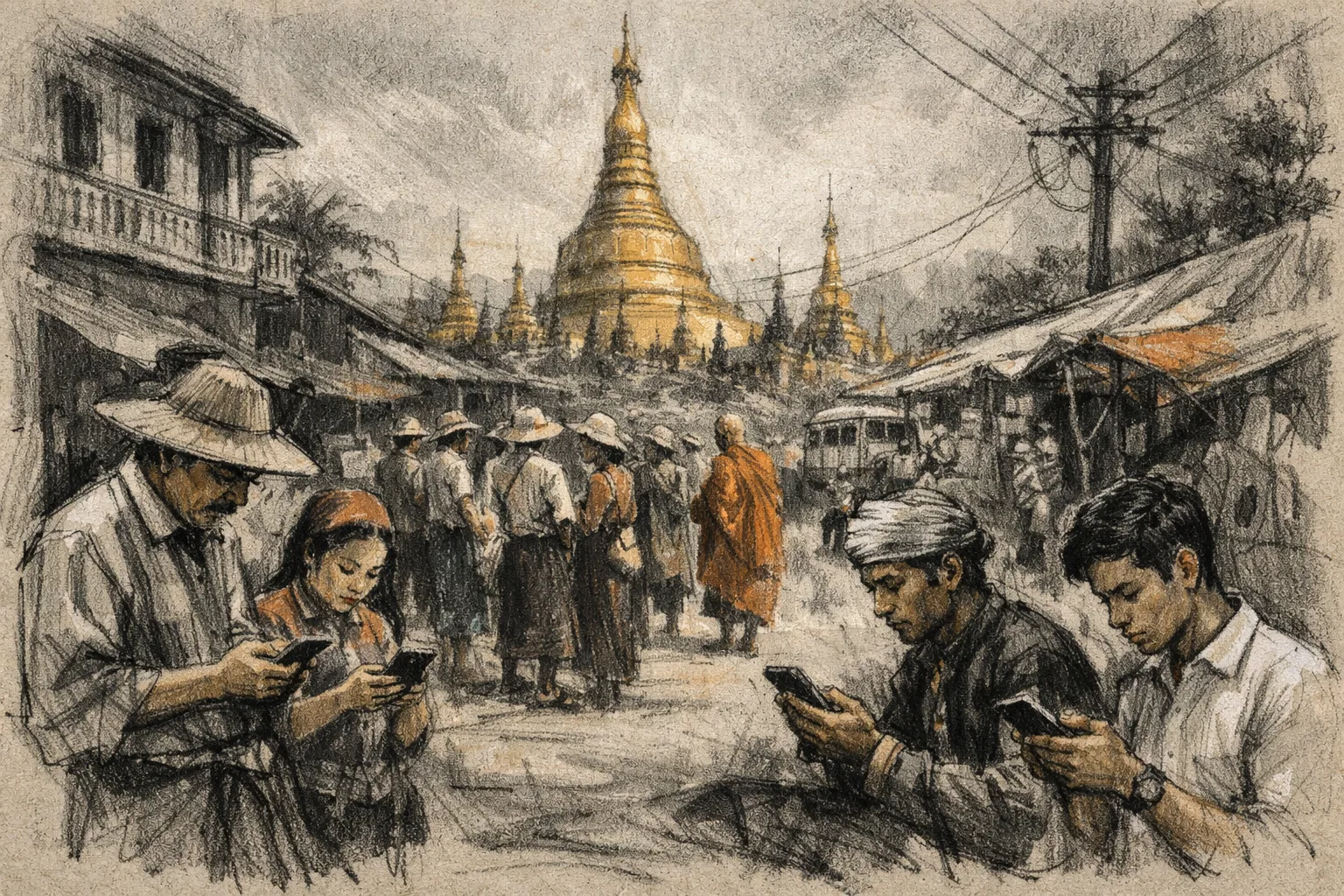
Political uncertainty created demand for simple explanations. The end of monarchy, colonial conquest, military dictatorship, partial political opening and renewed civil war each unsettled established ideas of authority. Prophets, nationalist preachers and official propagandists offered stories that identified a chosen protector and a dangerous enemy.
Economic insecurity was redirected towards visible minorities. Rural debt helped fuel anti-colonial rebellion, while competition over labour and commerce contributed to anti-Indian and anti-Muslim hostility. Rumours turned complex structural problems into accusations against neighbours.
Religion provided both moral language and organisational networks. Buddhist institutions have supported education, charity, resistance and peacebuilding, but religious prestige could also lend authority to nationalist claims. A sermon carried social weight that an anonymous political leaflet might not.
State institutions often lacked public credibility. Decades of censorship encouraged reliance on informal information networks. When media controls loosened, the result was not an immediate culture of trusted independent verification. Social media entered a landscape already shaped by secrecy, propaganda and suspicion.
Authorities sometimes benefited from division. Colonial officials portrayed rebellion as superstition rather than confronting economic grievances. Later governments tolerated or promoted narratives that weakened minority claims and divided potential opposition. United Nations investigators found that official conduct helped create an environment in which extremist discourse flourished.[google.gy]books.google.gyThe Return of the Galon King: History, Law, and Rebellion…17 Nov 2010 — Aung-Thwin reveals how counter-insurgency law produced and cri…

The lasting lesson
Myanmar’s history shows that contagious belief rarely floats free of material conditions. Prophecy became compelling where colonial rule had destroyed older sources of legitimacy. Anti-Muslim conspiracy theories flourished amid economic change, weak institutions and political competition. Digital platforms accelerated rumours because users already lived in a society where trustworthy information was scarce and identity had long been politicised.
The harm was not imaginary. Millenarian resistance met brutal repression. Communal scares produced deaths, displacement and segregation. Claims that Buddhist women and the national population were under threat helped bring discriminatory controls into law. Online dehumanisation contributed to an atmosphere in which mass violence against the Rohingya could be presented as defence rather than persecution.
The most useful distinction is therefore not between rational modern people and superstitious crowds. It is between evidence and accusation, voluntary belief and coercive mobilisation, local conflict and collective blame. Myanmar’s cases demonstrate how genuine grievances can be expressed through sacred stories, and how political actors can turn fear into a weapon by giving rumours the appearance of moral certainty.
Amazon book picks
Further Reading
Books and field guides related to When Belief and Fear Changed Myanmar. Use these as the next step if you want deeper reading beyond the article.

The Glass Palace
First published 2000. Subjects: Fiction, History, Historical fiction, Love stories, Domestic fiction.
Myanmar's Enemy Within
First published 2017. Subjects: Islam and state, Buddhism and state, Burma, politics and government, Burma, religion, Rohingya (Burmese p...
The River of Lost Footsteps: Histories of Burma
Provides essential historical context for colonialism, nationalism, religion and political conflict behind the themes discussed.
The Hidden History of Burma: Race, Capitalism, and the Crisis...
Explains how ethnic tensions, military rule, misinformation and democratic crisis intersect in modern Myanmar.
Endnotes
1.
Source: jstor.org
Link:https://www.jstor.org/stable/311948
Source snippet
Saya San and the Burmese Rebellionby RL Solomon · 1969 · Cited by 43 — Saya San Rebellion was a key stage in the transition of Burme...
2.
Source: jstor.org
Title: construction of Southeast Asian culture, as
Link:https://www.jstor.org/stable/pdf/20071889.pdf
Source snippet
Structuring Revolt: Communities of Interpretation in the...by M Aung-Thwin · 2008 · Cited by 20 — Saya San rebellion Maitrii Aung-T...
3.
Source: cambridge.org
Title: University Press & Assessment Myanmar
Link:https://www.cambridge.org/core/journals/journal-of-southeast-asian-studies/article/myanmar-the-return-of-the-galon-king-history-law-and-rebellion-in-colonial-burma-by-maitrii-aungthwin-athens-oh-ohio-university-press-2010-and-singapore-nus-press-2011-pp-xiii-247-maps-illustrations-notes-bibliography-index/A9554EF02DDFEA4AA466A1874620D96C
Source snippet
The return of the Galon King: History, law and...by EA Jones · 2012 — A key understanding Aung-Thwin plots out is the notion of a 'Rebel...
4.
Source: books.google.gy
Link:https://books.google.gy/books?cad=2&id=jdouDmeMBPEC&source=gbs_book_other_versions_r
Source snippet
The Return of the Galon King: History, Law, and Rebellion...17 Nov 2010 — Aung-Thwin reveals how counter-insurgency law produced and cri...
5.
Source: englishkyoto-seas.org
Title: vol 4 no 3 book reviews ben van overmeire
Link:https://englishkyoto-seas.org/2016/01/vol-4-no-3-book-reviews-ben-van-overmeire/
Source snippet
4, No. 3, BOOK REVIEWS, Ben Van OVERMEIREJanuary 6, 2016 — 6 Jan 2016 — Champions of Buddhism: Weikza Cults in Contemporary Burma ・ a mil...
Published: January 6, 2016
6.
Source: historians.org
Link:https://www.historians.org/perspectives-article/origins-of-an-atrocity-tracing-the-roots-of-islamophobia-in-myanmar-september-2018/
Published: september 2018
7.
Source: historians.org
Title: misdirected rage the socioeconomic roots of burmese islamophobia june 2018
Link:https://www.historians.org/perspectives-article/misdirected-rage-the-socioeconomic-roots-of-burmese-islamophobia-june-2018/
Published: june 2018
8.
Source: sciencedirect.com
Link:https://www.sciencedirect.com/org/science/article/pii/S0006229422000119
9.
Source: time.com
Link:https://time.com/38249/burma-anti-muslim-laws/
10.
Source: time.com
Link:https://time.com/4405678/burma-myanmar-buddhist-muslim-wirathu/
11.
Source: wired.com
Title: How Facebook’s Rise Fueled Chaos and Confusion in Myanmar
Link:https://www.wired.com/story/how-facebooks-rise-fueled-chaos-and-confusion-in-myanmar
12.
Source: ohchr.org
Title: myanmar un fact finding mission releases its full account massive violations
Link:https://www.ohchr.org/en/press-releases/2018/09/myanmar-un-fact-finding-mission-releases-its-full-account-massive-violations
13.
Source: ohchr.org
Title: statement mr marzuki darusman chairperson independent international
Link:https://www.ohchr.org/en/statements-and-speeches/2018/03/statement-mr-marzuki-darusman-chairperson-independent-international
14.
Source: ohchr.org
Title: myanmar tatmadaw leaders must be investigated genocide crimes against
Link:https://www.ohchr.org/en/press-releases/2018/08/myanmar-tatmadaw-leaders-must-be-investigated-genocide-crimes-against
15.
Source: ohchr.org
Title: intensity war crimes and crimes against humanity have increased myanmar
Link:https://www.ohchr.org/en/meeting-summaries/2023/09/intensity-war-crimes-and-crimes-against-humanity-have-increased-myanmar
16.
Source: ohchr.org
Title: statement mr marzuki darusman chairperson united nations
Link:https://www.ohchr.org/en/statements-and-speeches/2018/10/statement-mr-marzuki-darusman-chairperson-united-nations
17.
Source: ohchr.org
Title: myanmar social media companies must stand juntas online terror campaign say
Link:https://www.ohchr.org/en/press-releases/2023/03/myanmar-social-media-companies-must-stand-juntas-online-terror-campaign-say
18.
Source: ohchr.org
Link:https://www.ohchr.org/Documents/HRBodies/HRCouncil/FFM-Myanmar/A_HRC_39_64.pdf
19.
Source: ohchr.org
Title: subm advocacy hatred based cso equality myanmar annex
Link:https://www.ohchr.org/sites/default/files/documents/issues/religion/cfis/advocacy-hatred/subm-advocacy-hatred-based-cso-equality-myanmar-annex.pdf
20.
Source: ohchr.org
Link:https://www.ohchr.org/en/press-releases/2018/11/universal-declaration-human-rights-70-30-articles-30-articles-article-19
21.
Source: ohchr.org
Title: statement ms yanghee lee special rapporteur situation human rights
Link:https://www.ohchr.org/en/statements-and-speeches/2017/06/statement-ms-yanghee-lee-special-rapporteur-situation-human-rights
22.
Source: ohchr.org
Title: high commissioner human rights says myanmar being suffocated illegitimate
Link:https://www.ohchr.org/en/meeting-summaries/2024/06/high-commissioner-human-rights-says-myanmar-being-suffocated-illegitimate
23.
Source: jstor.org
Link:https://www.jstor.org/stable/3173296
24.
Source: jstor.org
Link:https://www.jstor.org/stable/25614538
25.
Source: facebook.com
Link:https://www.facebook.com/amnestyafrica/videos/most-women-accused-of-witchcraft-do-not-turn-to-the-police-out-of-fear-or-a-lack/973533009011974/
26.
Source: facebook.com
Link:https://www.facebook.com/WoezorTV/posts/witchcraft-accusations-and-related-abuses-infringe-on-a-persons-right-to-life-se/1104312421740334/
27.
Source: facebook.com
Link:https://www.facebook.com/theirrawaddy/posts/five-buddhist-nationalists-who-were-arrested-for-their-involvement-in-a-violent-/1620389224672595/
28.
Source: facebook.com
Link:https://www.facebook.com/theirrawaddy/posts/breakingyangons-western-district-court-has-issued-an-arrest-warrant-against-myan/2599247963453378/
29.
Source: facebook.com
Link:https://www.facebook.com/TheEconomist/posts/in-myanmar-the-90-buddhist-majority-felt-so-threatened-by-a-muslim-minority-of-b/10156487496139060/
30.
Source: facebook.com
Link:https://www.facebook.com/ElevenMediaEnglishEdition/posts/21-students-faint-after-experiencing-shortness-of-breath-at-school-in-daweia-tot/1324415666509916/
31.
Source: facebook.com
Link:https://www.facebook.com/barakbulletin/videos/panic-at-bidyaratanpur-me-school-mass-fainting-sparks-ghost-rumours-holiday-decl/1049613523767564/
32.
Source: facebook.com
Link:https://www.facebook.com/TheStarOnline/posts/a-total-of-21-students-experienced-shortness-of-breath-and-fainted-at-no-1-basic/1491000679729119/
33.
Source: cambridge.org
Link:https://www.cambridge.org/core/services/aop-cambridge-core/content/view/1ABF0569043B0A9B7278F72179C4AB59/S0022463408000222a.pdf/structuring_revolt_communities_of_interpretation_in_the_historiography_of_the_saya_san_rebellion.pdf
34.
Source: cambridge.org
Link:https://www.cambridge.org/core/journals/modern-asian-studies/article/buddhism-has-been-insulted-take-immediate-steps-burmese-fascism-and-the-origins-of-burmese-islamophobia-193638/9691384DFB8459061F429EE85FF4D819
35.
Source: cambridge.org
Title: div class title saya san and the burmese rebellion div
Link:https://www.cambridge.org/core/services/aop-cambridge-core/content/view/F6C361DE1964A48E71150C9688E792FC/S0026749X0000233Xa.pdf/div-class-title-saya-san-and-the-burmese-rebellion-div.pdf
36.
Source: sciencedirect.com
Link:https://www.sciencedirect.com/science/article/pii/S0305750X25000130
37.
Source: soas-repository.worktribe.com
Title: the economic crisis and rebellion in rural burma in the early 1930s
Link:https://soas-repository.worktribe.com/output/448910/the-economic-crisis-and-rebellion-in-rural-burma-in-the-early-1930s
Source snippet
SOAS Research OnlineThe Economic Crisis and Rebellion in Rural Burma in the...1 Jan 1999 — In raising the rebellion, Hsaya San presented...
38.
Source: journals.sagepub.com
Link:https://journals.sagepub.com/doi/10.1177/223386591001300209
Source snippet
Sage JournalsBuddhist Nationalism and its Limitations in Colonial Myanmarby JY Jang · 2010 · Cited by 5 — Saya San rebellion was a kind o...
39.
Source: tandfonline.com
Link:https://www.tandfonline.com/doi/full/10.1080/00472336.2022.2032801
40.
Source: crisisgroup.org
Title: 290 buddhism and state power myanmar
Link:https://www.crisisgroup.org/rpt/asia-pacific/myanmar/290-buddhism-and-state-power-myanmar
41.
Source: burmalibrary.org
Title: Justice Trust 2015 03 Hidden Hands en to rev1 red
Link:https://www.burmalibrary.org/docs21/Justice_Trust-2015-03-Hidden_Hands-en-to-rev1-red.pdf
42.
Source: graphics.thomsonreuters.com
Title: Reuters The Buddhist war on Myanmar’s Muslims
Link:https://graphics.thomsonreuters.com/13/04/Myanmar.pdf
43.
Source: crisisgroup.org
Title: myanmar the politics of rakhine state
Link:https://www.crisisgroup.org/sites/default/files/myanmar-the-politics-of-rakhine-state.pdf
44.
Source: about.fb.com
Title: Facebook Human Rights Impact Assessment
Link:https://about.fb.com/wp-content/uploads/2018/11/bsr-facebook-myanmar-hria_final.pdf
45.
Source: about.fb.com
Title: myanmar hria
Link:https://about.fb.com/news/2018/11/myanmar-hria/
46.
Source: Wikipedia
Title: Mass psychogenic illness
Link:https://en.wikipedia.org/wiki/Mass_psychogenic_illness
47.
Source: Wikipedia
Title: Saya San
Link:https://en.wikipedia.org/wiki/Saya_San
48.
Source: Wikipedia
Title: Setkya Min
Link:https://en.wikipedia.org/wiki/Setkya_Min
49.
Source: crisisgroup.org
Title: 290 buddhism and state power in myanmar
Link:https://www.crisisgroup.org/sites/default/files/290-buddhism-and-state-power-in-myanmar.pdf
50.
Source: crisisgroup.org
Title: 330 silent sangha buddhist monks post coup myanmar
Link:https://www.crisisgroup.org/rpt/asia/south-east-asia/myanmar/330-silent-sangha-buddhist-monks-post-coup-myanmar
51.
Source: crisisgroup.org
Title: 330 myanmar a silent sangha.docx
Link:https://www.crisisgroup.org/sites/default/files/2023-03/330-myanmar-a-silent-sangha.docx.pdf
52.
Source: about.fb.com
Title: Meta Human Rights Report July 2022
Link:https://about.fb.com/wp-content/uploads/2022/07/Meta_Human-Rights-Report-July-2022.pdf?ref=ghost.opendemocracy.net
Published: July 2022
53.
Source: bactra.org
Link:https://bactra.org/notebooks/millenarian.html
54.
Source: ebsco.com
Link:https://www.ebsco.com/research-starters/social-sciences-and-humanities/mass-hysteria
55.
Source: academia.edu
Link:https://www.academia.edu/84504000/Introduction_Communities_of_interpretation_and_the_construction_of_modern_Myanmar
56.
Source: newint.org
Link:https://newint.org/features/2008/04/18/history
57.
Source: frontiersin.org
Link:https://www.frontiersin.org/journals/psychiatry/articles/10.3389/fpsyt.2020.493094/full
58.
Source: burmalibrary.org
Link:https://www.burmalibrary.org/en/the-coming-of-the-future-king-burmese-minlaung-expectations-before-and-during-the-second-world-war
Additional References
59.
Source: youtube.com
Title: Rohingya vs Facebook: Will social media giant be blamed for alleged genocide?
Link:https://www.youtube.com/watch?v=AWT2tjVQ5Qo
Source snippet
is highly relevant as it analyzes how modern online algorithms and viral rumors on social media platforms directly fueled real-world ethn...
60.
Source: youtube.com
Title: The State of Buddhism and Buddhist Nationalism After the Coup in Myanmar
Link:https://www.youtube.com/watch?v=5Hd3apLxxp0
Source snippet
Why Are Buddhist Monks Turning Violent against rohingya?...
61.
Source: youtube.com
Title: History of Southeast Asia: Peasant Resistance and Nationalism
Link:https://www.youtube.com/watch?v=CJJLOFhWEUs
Source snippet
The State of Buddhism and Buddhist Nationalism After the Coup in Myanmar...
62.
Source: youtube.com
Title: Arrest warrant issued for Myanmar firebrand monk Wirathu
Link:https://www.youtube.com/watch?v=vDJPnkmYBXY
Source snippet
Rohingya vs Facebook: Will social media giant be blamed for alleged genocide?...
63.
Source: youtube.com
Title: Why Are Buddhist Monks Turning Violent against rohingya?
Link:https://www.youtube.com/watch?v=SyGIqWQ-tFg
Source snippet
Arrest warrant issued for Myanmar firebrand monk Wirathu...
64.
Source: researchgate.net
Link:https://www.researchgate.net/publication/342384299_Partners_in_Empire_Co-colonialism_and_the_Rise_of_Anti-Indian_Nationalism_in_Burma
65.
Source: researchgate.net
Link:https://www.researchgate.net/publication/367859892_Buddhist_Nationalist_Sermons_in_Myanmar_Anti-Muslim_Moral_Panic_Conspiracy_Theories_and_Socio-Cultural_Legacies
66.
Source: x.com
Link:https://x.com/staronline/status/2071113923177128162
67.
Source: academia.edu
Link:https://www.academia.edu/43181640/Buddhist_Wizards_Weizz%C4%81_Weikza_of_Myanmar_or_Buddhist_Wizards_of_Myanmar_and_the_Academic_Study_of_Lived_Religion
68.
Source: cato.org
Link:https://www.cato.org/policy-analysis/challenging-social-media-moral-panic-preserving-free-expression-under
Topic Tree
Follow this branch
Related pages 192
- Antigua and Barbuda
- Argentina Belief Scares
- Azerbaijan Belief
- Bahrain Beliefs
- North Korea
- +187 more in sidebar