Within Comoros
Why Karthala's Eruptions Sparked Mass Flight
The 2005 Karthala evacuations show how real danger, weak information and frightening rumours can combine during a disaster.
On this page
- What happened during the 2005 eruptions
- How rumours amplified visible hazards
- How officials separated risk from speculation
Page outline Jump by section
Introduction
Mount Karthala dominates the island of Grande Comore, so when it erupts, the threat is impossible for local people to ignore. The volcano has produced numerous eruptions over the past two centuries, but the events of 2005 are especially important for understanding collective fear in Comoros. They show how a genuine natural hazard can be accompanied by rumours, uncertainty and rapid population movements without becoming a classic case of mass hysteria.
The 2005 eruptions combined real volcanic danger with limited monitoring capacity, incomplete public information and widespread anxiety about what might happen next. Many residents made decisions under conditions of uncertainty, balancing official advice against rumours shared through families, neighbours and local media. Rather than demonstrating irrational panic, the episode illustrates how visible hazards and uncertain communication can amplify fear during a fast-moving disaster.[Smithsonian Global Volcanism]volcano.si.eduSmithsonian Global VolcanismGlobal Volcanism Program | Volcanic Activity Report on Karthala (Union of the Comoros) — April 2005April 1, 2005…
What happened during the 2005 eruptions?
Karthala experienced two significant eruptive episodes in 2005.
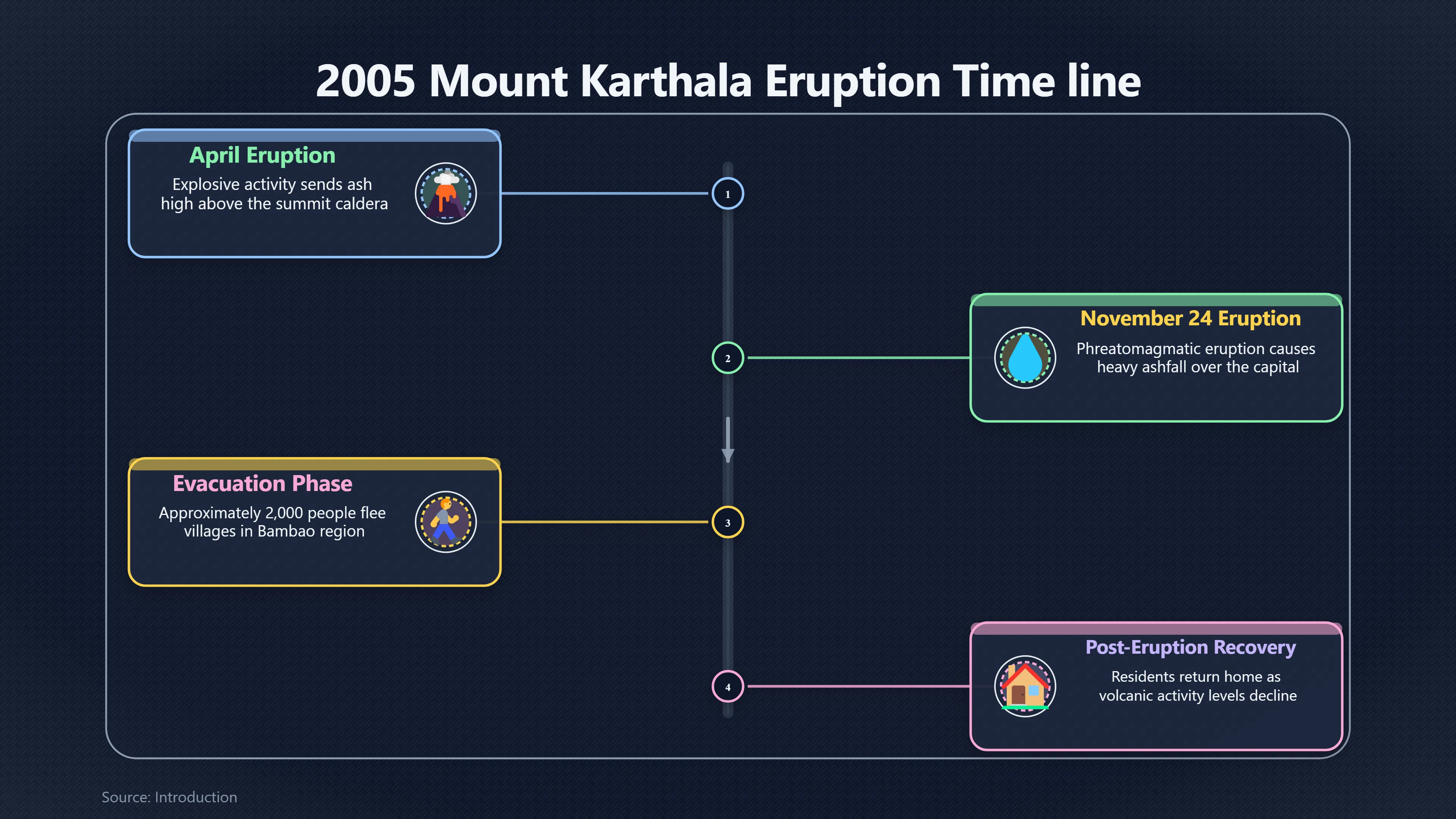
The first began in April after weeks of increasing seismic activity. Scientists at the Karthala Volcano Observatory detected an unusual rise in earthquakes before an explosive eruption sent ash high above the summit. Ash fell across parts of Grande Comore, flights were suspended and hundreds of residents living closest to the volcano temporarily left their homes. Although dramatic, the eruption remained largely confined to the summit caldera, allowing many evacuees to return within days once activity declined.[Smithsonian Global Volcanism]volcano.si.eduSmithsonian Global VolcanismGlobal Volcanism Program | Volcanic Activity Report on Karthala (Union of the Comoros) — April 2005April 1, 2005…
A second and more disruptive eruption followed on 24 November. This phreatomagmatic eruption—caused by magma interacting with water—produced heavy ashfall over large parts of the island, including the capital, Moroni. Darkness from volcanic ash, strong sulphur smells and continuous tremors created an atmosphere of intense uncertainty. Local authorities estimated that around 2,000 people fled villages in the Bambao region for areas thought to be safer. Schools closed, breathing became difficult in some locations because of ash, and at least one infant reportedly died from respiratory complications during the evacuation.[Smithsonian Global Volcanism]volcano.si.eduSmithsonian Global VolcanismGlobal Volcanism Program | Report on Karthala (Union of the Comoros) — 23 November-29 November 2005November 2…
Why visible danger quickly became collective fear
Unlike many historical episodes discussed under the label of “mass hysteria”, Karthala presented an authentic physical threat. The challenge was not deciding whether danger existed, but determining how great it was and where it would spread.
Several factors amplified public anxiety:
- The volcano dominates the island. Grande Comore is largely formed by Karthala itself, leaving relatively few places far from potential volcanic hazards.
- Ash and gas were immediately visible. Falling ash, rumbling sounds, lightning around the eruption column and the smell of sulphur made the danger tangible even for people far from the crater.
- Scientific uncertainty remained high. Although observatory staff monitored increasing seismicity, predicting exactly how an eruption would develop remained impossible.
- Communication infrastructure was limited. Many residents depended on neighbours, relatives and local radio rather than continuous official updates, allowing rumours to circulate alongside verified information.[Smithsonian Global Volcanism]volcano.si.eduSmithsonian Global VolcanismGlobal Volcanism Program | Volcanic Activity Report on Karthala (Union of the Comoros) — April 2005April 1, 2005…
These conditions created what disaster researchers often describe as an “information vacuum”: when reliable information arrives more slowly than frightening observations, speculation naturally fills the gap.
How rumours amplified visible hazards
Reports from humanitarian agencies and volcanic monitoring organisations show that rumours accompanied both eruptions.
Stories circulated that lava would soon reach populated areas, that much larger explosions were imminent, or that the entire island might need evacuation. Similar rumours had appeared during earlier periods of volcanic unrest, including false reports in 2003 that lava was already flowing towards towns. These claims spread despite lacking confirmation from scientists.[Smithsonian Global Volcanism]volcano.si.eduOpen source on si.edu.
Rumours gained credibility because they built upon facts people could already observe:
- earthquakes were increasing;
- ash was falling across villages;
- visibility was poor;
- air traffic had been disrupted;
- officials were organising evacuations.
When people already experience undeniable evidence of danger, distinguishing reasonable precaution from exaggerated claims becomes much harder. The rumours therefore did not invent fear from nothing; they extended genuine uncertainty beyond what was actually known.

How officials separated risk from speculation
One of the clearest lessons from the 2005 eruptions is the importance of scientific institutions even when they cannot eliminate uncertainty.
The Karthala Volcano Observatory monitored earthquake swarms before both eruptions, allowing authorities to recognise that volcanic activity was increasing. After the eruptions began, scientists used field observations, aerial surveys and seismic measurements to determine whether lava remained confined within the summit crater or threatened populated areas. During the April eruption, these observations showed that lava had not escaped the caldera, helping support decisions to allow residents to return home once ash emissions declined.[Smithsonian Global Volcanism]volcano.si.eduSmithsonian Global VolcanismGlobal Volcanism Program | Volcanic Activity Report on Karthala (Union of the Comoros) — April 2005April 1, 2005…
International organisations also contributed. The United Nations Office for the Coordination of Humanitarian Affairs (OCHA), satellite monitoring services and the Toulouse Volcanic Ash Advisory Centre tracked ash clouds, coordinated humanitarian information and helped distinguish confirmed developments from unverified reports.[Smithsonian Global Volcanism]volcano.si.eduSmithsonian Global VolcanismGlobal Volcanism Program | Volcanic Activity Report on Karthala (Union of the Comoros) — November 2005…
This process did not eliminate fear, but it gradually replaced speculation with evidence as more information became available.
Was this an example of mass hysteria?
Most historians, volcanologists and disaster specialists would say no.
The defining feature of the 2005 episode was a real volcanic emergency, not a contagious psychological disorder. Residents faced genuine hazards including ashfall, volcanic gases, earthquakes and the possibility—however uncertain—of larger eruptions. Evacuations therefore reflected rational responses to incomplete information rather than collective delusion.
The psychological element lay elsewhere. Fear spread because people had to make urgent decisions before anyone could know exactly how the eruption would develop. This is better understood as risk amplification during a disaster than as mass psychogenic illness. The social process was driven by uncertainty, rumour and limited communication rather than by imagined symptoms or entirely false beliefs.
Why the Karthala eruptions remain important
The 2005 eruptions remain one of the clearest examples in Comorian history of how collective fear develops around a genuine natural hazard.
The episode demonstrated several enduring lessons:
- visible hazards give rumours unusual credibility;
- trusted scientific monitoring reduces uncertainty even when prediction is imperfect;
- evacuation decisions are shaped as much by communication as by volcanic activity itself;
- humanitarian coordination becomes especially important on small islands where transport and shelter options are limited.
For Comoros, Karthala is therefore significant not simply as an active volcano but as a reminder that disasters involve both physical processes and social ones. Communities must interpret incomplete information while confronting immediate danger. The events of 2005 show that collective fear often grows not from irrationality but from the difficult task of making life-or-death decisions when certainty is impossible.
Amazon book picks
Further Reading
Books and field guides related to Why Karthala's Eruptions Sparked Mass Flight. Use these as the next step if you want deeper reading beyond the article.


Volcanoes and the earth's interior
First published 1982. Subjects: Internal structure, Volcanoes, Earthquakes & Volcanoes, Nature, Earth.
Endnotes
1.
Source: volcano.si.edu
Link:https://volcano.si.edu/showreport.cfm?doi=10.5479%2Fsi.GVP.BGVN200504-233010
Source snippet
Smithsonian Global VolcanismGlobal Volcanism Program | Volcanic Activity Report on Karthala (Union of the Comoros) — April 2005April 1, 2005...
Published: April 1, 2005
2.
Source: volcano.si.edu
Link:https://volcano.si.edu/showreport.cfm?doi=10.5479%2Fsi.GVP.BGVN200511-233010
Source snippet
Smithsonian Global VolcanismGlobal Volcanism Program | Volcanic Activity Report on Karthala (Union of the Comoros) — November 2005...
Published: November 2005
3.
Source: volcano.si.edu
Link:https://volcano.si.edu/volcano.cfm?vn=233010
4.
Source: volcano.si.edu
Link:https://volcano.si.edu/showreport.cfm?wvar=GVP.WVAR20051123-233010
Source snippet
Smithsonian Global VolcanismGlobal Volcanism Program | Report on Karthala (Union of the Comoros) — 23 November-29 November 2005November 2...
Published: November 2005
5.
Source: volcano.si.edu
Link:https://volcano.si.edu/showreport.cfm?doi=10.5479%2Fsi.GVP.BGVN200601-233010
Source snippet
Smithsonian Global VolcanismGlobal Volcanism Program | Volcanic Activity Report on Karthala (Union of the Comoros) — January 2006...
Published: January 2006
6.
Source: volcano.si.edu
Title: Ashfall occurred in Moroni, the capital
Link:https://volcano.si.edu/volcano.cfm?vn=233010&vtab=Weekly
Source snippet
Volcanism Program | KarthalaOctober 4, 2022 — An explosive eruption on 24-25 November 2005 deposited ash over the SE and SW parts of Gran...
Published: October 4, 2022
7.
Source: a.cf11.si.edu
Link:https://a.cf11.si.edu/volcano.cfm?vn=233010
Source snippet
Zorick, Comoros Officer, Embassy of the United States of America, Antananarivo, Madagascar; and Hawai'i Institute of Geophysics and Plane...
8.
Source: a.cf11.si.edu
Link:https://a.cf11.si.edu/showreport.cfm?doi=10.5479%2Fsi.GVP.BGVN200504-233010
9.
Source: a.cf11.si.edu
Link:https://a.cf11.si.edu/showreport.cfm?gvpvar=GVP.WVAR20030820-233010
10.
Source: volcano.si.edu
Link:https://volcano.si.edu/showreport.cfm?doi=10.5479%2Fsi.GVP.BGVN200606-233010
11.
Source: a.cf11.si.edu
Link:https://a.cf11.si.edu/showreport.cfm?doi=10.5479%2Fsi.GVP.BGVN200511-233010
Additional References
12.
Source: science.nasa.gov
Title: volcanic activity on mount karthala 16764
Link:https://science.nasa.gov/earth/earth-observatory/volcanic-activity-on-mount-karthala-16764/
Source snippet
Activity on Mount Karthala - NASA ScienceJune 5, 2006 — Earth Observatory 1 min read VOLCANIC ACTIVITY ON MOUNT KARTHALA NASA Earth Obser...
Published: June 5, 2006
13.
Source: youtube.com
Link:https://www.youtube.com/watch?v=TGOLICMkeVg
Source snippet
Travel & Geopolitics COMOROS | What's Like To Visit the Country FEW PEOPLE Heard of. VOLCANO & More...
14.
Source: youtube.com
Link:https://www.youtube.com/watch?v=2b261L1-0Ok
Source snippet
How to CLIMB Mount KARTHALA in Comoros Independently. Everything You Need to Know...
15.
Source: youtube.com
Title: Karthala Volcano Update; Alert Level Raised in Comoros, Earthquake Swarm Ongoing
Link:https://www.youtube.com/watch?v=Lfcn5zpuDi8
Source snippet
This Week in Volcano News; Alert Level Raised at Mayon, New Eruption at Semisopochnoi...
16.
Source: youtube.com
Link:https://www.youtube.com/watch?v=fy8-94SKVm4
Source snippet
Hiking an Ancient Volcano: A Journey Through Time...
17.
Source: ungeneva.org
Link:https://www.ungeneva.org/en/news-media/bi-weekly-briefing/2005/12/regular-press-briefing-information-service
18.
Source: irishtimes.com
Title: Hundreds flee as Comoros volcano spews smoke – The Irish Times
Link:https://www.irishtimes.com/news/hundreds-flee-as-comoros-volcano-spews-smoke-1.1176204
19.
Source: mg.co.za
Title: Volcanoes erupt in Comoros, Colombia – The Mail & Guardian
Link:https://mg.co.za/article/2005-11-25-volcanoes-erupt-in-comoros-colombia/
20.
Source: abc.net.au
Title: Thousands flee villages after Comoros volcano erupts
Link:https://www.abc.net.au/news/2005-04-19/thousands-flee-villages-after-comoros-volcano/1553822
21.
Source: aljazeera.com
Title: Lava spews from Comoros volcano | News | Al Jazeera
Link:https://www.aljazeera.com/amp/news/2006/5/28/lava-spews-from-comoros-volcano
Topic Tree