Within Japan Panics
When Religious Belief Became Celebration or Terror
Japan's religious panics range from festive miracle movements to Aum Shinrikyo's real campaign of murder and chemical violence.
On this page
- Sacred amulets and the dancing of 1867 68
- How apocalyptic ideas spread during instability
- Aum Shinrikyo and the limits of the cult label
Page outline Jump by section
Introduction
Japan’s history of religious excitement cannot be reduced to a single story of irrational crowds or dangerous sects. It ranges from joyful, communal celebrations inspired by reports of miraculous sacred amulets to one of the world’s most shocking cases of religiously motivated terrorism. These episodes differ profoundly in their causes, methods and consequences, yet they reveal a recurring pattern: periods of uncertainty can make extraordinary religious claims especially compelling, while charismatic leaders, rumours and shared expectations can spread belief rapidly through communities. Understanding the contrast between the festive movements of the late Edo period and the violence of Aum Shinrikyo helps explain why modern Japan treats both religious freedom and public safety with particular sensitivity.[OUP Academic]academic.oup.comOUP AcademicAum Shinrikyo and religious terrorism in Japanese collective memory | British Academy Scholarship Online | Oxford AcademicDec…

Sacred amulets and the dancing of 1867–68
The best-known example of collective religious excitement before modern Japan emerged during the final months of the Tokugawa shogunate. Across large parts of central and western Japan, people reported that sacred amulets had miraculously fallen from the sky. Whether they were believed to be gifts from the gods, deliberately scattered by local organisers or simply misunderstood rumours varied from place to place. What mattered was that many communities accepted the reports as a reason to celebrate.
The resulting movement, remembered as the Ee ja nai ka celebrations, combined religious thanksgiving, carnival, pilgrimage and public festivity. Villages and towns organised mass dances, singing, drinking and elaborate costumes. Social conventions relaxed temporarily, with reports of cross-dressing, public revelry and unusually free interaction across social boundaries. Rather than a single centrally organised movement, these were locally organised events connected by imitation and shared expectations.[Wikipedia]WikipediaEe ja nai kaEe ja nai ka
The timing was crucial. Japan stood on the edge of political revolution as the Tokugawa regime collapsed and the Meiji Restoration approached. Economic uncertainty, social tension and weakening political authority created fertile conditions for reports of miracles to spread. The celebrations therefore acted both as sincere religious expression and as a release from everyday discipline.
Historians generally reject comparisons with Europe’s so-called dancing plagues. Participants were not displaying symptoms of unexplained illness. Instead, the dances were voluntary communal performances in which belief, entertainment, local custom and social protest became intertwined. Different participants probably attached very different meanings to the same events, from genuine devotion to simple enjoyment of an extraordinary festival.[Wikipedia]WikipediaEe ja nai kaEe ja nai ka
How apocalyptic ideas spread during instability
The celebrations surrounding sacred amulets were only one expression of a broader tendency within Japanese religious history. At moments of political upheaval, natural disaster or rapid social change, religious movements offering explanations of the present and predictions about the future often gained followers.
Japan has repeatedly experienced periods in which earthquakes, epidemics, famine or economic disruption encouraged renewed interest in millenarian ideas—the belief that the existing age was approaching a dramatic transformation or ending. Such expectations rarely produced violence. More commonly they inspired:
- renewed devotion and pilgrimage;
- expectations of miraculous intervention;
- charismatic religious leadership;[cambridge.org]cambridge.orgEastern Religious Cults (Chapter 1A Clinical and Forensic Guide to Cults and Persuasive LeadershipJune 19, 2025 — AUM SHINRIKYO Japan’s Aum Shinrikyo cult (often called “A…
- communal rituals promising protection or renewal; and
- temporary challenges to established authority.
The growth of many twentieth-century Japanese new religions reflected similar social dynamics. Rapid industrialisation, urban migration and later economic uncertainty left some people searching for communities that offered certainty, moral purpose and spiritual healing. Most remained peaceful and lawful despite attracting criticism or public suspicion. Religious enthusiasm alone was therefore never a reliable predictor of danger.[Springer Nature Link]link.springer.comSpringer Nature LinkReligion and Social Crisis in Japan: Understanding Japanese Society Through the Aum Affair | Springer Nature Link…
This distinction matters because later events profoundly altered how the Japanese public viewed minority religions. After 1995, many groups found themselves judged through the shadow cast by one exceptional organisation rather than by their own beliefs or conduct.

Aum Shinrikyo and the limits of the cult label
No discussion of religious excitement in modern Japan can avoid Aum Shinrikyo, but it also demonstrates why the label “cult” has limited explanatory value.
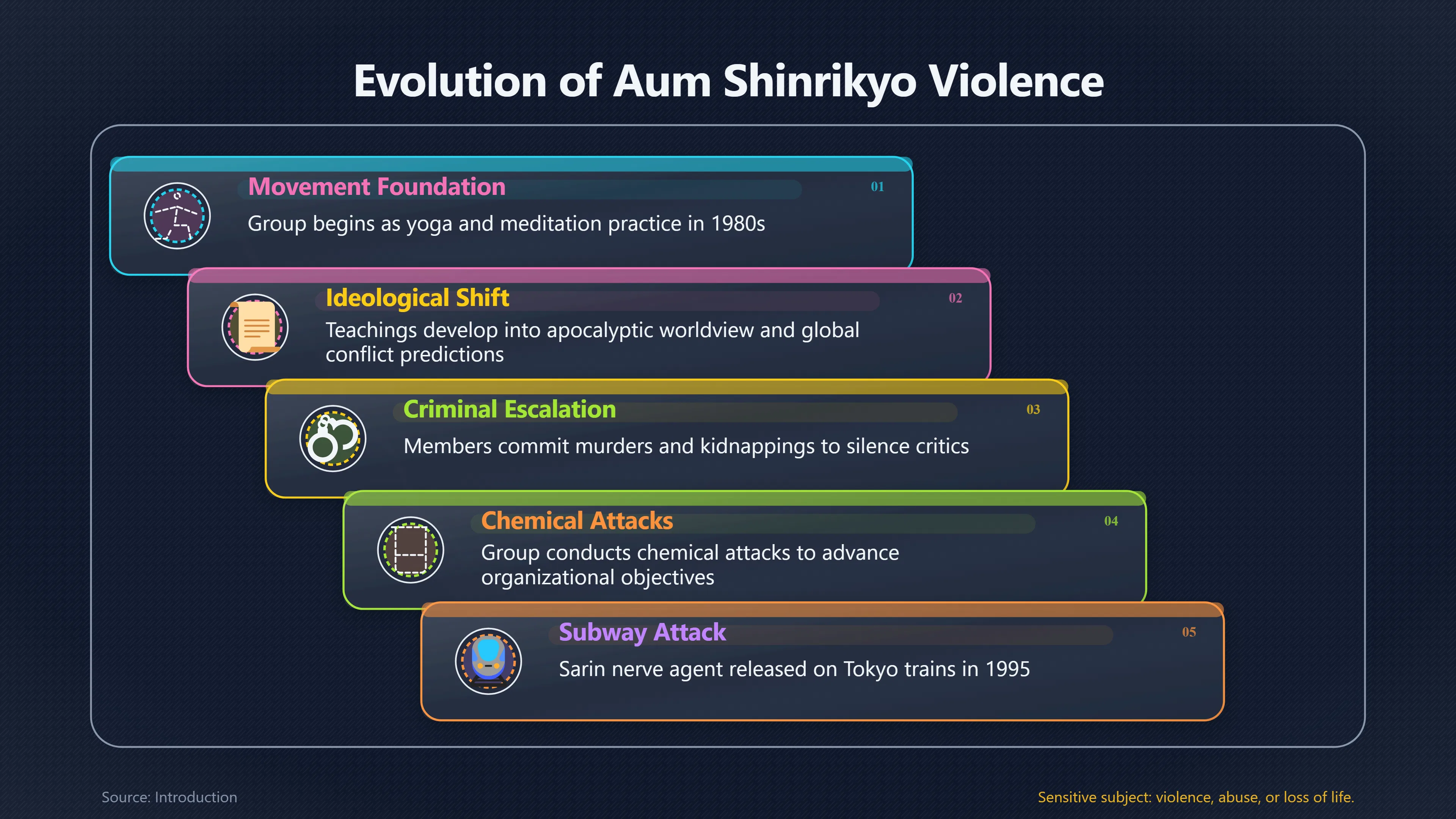
Founded in the 1980s by Shoko Asahara, Aum began as a movement combining yoga, meditation and teachings drawn from several religious traditions. It attracted educated recruits, including scientists, engineers and medical professionals. Over time, however, Asahara’s authority became increasingly absolute, while the group’s teachings developed into an apocalyptic worldview predicting catastrophic global conflict and portraying outsiders as enemies.[OUP Academic]academic.oup.comAcademic Aum Shinrikyo and the Aum Incident: A CriticalOUP AcademicAum Shinrikyo and the Aum Incident: A Critical Introduction | Controversial New Religions | Oxford AcademicAugust 28, 2014…
Scholars argue that Aum’s violence cannot be explained simply by unusual religious beliefs. Instead, several interacting factors transformed the movement:
- an increasingly unquestioned charismatic leader;
- isolation from outside criticism;
- doctrines that justified violence as spiritually necessary;
- organisational secrecy;
- recruitment of technically skilled members capable of developing chemical weapons; and
- escalating confrontations with perceived enemies inside and outside the movement.[oup.com]academic.oup.comAcademic Aum Shinrikyo and the Aum Incident: A CriticalOUP AcademicAum Shinrikyo and the Aum Incident: A Critical Introduction | Controversial New Religions | Oxford AcademicAugust 28, 2014…
This evolution illustrates why researchers distinguish between controversial religious movements in general and the rare organisations that develop systematic criminal or terrorist structures.
When belief became organised violence
Before the Tokyo subway attack, Aum members had already committed murders, kidnappings and chemical attacks while attempting to silence critics and advance the group’s objectives. The movement’s leadership increasingly interpreted violence as both morally justified and religiously necessary.
On 20 March 1995, Aum members released sarin nerve agent on several Tokyo Underground trains during the morning rush hour. Thirteen people were killed and thousands were injured, making it the deadliest act of terrorism in post-war Japan. The attack shocked a country that regarded itself as unusually safe and fundamentally altered public attitudes towards new religious movements.[OUP Academic]academic.oup.comOUP AcademicIntroduction | Aum Shinrikyo and religious terrorism in Japanese collective memory | British Academy Scholarship Online | Oxf…
The attack demonstrated that genuine organised violence must be distinguished from episodes of collective excitement or moral panic. Earlier Japanese religious movements had generated rumours, ecstatic celebrations or controversial beliefs without producing systematic campaigns of murder. Aum crossed an entirely different threshold by constructing laboratories, manufacturing chemical weapons and directing planned attacks against civilians.
For this reason, historians increasingly treat Aum primarily as a case of religiously framed terrorism rather than simply an example of religious enthusiasm or mass hysteria.[OUP Academic]academic.oup.comAcademic Aum Shinrikyo and the Aum Incident: A CriticalOUP AcademicAum Shinrikyo and the Aum Incident: A Critical Introduction | Controversial New Religions | Oxford AcademicAugust 28, 2014…

How Aum changed Japanese attitudes towards religion
The consequences extended well beyond the prosecution of Aum’s leaders.
Public trust in new religious movements declined sharply, and media coverage often became more suspicious of minority faiths generally. Authorities strengthened surveillance of organisations considered potentially dangerous while seeking to balance these powers against constitutional protections for religious freedom. Scholars continue to debate whether public discussion after 1995 relied too heavily on ideas such as “brainwashing” and “mind control”, potentially overlooking organisational, social and political factors that allowed the violence to develop.[Queen's University Belfast]pure.qub.ac.ukQueen's University BelfastAum Shinrikyo and religious terrorism in Japanese collective memory - Queen's University BelfastDecember 8, 2022…
The movement itself did not disappear entirely. Successor organisations continue to exist under close government monitoring, illustrating the long-term challenge of responding to extremist religious groups without undermining broader protections for peaceful religious practice.[OUP Academic]academic.oup.comAcademic Aum Shinrikyo and the Aum Incident: A CriticalOUP AcademicAum Shinrikyo and the Aum Incident: A Critical Introduction | Controversial New Religions | Oxford AcademicAugust 28, 2014…
Why these episodes belong together
The journey from miraculous amulets to Aum Shinrikyo is not a story of steadily increasing extremism. Instead, it shows that collective religious behaviour can take radically different forms depending on its social setting.
The celebrations of 1867–68 transformed uncertainty into communal joy, temporary social inversion and shared festivity. Aum transformed uncertainty into isolation, authoritarian leadership and organised violence. Both spread through networks of belief and expectation, but only one developed mechanisms that normalised coercion and criminal acts.
Taken together, these episodes illustrate why historians avoid treating all intense religious movements as the same phenomenon. Japan’s experience shows that communal religious excitement, apocalyptic expectation, moral panic and genuine terrorist violence are distinct processes that sometimes overlap but require different historical explanations. Understanding those distinctions remains essential for interpreting both Japan’s religious history and contemporary debates about controversial religious movements.
Amazon book picks
Further Reading
Books and field guides related to When Religious Belief Became Celebration or Terror. Use these as the next step if you want deeper reading beyond the article.

Destroying the World to Save It
Directly examines Japan's most infamous modern religious movement.
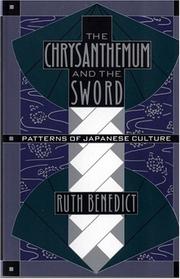
The Chrysanthemum and the Sword
Influential interpretation of Japanese culture and social norms.

Endnotes
1.
Source: academic.oup.com
Link:https://academic.oup.com/british-academy-scholarship-online/book/44964
Source snippet
OUP AcademicAum Shinrikyo and religious terrorism in Japanese collective memory | British Academy Scholarship Online | Oxford AcademicDec...
2.
Source: link.springer.com
Link:https://link.springer.com/book/9780333772690
Source snippet
Springer Nature LinkReligion and Social Crisis in Japan: Understanding Japanese Society Through the Aum Affair | Springer Nature Link...
3.
Source: Wikipedia
Title: Ee ja nai ka
Link:https://en.wikipedia.org/wiki/Ee_ja_nai_ka
4.
Source: academic.oup.com
Title: Academic Aum Shinrikyo and the Aum Incident: A Critical
Link:https://academic.oup.com/book/8388/chapter-abstract/154100562
Source snippet
OUP AcademicAum Shinrikyo and the Aum Incident: A Critical Introduction | Controversial New Religions | Oxford AcademicAugust 28, 2014...
Published: August 28, 2014
5.
Source: academic.oup.com
Link:https://academic.oup.com/british-academy-scholarship-online/book/44964/chapter/385185042
Source snippet
OUP AcademicIntroduction | Aum Shinrikyo and religious terrorism in Japanese collective memory | British Academy Scholarship Online | Oxf...
6.
Source: academic.oup.com
Link:https://academic.oup.com/book/57488/chapter-abstract/466902857
Source snippet
"Lewis (ed.), Akil N. Awan (ed.) [https://doi.org/10.1093/oso/9780197771266.001.0001..."](https://doi.org/10.1093/oso/9780197771266.001.0001...")...
7.
Source: academic.oup.com
Link:https://academic.oup.com/british-academy-scholarship-online/book/44964/chapter/398958275%20https%3A/academic.oup.com/british-academy-scholarship-online/book/44964/chapter/385187385?login=false
Source snippet
Shinrikyo and religious terrorism in Japanese collective memory | British Academy Scholarship Online | Oxford AcademicDecember 8, 2022 —...
Published: December 8, 2022
8.
Source: pure.qub.ac.uk
Link:https://pure.qub.ac.uk/en/publications/aum-shinrikyo-and-religious-terrorism-in-japanese-collective-memo/
Source snippet
Queen's University BelfastAum Shinrikyo and religious terrorism in Japanese collective memory - Queen's University BelfastDecember 8, 2022...
Published: December 8, 2022
Additional References
9.
Source: sciencedirect.com
Title: ScienceDirect Aum Shinrikyō. Can Religious Studies Cope?
Link:https://www.sciencedirect.com/science/article/abs/pii/S0048721X96900202
Source snippet
Can Religious Studies Cope? - ScienceDirectJuly 1, 1996 — RELIGION Volume 26, Issue 3, July 1996, Pages 261-270 Regular article Aum Shinr...
Published: July 1, 1996
10.
Source: cambridge.org
Title: Eastern Religious Cults (Chapter 1)
Link:https://www.cambridge.org/core/books/clinical-and-forensic-guide-to-cults-and-persuasive-leadership/eastern-religious-cults/CEE703B5FB8604F090FCC57D67D734ED
Source snippet
A Clinical and Forensic Guide to Cults and Persuasive LeadershipJune 19, 2025 — AUM SHINRIKYO Japan’s Aum Shinrikyo cult (often called “A...
Published: June 19, 2025
11.
Source: jstage.jst.go.jp
Link:https://www.jstage.jst.go.jp/article/soshioroji/40/2/40_41/_article/-char/ja/
Source snippet
41-57,174 DOI [https://doi.org/10.14959/soshioroji.40.2_41](https://doi.org/10.14959/soshioroji.40.2_41) 詳細 * 発行日: 1995/05/31 受付日: - J-STAGE公開日...
12.
Source: youtube.com
Link:https://www.youtube.com/watch?v=xR_FrDbud1E
Source snippet
Shoko Asahara, head of Aum Shinrikyo cult behind Tokyo gas attack executed...
13.
Source: youtube.com
Title: Japan’s Dancing Plague Of “What The Hell!” | Historia Ephemera
Link:https://www.youtube.com/watch?v=YucIAZGn45Q
Source snippet
Shoko Asahara: The Cultist who Terrorized Japan...
14.
Source: youtube.com
Title: AUM: The Cult at the End of the World | Official Trailer
Link:https://www.youtube.com/watch?v=v60pp4TGV4U
Source snippet
Japan's Strange and Deadly Insurrectionist Cult (1995)...
15.
Source: youtube.com
Title: Shoko Asahara: The Cultist who Terrorized Japan
Link:https://www.youtube.com/watch?v=9nAI46ZEu-w
Source snippet
AUM: The Cult at the End of the World | Official Trailer...
16.
Source: youtube.com
Title: Shoko Asahara, head of Aum Shinrikyo cult behind Tokyo gas attack executed
Link:https://www.youtube.com/watch?v=CbmeGRffcJY
Topic Tree