Within Poland
How a False Rumour Became the Kielce Pogrom
A false child-abduction story became deadly in Kielce when antisemitic rumour, social tension and official participation converged.
On this page
- The missing child story and the blood libel
- Why police, soldiers and civilians joined the violence
- The massacre's impact on Jewish survival and emigration
Page outline Jump by section
Introduction
The Kielce pogrom of 4 July 1946 was one of the most devastating examples of how an old antisemitic myth could become lethal even after the Holocaust had ended. In the city of Kielce, a false accusation that Jews had kidnapped a Christian boy for ritual murder revived the medieval “blood libel”—the baseless claim that Jews murdered Christian children to use their blood in religious ceremonies. Within hours, rumours spread through the city, and police officers, soldiers, factory workers and civilians joined in attacks on Jewish Holocaust survivors. At least 42 Jews were killed and dozens more injured.[Holocaust Encyclopedia]encyclopedia.ushmm.orgOpen source on ushmm.org.

The event matters not because it represents an outbreak of irrational mass panic alone, but because it demonstrates how deep-rooted prejudice, post-war instability, official failures and organised violence reinforced one another. The Kielce pogrom became a turning point in post-war Jewish history, convincing many survivors that rebuilding their lives in Poland was impossible.
How a False Rumour Became the Kielce Pogrom
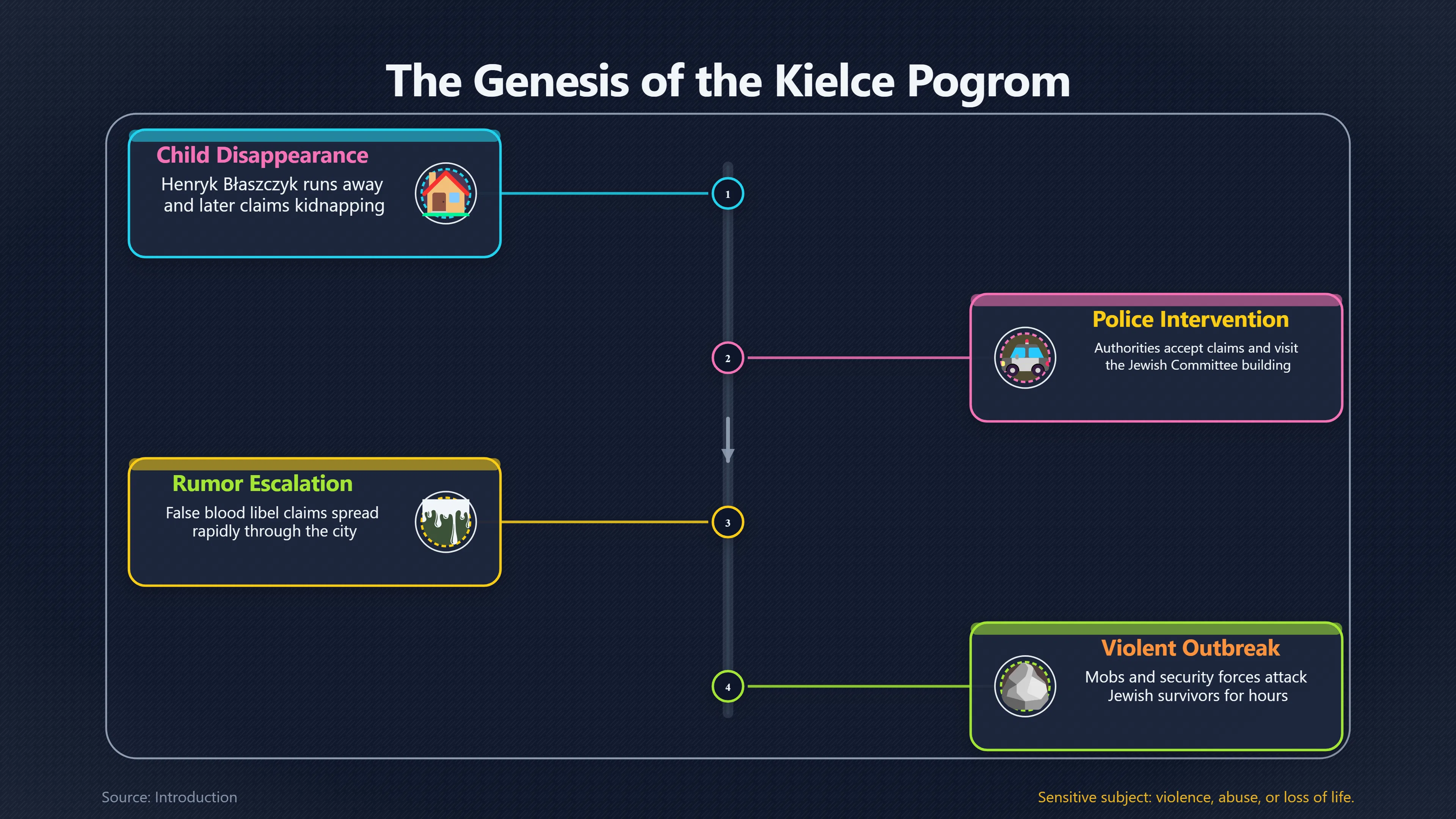
The immediate trigger was the disappearance of nine-year-old Henryk Błaszczyk. After spending time away from home, he returned and falsely claimed that Jews had abducted him. Historians agree that he had simply run away and invented the story to avoid punishment. Nevertheless, police accepted his allegations and accompanied him to the Jewish Committee building on Planty Street, where approximately 150–200 Jewish survivors and repatriates lived or worked.[Holocaust Encyclopedia]encyclopedia.ushmm.orgHolocaust Encyclopedia Kielce Pogrom | Holocaust EncyclopediaHolocaust Encyclopedia Kielce Pogrom | Holocaust Encyclopedia
The accusation quickly transformed into a familiar antisemitic rumour. Word spread that the child had been held for ritual purposes and that Jews intended to murder him for religious reasons. The allegation echoed the medieval blood libel, despite centuries of evidence demonstrating that it was entirely fictitious and had repeatedly been used to justify violence against Jewish communities across Europe.[Holocaust Encyclopedia]encyclopedia.ushmm.orgHolocaust Encyclopedia Pogroms | Holocaust EncyclopediaHolocaust Encyclopedia Pogroms | Holocaust Encyclopedia
The rumour gained credibility because it fitted existing prejudices rather than because any evidence supported it. Searches of the building found no kidnapped children or secret cellars matching the claims. The supposed crime never occurred.
Why Police, Soldiers and Civilians Joined the Violence
The violence escalated because state authority failed to challenge the rumour and, in many cases, actively participated in the attacks.
Police officers entered the building, disarmed many Jewish residents and failed to protect them. Soldiers also became involved. Outside, crowds of civilians gathered, throwing stones, beating people attempting to escape and attacking anyone identified as Jewish. Workers from a nearby factory joined the assault, increasing the size and confidence of the mob. Rather than dispersing the crowd, elements of the security forces helped create conditions in which violence could continue for hours.[Holocaust Encyclopedia]encyclopedia.ushmm.orgHolocaust Encyclopedia Kielce Pogrom | Holocaust EncyclopediaHolocaust Encyclopedia Kielce Pogrom | Holocaust Encyclopedia
Modern historians generally reject simple explanations that portray the pogrom as either a purely spontaneous riot or solely a centrally organised conspiracy. Instead, they point to several interacting pressures:
- Persistent antisemitism, including long-standing belief in blood libel myths.
- Post-war insecurity, with widespread violence, shortages and political uncertainty after German occupation.
- Competition over property, as returning Jewish survivors sometimes sought homes or possessions occupied during the war.
- Political polarisation, with communist authorities, anti-communist resistance and ordinary citizens living amid suspicion and fear.
- Institutional failure, since police and military personnel who should have restored order instead participated in or tolerated violence.[Holocaust Encyclopedia]encyclopedia.ushmm.orgHolocaust Encyclopedia Kielce Pogrom | Holocaust EncyclopediaHolocaust Encyclopedia Kielce Pogrom | Holocaust Encyclopedia
These overlapping factors made the rumour extraordinarily dangerous. The false accusation alone did not produce the massacre; it became deadly because influential individuals treated it as credible and because armed authorities failed to stop—or joined—the attacks.

Why the Blood Libel Was So Powerful
Blood libel had circulated in Christian Europe since the Middle Ages despite repeated investigations finding no evidence for the allegations. By 1946 it had been thoroughly discredited by historians, legal authorities and religious scholars, yet it still survived in local folklore and antisemitic propaganda.
The Kielce case demonstrates how enduring myths can resurface during periods of social crisis. The accusation required no physical evidence because it appealed to pre-existing stereotypes portraying Jews as dangerous outsiders. Once repeated by witnesses and officials, the rumour acquired an appearance of legitimacy even though every factual element collapsed under examination.[Holocaust Encyclopedia]encyclopedia.ushmm.orgOpen source on ushmm.org.
For historians of collective fear, Kielce illustrates a classic pattern: a familiar rumour spread rapidly because it confirmed existing anxieties rather than because new evidence emerged. Institutional endorsement then magnified the rumour’s destructive effects.
The Massacre and Its Immediate Consequences
By the end of the violence, at least 42 Jews had been murdered and roughly 40–50 others wounded. Many victims were Holocaust survivors who had returned hoping to rebuild their lives after Nazi persecution. Some were beaten to death, while others died from gunshot wounds inflicted during the attacks.[Holocaust Encyclopedia]encyclopedia.ushmm.orgHolocaust Encyclopedia Kielce Pogrom | Holocaust EncyclopediaHolocaust Encyclopedia Kielce Pogrom | Holocaust Encyclopedia
The communist government reacted quickly by arresting suspects and conducting rapid trials. Several participants were sentenced to death and executed within days. Later prosecutions also involved some police and security officials, although many historians argue that accountability remained incomplete and that political considerations influenced the investigations.[Holocaust Encyclopedia]encyclopedia.ushmm.orgOpen source on ushmm.org.
Debate over responsibility continued for decades. During the communist era, official explanations often blamed anti-communist underground groups while minimising broader social antisemitism. After 1989, access to additional archives encouraged more nuanced scholarship recognising the roles of ordinary civilians, police, soldiers, political tensions and entrenched prejudice together rather than seeking a single cause.[Holocaust Encyclopedia]encyclopedia.ushmm.orgOpen source on ushmm.org.
Why the Pogrom Changed Jewish Life in Poland
The psychological impact reached far beyond Kielce itself.
Thousands of Jewish survivors had already faced harassment and violence after returning to Poland. The Kielce massacre convinced many that even surviving Nazi occupation did not guarantee safety in peacetime. Within weeks, emigration accelerated dramatically as survivors sought refuge elsewhere in Europe, Palestine under the British Mandate and, later, Israel and other countries. The pogrom became one of the defining events driving the post-war exodus of Polish Jews.[Holocaust Encyclopedia]encyclopedia.ushmm.orgHolocaust Encyclopedia Pogroms | Holocaust EncyclopediaHolocaust Encyclopedia Pogroms | Holocaust Encyclopedia
The massacre also altered international perceptions of post-war Poland. Coming only a year after the liberation of Nazi concentration camps, it shocked observers who believed antisemitic violence would disappear with Germany’s defeat.
Why Historians Still Study Kielce
The Kielce pogrom occupies an important place in the history of collective belief because it demonstrates how rumours become dangerous when reinforced by institutions and existing prejudice.
Several broader lessons continue to shape historical interpretation:
- False stories rarely spread in isolation; they succeed when they resonate with existing fears.
- Authorities have enormous influence over whether rumours are contained or legitimised.
- Collective violence often results from the interaction of long-term prejudice with immediate political and social instability.
- Surviving the Holocaust did not end the dangers faced by many European Jews after 1945.[Holocaust Encyclopedia]encyclopedia.ushmm.orgOpen source on ushmm.org.
Unlike episodes of mass psychogenic illness, the Kielce pogrom was not driven by contagious physical symptoms or shared delusions alone. It was a case of murderous persecution fuelled by a fabricated accusation, centuries-old antisemitic mythology and institutional complicity. Within the wider history of Poland’s collective fears and moral panics, it remains one of the clearest examples of how an unfounded rumour, accepted as truth by both crowds and officials, produced catastrophic human consequences.

Amazon book picks
Further Reading
Books and field guides related to How a False Rumour Became the Kielce Pogrom. Use these as the next step if you want deeper reading beyond the article.
Fear: Anti-Semitism in Poland after Auschwitz
Directly examines post-war antisemitism including Kielce.

Endnotes
1.
Source: encyclopedia.ushmm.org
Link:https://encyclopedia.ushmm.org/narrative/11504/en
2.
Source: encyclopedia.ushmm.org
Title: Holocaust Encyclopedia Kielce Pogrom | Holocaust Encyclopedia
Link:https://encyclopedia.ushmm.org/content/en/timeline-event/holocaust/after-1945/kielce-pogrom
3.
Source: encyclopedia.ushmm.org
Title: Holocaust Encyclopedia Pogroms | Holocaust Encyclopedia
Link:https://encyclopedia.ushmm.org/content/en/article/pogroms
4.
Source: encyclopedia.ushmm.org
Title: Holocaust Encyclopedia Aftermath of pogrom in Kielce | Holocaust Encyclopedia
Link:https://encyclopedia.ushmm.org/content/en/film/aftermath-of-pogrom-in-kielce
5.
Source: ushmm.org
Title: Chilik Weizman, with permission from the family of Niusia Borensztajn Nester Niu
Link:https://www.ushmm.org/online-calendar/event/MCHLEVINELEC0524
Source snippet
2024 Ina Levine Annual Lecture—Untold Stories: The 1946 Massacre of Jews in Kielce, Poland - United States Holocaust Memorial MuseumMay 2...
6.
Source: encyclopedia.ushmm.org
Title: the kielce pogrom a blood libel massacre of holocaust survivors
Link:https://encyclopedia.ushmm.org/content/fr/article/the-kielce-pogrom-a-blood-libel-massacre-of-holocaust-survivors
7.
Source: encyclopedia.ushmm.org
Link:https://encyclopedia.ushmm.org/tags/en/tag/kielce
8.
Source: encyclopedia.ushmm.org
Link:https://encyclopedia.ushmm.org/content/hu/article/pogroms
9.
Source: holocaust.projects.history.ucsb.edu
Title: the kielce pogrom
Link:https://holocaust.projects.history.ucsb.edu/Resources/the_kielce_pogrom.htm
10.
Source: mhki.kielce.eu
Link:https://mhki.kielce.eu/aktualnosci/78-rocznica-pogromu-kieleckiego
11.
Source: newspapers.ushmm.org
Title: 1946 many dead in kielce pogrom 61287
Link:https://newspapers.ushmm.org/historical-article/1946-many-dead-in-kielce-pogrom-61287
12.
Source: newspapers.ushmm.org
Title: 1946 34 killed 42 wounded in riots at kielce in poland 61225
Link:https://newspapers.ushmm.org/historical-article/1946-34-killed-42-wounded-in-riots-at-kielce-in-poland-61225
13.
Source: newspapers.ushmm.org
Link:https://newspapers.ushmm.org/historical-article/1946-100000-jews-in-poland-strike-following-the-bloody-anti-semitic-riot-yesterday-61183
14.
Source: newspapers.ushmm.org
Title: 1946 pogrom sweeps polish city leaving 34 dead 53014
Link:https://newspapers.ushmm.org/historical-article/1946-pogrom-sweeps-polish-city-leaving-34-dead-53014
Additional References
15.
Source: youtube.com
Link:https://www.youtube.com/watch?v=vJfJ242Wd6A
Source snippet
4 The Kielce Pogrom: What was happening to the Jews in post-WWII Soviet Europe...
16.
Source: youtube.com
Link:https://www.youtube.com/watch?v=onVS9R_g2io
Source snippet
2 Virtual Discussion: The Kielce Pogrom and Holocaust Distortion in Poland...
17.
Source: youtube.com
Title: Virtual Discussion: The Kielce Pogrom and Holocaust Distortion in Poland
Link:https://www.youtube.com/watch?v=Vv7KAU6jTf4
Source snippet
3 80th Anniversary of the Kielce Pogrom. Dr. Ryszard Śmietanka-Kruszelnicki on "History Happens Today"...
18.
Source: youtube.com
Title: The Kielce Pogrom: What was happening to the Jews in post-WWII Soviet Europe
Link:https://www.youtube.com/watch?v=Tl6SCLutZcY
Source snippet
5 IPNtv: POGROM or SLAUGHTER (documentary with ENG subtitles - 2008)...
19.
Source: kielce.ipn.gov.pl
Link:https://kielce.ipn.gov.pl/kie/aktualnosci/203233%2C78-rocznica-pogromu-Zydow-w-Kielcach.html
Source snippet
rocznica pogromu Żydów w Kielcach - Aktualności Instytut Pamięci Narodowej - KielceJuly 4, 2024 — 78. rocznica pogromu Żydów w Kielcach P...
Published: July 4, 2024
20.
Source: kielce.ipn.gov.pl
Link:https://kielce.ipn.gov.pl/kie/aktualnosci/224919%2C79-rocznica-pogromu-Zydow-w-Kielcach.html
Source snippet
rocznica pogromu Żydów w Kielcach - Aktualności Instytut Pamięci Narodowej - KielceJuly 4, 2025 — 79. ROCZNICA POGROMU ŻYDÓW W KIELCACH 4...
Published: July 4, 2025
21.
Source: academic.oup.com
Link:https://academic.oup.com/hgs/advance-article-abstract/doi/10.1093/hgs/dcag026/8671263
Source snippet
Ewa Wampuszyc | Holocaust and Genocide Studies | Oxford AcademicMay 6, 2026 — Journal Article CURSED: A SOCIAL PORTRAIT OF THE KIELCE POG...
Published: May 6, 2026
22.
Source: academic.oup.com
Link:https://academic.oup.com/cornell-scholarship-online/book/56620
Source snippet
oup.comCursed: A Social Portrait of the Kielce Pogrom | Cornell Scholarship Online | Oxford AcademicNovember 15, 2023 — CURSED: A SOCIAL...
Published: November 15, 2023
23.
Source: youtube.com
Title: IPNtv: POGROM or SLAUGHTER (documentary with ENG subtitles
Link:https://www.youtube.com/watch?v=jKgQprIuGUU
24.
Source: kielce.ipn.gov.pl
Title: ipn.gov.pl77. rocznica pogromu Żydów w Kielcach
Link:https://kielce.ipn.gov.pl/kie/aktualnosci/187714%2C77-rocznica-pogromu-Zydow-w-Kielcach.html
Topic Tree