Within France's Strange Fears
When Possession and Miracles Became Political Weapons
Loudun and Saint-Medard show how contested bodies became evidence in struggles over religion, politics and public authority.
On this page
- The Loudun possessions and Urbain Grandier
- The Saint Medard Convulsionaries
- Who controlled the meaning of extraordinary symptoms
Page outline Jump by section
Introduction
In seventeenth- and eighteenth-century France, reports of demonic possession, miraculous healing and violent religious convulsions were never simply matters of private faith. They became public contests over authority. Kings, bishops, judges, physicians and rival religious factions all sought to decide whether extraordinary events were genuine acts of God, fraud, illness or political provocation. The result was that unusual bodily experiences—visions, convulsions, ecstatic trances and claimed miracles—became evidence in struggles over who possessed legitimate religious and political power.
Two episodes illustrate this especially clearly: the possessions at Loudun in the 1630s and the Convulsionary movement centred on the cemetery of Saint-Médard in Paris a century later. Although separated by nearly one hundred years, both cases show how contested religious experiences could be transformed into national controversies that shaped debates about faith, medicine, law and state authority.[Wiley Online Library]onlinelibrary.wiley.comOnline Library The possessions at Loudun: tracking the discourse of dissociationWiley Online LibraryThe possessions at Loudun: tracking the discourse of dissociation - Stephenson - 2017 - Journal of Analytical Psychol…
When possession became a political weapon
France in the seventeenth century remained deeply marked by the religious conflicts that had followed the Reformation. Catholic leaders sought visible demonstrations of the Church’s authority at the same time as the monarchy worked to centralise political power. In this atmosphere, public exorcisms and miraculous claims carried significance far beyond the individuals involved.
A successful exorcism could be presented as proof of the Catholic Church’s divine authority. A failed one, or one surrounded by scandal, could damage both religious and political credibility. Likewise, accusations of witchcraft or demonic influence could eliminate troublesome individuals while appearing to defend the faith.
Because these events unfolded before crowds, attracted pamphlets and rumours, and often involved official investigations, they became part of wider struggles over legitimacy rather than isolated episodes of private belief.[Taylor & Francis]taylorfrancis.compossessions loudun 1634 brian levackTaylor & FrancisThe Possessions at Loudun, 1634 | 67 | v2 | The Witchcraft Sourcebook…
The Loudun possessions and Urbain Grandier
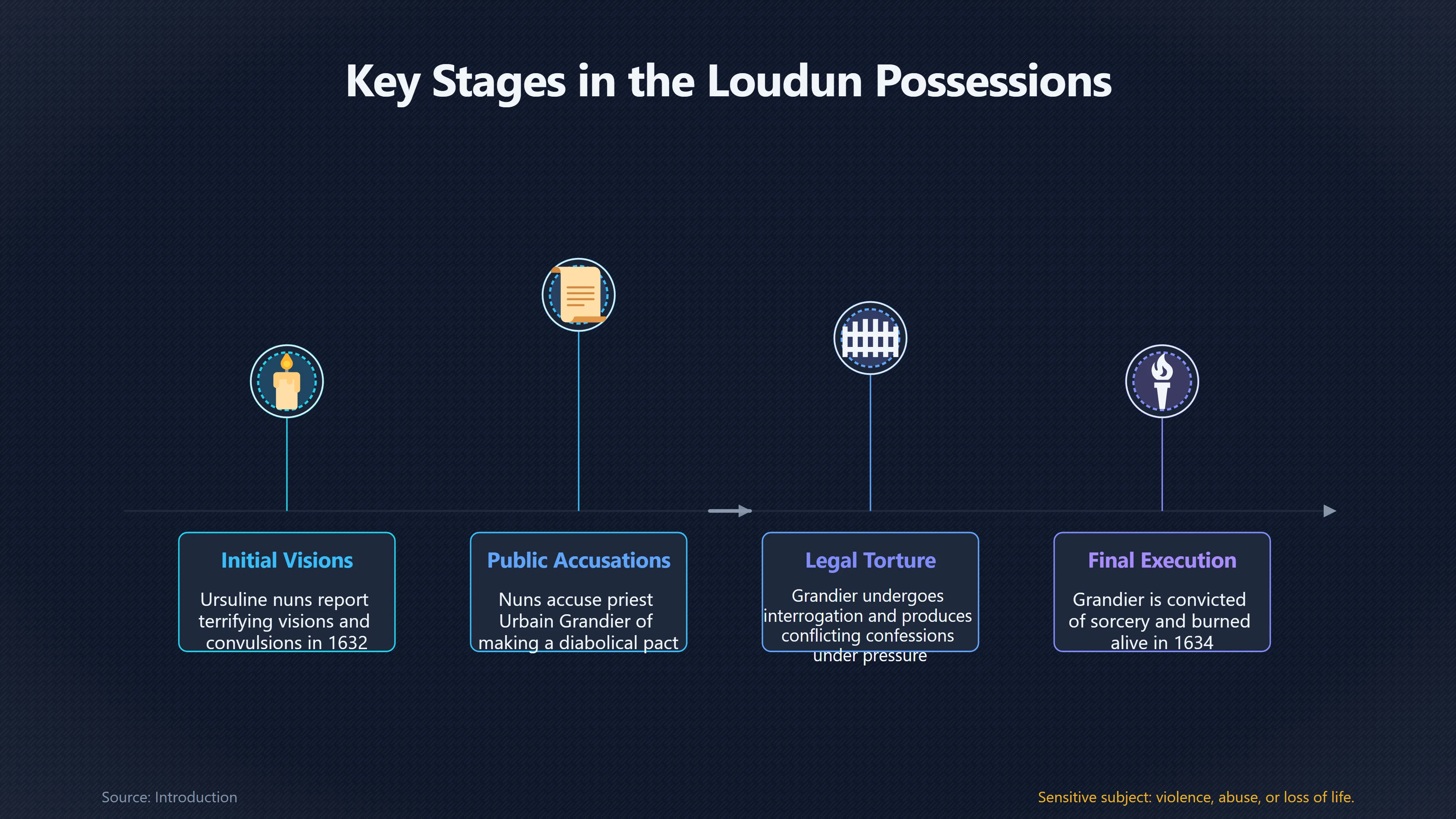
The possessions at Loudun began in 1632, when Ursuline nuns claimed to suffer terrifying visions, convulsions and attacks by demons. During public exorcisms they accused the local priest, Urbain Grandier, of having bewitched them through a pact with the Devil.
Grandier was already a controversial figure. He had enemies among local officials, had quarrelled with influential clergy and had become entangled in wider political disputes during the period when Cardinal Richelieu was strengthening royal authority. Historians generally agree that these existing conflicts made him an unusually vulnerable target once accusations of possession emerged.[Taylor & Francis]taylorfrancis.compossessions loudun 1634 brian levackTaylor & FrancisThe Possessions at Loudun, 1634 | 67 | v2 | The Witchcraft Sourcebook…
His trial combined religious spectacle with legal procedure. Exorcists claimed demons identified Grandier by name. Documents supposedly proving a diabolical pact were produced. Under torture he confessed before withdrawing the confession, yet he was convicted of sorcery and burned alive in 1634.
One striking feature of the episode is that the possessions did not simply end with Grandier’s execution. Some nuns continued to report possession and further exorcisms followed, undermining the simple claim that removing the alleged sorcerer had removed the cause. Modern historians therefore tend to see Loudun less as proof of supernatural intervention than as a complex interaction between religious expectation, institutional rivalry, psychological distress and political manipulation.[wiley.com]onlinelibrary.wiley.comOnline Library The possessions at Loudun: tracking the discourse of dissociationWiley Online LibraryThe possessions at Loudun: tracking the discourse of dissociation - Stephenson - 2017 - Journal of Analytical Psychol…
Why Loudun mattered beyond one convent
Loudun became famous across Europe because it demonstrated how spectacular religious performances could influence public opinion.
Several forces reinforced one another:
- Public exorcisms drew enormous crowds.
- Printed accounts spread the story well beyond the town.
- Church authorities presented the events as evidence of spiritual warfare.
- Political rivals used the accusations against Grandier.
- Royal officials demonstrated that challenges to established authority would be crushed.
Later writers interpreted the same evidence very differently. Some nineteenth-century physicians regarded the nuns’ behaviour as an early example of hysteria or dissociation. Twentieth-century scholars such as Michel de Certeau examined the case as a struggle over language, authority and the power to define truth, while psychologists have explored it through theories of dissociation and social contagion rather than supernatural causation.[Wiley Online Library]onlinelibrary.wiley.comOnline Library The possessions at Loudun: tracking the discourse of dissociationWiley Online LibraryThe possessions at Loudun: tracking the discourse of dissociation - Stephenson - 2017 - Journal of Analytical Psychol…
The Saint-Médard Convulsionaries
If Loudun centred on demonic possession, Saint-Médard revolved around miracles.
After the death of the Jansenist deacon François de Pâris in 1727, pilgrims gathered at his grave in the Saint-Médard cemetery in Paris. Visitors soon reported miraculous cures. Then increasingly dramatic physical manifestations appeared: shaking, convulsions, ecstatic cries, prophetic speech and apparent insensitivity to pain.
Unlike Loudun, these phenomena were linked to a major religious dispute inside French Catholicism. Jansenists argued that the miracles demonstrated divine approval for their movement, while opponents dismissed them as fraud, enthusiasm or demonic deception. The same bodily symptoms therefore acquired radically different meanings depending on the observer’s theological commitments.[OUP Academic]academic.oup.comOUP AcademicThe Convulsionaries: Antics on the French Revolutionary Stage | Choreomania: Dance and Disorder | Oxford Academic…
As reports multiplied, crowds flocked to the cemetery. Printed testimonies, medical commentary and religious polemics spread throughout France. What began as local devotion became a national controversy over whether miracles still occurred and who possessed authority to authenticate them.
Convulsions, suffering and public controversy
The movement evolved in unexpected directions.
Many Convulsionaries believed violent bodily experiences demonstrated God’s action. Some participants voluntarily underwent what they called “reliefs”—extreme physical pressures or blows administered while they were in ecstatic states—which they believed confirmed divine protection. Critics regarded these practices as dangerous fanaticism or theatrical fraud.
Authorities initially watched with caution but eventually concluded that the gatherings threatened public order. In 1732 the cemetery was closed by royal order. Rather than disappearing, however, the movement shifted into private houses where smaller groups continued meeting for years, developing increasingly elaborate prophetic traditions.[Persée]persee.frPerséeCatherine-Laurence Maire, Les convulsionnaires de Saint-Médard: miracles, convulsions et prophéties à Paris au XVIIIe siècle - Persée…
The government’s response reflected more than concern about unusual religious behaviour. Officials feared the movement could become a focus for political opposition because Jansenism already challenged important elements of royal and ecclesiastical policy.
Who controlled the meaning of extraordinary symptoms?
Both Loudun and Saint-Médard reveal a recurring pattern in French history: unusual bodily experiences became battlegrounds because no single institution possessed uncontested authority to explain them.
Different groups interpreted identical behaviours through entirely different frameworks.
ObserverLikely interpretationCatholic exorcistsDemonic possession or divine interventionJansenistsMiraculous confirmation of religious truthOpposing clergyFanaticism, deception or diabolical illusionRoyal authoritiesPotential threat to public orderPhysiciansPhysical or psychological disorderModern historiansInteraction of belief, politics, culture and psychology
The central question was therefore not simply whether miracles occurred. It was who had the right to declare them genuine.
That dispute explains why authorities invested so much effort in investigations, public ceremonies, censorship and legal proceedings. Controlling the interpretation of extraordinary experiences also meant controlling religious legitimacy.
How historians explain these episodes today
Most modern historians reject simple explanations that reduce either Loudun or Saint-Médard to deliberate fraud or to straightforward “mass hysteria”. Instead, they emphasise several overlapping influences.
Religious expectation. Participants lived in a culture where demons, miracles and divine intervention were widely accepted possibilities.
Political conflict. Existing rivalries shaped who became accused, defended or celebrated.
Social contagion. Dramatic behaviours could spread through observation, imitation and shared emotional environments without implying conscious deception.
Institutional incentives. Churches, courts and governments all had reasons to authenticate or suppress extraordinary claims depending on their wider interests.
Changing medical interpretation. Later physicians increasingly described possession and convulsions using concepts such as hysteria, dissociation or neurological disturbance, although historians caution against imposing modern diagnoses too confidently on people from very different cultural settings.[wiley.com]onlinelibrary.wiley.comOnline Library The possessions at Loudun: tracking the discourse of dissociationWiley Online LibraryThe possessions at Loudun: tracking the discourse of dissociation - Stephenson - 2017 - Journal of Analytical Psychol…
Why these episodes still matter
The Loudun possessions and the Saint-Médard Convulsionaries remain important because they illustrate how collective belief becomes politically significant when institutions compete to define reality.
Neither episode can be understood purely as religious enthusiasm or psychological disturbance. In both cases, extraordinary bodily experiences acquired their historical importance because they intersected with struggles over authority. Kings sought stability, churches defended doctrine, religious minorities sought legitimacy, physicians developed competing explanations and spectators interpreted the same events according to their own expectations.
These French controversies also anticipated later debates about crowd behaviour, psychosomatic illness, media amplification and the relationship between belief and evidence. They demonstrate that spectacular claims rarely spread on their own. They become historically powerful when they fit wider conflicts over identity, legitimacy and the right to decide what counts as truth.
Amazon book picks
Further Reading
Books and field guides related to When Possession and Miracles Became Political Weapons. Use these as the next step if you want deeper reading beyond the article.
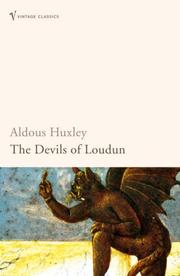

The witch-hunt in early modern Europe
Places French possession episodes within wider persecution history.
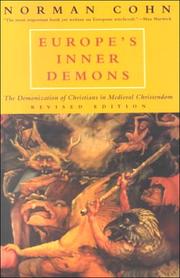

Witchcraft in Europe,
Includes documents on exorcism, witchcraft and religious conflict.
Endnotes
1.
Source: onlinelibrary.wiley.com
Title: Online Library The possessions at Loudun: tracking the discourse of dissociation
Link:https://onlinelibrary.wiley.com/doi/10.1111/1468-5922.12336
Source snippet
Wiley Online LibraryThe possessions at Loudun: tracking the discourse of dissociation - Stephenson - 2017 - Journal of Analytical Psychol...
2.
Source: academic.oup.com
Link:https://academic.oup.com/book/5874/chapter/149145340
Source snippet
OUP AcademicThe Convulsionaries: Antics on the French Revolutionary Stage | Choreomania: Dance and Disorder | Oxford Academic...
3.
Source: onlinelibrary.wiley.com
Title: 1468 5922.12336
Link:https://onlinelibrary.wiley.com/doi/abs/10.1111/1468-5922.12336
4.
Source: academic.oup.com
Link:https://academic.oup.com/book/12871/chapter-abstract/163191543
5.
Source: youtube.com
Title: Loudun Possessions | STUFF YOU MISSED IN HISTORY CLASS
Link:https://www.youtube.com/watch?v=72LB8-K7mbo
Source snippet
The Devils of Loudun | A Story of Witchcraft...
6.
Source: taylorfrancis.com
Title: possessions loudun 1634 brian levack
Link:https://www.taylorfrancis.com/chapters/mono/10.4324/9781315715292-67/possessions-loudun-1634-brian-levack
Source snippet
Taylor & FrancisThe Possessions at Loudun, 1634 | 67 | v2 | The Witchcraft Sourcebook...
7.
Source: pubmed.ncbi.nlm.nih.gov
Title: Pub Med The possessions at Loudun: tracking the discourse of dissociation
Link:https://pubmed.ncbi.nlm.nih.gov/28776658/
Source snippet
The possessions at Loudun: tracking the discourse of dissociation - PubMed...
8.
Source: persee.fr
Link:https://www.persee.fr/doc/ahess_0395-2649_1987_num_42_1_283373_t1
Source snippet
PerséeCatherine-Laurence Maire, Les convulsionnaires de Saint-Médard: miracles, convulsions et prophéties à Paris au XVIIIe siècle - Persée...
9.
Source: persee.fr
Link:https://www.persee.fr/doc/dhs_0070-6760_1986_num_18_1_1619_t1
10.
Source: persee.fr
Title: Pour une lecture bakhtinienne du témoignage religieux
Link:https://www.persee.fr/doc/textu_0766-4451_2012_num
11.
Source: persee.fr
Title: ether 0014 2239 1988 num 63 4 4365 t1 0613 0000 2
Link:https://www.persee.fr/doc/ether_0014-2239_1988_num_63_4_4365_t1
12.
Source: occult-world.com
Title: loudun possessions
Link:https://occult-world.com/loudun-possessions/
Additional References
13.
Source: journals.library.ualberta.ca
Link:https://journals.library.ualberta.ca/constellations/index.php/constellations/article/view/29475
Source snippet
Diabolical Martyrdom: Urbain Grandier, the Transgressive Outsider, and the Surrogate Victim in The Possession at Loudun | ConstellationsA...
14.
Source: youtube.com
Title: Demonic Possession, Sorcery & Satanic Pacts
Link:https://www.youtube.com/watch?v=qRGI6i4rULA
Source snippet
1961: John Whiting's TOUR of THE DEVILS' LOUDON | Monitor | BBC Archive...
15.
Source: degruyterbrill.com
Title: Case of Witchcraft
Link:https://www.degruyterbrill.com/document/doi/10.1515/9780773567115/html?lang=en
Source snippet
The Trial of Urbain GrandierAugust 3, 2023 — CASE OF WITCHCRAFT The Trial of Urbain Grandier * Robert Rapley Language: English Published/...
Published: August 3, 2023
16.
Source: youtube.com
Title: The Devils of Loudun | A Story of Witchcraft
Link:https://www.youtube.com/watch?v=BMxyt6x7_Bc
Source snippet
Demonic Possession, Sorcery & Satanic Pacts - Witchcraft and Exorcism in 17th Century Loudon France...
17.
Source: scielo.org.mx
Link:https://www.scielo.org.mx/scielo.php?pid=S1405-09272025000200251&script=sci_arttext_plus&tlng=es
Source snippet
“L’histoire n’est jamais sûre”: perspectivas epistémicas y políticas de La possessione di Loudun”1August 4, 2025 — “L’HISTOIRE N’EST JAMA...
Published: August 4, 2025
18.
Source: degruyterbrill.com
Link:https://www.degruyterbrill.com/document/doi/10.1515/9781400869916-009/html
19.
Source: degruyterbrill.com
Link:https://www.degruyterbrill.com/document/doi/10.1515/9781400869916-010/pdf?licenseType=restricted
20.
Source: cambridge.org
Link:https://www.cambridge.org/core/journals/annales-histoire-sciences-sociales/article/abs/catherinelaurence-maire-les-convulsionnaires-de-saintmedard-miracles-convulsions-et-propheties-a-paris-au-xviiie-siecle-paris-gallimardjulliard-archives-1985-268-p/426F8729B4B908F01F2F7DFA4A3DC423
21.
Source: cambridge.org
Link:https://www.cambridge.org/core/journals/annales-histoire-sciences-sociales/article/catherinelaurence-maire-les-convulsionnaires-de-saintmedard-miracles-convulsions-et-propheties-a-paris-au-xviiie-siecle-paris-gallimardjulliard-archives-1985-268-p/426F8729B4B908F01F2F7DFA4A3DC423
22.
Source: encyclopedia.com
Link:https://www.encyclopedia.com/science/encyclopedias-almanacs-transcripts-and-maps/convulsionaries-st-medard
Topic Tree