Within Guatemala Panics
Why Guatemala Believed the Organ Theft Rumours
The 1994 organ theft scare shows how false claims can become believable when they echo real trafficking, adoption abuse and official deception.
On this page
- The attacks on Melissa Larson and June Weinstock
- How adoption abuses made the rumours feel plausible
- How distrust turned an unverified story into violence
Page outline Jump by section
Introduction
In 1994, Guatemala experienced one of its most destructive rumour panics when false claims that foreigners were kidnapping children to harvest their organs triggered mob attacks against innocent visitors. No credible evidence ever emerged that an international network of foreign organ thieves was operating in the country. Yet the rumour spread with extraordinary force because it echoed genuine fears about child disappearances, a deeply flawed international adoption system, decades of state violence and widespread distrust of official institutions. The result was not simply a mistaken belief but a series of violent assaults that demonstrated how rumours can become deadly when they appear to fit people’s lived experience rather than the available evidence.[time.com]time.comDangerous RumorsDangerous RumorsApril 18, 1994…
The attacks on Melissa Larson and June Weinstock
The panic became internationally visible through two attacks on American women travelling in Guatemala.
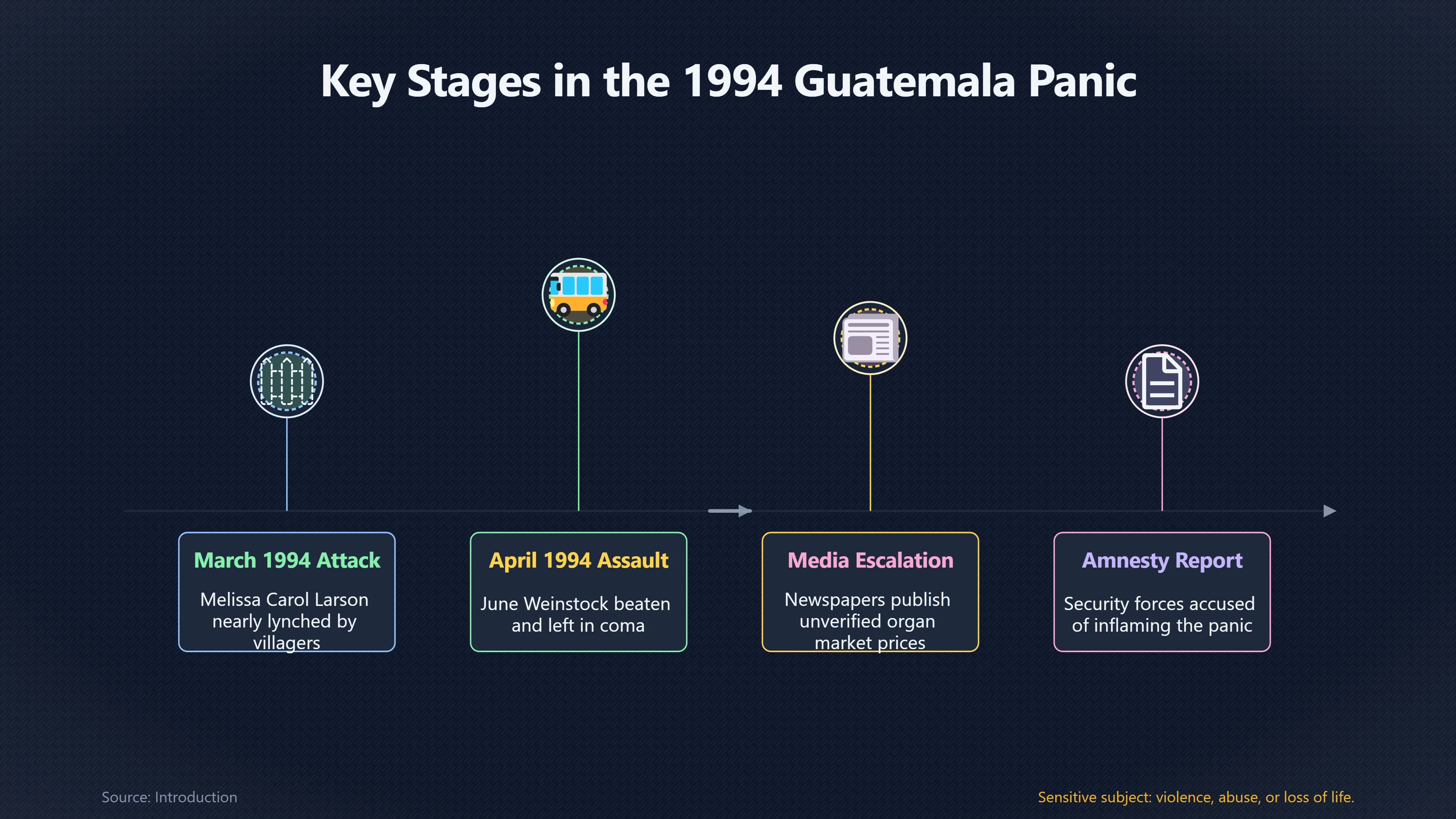
In March 1994, Melissa Carol Larson of New Mexico was nearly lynched after villagers accused her of attempting to steal a child. Police investigated and found no evidence supporting the allegation. Nevertheless, the accusation spread rapidly through the community before officials could intervene.[The Independent]independent.co.ukThe IndependentGuatemala 'child theft' fears spark mob attack | The Independent | The IndependentApril 2, 1994…
Only weeks later, environmental writer and editor June Weinstock visited San Cristóbal Verapaz. After photographing local children, she became the target of rumours that she had abducted a child for the organ trade. The missing child was later found unharmed, but by then hundreds of people had gathered. Weinstock was dragged from a bus and beaten for hours with clubs, metal pipes and machetes, suffering catastrophic injuries that left her in a coma. An American interpreter accompanying her was also assaulted. Dozens of people were later detained.[latimes.com]latimes.comLos Angeles TimesChild Kidnaping Rumors Fuel Attacks on Americans: Guatemala: Military may be fomenting fear of foreigners. Hysteria may…
These were not isolated misunderstandings. During the same period, foreigners, aid workers and journalists reported increasing hostility in rural areas, where rumours of child theft circulated from village to village and strangers were viewed with suspicion.[Time]time.comDangerous RumorsDangerous RumorsApril 18, 1994…
How adoption abuses made the rumours feel plausible
The most important question is not whether the organ-theft story was true—it was not—but why so many people found it believable.
By the early 1990s, Guatemala already had a long history of children disappearing during the civil war. Thousands of children had been separated from their families through conflict, forced disappearance or irregular adoption practices. During the following decades, an expanding private international adoption industry also developed, with documented cases of fraud, coercion, falsified paperwork and, in some instances, outright kidnapping for adoption. These abuses were real, although they were very different from the claim that children were being killed for their organs.[theguardian.com]theguardian.comOpen source on theguardian.com.
Rachel Nolan’s research shows that many Guatemalans had direct experience of child trafficking, corrupt intermediaries and weak legal oversight. In that environment, rumours about children being taken abroad did not emerge from nowhere. Instead, they exaggerated genuine abuses into an even more frightening story involving wealthy foreigners and the international organ market.[The Guardian]theguardian.comOpen source on theguardian.com.
This distinction matters. Historians generally treat the organ-theft allegation as a classic rumour panic built upon fragments of reality. The trafficking of children for international adoption has been extensively documented. The alleged harvesting of organs by foreign visitors has not.[Human Trafficking Search]humantraffickingsearch.orgHuman Trafficking SearchBeneath the organ trade: a critical analysis of the organ trafficking discourse - Human Trafficking Search…

How distrust turned an unverified story into violence
Guatemala in 1994 was emerging from more than three decades of civil war. Many rural communities had experienced massacres, forced disappearances, military repression and repeated official deception. Confidence in police, courts and government institutions was extremely low.
In such conditions, rumours often become substitutes for trusted information. Rather than waiting for official investigations, frightened communities relied on neighbours, relatives and local gossip to identify supposed threats. A stranger photographing children or speaking poor Spanish could quickly become the focus of collective suspicion.[humanrts.umn.edu]humanrts.umn.eduU N Commission on Human RightsUN Commission on Human Rights - Report on Human Rights Situation in Guatemala (Dec 94)…
Several contemporary observers argued that the panic was intensified by sensational reporting. Stories about child theft circulated widely in newspapers and local media despite the absence of evidence for organ harvesting. One notorious newspaper graphic even claimed to list supposed market prices for children’s organs without providing credible sourcing, reinforcing public fears instead of questioning them.[harpers.org]harpers.orgDestined for Export, by Rachel NolanDestined for Export, by Rachel Nolan
Human rights organisations also warned that some political actors may have exploited the rumours. Amnesty International reported allegations that people linked to the security forces helped inflame the panic and later used the resulting violence to justify mass arrests and repression in San Cristóbal Verapaz. Although these claims remain debated, they illustrate how rumour panics can become intertwined with existing political conflicts.[Amnesty International]amnesty.orgAmnesty InternationalGuatemala: torture / fear of torture: Jorge Alberto Caal, Gilberto Moral Caal - Amnesty InternationalApril 12, 1994…
What evidence exists for the organ-theft claims?
Despite widespread belief at the time, investigators never found credible evidence that foreign visitors in Guatemala were abducting children to remove their organs for transplantation.
International reporting in 1994 repeatedly noted the absence of supporting evidence, even while documenting the attacks themselves. Human rights observers likewise distinguished between documented child-trafficking problems and the unsubstantiated organ-harvesting allegations.[independent.co.uk]independent.co.ukThe IndependentGuatemala 'child theft' fears spark mob attack | The Independent | The IndependentApril 2, 1994…
Scholars studying organ-trafficking rumours place Guatemala within a broader pattern found in Latin America and elsewhere, where stories about wealthy outsiders stealing children’s organs spread during periods of political instability and inequality. These narratives often borrow from much older folklore about body theft while adapting it to modern fears about transplantation, globalisation and international power imbalances.[Human Trafficking Search]humantraffickingsearch.orgHuman Trafficking SearchBeneath the organ trade: a critical analysis of the organ trafficking discourse - Human Trafficking Search…

Why the episode remains important
The 1994 panic is remembered not because the rumour proved true, but because it illustrates how false claims can become persuasive when they echo genuine social wounds.
Subsequent investigations into Guatemala’s adoption industry confirmed widespread fraud, coercion and illegal practices that separated many children from their families, particularly during and after the civil war. Those findings help explain why communities were prepared to believe that children were disappearing, even though the specific allegation of organ theft by foreigners lacked evidence.[The Guardian]theguardian.comOpen source on theguardian.com.
The episode therefore stands as a cautionary example of a rumour panic rather than a medical case of mass hysteria. Fear spread collectively, but it was rooted in historical experience: real child trafficking, real institutional corruption and real distrust created conditions in which an unsupported story could appear more believable than official denials. The consequences were immediate and severe, leaving innocent people seriously injured while diverting attention from the genuine abuses that required investigation.[umn.edu]humanrts.umn.eduU N Commission on Human RightsUN Commission on Human Rights - Report on Human Rights Situation in Guatemala (Dec 94)…
Amazon book picks
Further Reading
Books and field guides related to Why Guatemala Believed the Organ Theft Rumours. Use these as the next step if you want deeper reading beyond the article.
Extraordinary Popular Delusions and the Madness of Crowds
Rating: 4.0/5 from 5 Google Books ratings
Offers historical perspective on destructive rumour panics.



Endnotes
1.
Source: time.com
Title: Dangerous Rumors
Link:https://time.com/archive/6725133/dangerous-rumors/
Source snippet
Dangerous RumorsApril 18, 1994...
Published: April 18, 1994
2.
Source: humanrts.umn.edu
Title: U N Commission on Human Rights
Link:https://humanrts.umn.edu/commission/country51/15.htm
Source snippet
UN Commission on Human Rights - Report on Human Rights Situation in Guatemala (Dec 94)...
3.
Source: harpers.org
Title: Destined for Export, by Rachel Nolan
Link:https://harpers.org/archive/2019/04/destined-for-export-guatemalan-adoptions/
4.
Source: amnesty.org
Link:https://www.amnesty.org/en/documents/amr34/021/1994/en/
Source snippet
Amnesty InternationalGuatemala: torture / fear of torture: Jorge Alberto Caal, Gilberto Moral Caal - Amnesty InternationalApril 12, 1994...
Published: April 12, 1994
5.
Source: content.time.com
Link:https://content.time.com/time/subscriber/article/0%2C33009%2C980550%2C00.html
6.
Source: the-independent.com
Link:https://www.the-independent.com/news/world/guatemala-child-theft-fears-spark-mob-attack-1367414.html
7.
Source: harpers.org
Link:https://harpers.org/author/rachelnolan/
8.
Source: harpers.org
Link:https://harpers.org/archive/2024/04/children-for-sale/
9.
Source: harpers.org
Link:https://harpers.org/tag/rachel-nolan/
10.
Source: theguardian.com
Link:https://www.theguardian.com/news/2024/jan/04/guatemalas-baby-brokers-how-tens-of-thousands-of-children-were-stolen-for-adoption
11.
Source: independent.co.uk
Link:https://www.independent.co.uk/news/world/guatemala-child-theft-fears-spark-mob-attack-1367414.html
Source snippet
The IndependentGuatemala 'child theft' fears spark mob attack | The Independent | The IndependentApril 2, 1994...
Published: April 2, 1994
12.
Source: latimes.com
Link:https://www.latimes.com/archives/la-xpm-1994-04-02-mn-41338-story.html
Source snippet
Los Angeles TimesChild Kidnaping Rumors Fuel Attacks on Americans: Guatemala: Military may be fomenting fear of foreigners. Hysteria may...
13.
Source: humantraffickingsearch.org
Link:https://humantraffickingsearch.org/resource/beneath-the-organ-trade-a-critical-analysis-of-the-organ-trafficking-discourse/
Source snippet
Human Trafficking SearchBeneath the organ trade: a critical analysis of the organ trafficking discourse - Human Trafficking Search...
14.
Source: theguardian.com
Link:https://www.theguardian.com/p/qtaqn
15.
Source: theguardian.com
Link:https://www.theguardian.com/news/2024/jan/04/guatemalas-baby-brokers-how-tens-of-thousands-of-children-were-stolen-for-adoption?s=09
16.
Source: latimes.com
Title: Behind the Kidnaping of Children for Their Organs
Link:https://www.latimes.com/archives/la-xpm-1994-05-01-op-52449-story.html
17.
Source: latimes.com
Link:https://www.latimes.com/archives/la-xpm-1994-04-16-mn-46486-story.html
18.
Source: latimes.com
Title: World IN BRIEF: GUATEMALA: American Woman Beaten by Mob
Link:https://www.latimes.com/archives/la-xpm-1994-03-31-mn-40533-story.html
Additional References
19.
Source: ecoi.net
Link:https://www.ecoi.net/en/document/2136987.html
Source snippet
OHCHR – UN Office of the High Commissioner for Human Rights (Author): “UN experts alarmed by reports of historic illegal adoptions and al...
20.
Source: dialnet.unirioja.es
Link:https://dialnet.unirioja.es/servlet/articulo?codigo=4821475
21.
Source: washingtonpost.com
Title: The Washington Post WITCH HUNT
Link:https://www.washingtonpost.com/archive/lifestyle/1994/05/17/witch-hunt/d2663dda-139e-4e3d-8e81-eb48b09f02be/
Source snippet
The Washington PostWITCH HUNT - The Washington Post...
22.
Source: bu.edu
Link:https://www.bu.edu/pardeeschool/2024/01/04/nolans-book-excerpted-in-the-guardian/
23.
Source: nybooks.com
Link:https://www.nybooks.com/articles/1998/03/26/the-international-organ-traffic/
24.
Source: longreads.com
Title: Guatemala’s Baby Brokers: How Thousands of Children Were Stolen for Adoption
Link:https://longreads.com/2024/01/05/guatemalas-baby-brokers-how-thousands-of-children-were-stolen-for-adoption/
25.
Source: aceprensa.com
Title: Guatemala: incidentes violentos por rumores sobre raptos de niños
Link:https://www.aceprensa.com/familia/guatemala-incidentes-violentos-por-rumores-sobre-r/
26.
Source: researchprofiles.csumb.edu
Title: el uso de la fuerza el fraude y la coerción en algunas adopciones
Link:https://researchprofiles.csumb.edu/en/publications/el-uso-de-la-fuerza-el-fraude-y-la-coerci%C3%B3n-en-algunas-adopciones/
27.
Source: nybooks.com
Title: Torn Asunder | Oscar Lopez | The New York Review of Books
Link:https://www.nybooks.com/articles/2026/02/26/torn-asunder-until-i-find-you-rachel-nolan/
28.
Source: deseret.com
Title: TOURIST S AVOIDING CHILDREN IN GUATEMALA – Deseret News
Link:https://www.deseret.com/1994/4/2/19100760/tourists-avoiding-children-in-guatemala/
Topic Tree