Within Guinea
How Rumour Turned Deadly at Wome
The murder of eight outreach workers shows how repeated rumours can turn official intervention into apparent proof of conspiracy.
On this page
- What happened on 16 September 2014
- The beliefs surrounding the outreach team
- What later accounts explain and dispute
Page outline Jump by section
Introduction
The killings at Womé (also spelled Womey) on 16 September 2014 became the deadliest single attack on Ebola outreach workers during the West African epidemic and one of the clearest examples of how rumours can transform a public health emergency into a crisis of trust. Eight members of an outreach delegation—including health officials, local administrators, journalists and a religious leader—were murdered after travelling to the village to explain Ebola prevention measures. Their deaths were not caused by a mysterious cult or an irrational panic in isolation. Instead, they emerged from a combination of frightening rumours, long-standing distrust of the state, confusion about an unfamiliar disease and local political tensions. Later research has challenged simple explanations that blamed only “ignorance” or “superstition”, arguing that the attack reflected much deeper social and historical pressures.[cpj.org]cpj.orgCommittee to Protect JournalistsJournalists killed while covering Ebola education campaign in Guinea - Committee to Protect JournalistsSe…
What happened on 16 September 2014?
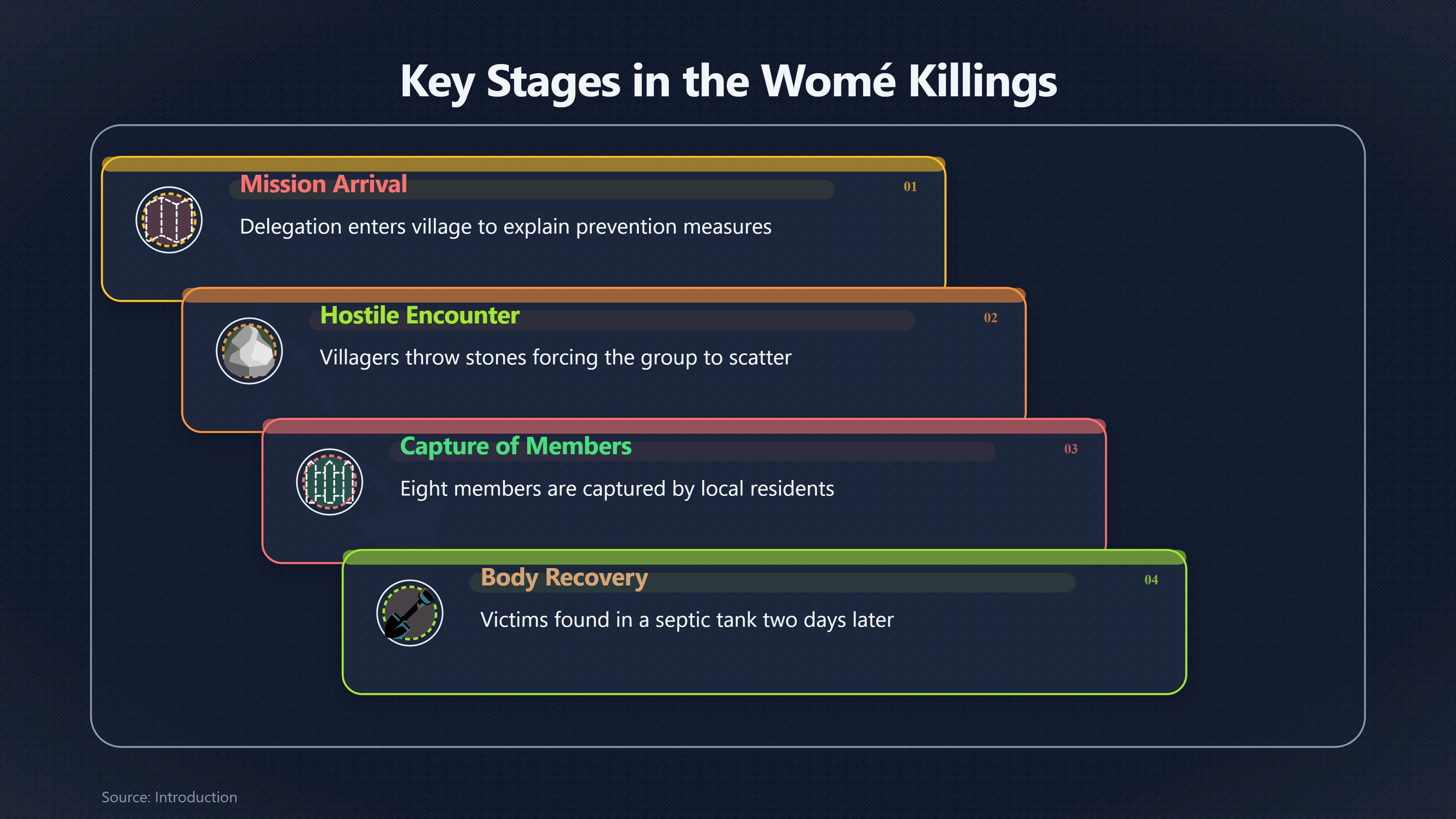
The delegation arrived in Womé, in Guinea’s Forest Region near Nzérékoré, as part of an Ebola awareness campaign. The group included public health workers, local government representatives, three journalists covering the mission and a local religious figure. Their aim was to explain the disease, encourage reporting of cases and promote measures intended to reduce transmission.[Committee to Protect Journalists]cpj.orgCommittee to Protect JournalistsJournalists killed while covering Ebola education campaign in Guinea - Committee to Protect JournalistsSe…
Instead of being welcomed, the visitors encountered hostility. Villagers threw stones, forcing the delegation to scatter. Some escaped, but eight members of the group were captured. Two days later their bodies were recovered from a septic tank at the village school. Reports indicated that several had been beaten with clubs and machetes and some had suffered throat wounds. The murders shocked Guinea and drew international condemnation, with the United Nations, the World Health Organization (WHO) and media-freedom organisations warning that violence against response teams threatened efforts to contain the epidemic.[unesco.org]unesco.orgDirector-General condemns killing of three media workers on Ebola aidDirector-General condemns killing of three media workers on Ebola aid…
Guinean authorities later arrested dozens of suspects, and several people were ultimately convicted for their roles in the killings.[Al Jazeera]aljazeera.comOpen source on aljazeera.com.
The beliefs surrounding the outreach team
The attack did not arise because villagers denied that illness existed. Ebola was killing people across the region. The crucial issue was how many residents interpreted the arrival of outside officials.
Rumours circulating in parts of Guinea suggested that:
- Ebola had been invented for political or financial reasons.
- Foreign organisations or the government were introducing the disease rather than stopping it.
- Medical teams were poisoning wells or spraying dangerous chemicals.
- Treatment centres were places where patients disappeared or were deliberately killed.
- Restrictions on funerals represented an assault on local customs rather than genuine infection control.[gov.uk]GOV.UKBriefing: Ebolamyths, realities and structural violence - GOV.UKJanuary 1, 2015…
These rumours reinforced one another. Protective clothing, chlorine spraying, body removal procedures and quarantine all appeared unfamiliar and alarming to communities that had never experienced Ebola before. To people already suspicious of state authorities, the arrival of an official delegation could itself seem like confirmation of a hidden conspiracy rather than evidence that help had arrived.[cambridge.org]cambridge.orgCambridge University Press & AssessmentUnderstanding Social Resistance to the Ebola Response in the Forest Region of the Republic of Guin…
Why did these rumours become so persuasive?
Early reporting sometimes portrayed the killings simply as an outbreak of irrational fear. Later anthropological research argues that this explanation is incomplete.
Researchers point to several overlapping factors.
Long histories of political mistrust. Guinea’s Forest Region had experienced decades of marginalisation and tense relations with central government. Many communities already viewed outside officials with suspicion before Ebola appeared.[nih.gov]pmc.ncbi.nlm.nih.govculture - PMC…
An unfamiliar disease. Ebola’s symptoms resembled more familiar illnesses at first, while its infection-control measures required rapid changes to everyday life. Families often saw relatives taken away without understanding why traditional funeral practices had suddenly become dangerous.[OUP Academic]academic.oup.comOpen source on oup.com.
Communication that often ran in one direction. Early response efforts frequently focused on delivering instructions rather than listening to local concerns. Anthropologists involved in the Ebola Response Anthropology Platform later argued that treating rumours simply as false information to be corrected overlooked the social experiences that made those rumours believable.[PubMed]pubmed.ncbi.nlm.nih.govPub Med Ebola: limitations of correcting misinformationEbola: limitations of correcting misinformation - PubMed…
Existing social tensions. James Fairhead argues that Ebola response measures disrupted several fragile social arrangements involving healthcare, local politics, economic interests and beliefs about misfortune. Violence therefore cannot be understood only as a reaction to medical advice; it also reflected broader struggles over authority and legitimacy.[Cambridge University Press & Assessment]cambridge.orgCambridge University Press & AssessmentUnderstanding Social Resistance to the Ebola Response in the Forest Region of the Republic of Guin…
What later accounts explain—and dispute
The Womé killings have generated competing interpretations.

The early explanation
Immediately after the attack, many reports emphasised fear, ignorance and misinformation. These were certainly important elements. False rumours directly encouraged resistance to health workers, and some participants reportedly believed they were defending their community against a deadly plot.[Committee to Protect Journalists]cpj.orgCommittee to Protect JournalistsJournalists killed while covering Ebola education campaign in Guinea - Committee to Protect JournalistsSe…
The broader interpretation
Subsequent scholarship argues that focusing only on misinformation risks misunderstanding why those rumours gained traction.
Comparative research on Guinea and Sierra Leone concludes that the sharp differences in public resistance cannot be explained by “culture” alone. Instead, political relationships, previous experiences with government, patterns of local authority and the way response programmes interacted with communities better explain why Guinea experienced repeated violent confrontations, including Womé.[PMC]pmc.ncbi.nlm.nih.govculture - PMC…
Melissa Leach, Annie Wilkinson and colleagues similarly argue that the epidemic exposed forms of structural violence—long-term inequalities, weak public services and exclusion from decision-making—that made official messages difficult to trust. In this view, rumours were not random fantasies but attempts to interpret frightening events through existing experiences of power and neglect, even when those interpretations were factually wrong.[GOV.UK]GOV.UKBriefing: Ebolamyths, realities and structural violence - GOV.UKJanuary 1, 2015…
Other researchers have stressed that dismissing rumours as mere superstition can be counterproductive. Public health campaigns became more effective when they incorporated dialogue with respected local leaders, adapted burial practices where possible and treated communities as partners rather than passive recipients of information.[PubMed]pubmed.ncbi.nlm.nih.govPub Med Ebola: limitations of correcting misinformationEbola: limitations of correcting misinformation - PubMed…
Why Womé remains important
The Womé killings became a turning point in thinking about epidemic response. They demonstrated that controlling an infectious disease requires more than medical expertise. Trust, communication and local legitimacy are also essential.
The episode is therefore remembered not as evidence of a mysterious collective delusion but as a tragic example of how repeated rumours, historical distrust and an emergency response perceived as imposed from outside can combine with a real epidemic to produce deadly violence. For studies of collective fear in Guinea, Womé remains one of the clearest cases showing that false beliefs become most dangerous when they connect with genuine political grievances and lived experiences of exclusion.[nih.gov]pmc.ncbi.nlm.nih.govculture - PMC…
Amazon book picks
Further Reading
Books and field guides related to How Rumour Turned Deadly at Wome. Use these as the next step if you want deeper reading beyond the article.

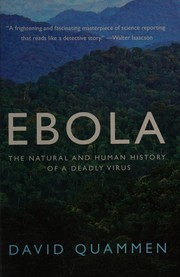
Ebola: The Natural and Human History of a Deadly Virus
Directly relevant to the Womé killings and outbreak context.
Endnotes
1.
Source: cambridge.org
Link:https://www.cambridge.org/core/journals/african-studies-review/article/understanding-social-resistance-to-the-ebola-response-in-the-forest-region-of-the-republic-of-guinea-an-anthropological-perspective/79914D998AA67442119F1C45E274764E
Source snippet
Cambridge University Press & AssessmentUnderstanding Social Resistance to the Ebola Response in the Forest Region of the Republic of Guin...
2.
Source: unesco.org
Title: Director-General condemns killing of three media workers on Ebola aid
Link:https://www.unesco.org/en/articles/director-general-condemns-killing-three-media-workers-ebola-aid-mission-guinea
Source snippet
Director-General condemns killing of three media workers on Ebola aid...
3.
Source: who.int
Link:https://www.who.int/news/item/19-09-2014-who-welcomes-decision-to-establish-united-nations-mission-for-ebola-emergency-response
4.
Source: GOV.UK
Title: Briefing: Ebola
Link:https://www.gov.uk/research-for-development-outputs/briefing-ebola-myths-realities-and-structural-violence
Source snippet
myths, realities and structural violence - GOV.UKJanuary 1, 2015...
Published: January 1, 2015
5.
Source: pmc.ncbi.nlm.nih.gov
Link:https://pmc.ncbi.nlm.nih.gov/articles/PMC5351787/
Source snippet
culture - PMC...
6.
Source: GOV.UK
Link:https://www.gov.uk/research-for-development-outputs/engaging-communities-anthropological-insights-from-the-west-african-ebola-epidemic
7.
Source: academic.oup.com
Link:https://academic.oup.com/afraf/article/114/454/136/2195203
8.
Source: GOV.UK
Title: www.gov.uk Ebola: the Limitations of correcting misinformation
Link:https://www.gov.uk/research-for-development-outputs/ebola-the-limitations-of-correcting-misinformation
9.
Source: who.int
Link:https://www.who.int/news/item/22-09-2014-statement-on-the-2nd-meeting-of-the-ihr-emergency-committee-regarding-the-2014-ebola-outbreak-in-west-africa
10.
Source: who.int
Title: Guinea: WHO opens regional Ebola response centre
Link:https://www.who.int/news-room/feature-stories/detail/guinea-who-opens-regional-ebola-response-centre
11.
Source: afro.who.int
Link:https://www.afro.who.int/news/who-supplies-arrive-guinea-support-ebola-outbreak-response
12.
Source: who.int
Title: Ebola virus disease in Guinea – update
Link:https://www.who.int/emergencies/disease-outbreak-news/item/2014_03_25_ebola-en
13.
Source: who.int
Link:https://www.who.int/news-room/spotlight/one-year-into-the-ebola-epidemic/guinea-the-ebola-virus-shows-its-tenacity
14.
Source: cpj.org
Link:https://cpj.org/2014/09/journalists-killed-while-covering-ebola-in-guinea/
Source snippet
Committee to Protect JournalistsJournalists killed while covering Ebola education campaign in Guinea - Committee to Protect JournalistsSe...
15.
Source: aljazeera.com
Link:https://www.aljazeera.com/news/2014/9/25/arrests-in-guinea-over-ebola-related-murders
16.
Source: pubmed.ncbi.nlm.nih.gov
Title: Pub Med Ebola: limitations of correcting misinformation
Link:https://pubmed.ncbi.nlm.nih.gov/25534188/
Source snippet
Ebola: limitations of correcting misinformation - PubMed...
17.
Source: pmc.ncbi.nlm.nih.gov
Link:https://pmc.ncbi.nlm.nih.gov/articles/PMC7141173/
18.
Source: pmc.ncbi.nlm.nih.gov
Link:https://pmc.ncbi.nlm.nih.gov/articles/PMC5394643/
19.
Source: pmc.ncbi.nlm.nih.gov
Link:https://pmc.ncbi.nlm.nih.gov/articles/PMC4655935/
Additional References
20.
Source: youtube.com
Title: Guinea: Mistrust thwarts Ebola vaccination effort
Link:https://www.youtube.com/watch?v=57konljP5RI
Source snippet
Fake doctor treat people fearful of hospital; opposition claim no confidence in health system...
21.
Source: tandfonline.com
Link:https://www.tandfonline.com/doi/abs/10.1080/09581596.2016.1252034
22.
Source: afrik.com
Link:https://www.afrik.com/guinee-sept-responsables-de-sante-et-journalistes-tues-lors-d-une-mission-de-sensibilisation-contre-ebola
23.
Source: tandfonline.com
Link:https://www.tandfonline.com/doi/full/10.1080/09581596.2016.1252034
24.
Source: archive.ids.ac.uk
Link:https://archive.ids.ac.uk/erap/evidence/briefing-ebola-myths-realities-and-structural-violence/
25.
Source: stm.cairn.info
Link:https://stm.cairn.info/journal-sante-publique-2017-4-page-497?lang=en
26.
Source: youtube.com
Link:https://www.youtube.com/watch?v=Dgturf3TPyg
Source snippet
Ebola heroes in Guinea...
27.
Source: theguardian.com
Link:https://www.theguardian.com/society/2014/sep/18/ebola-health-workers-missing-guinea
28.
Source: youtube.com
Title: Deadly attack in Guinea on Ebola team
Link:https://www.youtube.com/watch?v=KjmdSwYMyM0
Source snippet
Guinea: Mistrust thwarts Ebola vaccination effort...
29.
Source: nature.com
Title: Ethnography could help in Ebola crisis | Nature
Link:https://www.nature.com/articles/nature.2014.16067
Topic Tree