Within Montenegro
How Did a False Tsar Rule Montenegro?
A mysterious outsider became Montenegro's ruler after hope, ambiguity and political need sustained the belief that he was Peter III.
On this page
- The stranger identified as Peter III
- Why clans accepted the imperial story
- Rule, reform and the collapse of the fiction
Page outline Jump by section
Introduction
Between 1767 and 1773, much of Montenegro was ruled by a mysterious outsider named Šćepan Mali, even though many of his followers believed he was actually Peter III, the deposed Russian emperor who had supposedly been murdered in 1762. The episode is one of Europe’s most remarkable examples of collective political belief. It was not simply a case of widespread gullibility. Rather, hope, uncertainty, religious identity, fragmented local politics and the prestige of imperial Russia combined to make an extraordinary claim seem plausible to many contemporaries. Even after convincing evidence emerged that Peter III was dead, Šćepan retained power because many Montenegrins judged him by his effectiveness as a ruler as much as by his supposed identity. Historians therefore treat the episode as an important case of how rumours can become politically useful and how collective belief can endure after its factual basis has collapsed.[Cambridge University Press & Assessment]cambridge.orgCambridge University Press & AssessmentCatherine II and a False Peter III in Montenegro | American Slavic and East European Review | Camb…
The stranger identified as Peter III
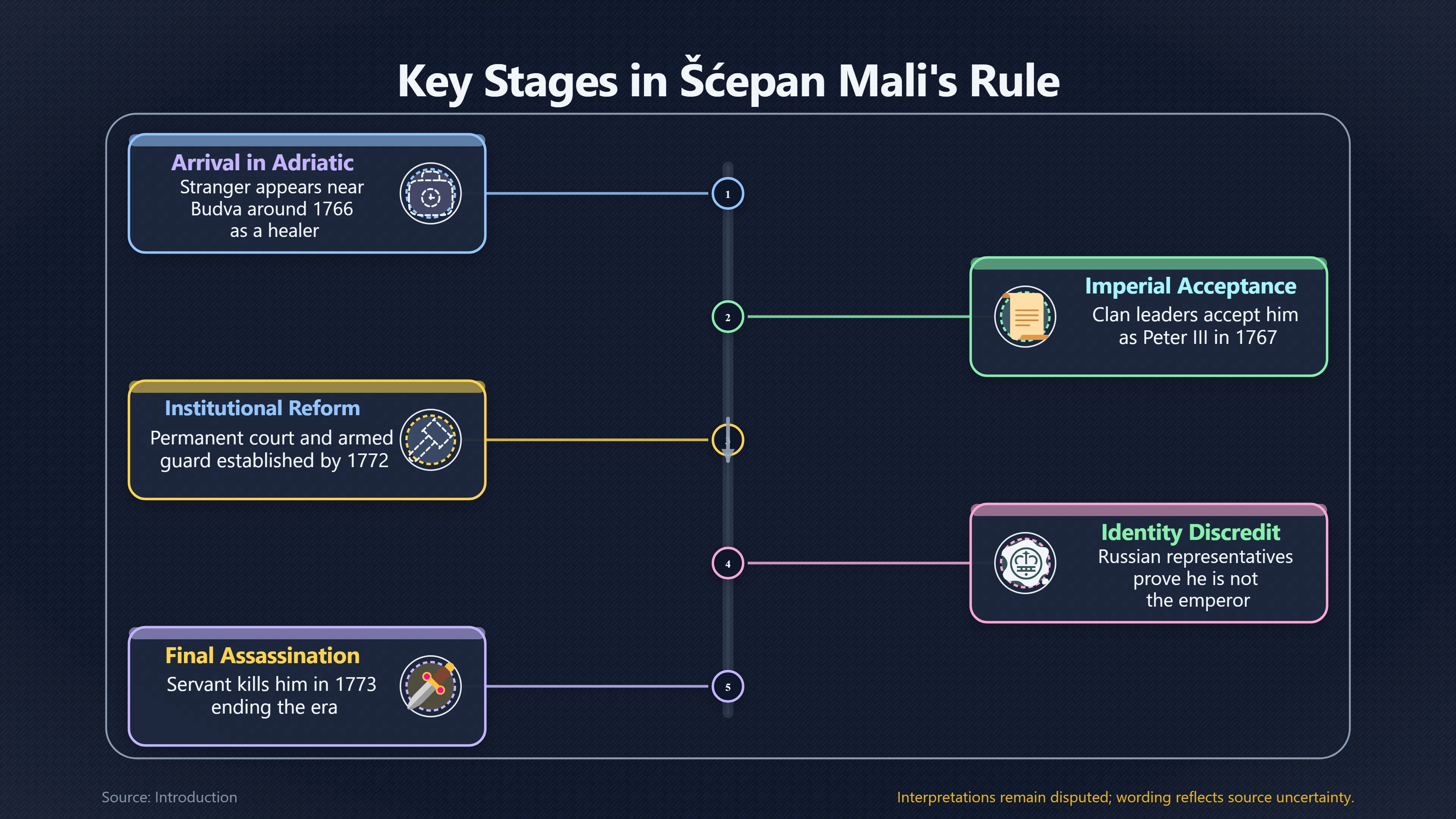
Šćepan Mali appeared in the eastern Adriatic around 1766. His early life remains obscure, and even today historians disagree about his birthplace and background. Contemporary reports describe him variously as a labourer, healer or wandering adventurer. He settled for a time near Budva and gradually attracted attention through his medical knowledge, confident manner and mysterious past.[Cambridge University Press & Assessment]cambridge.orgCambridge University Press & AssessmentCatherine II and a False Peter III in Montenegro | American Slavic and East European Review | Camb…
The crucial step was not that Šćepan openly declared himself to be Peter III. Contemporary evidence suggests he usually avoided making a direct claim. Instead, rumours spread among monks, clan leaders and villagers that the Russian emperor had escaped assassination and was living in disguise. Peter III’s violent overthrow by Catherine II had already generated survival stories elsewhere in Europe and Russia, making the idea less extraordinary than it appears today. Šćepan’s refusal either to confirm or firmly deny the rumours allowed supporters to fill in the gaps themselves.[Cambridge University Press & Assessment]cambridge.orgCambridge University Press & AssessmentCatherine II and a False Peter III in Montenegro | American Slavic and East European Review | Camb…
By September 1767, a general assembly of Montenegrin clan leaders accepted him as Peter III despite growing objections from Prince-Bishop Sava Petrović. The belief quickly became a political fact. Once enough influential figures behaved as though he were the Russian emperor, scepticism became increasingly difficult to sustain in public.[Hrvatska enciklopedija]enciklopedija.hrHrvatska enciklopedijaŠćepan MaliHrvatska enciklopedija…
Why clans accepted the imperial story
The false tsar belief spread because it addressed several pressing problems at once rather than because it rested on convincing evidence.
Russia occupied a unique place in the imagination of Orthodox Montenegro. For decades, Russian rulers had provided diplomatic support, financial assistance and symbolic protection to Montenegro’s leaders. If Peter III had truly survived and chosen Montenegro as his refuge, many believed this could transform the country’s international position and strengthen resistance to both Ottoman and Venetian pressure.[Cambridge University Press & Assessment]cambridge.orgCambridge University Press & AssessmentCatherine II and a False Peter III in Montenegro | American Slavic and East European Review | Camb…
Equally important was Montenegro’s fragmented internal structure. Authority rested largely with competing clans whose rivalries frequently erupted into blood feuds. An outsider claiming imperial status could stand above these local divisions in a way that no single clan leader could. Accepting the supposed emperor therefore offered a practical solution to a longstanding political problem.[Hrvatska enciklopedija]enciklopedija.hrHrvatska enciklopedijaŠćepan MaliHrvatska enciklopedija…
The belief also demonstrates a familiar feature of collective rumours: ambiguity often strengthens rather than weakens them. Because Šćepan avoided precise claims, contradictions could be explained away. Supporters interpreted silence as caution, modesty or political necessity. Instead of requiring continuous proof, the story became self-reinforcing through repeated public acceptance.[Cambridge University Press & Assessment]cambridge.orgCambridge University Press & AssessmentCatherine II and a False Peter III in Montenegro | American Slavic and East European Review | Camb…

Rule, reform and the collapse of the fiction
What makes Šćepan Mali unusual among historical impostors is that he proved to be an energetic ruler.
He worked to reduce inter-clan violence, discouraged blood revenge, strengthened central authority and attempted to create more regular institutions of justice. Around 1771 he established a permanent court composed of tribal representatives, and in 1772 organised a permanent armed guard to enforce his authority. These measures represented early attempts to build institutions that extended beyond traditional clan loyalties.[Hrvatska enciklopedija]enciklopedija.hrHrvatska enciklopedijaŠćepan MaliHrvatska enciklopedija…
Meanwhile, Russia investigated the remarkable reports coming from Montenegro. Catherine II had no interest in allowing a pretender to her murdered husband to become a rallying figure in the Balkans, especially while Russia was engaged in conflict with the Ottoman Empire. Russian representatives eventually established beyond doubt that Šćepan was not Peter III. His identity as the emperor was publicly discredited.[Cambridge University Press & Assessment]cambridge.orgCambridge University Press & AssessmentCatherine II and a False Peter III in Montenegro | American Slavic and East European Review | Camb…
Yet exposing the deception did not immediately end his rule. By that point many Montenegrin leaders had shifted their support from the story to the man. Although the imperial identity had helped him gain power, his ability to maintain order persuaded many that removing him would do more harm than good. This transition from belief in a miraculous identity to acceptance of practical leadership is one of the most striking aspects of the episode.[Cambridge University Press & Assessment]cambridge.orgCambridge University Press & AssessmentCatherine II and a False Peter III in Montenegro | American Slavic and East European Review | Camb…
His rule ended not because public belief suddenly evaporated but because he was assassinated in 1773 by one of his own servants, reportedly acting on behalf of the Ottoman governor of Scutari. His death brought an end to Montenegro’s brief experiment under its self-proclaimed “tsar”.[Hrvatska enciklopedija]enciklopedija.hrHrvatska enciklopedijaŠćepan MaliHrvatska enciklopedija…
Was this a case of mass hysteria?
Modern historians generally avoid describing the episode simply as “mass hysteria”. That label suggests irrational behaviour detached from circumstances, whereas the evidence points to a more complex interaction between political need and collective belief.
Several mechanisms worked together:
- Prestige bias: Russia’s reputation as the leading Orthodox power made extraordinary claims about its emperor easier to accept.
- Information scarcity: Reliable communication between Montenegro and the wider European world was slow, allowing rumours to circulate for months before authoritative corrections arrived.
- Political usefulness: Even those who doubted the story could benefit from supporting a ruler capable of reducing clan conflict.
- Social reinforcement: Public endorsement by influential clan leaders made disbelief increasingly costly, encouraging wider acceptance.[Cambridge University Press & Assessment]cambridge.orgCambridge University Press & AssessmentCatherine II and a False Peter III in Montenegro | American Slavic and East European Review | Camb…
Rather than illustrating irrational panic, the episode shows how communities under external pressure may adopt a hopeful narrative that appears to solve multiple problems simultaneously.
Why the false tsar still matters
Šćepan Mali occupies a distinctive place in Montenegrin historical memory because his story combines deception with genuine state-building. Unlike many impostors, he left behind more than a remarkable tale. His efforts to strengthen central authority anticipated later reforms pursued by Montenegro’s rulers during the nineteenth century.[Hrvatska enciklopedija]enciklopedija.hrHrvatska enciklopedijaŠćepan MaliHrvatska enciklopedija…
The story also became part of the country’s cultural tradition. Petar II Petrović Njegoš later dramatised the episode in The False Tsar Šćepan Mali, ensuring that the events remained embedded in Montenegrin historical imagination long after the original rumours had faded.[Hrvatska enciklopedija]enciklopedija.hrHrvatska enciklopedijaŠćepan MaliHrvatska enciklopedija…
Today, historians see the false tsar episode as one of the clearest examples of how collective belief can emerge from genuine political circumstances rather than simple credulity. It illustrates how rumours gain authority when they satisfy hopes, provide a framework for unity and appear to offer practical solutions to real social problems. In that sense, the rise of Šćepan Mali remains one of Montenegro’s most revealing episodes of collective political belief.[Cambridge University Press & Assessment]cambridge.orgCambridge University Press & AssessmentCatherine II and a False Peter III in Montenegro | American Slavic and East European Review | Camb…
Amazon book picks
Further Reading
Books and field guides related to How Did a False Tsar Rule Montenegro?. Use these as the next step if you want deeper reading beyond the article.
Extraordinary Popular Delusions and the Madness of Crowds
Rating: 4.0/5 from 5 Google Books ratings
Provides historical comparisons for mass belief and rumor.


Montenegro: A Modern History
Explains the historical setting in which Šćepan Mali emerged.
Endnotes
1.
Source: cambridge.org
Link:https://www.cambridge.org/core/journals/american-slavic-and-east-european-review/article/abs/catherine-ii-and-a-false-peter-iii-in-montenegro/FC8FC66AD4E24B597D3475F6E51D8CF7
Source snippet
Cambridge University Press & AssessmentCatherine II and a False Peter III in Montenegro | American Slavic and East European Review | Camb...
2.
Source: enciklopedija.hr
Title: Hrvatska enciklopedijaŠćepan Mali
Link:https://www.enciklopedija.hr/clanak/scepan-mali
Source snippet
Hrvatska enciklopedija...
3.
Source: cambridge.org
Link:https://www.cambridge.org/core/journals/american-slavic-and-east-european-review/article/catherine-ii-and-a-false-peter-iii-in-montenegro/FC8FC66AD4E24B597D3475F6E51D8CF7
Source snippet
Cambridge University Press & AssessmentCatherine II and a False Peter III in Montenegro | American Slavic and East European Review | Camb...
4.
Source: cambridge.org
Link:https://www.cambridge.org/core/services/aop-cambridge-core/content/view/FC8FC66AD4E24B597D3475F6E51D8CF7/S1049754400101440a.pdf/div-class-title-catherine-ii-and-a-false-peter-iii-in-montenegro-div.pdf
5.
Source: cambridge.org
Title: Peter III, Catherine II and the nobility (Chapter 2)
Link:https://www.cambridge.org/core/books/abs/catherine-the-great-and-the-russian-nobilty/peter-iii-catherine-ii-and-the-nobility/0F40675E5B9ACD84A20ABEA3315EDCE2
7.
Source: Wikipedia
Title: Šćepan Mali
Link:https://en.wikipedia.org/wiki/%C5%A0%C4%87epan_Mali
8.
Source: en.wikisource.org
Link:https://en.wikisource.org/wiki/1911_Encyclop%C3%A6dia_Britannica/Montenegro
Source snippet
1911 Encyclopædia Britannica/Montenegro - Wikisource, the free online library...
9.
Source: treccani.it
Link:https://www.treccani.it/enciclopedia/montenegro_%28Enciclopedia-Italiana%29/
Additional References
10.
Source: researchgate.net
Link:https://www.researchgate.net/publication/369626049_Contemporary_perception_of_Montenegrin-Russian_relations_in_the_context_of_Euro-Atlantic_integration_From_allied_to_enemy_states
Source snippet
(PDF) Contemporary perception of Montenegrin-Russian relations in the context of Euro-Atlantic integration: From allied to enemy statesMa...
11.
Source: labrujulaverde.com
Link:https://www.labrujulaverde.com/en/2024/08/scepan-mali-the-first-and-only-tsar-of-montenegro-who-pretended-to-be-the-russian-peter-iii/
Source snippet
Šcepan Mali, the first and only tsar of Montenegro, who pretended to be the Russian Peter IIIAugust 20, 2024 — ŠCEPAN MALI, THE FIRST AND...
Published: August 20, 2024
12.
Source: dergipark.org.tr
Title: Karadağ’da Küçük Stepan (Sahte Rus Çarı III
Link:https://dergipark.org.tr/tr/pub/vakanuvis/article/1336135
Source snippet
Petro) Dönemi (1767-1773) - Vakanüvis - Uluslararası Tarih Araştırmaları DergisiMarch 30, 2024 — KARADAĞ’DA KÜÇÜK STEPAN (SAHTE RUS ÇARI...
Published: March 30, 2024
13.
Source: youtube.com
Link:https://www.youtube.com/watch?v=rL7Gv8_nHW4
Source snippet
32 People Who Faked Being Royalty (And Almost Got Away With It)...
14.
Source: youtube.com
Title: 32 People Who Faked Being Royalty (And Almost Got Away With It)
Link:https://www.youtube.com/watch?v=pJqL08TTKwk
Source snippet
The largest uprising in Russia before the 20th century and the worst punishment. E.Pugachev. 1762...
15.
Source: youtube.com
Title: Lazni Car Scepan Mali
Link:https://www.youtube.com/watch?v=3N9Kwq020aM
Source snippet
Imposters Who Changed History | False Dmitry, Pugachev, Nero, and the Greatest Historical Scams...
16.
Source: njegos.org
Link:https://www.njegos.org/mnhistory/hist2.htm
17.
Source: books.google.com
Title: Lazni car Scepan Mali
Link:https://books.google.com/books/about/Lazni_car_Scepan_Mali.html?id=nq4F0AEACAAJ
Source snippet
Njegos - Google BooksJune 27, 2023 — LAZNI CAR SCEPAN MALI Image: Front CoverPetar P. NjegosGlobland Books, Jun 27, 2023 - Poetry - 222 p...
Published: June 27, 2023
18.
Source: mitropolija.com
Link:https://mitropolija.com/2021/05/15/ljetopis-scepan-mali-3/
19.
Source: youtube.com
Title: THE FAKE RUSSIAN TSAR WHO RULED MONTENEGRO?The story of a fake tsar Šćepan mali
Link:https://www.youtube.com/watch?v=CTHZl0vPLSs
Source snippet
Lazni Car Scepan Mali...
Topic Tree