Within Libya
How Mercenary Rumours Put Migrants in Danger
Wartime claims that Black Africans were hidden mercenaries spread rapidly and exposed migrants to suspicion, detention and violence.
On this page
- How the mercenary story spread
- Race, migration and wartime fear
- Evidence, exaggeration and human cost
Page outline Jump by section
Introduction
During Libya’s 2011 civil war, one of the most influential and damaging wartime rumours was the claim that Muammar Gaddafi had secretly deployed large numbers of Black African mercenaries to suppress the uprising. The rumour contained an element of truth—Gaddafi’s forces did recruit some foreign fighters—but it rapidly expanded into a much broader belief that many Black Africans in Libya, regardless of their nationality or occupation, were enemy combatants. As the conflict intensified, migrant workers and Black Libyans were stopped, detained, beaten and in some cases killed simply because they matched the stereotype of the alleged mercenaries. Human rights organisations later concluded that genuine foreign mercenaries existed but that the scale of the phenomenon was widely exaggerated, with devastating consequences for innocent civilians.[Human Rights Watch]hrw.orgHuman Rights WatchLibya: Stop Arbitrary Arrests of Black Africans | Human Rights WatchSeptember 4, 2011…

Rather than representing mass psychogenic illness, this episode is better understood as a wartime rumour panic. Fear, fragmented information, racial prejudice and the collapse of state authority combined to produce a contagious belief that spread far faster than reliable evidence.
How the mercenary story spread
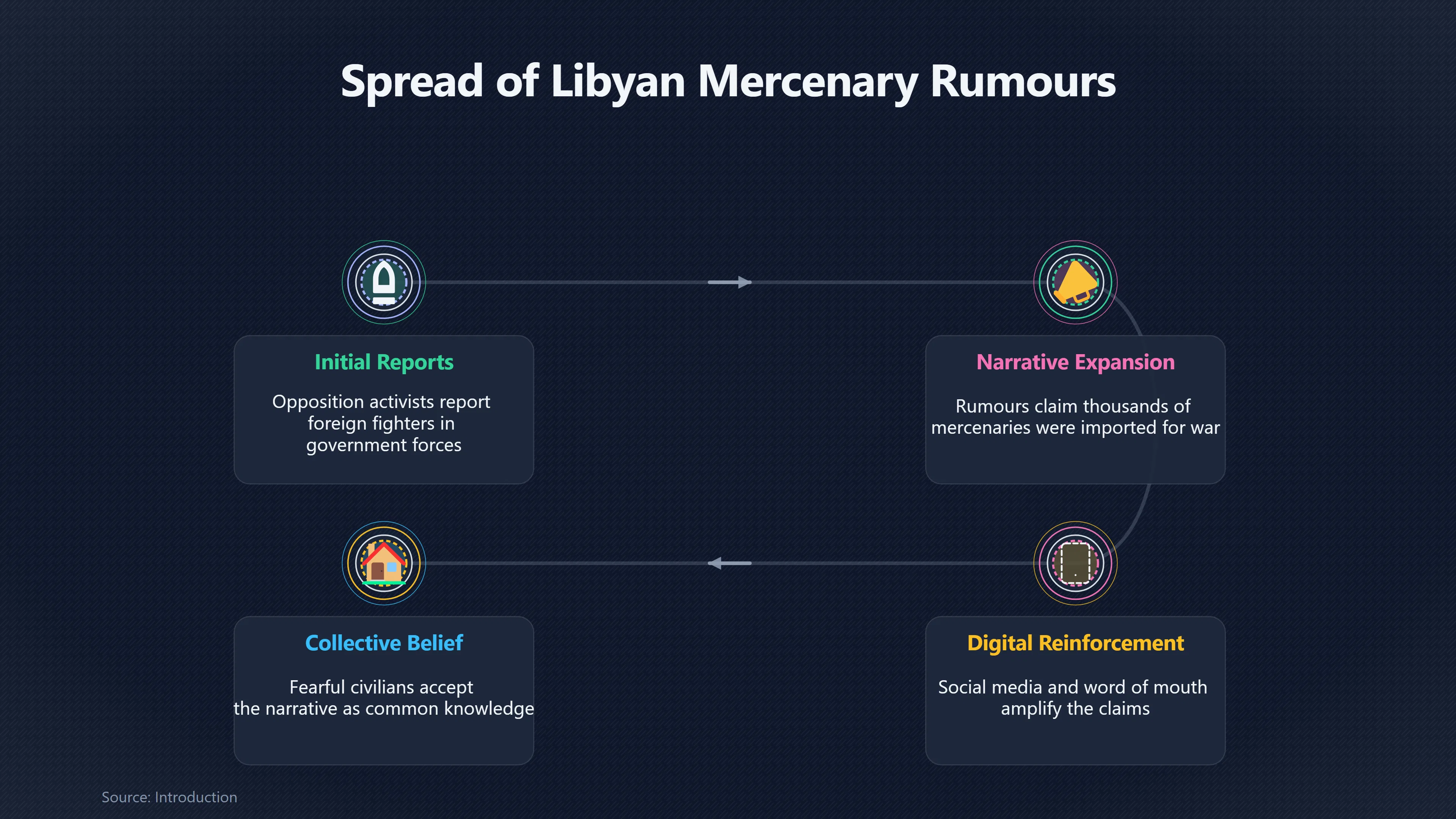
From the first days of the uprising in February 2011, opposition activists and witnesses reported that government forces included fighters who appeared to come from neighbouring African countries. Gaddafi had long maintained political and military relationships across the Sahel, and there is credible evidence that his government recruited some foreign combatants, particularly from Chad, Sudan and elsewhere in the region. Human Rights Watch later documented a military base used by hundreds of foreign recruits commanded by the elite Khamis Brigade.[Human Rights Watch]hrw.orgHuman Rights WatchLibya: Stop Arbitrary Arrests of Black Africans | Human Rights WatchSeptember 4, 2011…
The problem was that these verified cases quickly became transformed into a much broader narrative. Rumours circulated that thousands of Black Africans had been imported to wage war against Libyan civilians. In the confusion of a rapidly changing battlefield, distinguishing between genuine combatants, migrant labourers and Black Libyan citizens became increasingly difficult. Social media, word of mouth and repeated claims by some opposition figures reinforced the impression that any Black African man might be a mercenary.[Amnesty International]amnesty.orgAmnesty InternationalRevenge killings and reckless firing in opposition-held eastern LibyaMay 13, 2011…
The rumour spread because it appeared to explain shocking violence during the uprising. Many people found it easier to believe that outsiders were responsible for shootings than to accept that fellow Libyans might fire on demonstrators. Similar patterns have appeared in conflicts elsewhere, where communities under severe stress attribute atrocities to foreign agents rather than neighbours.
Race, migration and wartime fear
Before the war, Libya employed hundreds of thousands of migrant workers from countries including Niger, Chad, Sudan, Mali, Ghana and Nigeria. Many worked in construction, agriculture and domestic employment. Black Libyans, including communities such as those from Tawargha, had also lived in the country for generations.
When rumours about African mercenaries spread, these populations became immediate targets. Checkpoints, neighbourhood patrols and revolutionary militias frequently judged people by appearance rather than evidence. Skin colour itself became grounds for suspicion.
Human Rights Watch documented widespread arbitrary arrests of Black Africans after the fall of Tripoli. Amnesty International reported that both Black Libyans and sub-Saharan African migrants were particularly vulnerable to detention and abuse because they were assumed to have fought for Gaddafi.[Human Rights Watch]hrw.orgHuman Rights WatchLibya: Stop Arbitrary Arrests of Black Africans | Human Rights WatchSeptember 4, 2011…
The panic also reflected longer-standing racial prejudices. Although Libya had depended heavily on migrant labour, discrimination against darker-skinned Africans predated the conflict. The civil war magnified these existing tensions, allowing wartime suspicion to merge with entrenched stereotypes.
What the evidence actually shows
Subsequent investigations reached a more nuanced conclusion than either side’s wartime propaganda.
There is credible evidence that:
- Gaddafi employed some foreign fighters during the conflict.
- Some recruits came from neighbouring African countries.
- Certain foreign nationals participated directly in military operations.[Human Rights Watch]hrw.orgHuman Rights WatchLibya: Stop Arbitrary Arrests of Black Africans | Human Rights WatchSeptember 4, 2011…
However, investigations also found that:
- Claims of vast numbers of African mercenaries were greatly exaggerated.
- Most detained sub-Saharan Africans were ordinary migrant workers rather than combatants.
- Many arrests occurred without any individual evidence beyond race or nationality.[Amnesty International]amnesty.orgInternational Libya: NTC must take control to prevent spiral of abusesAmnesty InternationalLibya: NTC must take control to prevent spiral of abuses - Amnesty International…
Amnesty International concluded that rumours about large-scale recruitment of African mercenaries had been “significantly exaggerated” and criticised the post-Gaddafi authorities for failing to challenge false assumptions that all sub-Saharan Africans were fighters.[Amnesty International]amnesty.orgInternational Libya: NTC must take control to prevent spiral of abusesAmnesty InternationalLibya: NTC must take control to prevent spiral of abuses - Amnesty International…
This distinction is important. A rumour does not have to be completely false to become dangerous. In Libya, a limited and documented military practice became transformed into a sweeping racial suspicion affecting thousands of uninvolved people.
The human cost of the rumours
The consequences extended far beyond misinformation.
Human rights organisations documented arbitrary detention, assaults, disappearances and killings targeting Black Africans during and after the fighting. Many migrants hid in their homes or sought protection because they feared revolutionary fighters more than the collapsing Gaddafi government.
Amnesty International described witnessing armed men removing Black patients from hospital beds for detention, while migrant communities reported remaining indoors for fear of attack. Investigators also found that detention centres contained large numbers of foreign nationals who appeared to be migrant workers rather than captured combatants.[Amnesty International]amnesty.orgInternational Libya: Fears for detainees held by anti-Gaddafi forcesAmnesty InternationalLibya: Fears for detainees held by anti-Gaddafi forces - Amnesty International…
The rumours also contributed to collective punishment against entire communities. The predominantly Black Libyan town of Tawargha became especially associated with accusations of collaboration with Gaddafi’s forces following the siege of Misrata. Although individuals committed crimes during the conflict, many residents suffered displacement and persecution because entire communities were treated as collectively guilty rather than investigated individually.[Amnesty International]amnesty.orgInternational Libya: Fears for detainees held by anti-Gaddafi forcesAmnesty InternationalLibya: Fears for detainees held by anti-Gaddafi forces - Amnesty International…
For many migrants, simply surviving the war became secondary to avoiding mistaken identification as a mercenary.
Why the rumours proved so persuasive
Several factors helped these beliefs spread rapidly.
First, civil wars produce severe information shortages. Independent verification becomes difficult while propaganda from all sides increases.
Second, the existence of some genuine foreign fighters made broader claims appear plausible. People often generalise from isolated but real examples.
Third, racial profiling offered a quick, if deeply flawed, way for frightened civilians and poorly organised armed groups to identify supposed enemies.
Finally, the collapse of central authority meant that few institutions were able—or willing—to correct misinformation before it became accepted as common knowledge. Amnesty International criticised transitional authorities for doing too little to challenge the false assumption that sub-Saharan Africans were generally mercenaries.[Amnesty International]amnesty.orgInternational Libya: NTC must take control to prevent spiral of abusesAmnesty InternationalLibya: NTC must take control to prevent spiral of abuses - Amnesty International…
Why this episode remains important
The mercenary rumours illustrate how wartime fear can transform a limited truth into a widespread moral panic with severe humanitarian consequences. The episode is not evidence that Libyans as a whole succumbed to irrationality. Rather, it demonstrates how conflict, uncertainty, propaganda and pre-existing prejudice can reinforce one another until ordinary people become viewed primarily through the lens of suspicion.
For historians and scholars of collective belief, Libya provides a cautionary example of how rumours can shape real behaviour even when the underlying evidence is incomplete or distorted. The distinction between actual foreign combatants and innocent migrants became blurred, and once that happened, race itself became treated as evidence.
The legacy of these events has continued to influence discussions of migration, racism and human rights in post-2011 Libya. It also serves as a reminder that even rumours containing a kernel of truth can become socially dangerous when fear replaces careful investigation and individual evidence.
Amazon book picks
Further Reading
Books and field guides related to How Mercenary Rumours Put Migrants in Danger. Use these as the next step if you want deeper reading beyond the article.

The Return: Fathers, Sons and the Land in Between
Explores the legacy of the Libyan regime.



Endnotes
1.
Source: amnesty.org
Title: International Libya: NTC must take control to prevent spiral of abuses
Link:https://www.amnesty.org/en/latest/press-release/2011/09/libya-ntc-must-take-control-prevent-spiral-abuses/
Source snippet
Amnesty InternationalLibya: NTC must take control to prevent spiral of abuses - Amnesty International...
2.
Source: amnesty.org
Link:https://www.amnesty.org/en/latest/campaigns/2011/05/revenge-killings-and-reckless-firing-in-opposition-held-eastern-libya/
Source snippet
Amnesty InternationalRevenge killings and reckless firing in opposition-held eastern LibyaMay 13, 2011...
Published: May 13, 2011
3.
Source: amnesty.org
Title: International Libya: Fears for detainees held by anti-Gaddafi forces
Link:https://www.amnesty.org/en/latest/press-release/2011/08/libya-fears-detainees-held-anti-gaddafi-forces/
Source snippet
Amnesty InternationalLibya: Fears for detainees held by anti-Gaddafi forces - Amnesty International...
4.
Source: hrw.org
Link:https://www.hrw.org/news/2011/09/04/libya-stop-arbitrary-arrests-black-africans
Source snippet
Human Rights WatchLibya: Stop Arbitrary Arrests of Black Africans | Human Rights WatchSeptember 4, 2011...
Published: September 4, 2011
5.
Source: hrw.org
Title: Libya: Gaddafi Forces Suspected Of Executing Detainees | Human Rights Watch
Link:https://www.hrw.org/news/2011/08/28/libya-gaddafi-forces-suspected-executing-detainees
6.
Source: hrw.org
Title: Libya: Stranded Foreign Workers Need Urgent Evacuation | Human Rights Watch
Link:https://www.hrw.org/news/2011/03/02/libya-stranded-foreign-workers-need-urgent-evacuation
7.
Source: hrw.org
Link:https://www.hrw.org/world-report/2012/country-chapters/libya
Additional References
8.
Source: uclalawreview.org
Link:https://www.uclalawreview.org/deploying-race-employing-force-african-mercenaries-and-the-2011-nato-intervention-in-libya/
Source snippet
Deploying Race, Employing Force: ‘African Mercenaries’ and the 2011 NATO Intervention in Libya | UCLA Law ReviewDecember 13, 2020 — * # D...
Published: December 13, 2020
9.
Source: fidh.org
Title: Libya: Hounding of migrants continues
Link:https://www.fidh.org/en/issues/migrants-rights/Libya-Hounding-of-migrants
Source snippet
Preliminary findings of an investigation missionJune 20, 2012 — LIBYA: HOUNDING OF MIGRANTS CONTINUES - PRELIMINARY FINDINGS OF AN INVEST...
Published: June 20, 2012
10.
Source: amnesty.org.uk
Title: have not only continued but worsened’
Link:https://www.amnesty.org.uk/knowledge-hub/all-resources/libya-foreign-nationals-face-abuse-and-exploitation-new-report/
Source snippet
Libya: foreign nationals face abuse and exploitation- new report | Amnesty International UKNovember 13, 2012 — LIBYA: FOREIGN NATIONALS F...
Published: November 13, 2012
11.
Source: fletcher.tufts.edu
Title: african roles libyan conflict 2011
Link:https://fletcher.tufts.edu/research/research-publications/african-roles-libyan-conflict-2011
Source snippet
roles in the Libyan conflict of 2011March 1, 2013 — AFRICAN ROLES IN THE LIBYAN CONFLICT OF 2011 AFRICAN ROLES IN THE LIBYAN CONFLICT OF...
Published: March 1, 2013
12.
Source: youtube.com
Title: The Battle for liberating Western Libya: Imazighen Nalut
Link:https://www.youtube.com/watch?v=SODe6exHvCo
Source snippet
Libya the infernal trap: daily struggle of dozens of migrants...
13.
Source: researchgate.net
Link:https://www.researchgate.net/publication/270787676Mercenaries_in_Libya_Ramifications_of_the_Treatment_of%27Armed_Mercenary_Personnel%27_under_the_Arms_Embargo_for_Private_Military_Company_Contractors
14.
Source: issafrica.org
Link:https://issafrica.org/iss-today/the-use-of-mercenaries-in-libya-a-serious-indictment-against-the-african-union
15.
Source: research.icmpd.org
Link:https://research.icmpd.org/publication/libya-case-study-an-unending-crisis-responses-of-migrants-states-and-organisations-to-the-2011-libya-crisis/
16.
Source: youtube.com
Title: Dan Rather Reports “Libya,”
Link:https://www.youtube.com/watch?v=AHq8hH8_GLA
Source snippet
The Battle for liberating Western Libya: Imazighen Nalut...
Published: March 8, 2011
17.
Source: youtube.com
Title: Straight Talk Africa: Former Libya Ambassador Ali Aujali Talks Black Mercenaries
Link:https://www.youtube.com/watch?v=q9Zov3bv1HU
Source snippet
Libya: Africans at Risk...
Topic Tree