Within Colombia Belief Panics
How a School Illness Outbreak Changed Vaccine Trust
A wave of genuine symptoms among vaccinated schoolgirls became a national crisis after fear, media coverage and institutional distrust amplified it.
On this page
- How the symptoms spread through the community
- What investigators found about the vaccine
- Why the crisis reshaped national health policy
Page outline Jump by section
Introduction
In 2014, the Colombian town of El Carmen de Bolívar became the centre of one of the country’s most influential public health crises. Hundreds of schoolgirls developed alarming symptoms including fainting, numbness, chest pain, headaches, breathing difficulties and involuntary movements after receiving the human papillomavirus (HPV) vaccine. Families understandably feared the vaccine was responsible. Investigations by Colombian health authorities found no evidence that the vaccine itself had caused the illnesses, instead concluding that the outbreak was consistent with a case of mass psychogenic illness (also known as mass sociogenic illness), in which genuine physical symptoms spread through a community without a shared toxic or infectious cause. Yet the official findings failed to restore public confidence. The episode transformed attitudes towards HPV vaccination across Colombia and remains a major case study in how fear, distrust, media coverage and scientific uncertainty can interact during a public health emergency.[PMC]pmc.ncbi.nlm.nih.govSeptember 7, 2018…
How the symptoms spread through the community
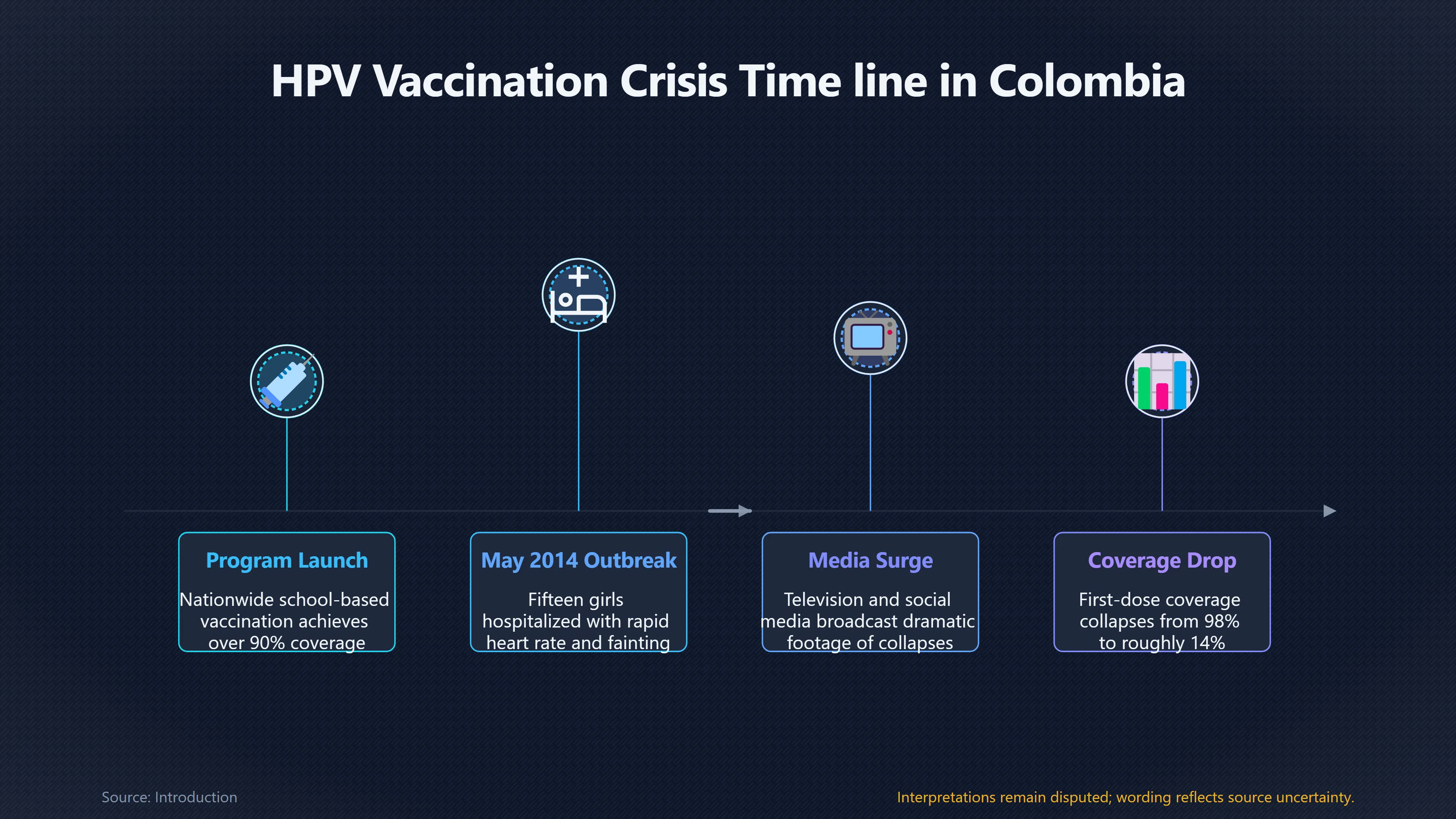
Colombia had introduced a nationwide school-based HPV vaccination programme in 2012 to reduce future cervical cancer. Initial uptake was exceptionally high, with coverage exceeding 90% among the target population. The programme was widely regarded as a public health success before events in El Carmen de Bolívar changed its trajectory.[PMC]pmc.ncbi.nlm.nih.govSeptember 7, 2018…
Between late May and early June 2014, 15 girls from the same school were admitted to hospital after reporting rapid heart rate, difficulty breathing, numbness, headaches and fainting. Parents immediately linked the illnesses to the second dose of the HPV vaccine that many had received several weeks earlier. Investigators also considered environmental explanations such as contaminated food, water, pesticides and heavy metals, but found no evidence of a common toxic exposure.[PMC]pmc.ncbi.nlm.nih.govSeptember 7, 2018…
What transformed a local medical mystery into a national crisis was the speed with which the story spread. Television news repeatedly showed dramatic footage of girls collapsing or being carried into hospitals. Similar videos circulated widely on social media, allowing disturbing images to reach audiences far beyond the town itself. Within weeks, more than 600 similar cases had been reported across Colombia. Researchers later noted that emergency admissions rose alongside peaks in media attention and official visits, while few or no cases were reported during weekends or school holidays, a pattern often seen in outbreaks of mass psychogenic illness.[PMC]pmc.ncbi.nlm.nih.govSeptember 7, 2018…
It is important to distinguish the diagnosis from the common misconception that the girls were “pretending” or inventing symptoms. Mass psychogenic illness refers to genuine physical symptoms that can spread through groups under conditions of stress, fear and heightened expectation. Those affected experience real distress even when no shared biological cause is identified.[PubMed]pubmed.ncbi.nlm.nih.govHPV vaccine confidence and cases of mass psychogenic illness following immunization in Carmen de Bolivar, Colombia - PubMed…
What investigators found about the vaccine
The Colombian National Institute of Health conducted an extensive epidemiological investigation involving hundreds of affected girls. Researchers searched for infectious diseases, environmental contamination, manufacturing defects, vaccination errors and recognised vaccine reactions. No evidence emerged that linked the reported illnesses to the HPV vaccine through a common biological mechanism. The investigation concluded that the outbreak was most consistent with a mass psychogenic reaction rather than vaccine toxicity.[PMC]pmc.ncbi.nlm.nih.govSeptember 7, 2018…
These findings were consistent with the broader international scientific evidence on HPV vaccines. Extensive surveillance by regulatory agencies and numerous large population studies have found HPV vaccines to be highly effective at preventing infections that cause cervical cancer, while serious adverse reactions remain rare. Researchers discussing the Colombian outbreak placed it alongside similar episodes in other countries where anxiety surrounding vaccination appeared to amplify clusters of unexplained symptoms.[BMJ]bmj.comAssociation between quadrivalent human papillomavirus vaccination and selected syndromes with autonomic dysfunction in Danish females…
Not everyone accepted the official interpretation. Some Colombian researchers argued that the evidence should be presented with greater caution, noting that government case-control analyses identified statistical associations between vaccination status and reported illness because affected girls had overwhelmingly been vaccinated. They argued that this relationship deserved fuller discussion and that uncertainty should be communicated more openly. Most public health researchers responded that such associations were expected in a heavily vaccinated population and did not establish that the vaccine biologically caused the symptoms. The debate therefore centred less on whether the girls were ill than on how the illnesses should be interpreted and communicated.[PMC]pmc.ncbi.nlm.nih.govMass psychogenic illness following HPV immunization in Carmen de Bolivar, Colombia (2014): more uncertainty is required - PMCApril 2…
Anthropologists studying El Carmen de Bolívar later argued that simply labelling the event “mass psychogenic illness” did not resolve the social conflict. Their interviews found that many families interpreted the diagnosis as dismissive of their suffering, deepening mistrust rather than rebuilding confidence. This highlighted a recurring challenge in public health: scientific explanations alone may not persuade communities that feel ignored or disbelieved.[PubMed]pubmed.ncbi.nlm.nih.govTurning suffering into side effects: Responses to HPV vaccination in Colombia - PubMedJune 14, 2021…

Why the crisis reshaped national health policy
The greatest long-term consequence was not the outbreak itself but its effect on vaccine confidence.
Before 2014, Colombia’s HPV vaccination programme had achieved some of the highest coverage levels in the Americas. Within two years of the Carmen de Bolívar crisis, uptake had collapsed. Published estimates indicate that first-dose coverage fell from around 98% in 2012 to roughly 14% by 2016, while completion of the full vaccination schedule dropped from about 88% to only 5%.[PMC]pmc.ncbi.nlm.nih.govSeptember 7, 2018…
This decline worried cancer specialists because persistent HPV infection is the principal cause of cervical cancer. Lower vaccination coverage means future generations may lose protection against a disease that causes thousands of deaths worldwide each year. The episode therefore became an example of how a crisis of confidence can have consequences extending far beyond the original event.[PMC]pmc.ncbi.nlm.nih.govOpen source on nih.gov.
The Colombian experience also prompted broader discussion about crisis communication. Researchers concluded that public health authorities need to respond rapidly, investigate transparently and acknowledge uncertainty without appearing dismissive. Scientific evidence remains essential, but maintaining trust also requires empathy, clear explanations and engagement with communities whose experiences do not fit easily into official narratives.[PubMed]pubmed.ncbi.nlm.nih.govHPV vaccine confidence and cases of mass psychogenic illness following immunization in Carmen de Bolivar, Colombia - PubMed…
Why the case remains culturally important
The Carmen de Bolívar outbreak occupies a distinctive place in Colombia’s history of collective fear because it combined several powerful forces at once: genuine illness, widespread uncertainty, emotionally compelling media coverage and longstanding mistrust of institutions.
Unlike classic moral panics, there was no invented threat or imaginary enemy. The girls experienced authentic symptoms, and families sought explanations that made sense from their perspective. At the same time, investigators found no evidence of a shared biological injury caused by the vaccine. The gap between those two realities created a conflict that scientific testing alone could not resolve.[PubMed]pubmed.ncbi.nlm.nih.govTurning suffering into side effects: Responses to HPV vaccination in Colombia - PubMedJune 14, 2021…
For historians, psychologists and public health specialists, the episode has become an important example of how collective belief can influence the spread of physical symptoms without implying deception or fabrication. It also illustrates how trust, once lost during a public health emergency, can prove far harder to rebuild than to establish in the first place.[PubMed]pubmed.ncbi.nlm.nih.govHPV vaccine confidence and cases of mass psychogenic illness following immunization in Carmen de Bolivar, Colombia - PubMed…


Endnotes
1.
Source: pmc.ncbi.nlm.nih.gov
Link:https://pmc.ncbi.nlm.nih.gov/articles/PMC7307134/
2.
Source: bmj.com
Link:https://www.bmj.com/content/370/bmj.m2930
Source snippet
Association between quadrivalent human papillomavirus vaccination and selected syndromes with autonomic dysfunction in Danish females...
3.
Source: pmc.ncbi.nlm.nih.gov
Link:https://pmc.ncbi.nlm.nih.gov/articles/PMC6605870/
Source snippet
Mass psychogenic illness following HPV immunization in Carmen de Bolivar, Colombia (2014): more uncertainty is required - PMCApril 2...
4.
Source: gh.bmj.com
Link:https://gh.bmj.com/content/6/Suppl_2/e003908
5.
Source: pmc.ncbi.nlm.nih.gov
Link:https://pmc.ncbi.nlm.nih.gov/articles/PMC6363158/
Source snippet
September 7, 2018...
Published: September 7, 2018
6.
Source: pubmed.ncbi.nlm.nih.gov
Link:https://pubmed.ncbi.nlm.nih.gov/30118381/
Source snippet
HPV vaccine confidence and cases of mass psychogenic illness following immunization in Carmen de Bolivar, Colombia - PubMed...
7.
Source: pubmed.ncbi.nlm.nih.gov
Link:https://pubmed.ncbi.nlm.nih.gov/34146986/
Source snippet
Turning suffering into side effects: Responses to HPV vaccination in Colombia - PubMedJune 14, 2021...
Published: June 14, 2021
Additional References
8.
Source: who.int
Link:https://www.who.int/groups/global-advisory-committee-on-vaccine-safety/topics/human-papillomavirus-vaccines/safety
Source snippet
SafetyJuly 14, 2017 — In summary, GACVS was presented with a series of cases of adverse events following administration of the HPV vaccine...
Published: July 14, 2017
9.
Source: tandfonline.com
Link:https://www.tandfonline.com/doi/full/10.1080/21645515.2018.1511667
Source snippet
September 7, 2018 — Human Vaccines & Immunotherapeutics Volume 15, 2019 - Issue 1 Submit an article Journal homepage Open access 8,313 Vi...
Published: September 7, 2018
10.
Source: youtube.com
Link:https://www.youtube.com/watch?v=0mtcjdtBaLo
Source snippet
Strengthening the Health Ecosystem with the GLP's Heidi Larson & GSK's Susie Barnes...
11.
Source: tandfonline.com
Link:https://www.tandfonline.com/doi/full/10.1080/21645515.2019.1577676
Source snippet
Full article: Mass psychogenic illness following HPV immunization in Carmen de Bolivar, Colombia (2014): more uncertainty is requiredApri...
12.
Source: youtube.com
Title: When facts are not enough: Insights from COVID-19 to build trust in science
Link:https://www.youtube.com/watch?v=F18c1T9xEtI
Source snippet
Global Health Conversation with Heidi Larson and Paul Costello on Vaccine Confidence...
13.
Source: youtube.com
Link:https://www.youtube.com/watch?v=CFaZGiDJ6Dw
Source snippet
Conquering Cancer: Fighting Cervical Cancer – Natalia's Story...
14.
Source: youtube.com
Title: Conquering Cancer: Fighting Cervical Cancer – Natalia’s Story
Link:https://www.youtube.com/watch?v=LDEmlG1_wRw
Source snippet
Women against HPV: Together, we can save lives...
15.
Source: sciencedirect.com
Title: Turning suffering into side effects: Responses to HPV vaccination in Colombia
Link:https://www.sciencedirect.com/science/article/pii/S0277953621004676
16.
Source: youtube.com
Title: Women against HPV: Together, we can save lives!
Link:https://www.youtube.com/watch?v=e-ku6aak_UU
17.
Source: ideas.repec.org
Link:https://ideas.repec.org/a/eee/socmed/v282y2021ics0277953621004676.html
Topic Tree