Within Armenian Panics
Were Armenia's Medieval Heretics Really Traitors?
Medieval religious dissent became a political threat when hostile labels blurred heresy, rebellion and territorial disloyalty.
On this page
- What the Paulicians and Tondrakians believed
- How hostile sources shaped their reputation
- Why persecution and rebellion reinforced each other
Page outline Jump by section
Introduction
Were the Paulicians and Tondrakians really traitors, or were they remembered that way because their religious dissent became entangled with medieval politics? The surviving evidence suggests that the answer is more complicated than the accusations found in many medieval chronicles. Both movements emerged within Armenian society and challenged established church authority. Over time, however, church leaders and political rulers increasingly described them not merely as religious heretics but as dangers to the state itself. In some cases, especially among the Paulicians, later armed resistance and alliances with the Byzantine Empire’s enemies gave rulers genuine security concerns. Yet those developments also grew out of persecution, creating a cycle in which repression encouraged rebellion, and rebellion was then cited as proof that the original accusations had been justified. Modern historians therefore treat labels such as “heretic” and “traitor” as political claims that must be examined critically rather than accepted at face value.[Research @ Flinders]researchnow.flinders.edu.auyzantine Empire - Research @ Flinders…
What the Paulicians and Tondrakians believed
Neither movement left behind a substantial body of uncontested writings. As a result, their beliefs must largely be reconstructed from hostile descriptions written by church opponents. This immediately creates a problem: medieval writers often exaggerated or misunderstood the teachings of groups they wished to condemn.
The Paulicians probably originated in seventh-century Armenia before spreading across eastern Anatolia and the Byzantine frontier. Medieval critics accused them of rejecting the authority of the established church, refusing the veneration of the cross and saints, questioning the sacraments, and relying heavily on Scripture. Earlier scholarship often described them as extreme dualists related to Manichaeism, but more recent research argues that the evidence for this is much weaker than once believed. Some historians instead see them as Christians seeking to restore what they regarded as apostolic simplicity rather than founding an entirely different religion.[brill.com]brill.comThe Paulicians – Heresy, Persecution and Warfare on the Byzantine Frontier, c.750-880 | Brill…
The Tondrakians, who appeared several centuries later in medieval Armenia, likewise criticised the wealth and authority of the institutional church. Surviving accounts accuse them of rejecting the priesthood, questioning sacraments, and opposing the privileged position of church institutions. Because nearly all descriptions come from hostile clerics, historians disagree over how literally these accusations should be taken. Some Soviet-era historians portrayed the movement as an early social revolt against feudal structures, while more recent scholarship generally treats that interpretation as too simplistic, even if social tensions clearly played some part.[openedition.org]books.openedition.orgOpen Edition Books Hérésies chrétiennes dans l’Orient médiéval (ive-xve siècleOpenEdition BooksHérésies chrétiennes dans l’Orient médiéval (ive-xve siècle) - Les dénonciations des T‘ondrakiens - Presses universitair…
How hostile sources shaped their reputation
The greatest obstacle to understanding either movement is that almost every surviving narrative was written by people trying to defeat them.
Armenian and Byzantine church writers portrayed the Paulicians and Tondrakians using familiar language associated with dangerous heresy. They were described as deceivers, corrupters of the faithful and enemies of Christian order. Such descriptions served practical as well as theological purposes. If dissidents could be presented as spiritually diseased, extraordinary measures against them—including confiscation of property, forced resettlement and execution—became easier to justify.[Research @ Flinders]researchnow.flinders.edu.auyzantine Empire - Research @ Flinders…
Modern historians therefore distinguish between three different questions that medieval sources often merged together:
- What the groups actually believed.
- How church authorities described those beliefs.
- Why those descriptions were politically useful.
This distinction matters because medieval heresiology—the literature describing heresies—frequently recycled accusations from one movement to another. Groups separated by centuries could be accused of belonging to the same ancient errors regardless of their actual teachings. Labels such as “Manichaean” or “dualist” often functioned as broad terms of condemnation rather than careful theological descriptions.[Brill]brill.comThe Paulicians – Heresy, Persecution and Warfare on the Byzantine Frontier, c.750-880 | Brill…
The Tondrakians provide a particularly good example. Some modern writers assumed they were simply a continuation of Paulicianism, partly because medieval opponents connected the two. However, close study of Armenian sources, especially the writings of Grigor Magistros, suggests the evidence is less straightforward. Modern philological research argues that Grigor distinguished between the movements rather than identifying them as one and the same.[Cris Unibo]cris.unibo.itOpen source on unibo.it.
Why persecution and rebellion reinforced each other
The accusation of treason became most convincing in the case of the Paulicians because political conflict eventually accompanied religious disagreement.
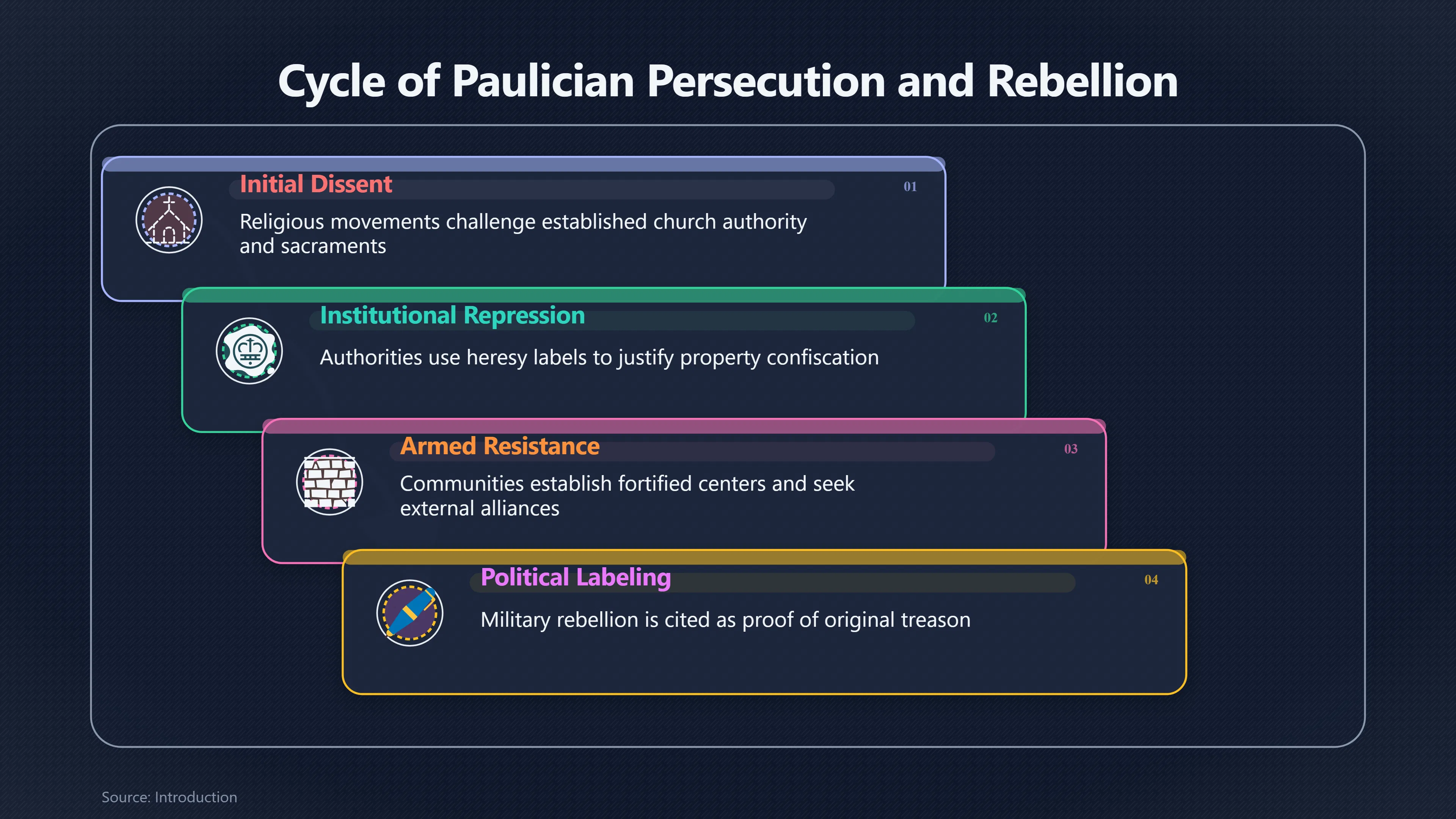
By the ninth century, repeated persecution by Byzantine authorities had driven many Paulicians towards armed resistance. Under leaders such as Karbeas and Chrysocheir, Paulician communities established a fortified centre at Tephrike on the Byzantine frontier and cooperated with Muslim rulers against the empire. They carried out military campaigns into Byzantine territory and became an authentic strategic problem for Constantinople.[Brill]brill.comThe Paulicians – Heresy, Persecution and Warfare on the Byzantine Frontier, c.750-880 | Brill…
These events allowed imperial authorities to argue that Paulician religious dissent naturally produced political betrayal. Modern historians, however, point out that the sequence also worked in reverse. Decades of executions, deportations and repression encouraged communities to seek protection wherever they could, including among Byzantium’s enemies. Political rebellion was therefore partly a consequence of persecution rather than simply its cause.[Brill]brill.comThe Paulicians – Heresy, Persecution and Warfare on the Byzantine Frontier, c.750-880 | Brill…
The Tondrakians present a different picture. Although they were repeatedly condemned by Armenian church authorities and occasionally suppressed by secular rulers, there is far less evidence that they organised sustained military resistance comparable to the Paulicians. Instead, accusations of disloyalty arose largely because rejection of church authority also appeared to challenge the social and political order that church and aristocracy jointly upheld. In medieval Armenia, criticism of ecclesiastical hierarchy could easily be interpreted as criticism of the kingdom itself.[OpenEdition Books]books.openedition.orgOpen Edition Books Hérésies chrétiennes dans l’Orient médiéval (ive-xve siècleOpenEdition BooksHérésies chrétiennes dans l’Orient médiéval (ive-xve siècle) - Les dénonciations des T‘ondrakiens - Presses universitair…
Why “traitor” meant more than military betrayal
Modern readers often understand treason as aiding a foreign enemy. Medieval Armenia operated with a broader concept.
Religious institutions were deeply intertwined with political authority, aristocratic privilege and communal identity. The Armenian Apostolic Church did far more than regulate worship: it helped preserve literacy, legal customs and collective identity during periods of foreign domination. Consequently, rejecting church authority could appear to contemporaries as an attack on the foundations of society itself.
For this reason, medieval accusations often blended together:
- doctrinal error;
- rejection of ecclesiastical authority;
- refusal to participate in accepted religious practice;
- social disorder;
- political unreliability.
These categories reinforced one another. A person denounced as a heretic could quickly become suspected of undermining public order, while someone resisting political authority could be portrayed as spiritually corrupt. The label “traitor” therefore described perceived threats to the religious and social fabric of the community as much as military collaboration with enemies.[Research @ Flinders]researchnow.flinders.edu.auyzantine Empire - Research @ Flinders…
What modern historians conclude
Recent scholarship has moved away from asking whether medieval church writers were simply “right” or “wrong”. Instead, historians ask why particular stories about heresy became persuasive and how they justified violence.
Several broad conclusions have emerged.
First, the surviving evidence is overwhelmingly one-sided. Much of what is known comes from opponents who had strong incentives to portray dissenters in the darkest possible terms. The destruction of Paulician and Tondrakian texts means historians rarely hear the movements speaking in their own voices.[Research @ Flinders]researchnow.flinders.edu.auyzantine Empire - Research @ Flinders…
Second, neither movement fits neatly into older categories. The once-common description of the Paulicians as straightforward dualists or direct ancestors of later western heresies has become increasingly contested. Likewise, interpretations of the Tondrakians as either purely theological reformers or purely social revolutionaries are generally regarded as overly simple.[brill.com]brill.comThe Paulicians – Heresy, Persecution and Warfare on the Byzantine Frontier, c.750-880 | Brill…
Finally, the combination of religious persecution and political conflict remains the most important lesson. The Paulicians demonstrate how repression can transform a dissident movement into an armed opponent, while the Tondrakians illustrate how criticism of religious institutions could be reframed as a threat to the stability of medieval Armenian society. In both cases, the language of heresy became inseparable from the language of political loyalty.

Why this history still matters
The stories of the Paulicians and Tondrakians illustrate a recurring pattern in Armenian history: religious disagreement was often interpreted through the lens of national survival. Because the Armenian Church played such a central role in preserving identity during centuries of political uncertainty, dissent was frequently understood not simply as theological error but as a challenge to the community itself.
For modern readers, the most important insight is not whether every medieval accusation was true or false. It is recognising how labels such as “heretic” and “traitor” were constructed, repeated and reinforced by institutions with political as well as religious interests. Understanding that process helps explain why these medieval movements continue to occupy an important place in discussions of religious minorities, persecution and the relationship between belief and political loyalty in Armenian history.[edu.au]researchnow.flinders.edu.auyzantine Empire - Research @ Flinders…
Amazon book picks
Further Reading
Books and field guides related to Were Armenia's Medieval Heretics Really Traitors?. Use these as the next step if you want deeper reading beyond the article.
The formation of a persecuting society
First published 1987. Subjects: Deviant behavior, History, Persecution, Power (Social sciences), Social conditions.
A Concise History of the Armenian People
First published 2002. Subjects: History, Armenians.
The medieval Manichee
First published 1947. Subjects: Christian sects, Medieval, Dualism, Manichaeism, Medieval Christian sects, Medieval Sects.
Endnotes
1.
Source: brill.com
Link:https://brill.com/display/book/9789004517080/9789004517080_webready_content_text.pdf
Source snippet
The Paulicians – Heresy, Persecution and Warfare on the Byzantine Frontier, c.750-880 | Brill...
2.
Source: books.openedition.org
Title: Open Edition Books Hérésies chrétiennes dans l’Orient médiéval (ive-xve siècle)
Link:https://books.openedition.org/pur/196521?lang=en
Source snippet
OpenEdition BooksHérésies chrétiennes dans l’Orient médiéval (ive-xve siècle) - Les dénonciations des T‘ondrakiens - Presses universitair...
3.
Source: cris.unibo.it
Link:https://cris.unibo.it/handle/11585/585669
4.
Source: researchnow.flinders.edu.au
Link:https://researchnow.flinders.edu.au/en/publications/sunk-in-thegulf-of-perdition-the-heretical-paulician-and-tondraki/
Source snippet
yzantine Empire - Research @ Flinders...
5.
Source: degruyterbrill.com
Title: De Gruyter Brill III. The History of the Paulicians
Link:https://www.degruyterbrill.com/document/doi/10.1515/9783111344522.112/html
Source snippet
The History of the PauliciansIII. THE HISTORY OF THE PAULICIANS Veröffentlicht von Image: De Gruyter Mouton Veröffentlichen auch Sie bei...
6.
Source: degruyterbrill.com
Title: The Paulicians
Link:https://www.degruyterbrill.com/document/isbn/9789004517080/html?lang=en
Source snippet
Your documents are now available to view. Dixon, Carl. The Paulicians: Heresy, Persecution and Warfare on the Byzantine Frontier, c.750-8...
8.
Source: researchgate.net
Link:https://www.researchgate.net/publication/368464411%27Sunk_in_theGulf_of_Perdition%27_The%27Heretical%27_Paulician_and_Tondrakian_Movements_in_the_Periphery_of_the_Medieval_Byzantine_Empire
Source snippet
January 1, 2022 — Article PDF Available 'SUNK IN THE…GULF OF PERDITION': THE 'HERETICAL' PAULICIAN AND TONDRAKIAN MOVEMENTS IN THE PERIPH...
Published: January 1, 2022
9.
Source: researchgate.net
Link:https://www.researchgate.net/publication/397179814_Syuzanna_Badalyan_Pavlikyan_ev_tondrakyan_sarzumneri_patmutyan_ardiakanutyun_Knnakan_hayack_18-20-rd_dareri_hay_patmagrutyan
Source snippet
նըJanuary 1, 2025 — Article PDF Available ՍՅՈՒԶԱՆՆԱ ԲԱԴԱԼՅԱՆ․ ՊԱՎԼԻԿՅԱՆ ԵՒ ԹՈՆԴՐԱԿՅԱՆ ՇԱՐԺՈՒՄՆԵՐԻ ՊԱՏՄՈՒԹՅԱՆ ԱՐԴԻԱԿԱՆՈՒԹՅՈՒՆԸ։ ՔՆՆԱԿԱՆ ՀԱ...
Published: January 1, 2025
10.
Source: edizionicafoscari.unive.it
Link:https://edizionicafoscari.unive.it/it/edizioni4/libri/978-88-97735-55-7/lidentificazione-fra-tondrachiani-e-pauliciani-e-l/
Source snippet
4 (K67) DI GRIGOR MAGISTROS + FEDERICO ALPI * Federico Alpi - Alma Mater Studiorum Università di Bologna, Italia...
11.
Source: cambridge.org
Title: The Paulicians (CHAPTER III)
Link:https://www.cambridge.org/core/books/abs/medieval-manichee/paulicians/F716F4687C328DA67E4030B752318448
Source snippet
The Medieval ManicheeDecember 10, 2009 — This chapter is part of a book that is no longer available to purchase from Cambridge Core CHAPT...
Published: December 10, 2009
12.
Source: youtube.com
Link:https://www.youtube.com/watch?v=3zpcVRwk3no
13.
Source: youtube.com
Link:https://www.youtube.com/watch?v=Anlz4zM_zAs
14.
Source: youtube.com
Link:https://www.youtube.com/watch?v=FdjI4Bosmwc
15.
Source: youtube.com
Link:https://www.youtube.com/watch?v=acSykshvrew
16.
Source: youtube.com
Link:https://www.youtube.com/watch?v=s_75QK3WEIM
Topic Tree