How Did Fear Become Contagious in Denmark?
Denmark’s history of collective fear is dominated not by one famous episode of “mass hysteria”, but by several different processes that should not be confused. Early modern witch hunts turned neighbourly suspicions into prosecutions and executions. A late seventeenth-century possession scare in Thisted helped expose the weaknesses of such cases.
Page outline Jump by section
Introduction
These episodes were not all cases of mental illness, nor were they simply outbreaks of irrational behaviour. They involved courts, clergy, journalists, doctors, museums, political authorities and frightened families. Their common feature was a feedback loop: ambiguous events acquired a threatening explanation; respected institutions repeated or investigated that explanation; apparent confirmation encouraged further testimony; and the resulting social response made the danger seem more real. Denmark’s record therefore shows how contagious belief usually depends on institutions as much as on crowds.
How witchcraft became a national threat
Belief in harmful magic existed in Denmark long before the major witch persecutions. What changed after the Lutheran Reformation of 1536 was the meaning attached to it. Historian Louise Nyholm Kallestrup argues that Danish authorities increasingly redefined witchcraft from an offence involving practical harm into a religious crime against God and Christian society. Political power, theology and criminal law reinforced one another until the supposed witch appeared not merely as a troublesome neighbour but as part of a hidden diabolical enemy.[Syddansk Universitet]portal.findresearcher.sdu.dkthe construction of witchcraft in early modern denmarkSyddansk UniversitetThe construction of witchcraft in early modern Denmark…by LN Kallestrup · 2025 · Cited by 2 — This book examines h…
This distinction matters because most accusations began with ordinary misfortune. A child fell ill, livestock died, beer failed to brew or a household suffered repeated accidents. Suspicion often settled on somebody who had recently quarrelled with the victim, issued a threat or possessed a longstanding reputation for magic. The dramatic stories of Devil worship that appeared in legal proceedings were therefore frequently imposed upon much older local beliefs about curses, healing and supernatural retaliation.
The royal court helped give these fears national force. In 1589, storms disrupted the voyage of Princess Anne of Denmark, who was travelling to marry James VI of Scotland. Danish proceedings subsequently blamed women accused of using witchcraft against the royal ships. Accounts of collective meetings, demons and weather magic crossed the North Sea and influenced the Scottish North Berwick trials. The episode illustrates how witch panics could travel through royal correspondence, interrogations and shared demonological ideas rather than through spontaneous public contagion alone.[livhelenewillumsen.no]livhelenewillumsen.noWitchcraft AgainstROYAL DANISH SHIPS IN 1589…December 3, 2020 — by LH Willumsen · Cited by 12 — 35 Julian Goodare, The European Witch-Hunt (New York: Ro…
Persecution intensified under Christian IV. A royal ordinance issued in 1617 encouraged clergy and local officials to identify and prosecute suspected sorcery. The measure arrived during the centenary celebrations of the Reformation, when the defence of Lutheran order had particular political and religious importance. Surviving Jutland records show a sharp concentration of executions between 1617 and 1625, although historians caution that records from other parts of the kingdom are incomplete. The evidence supports a major, state-assisted witch hunt, but not a perfectly precise national death toll.[sdu.dk]portal.findresearcher.sdu.dkthe construction of witchcraft in early modern denmarkSyddansk UniversitetThe construction of witchcraft in early modern Denmark…by LN Kallestrup · 2025 · Cited by 2 — This book examines h…
Women formed the large majority of those executed. Yet gender alone does not explain who was accused. Poverty, dependence, poor reputation, neighbourhood disputes and the social risks of being regarded as quarrelsome or magically knowledgeable also mattered. The typical case grew from local relationships, then became more dangerous when courts translated rumours about harmful magic into the official language of demonic conspiracy.
Køge: how accusations multiplied
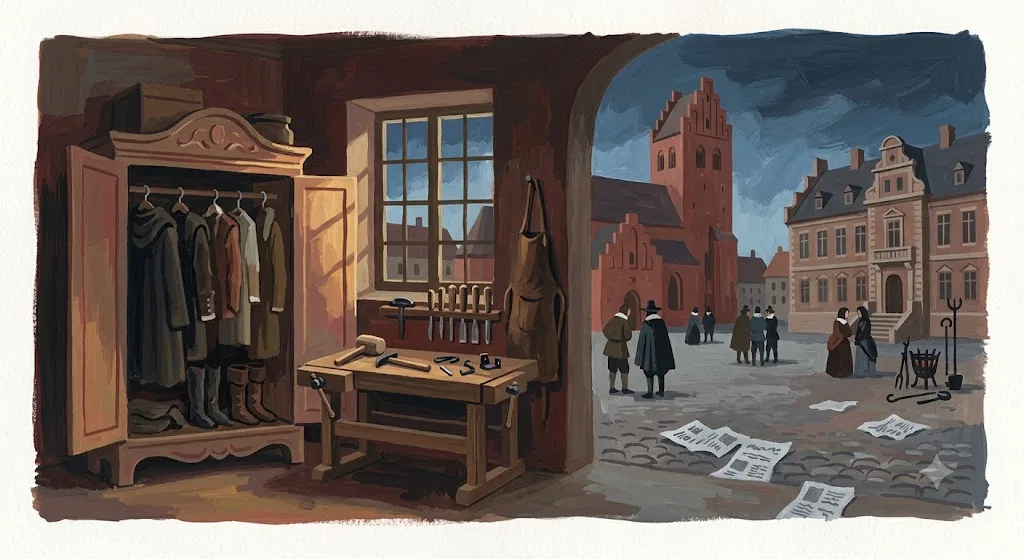
The trials remembered as the Køge witch persecution offer Denmark’s clearest example of an accusation chain. Between 1612 and 1615, sixteen women were accused in and around the town; according to Køge Museum, only one survived.[Museum Sydøstdanmark]museerne.dkMuseum SydøstdanmarkKøge Museum - Exhibitions - POSSESSEDAt that time, 16 women in Køge were accused of witchcraft in what we know today…
The crisis began with claims that a household was being tormented by an unseen presence. Strange noises, illness and domestic disturbances were interpreted as evidence that a local woman had sent the Devil into the home. Existing quarrels made that explanation plausible to neighbours and officials. Once proceedings began, accused women were pressed to identify supposed accomplices, causing suspicion to move through the community.
This mechanism was central to many witch hunts. A confession did more than condemn one person: it provided names, meetings and narratives that appeared to confirm the existence of a wider conspiracy. The growing list of defendants then seemed to validate the original allegation. Fear generated evidence, and that evidence generated more fear.
The Køge case is sometimes retold as though the town suddenly succumbed to an inexplicable collective delusion. The surviving pattern is more concrete and disturbing. Householders made claims; witnesses recalled quarrels and misfortunes; clerical ideas supplied a demonic explanation; and the judicial process converted accusation into further accusation. The victims were not harmed by belief alone but by institutions capable of imprisonment, coercive interrogation and execution.
Modern commemoration has changed the moral focus of the story. The accused women, once represented as threats to the town, are now presented as victims of persecution. That reversal is culturally important: it asks visitors to examine how ordinary testimony and official certainty can combine to produce irreversible injustice.
Thisted and the collapse of a possession case
The possession affair in Thisted in 1696–98 began when a young woman experienced fits and a local clergyman interpreted them as demonic possession. Other young women soon displayed similar behaviour, while several local women were accused of causing the attacks through witchcraft. A local court imposed death sentences.[Wikipedia]WikipediaThisted witch trialThisted witch trial
To a modern reader, the spread of convulsions may resemble mass psychogenic illness: real symptoms arising and circulating within a stressed social group without a demonstrated physical cause. That interpretation is possible, but the surviving record does not allow a confident retrospective diagnosis. Some participants later admitted deception, and the case involved performance, suggestion, religious expectation and local conflict in proportions that cannot now be measured precisely.
What can be established is that higher authorities became sceptical. Bishop Jens Bircherod questioned the allegedly possessed women, confessions of fabrication emerged, and the death sentences were overturned. The clergyman who had promoted the possession narrative was himself punished. The episode damaged the credibility of spectacular possession evidence and helped make Danish authorities more reluctant to accept new witchcraft accusations.[Wikipedia]WikipediaThisted witch trialThisted witch trial
Thisted did not mean that belief in magic vanished. Anne Palles had been executed in Copenhagen in 1693, and prosecutions or unofficial violence continued afterwards. A woman named Anna Klemens was lynched by villagers near Horsens in 1800 after being identified as a witch. The decline of formal trials was therefore a change in legal credibility, not an overnight transformation of popular belief.[Wikipedia]WikipediaWitch trials in DenmarkWitch trials in Denmark
The affair remains significant because it captures a transition. Earlier courts had treated fits and possession claims as evidence of an invisible criminal conspiracy. By the end of the Thisted case, central authorities were more willing to investigate the witnesses themselves and to consider fraud, manipulation or error.
The Satanic cult that never existed
In 1973, strange ritual-looking sites were discovered on the island of Anholt. They included masks, bones, candles, stone arrangements and other objects that appeared to suggest occult ceremonies. Danish media reported claims about black masses and secret Satanists. Similar coins and messages later appeared in churches, museums and public buildings, sometimes accompanied by letters attributed to a supposed high priestess called Alice Mandragora.[Wessex Archaeology]wessexarch.co.ukhoax satanist coins bath abbeyhoax satanist coins bath abbey
The objects looked like physical confirmation of a hidden organisation. That made the story unusually resilient. Unlike a vague rumour, it offered things that could be photographed, displayed, handled and rediscovered. Each new find renewed the apparent mystery, while its placement inside respected institutions gave the fiction an unintended air of authenticity.
The “cult”, however, was an elaborate long-running fabrication rather than evidence of an organised Satanic religion. The creators manufactured artefacts, identities and fragments of narrative, then planted them where discovery was likely. One sensational claim about a possible human sacrifice collapsed when the supposed victim contacted police and confirmed that she was alive.[Wessex Archaeology]wessexarch.co.ukhoax satanist coins bath abbeyhoax satanist coins bath abbey
The Anholt affair was not identical to the international Satanic ritual-abuse panic of the 1980s and 1990s. It began earlier, revolved around planted objects rather than children’s testimony and was ultimately closer to artistic hoax, private mythology and media mystery. Nevertheless, it drew upon the same cultural image: a disciplined underground cult conducting secret rites beneath an apparently orderly society.
It also demonstrates why “evidence” must be assessed through provenance rather than appearance. A sinister coin proves that somebody made a sinister coin. It does not, without independent corroboration, prove the existence of the organisation named on it. Today, Køge Museum presents the case as a story about fear, fascination and the eventual unravelling of a fabricated mystery.[Museum Sydøstdanmark]museerne.dkMuseum Sydøstdanmark Køge MuseumMuseum Sydøstdanmark Køge Museum
UFO prophecy in the nuclear age
Danish interest in unidentified flying objects developed after the Second World War within an international culture of flying-saucer reports, contactee stories and Cold War anxiety. Most enthusiasts treated UFOs as a scientific or technical mystery, but some interpreted extraterrestrials as morally superior beings with messages for humanity. Scholars of religion describe such movements as UFO religions when alien contact supplies revelation, salvation teaching or a new account of humanity’s place in the universe.[brill.com]brill.comOpen source on brill.com.
One striking Danish case began in 1967, when a taxi driver claimed to receive telepathic messages from an extraterrestrial being. The messages reportedly warned that nuclear war would begin on Christmas Eve and instructed him to construct a protective bunker. The predicted catastrophe did not occur, but elements of the message later reached followers beyond Denmark, particularly in Czechoslovakia and its successor states.[Hiddenmark.dk]hiddenmark.dkspace savior orthon and his many disciplesspace savior orthon and his many disciples
The episode combined modern technology with an old millenarian structure. There was an approaching catastrophe, a chosen messenger, privileged knowledge and the prospect that a prepared remnant might survive. Spaceships and nuclear weapons replaced angels and divine fire, but the emotional logic remained familiar.
It would be misleading to describe Danish UFO enthusiasts generally as members of a cult. The scene contained investigators, sceptics, hobbyists, spiritual seekers and small contactee circles with very different beliefs. Nor did the failed Christmas prophecy lead to mass disorder. Its value as a case study lies in showing how global fears can be converted into intimate revelation. The prospect of nuclear annihilation was real; the alien warning provided an interpretable timetable and a possible route to safety.
The HPV vaccine crisis
Denmark’s HPV vaccine controversy shows how a collective health scare can develop without invented symptoms or malicious participants. Girls and young women reported fatigue, dizziness, pain and other distressing conditions after vaccination. Their suffering was real and deserved clinical attention. The disputed question was whether the vaccine had caused the reported syndromes.
Negative media coverage increased markedly from 2013, including emotionally powerful accounts centred on affected individuals and families. Reports of suspected adverse reactions rose, political pressure intensified and Denmark asked the European Medicines Agency to re-examine vaccine safety. The agency concluded that the available evidence did not support a causal link between HPV vaccination and the syndromes under review. Later Danish research likewise found no increased risk of chronic fatigue syndrome, complex regional pain syndrome or postural orthostatic tachycardia syndrome following vaccination.[BMJ]bmj.comOpen source on bmj.com.
Public confidence nevertheless fell sharply. Uptake among Danish girls, previously around 90 per cent in some cohorts, dropped below 40 per cent among twelve-year-olds during the crisis. A population study found a close association between the volume and tone of media attention and falling vaccination acceptance.[PMC]pmc.ncbi.nlm.nih.govPMCDecline in HPV-vaccination uptake in DenmarkPMCDecline in HPV-vaccination uptake in Denmark
Calling the episode “mass hysteria” would be both imprecise and unfair. It could wrongly imply that patients fabricated their symptoms, while obscuring the communication failures and institutional decisions that shaped the controversy. A better description is a vaccine-confidence crisis in which personal testimony, uncertainty about medically unexplained symptoms, repeated news coverage and public suspicion reinforced one another.
Authorities eventually changed their approach. The Danish Health Authority, Danish Cancer Society and Danish Medical Association launched a joint campaign focused on cancer prevention, accessible evidence and dialogue with parents. Vaccination rates recovered substantially, although researchers estimated that approximately 26,000 fewer girls began vaccination than would have done so without the disruption.[sciencedirect.com]sciencedirect.comOpen source on sciencedirect.com.
The episode offers an important lesson about official responses to scares. Simply dismissing alarming claims can deepen mistrust, but treating an unproven causal explanation as established can magnify fear. Effective communication must acknowledge suffering, explain uncertainty and distinguish the timing of an illness from proof that one event caused another.

What connects these episodes
Denmark’s witch trials, possession accusations, Satanic hoax, UFO prophecy and vaccine controversy differed enormously in scale, evidence and harm. They should not be flattened into a single theory of irrational crowds. Several recurring mechanisms are nevertheless visible.
Ambiguous experiences acquired culturally available explanations. Illness could become bewitchment, convulsions could become possession, planted objects could become proof of Satanists, Cold War dread could become alien prophecy, and symptoms following vaccination could become evidence of vaccine injury.
Institutions amplified as well as restrained belief. Clergy and courts intensified witchcraft accusations, while higher courts later checked them. Newspapers helped spread the Anholt mystery. Health reporting contributed to vaccine anxiety, but coordinated public-health communication later rebuilt confidence.
Personal testimony carried exceptional emotional force. Witnesses to witchcraft, allegedly possessed women and patients describing illness could all speak sincerely or persuasively while remaining mistaken about causes. Respect for testimony does not remove the need to test explanations.
Conspiracy narratives explained missing evidence. Invisible witches, hidden Satanists and secretive organisations were imagined as skilled at concealment. Once absence itself becomes proof of secrecy, a belief becomes difficult to disconfirm.
Social harm came from responses, not merely ideas. Witchcraft beliefs became lethal because courts could execute. The Anholt story generated fascination more than mass victimisation. The HPV controversy mattered because falling uptake weakened protection against cancers caused by human papillomavirus.
The most useful distinction is therefore not between rational Denmark and moments when the country “went mad”. It is between documented danger and imagined conspiracy; real symptoms and disputed causal explanations; minority religion and hostile labelling; folklore and planted evidence; local rumour and state prosecution. Denmark’s history shows that collective fear becomes most dangerous when uncertainty is converted too quickly into certainty and when powerful institutions act before alternative explanations have been properly tested.
Amazon book picks
Further Reading
Books and field guides related to How Did Fear Become Contagious in Denmark?. Use these as the next step if you want deeper reading beyond the article.
Europe's inner demons
Examines conspiracy beliefs and persecution in European history.

The Witch: A History of Fear, from Ancient Times to the Present
Explains recurring patterns of fear, accusation and institutions across centuries.

The Penguin book of witches
Primary documents illustrate how accusations and beliefs spread.

Witchcraft: A History in Thirteen Trials
Shows how famous witch trials expanded through legal and social processes.
Endnotes
1.
Source: livhelenewillumsen.no
Title: Witchcraft Against
Link:https://www.livhelenewillumsen.no/res/Witchcraft%20Against.pdf
Source snippet
ROYAL DANISH SHIPS IN 1589...December 3, 2020 — by LH Willumsen · Cited by 12 — 35 Julian Goodare, The European Witch-Hunt (New York: Ro...
Published: December 3, 2020
2.
Source: Wikipedia
Title: Copenhagen witch trials
Link:https://en.wikipedia.org/wiki/Copenhagen_witch_trials
3.
Source: Wikipedia
Title: Ane Koldings
Link:https://en.wikipedia.org/wiki/Ane_Koldings
4.
Source: Wikipedia
Title: Witch trials in Denmark
Link:https://en.wikipedia.org/wiki/Witch_trials_in_Denmark
5.
Source: Wikipedia
Title: Thisted witch trial
Link:https://en.wikipedia.org/wiki/Thisted_witch_trial
6.
Source: Wikipedia
Title: Anne Palles
Link:https://en.wikipedia.org/wiki/Anne_Palles
7.
Source: brill.com
Link:https://brill.com/display/book/9789004325968/B9789004325968_080.pdf?srsltid=AfmBOoqDmh1nr2bUeLMpffbL7fRpx6CRjY4EVdNBef01RN_XJoprjDfx
8.
Source: journal.fi
Link:https://journal.fi/scripta/article/view/67234/27532
9.
Source: hiddenmark.dk
Title: space savior orthon and his many disciples
Link:https://hiddenmark.dk/english/ufos/contactees/space-savior-orthon-and-his-many-disciples/
10.
Source: bmj.com
Link:https://www.bmj.com/content/370/bmj.m2930
11.
Source: pmc.ncbi.nlm.nih.gov
Title: PMCDecline in HPV-vaccination uptake in Denmark
Link:https://pmc.ncbi.nlm.nih.gov/articles/PMC6288961/
12.
Source: who.int
Title: denmark campaign rebuilds confidence in hpv vaccination
Link:https://www.who.int/news-room/feature-stories/detail/denmark-campaign-rebuilds-confidence-in-hpv-vaccination
13.
Source: sciencedirect.com
Link:https://www.sciencedirect.com/science/article/abs/pii/S0264410X19316615
14.
Source: who.int
Link:https://www.who.int/europe/news/item/28-01-2019-danish-health-literacy-campaign-restores-confidence-in-hpv-vaccination
15.
Source: mediebibliotek.cancer.dk
Link:https://mediebibliotek.cancer.dk/asset/030fdb60-7488-48f0-86a3-0e2e45a52e64/Lessons-Learned-Stop-HPV-get-vaccinated.pdf
16.
Source: Wikipedia
Title: Mass psychogenic illness
Link:https://en.wikipedia.org/wiki/Mass_psychogenic_illness
17.
Source: Wikipedia
Title: Academic study of new religious movements
Link:https://en.wikipedia.org/wiki/Academic_study_of_new_religious_movements
18.
Source: Wikipedia
Title: Satanic panic
Link:https://en.wikipedia.org/wiki/Satanic_panic
19.
Source: Wikipedia
Title: List of mass panic cases
Link:https://en.wikipedia.org/wiki/List_of_mass_panic_cases
20.
Source: Wikipedia
Title: Køge Huskors
Link:https://en.wikipedia.org/wiki/K%C3%B8ge_Huskors
21.
Source: Wikipedia
Title: Day care sex abuse hysteria
Link:https://en.wikipedia.org/wiki/Day-care_sex-abuse_hysteria
22.
Source: Wikipedia
Title: George Adamski
Link:https://en.wikipedia.org/wiki/George_Adamski
23.
Source: brill.com
Link:https://brill.com/display/book/9789004325968/B9789004325968_080.pdf?srsltid=AfmBOopsBAXFrxLDb-KvhTYSYO4H5-ZY5Zl8DgDh3cIpDk2jvCUA9VI7
24.
Source: brill.com
Title: B9789004244962 s013
Link:https://brill.com/display/book/9789004244962/B9789004244962-s013.pdf?srsltid=AfmBOornVepZ_5QmruHC-VXrR1BZMQogRQX8jbMgK-tREN0kOJ6kgXeE
25.
Source: brill.com
Title: B9789004244962 s013
Link:https://brill.com/display/book/9789004244962/B9789004244962-s013.pdf?srsltid=AfmBOorsy61-PGt1SrWgNtIEeBCVXq-lculx36B4CCybZTDVp2AKJoR2
26.
Source: bmj.com
Link:https://www.bmj.com/content/bmj/370/bmj.m2930.full.pdf
27.
Source: sciencedirect.com
Link:https://www.sciencedirect.com/science/article/pii/S0264410X21012329
28.
Source: youtube.com
Title: Danish Witch Trials, Ghost Stories, and Modern Magic in Denmark
Link:https://www.youtube.com/watch?v=gVuiWaAqh_4
Source snippet
Witch - The story of Maren Spliid from Ribe, Denmark...
29.
Source: youtube.com
Link:https://www.youtube.com/watch?v=OINhhPOxXvg
Source snippet
Surveillance of side-effects of the HPV vaccine...
30.
Source: portal.findresearcher.sdu.dk
Title: the construction of witchcraft in early modern denmark 1536 1617
Link:https://portal.findresearcher.sdu.dk/en/publications/the-construction-of-witchcraft-in-early-modern-denmark-1536-1617/
Source snippet
Syddansk UniversitetThe construction of witchcraft in early modern Denmark...by LN Kallestrup · 2025 · Cited by 2 — This book examines h...
31.
Source: museerne.dk
Link:https://museerne.dk/en/pages/koege-museum-besat
Source snippet
Museum SydøstdanmarkKøge Museum - Exhibitions - POSSESSEDAt that time, 16 women in Køge were accused of witchcraft in what we know today...
32.
Source: wessexarch.co.uk
Title: hoax satanist coins bath abbey
Link:https://www.wessexarch.co.uk/hoax-satanist-coins-bath-abbey
33.
Source: museerne.dk
Title: Museum Sydøstdanmark Køge Museum
Link:https://museerne.dk/en/pages/koge-museum
34.
Source: museerne.dk
Title: Museum Sydøstdanmark Køge Museum
Link:https://museerne.dk/en/pages/koege-museum-satankulten
35.
Source: southerndenmark.academia.edu
Title: Louise Nyholm Kallestrup
Link:https://southerndenmark.academia.edu/LouiseNyholmKallestrup
36.
Source: pmc.ncbi.nlm.nih.gov
Link:https://pmc.ncbi.nlm.nih.gov/articles/PMC4884863/
37.
Source: pmc.ncbi.nlm.nih.gov
Link:https://pmc.ncbi.nlm.nih.gov/articles/PMC7931130/
38.
Source: ebsco.com
Link:https://www.ebsco.com/research-starters/social-sciences-and-humanities/mass-hysteria
39.
Source: portal.findresearcher.sdu.dk
Title: dk Ancient Aliens
Link:https://portal.findresearcher.sdu.dk/en/publications/ancient-aliens/
40.
Source: portal.findresearcher.sdu.dk
Title: new religions state policy and anti cult activities aspects of th
Link:https://portal.findresearcher.sdu.dk/en/publications/new-religions-state-policy-and-anti-cult-activities-aspects-of-th
41.
Source: sdu.dk
Title: nhedp3 2019
Link:https://www.sdu.dk/-/media/files/om_sdu/institutter/ivoe/nhe_discussion_papers/2019/nhedp3_2019.pdf
42.
Source: portal.findresearcher.sdu.dk
Title: dk Louise Nyholm Kallestrup
Link:https://portal.findresearcher.sdu.dk/en/persons/lnk/
Additional References
43.
Source: carlsbergfondet.dk
Title: Constructing Witchcraft in Early Modern Denmark
Link:https://www.carlsbergfondet.dk/en/what-we-have-funded/cf17-0307/
Source snippet
Belief in witchcraft was common both before and after the era of the witch trials, but fear of witchcraft resulted in its massive persecu...
44.
Source: academia.edu
Link:https://www.academia.edu/2395018/Apocalypse_in_Early_UFO_and_Alien_Based_Religions_Christian_and_Theosophical_Themes
45.
Source: researchgate.net
Link:https://www.researchgate.net/publication/249981603_Presumed_Immanent_the_Raelians_UFO_Religions_and_the_Postmodern_Condition
46.
Source: researchgate.net
Link:https://www.researchgate.net/publication/261854096_Extraterrestrial_encounters_UFOs_science_and_the_quest_for_transcendence
47.
Source: researchgate.net
Link:https://www.researchgate.net/publication/329554128Decline_in_HPV-vaccination_uptake_in_Denmark-_The_association_between_HPV-related_media_coverage_and_HPV-vaccination
48.
Source: researchgate.net
Link:https://www.researchgate.net/publication/347450871_Witchcraft_against_Royal_Danish_Ships_in_1589_and_the_Transnational_Transfer_of_Ideas
49.
Source: researchgate.net
Link:https://www.researchgate.net/publication/385389157_Olav_Hammer_and_Karen_Swartz-Hammer_New_Religious_Movements_and_Comparative_Religion
50.
Source: carlsbergfondet.dk
Link:https://www.carlsbergfondet.dk/det-har-vi-stoettet/cf17-0307/
51.
Source: hpvboard.org
Link:https://www.hpvboard.org/wp-content/uploads/2025/09/2.-Denmark.pdf
52.
Source: hpvworld.com
Link:https://www.hpvworld.com/articles/hpv-vaccination-crisis-and-recovery-the-danish-case
Topic Tree
Follow this branch
Related pages 192
- Antigua and Barbuda
- Argentina Belief Scares
- Azerbaijan Belief
- Bahrain Beliefs
- North Korea
- +187 more in sidebar