When Fear Became a Defence of Georgia
Georgia’s history of collective fear is not dominated by a single famous witch craze, dance plague or apocalyptic sect.
Page outline Jump by section
Introduction
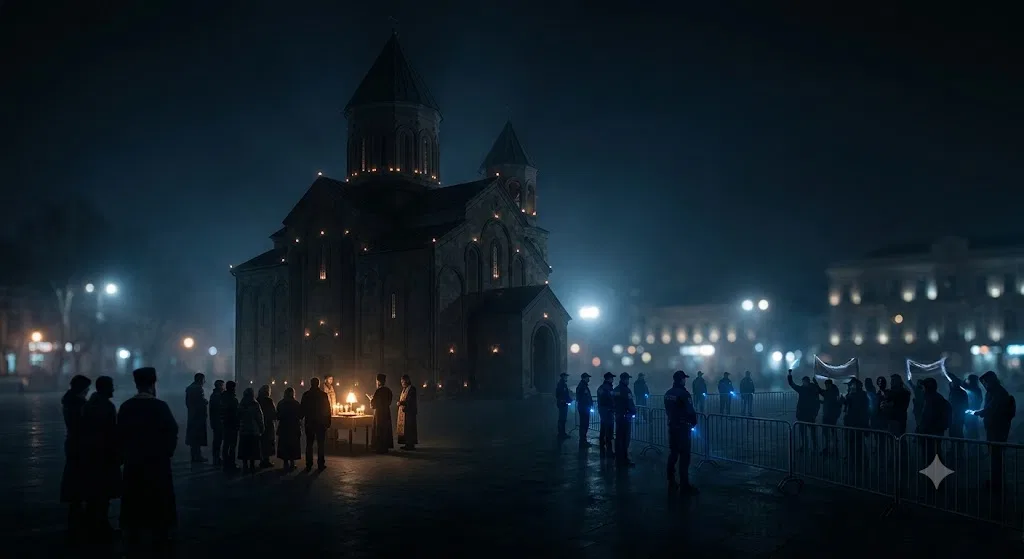
The most important lesson is that these episodes were not simply outbreaks of irrational crowd behaviour. They grew from Georgia’s difficult post-Soviet transition, the exceptional public authority of the Georgian Orthodox Church, weak or selective law enforcement, anxiety about Western influence and a recurring tendency to describe minorities as agents of moral contamination. Courts and human-rights investigators have repeatedly found that official passivity, and at times apparent cooperation, allowed threatening rhetoric to become organised violence.[state.gov]2001-2009.state.govDepartment Archive GeorgiaDepartment of State ArchiveFrom 1999 to 2003, followers of excommunicated Orthodox priest Basil Mkalavishvili (Basilists) engaged in nume…
Why Georgia’s scares took a religious form
Georgia is one of the world’s oldest Christian countries, and Orthodox Christianity occupies a central place in national memory. The traditional conversion story associates the adoption of Christianity with Saint Nino and King Mirian in the fourth century. One modern astronomical study has even proposed that the miraculous darkness described in the Georgian chronicles may preserve a memory of a solar eclipse in AD 319. Whatever the historical details, the story illustrates how closely religious faith, national origins and miraculous history are intertwined in Georgian culture.[arXiv]arxiv.orgNew evidence for determining of the date of adoption of Christianity as a state religion in GeorgiaFebruary 16, 2011…
That connection became politically powerful after the collapse of the Soviet Union. Soviet atheism had suppressed public religious life, but independence brought a rapid Orthodox revival at the same time as Georgia experienced civil conflict, poverty, corruption and weakened state institutions. For many people, the Church represented continuity and moral order. The danger arose when membership of the religious majority was treated as a test of authentic national belonging.
Minority faiths could then be represented not simply as theological rivals but as foreign forces undermining Georgia. Jehovah’s Witnesses were especially vulnerable because their door-to-door evangelism, refusal of certain patriotic and military practices, and visible international organisation made them easy to describe as an alien “sect”. The word carried more than a neutral religious meaning: in hostile political and media usage, it suggested manipulation, broken families, psychological control and a hidden campaign against Georgian identity.
This was a moral panic rather than proof of a secret conspiracy. Jehovah’s Witnesses openly conducted religious meetings and distributed literature. The documented conspiracy was instead the informal alliance of militant clergy, supporters, sympathetic officials and passive police officers who treated attacks on a disliked minority as religiously justified or socially tolerable.[rferl.org]rferl.orgRadioFreeEurope/RadioLibertyGeorgia: Religious Minorities Face Escalating ViolenceMay 14, 2001 — 14 May 2001 — A group of some 40 raiders…
The anti-sect violence of 1999–2004
The defining episode began on 17 October 1999 in Gldani, a district of Tbilisi. About 120 Jehovah’s Witnesses were holding a meeting when followers of Basili Mkalavishvili, an excommunicated Orthodox priest, invaded the gathering. According to the later judgment of the European Court of Human Rights, the attackers assaulted worshippers and destroyed religious materials while police failed to provide meaningful protection.[HUDOC]hudoc.echr.coe.intThey assaulted the Jehovah's Witnesses, journalists and the foreign observers who were present in the courtroom. The attackers were…
The Gldani attack became a model that others could imitate. During the following years, religious meetings were raided, believers were beaten and books were publicly burned. Human Rights Watch reported assaults involving clubs, iron crosses and sticks fitted with nails. In one February 2001 incident, police reportedly opened the gate of a private property before attackers entered. In April, another prayer meeting was broken up and several people required hospital treatment.[Human Rights Watch]hrw.orggeorgia mobs terrorize non orthodox christiansHuman Rights WatchGeorgia: Mobs Terrorize Non-Orthodox Christians28 Aug 2001 — On April 30, Mkalavishvili's supporters broke up another J…
The violence spread beyond Tbilisi. In Kaspi in 2002, a crowd of roughly 100 people attacked a house used by a local Jehovah’s Witness leader, burned literature and damaged equipment prepared for a convention. The gathering was cancelled. Contemporary reporting also recorded attacks on Baptists, Pentecostals, Catholics and other Christian communities considered insufficiently Orthodox.[CSCE]csce.govCommission Leaders Welcome Arrest of Caustic GeorgianCommission Leaders Welcome Arrest of Caustic Georgian…March 8, 2016 — Since 1999, several non-Georgian Orthodox religious groups h…
Estimates differ because incidents were recorded by religious groups, journalists and human-rights organisations using different definitions. One contemporary investigation reported that Jehovah’s Witnesses had documented more than 80 violent assaults over roughly two and a half years, affecting more than 1,000 followers. The precise total is less important than the pattern: attacks were repeated, geographically dispersed, publicly defended and rarely punished.[Institute for War & Peace Reporting]iwpr.netgeorgian priest rampagegeorgian priest rampage
Basili Mkalavishvili and the language of purification
Mkalavishvili did not present his campaign as ordinary criminal violence. He described it as a defence of Orthodox Georgia from dangerous religious forces. Accounts from the period record rhetoric about cleansing the country of “satanic” influence and warnings that other minority religions would be targeted after the Jehovah’s Witnesses.[Amnesty International]amnesty.orgInternational Police allegedly support mob attack on Jehovah's WitnessesInternational Police allegedly support mob attack on Jehovah's Witnesses
Such language supplied a simple moral drama. Georgia was imagined as a sacred community; minority missionaries became infiltrators; religious books became instruments of contamination; and physical aggression became purification. The belief did not need to be coherent or supported by evidence. It only had to connect existing anxieties about foreign influence, post-Soviet instability and loss of national identity.
Mkalavishvili’s followers are sometimes described as a cult-like movement because of their devotion to a charismatic cleric and participation in organised raids. That label should be used cautiously. They were better understood as a militant religious faction operating within a broader climate of Orthodox nationalism. Mkalavishvili had been excommunicated, and his violence did not represent every Orthodox believer. Yet the movement’s influence depended on attitudes that extended well beyond his immediate followers.
When state inaction became part of the panic
The attacks continued partly because perpetrators expected impunity. Police frequently arrived late, stood by or treated assaults as private religious disputes. Prosecutors were slow to act, while victims sometimes faced hostile officials when they attempted to report crimes. Contemporary US State Department reports described continuing harassment and discrimination even as the number of severe attacks began to decline after 2003.[U.S. Department of State]2009-2017.state.govU.S. Department of State GeorgiaU.S. Department of State Georgia
In its 2007 Gldani judgment, the European Court of Human Rights concluded that Georgian authorities had failed in their duty to protect the congregation. The Court found violations involving freedom of religion and inhuman or degrading treatment, emphasising that official tolerance had allowed religious violence to become generalised.[HUDOC]hudoc.echr.coe.intThey assaulted the Jehovah's Witnesses, journalists and the foreign observers who were present in the courtroom. The attackers were…
The political change following the 2003 Rose Revolution altered the situation. The new government moved more forcefully against militant groups, and Mkalavishvili was arrested in 2004. He was later convicted of organising violence against Jehovah’s Witnesses and Baptist Evangelicals and of burning religious literature. In January 2005 he received a six-year prison sentence.[Civil Georgia]civil.geGeorgia Human Rights Watch Welcomes Conviction of Assailant ExGeorgia Human Rights Watch Welcomes Conviction of Assailant Ex
This crackdown substantially reduced large, organised raids. It did not erase the prejudices that had made them possible. Later European human-rights cases continued to examine religiously motivated aggression and failures to investigate it properly. As recently as 2025, the Council of Europe was still pressing Georgia to complete reforms connected with the Gldani group of judgments.[HUDOC]hudoc.echr.coe.intHUDOCTSARTSIDZE AND OTHERS v. GEORGIAHUDOCTSARTSIDZE AND OTHERS v. GEORGIA
From the “dangerous sect” to the “threatened family”
The most visible Georgian moral panic of the next decade focused not on minority churches but on LGBT people. The central claim changed, yet the structure was familiar. A small and vulnerable group was presented as an organised danger to faith, children, family life and national survival. Western human-rights language was depicted as a vehicle for moral colonisation.
On 17 May 2012, LGBT activists attempting to mark the International Day Against Homophobia were attacked and their demonstration was disrupted. The European Court of Human Rights later ruled in Identoba and Others v Georgia that the authorities had not provided adequate protection or carried out an effective investigation into the discriminatory violence.[HUDOC]hudoc.echr.coe.intOpen source on coe.int.
The following year produced a far larger confrontation. On 17 May 2013, a small group of activists planned another event in central Tbilisi. Thousands of counter-demonstrators, including Orthodox clergy, gathered against them. The crowd broke through police lines, pursued activists and attacked vehicles used to evacuate them. Journalists, demonstrators and police officers were injured.[HUDOC]hudoc.echr.coe.inthe applicants' public rally from homophobic and/or transphobic acts of…Read more…
The incident was not a spontaneous clash between equivalent crowds. The LGBT gathering was small and had notified the authorities in advance. The counter-mobilisation was vastly larger and had been encouraged by public statements depicting homosexuality as a disease, sin or foreign imposition. The threatened spectacle of LGBT visibility became more important than anything the activists had actually done.
In 2021, the European Court of Human Rights ruled that Georgia had failed to protect the demonstrators. It stated that the unprecedented scale of the violence could not be separated from earlier official failures to investigate anti-LGBT attacks. The judgment also found that parts of the state response amounted to official connivance or acquiescence.[coe.int]hudoc.echr.coe.inthe applicants' public rally from homophobic and/or transphobic acts of…Read more…
How fear became politically useful
Moral panics become durable when they allow several groups to pursue different aims at once. Clerical activists can claim to defend religion. Politicians can present themselves as protectors of the family. Media organisations gain dramatic stories. People unsettled by rapid social change receive a visible group to blame.
In Georgia, LGBT rights increasingly became a symbolic substitute for a much larger argument about the country’s direction. Supporters of European integration generally presented minority protection as part of democratic reform. Conservative actors countered that European institutions were demanding the abandonment of Georgian religion, masculinity and family life.
This framing often relied on slippery language. Legal equality was described as “propaganda”. Public discussion became “promotion”. The existence of LGBT organisations was represented as recruitment. Protection from violence was reinterpreted as special privilege. Concerns about children were especially effective because they shifted debate away from the treatment of real adults and towards imagined future harm.
The same pattern appeared in political arguments surrounding the 2024 legislative package on “family values and minors”. The proposals included restrictions on public information, gatherings, media representation, legal gender recognition and other aspects of LGBT life. Supporters described the measures as protection from harmful ideology, while critics viewed them as an attempt to manufacture a cultural enemy before an election.[GOV.UK]GOV.UKCountry policy and information note: sexual orientationCountry policy and information note: sexual orientation
The Council of Europe’s Venice Commission warned that the proposed constitutional changes were vague, discriminatory and incompatible with fundamental rights. It also criticised the decision to advance them during a period of intense political and social tension. The legislation was nevertheless adopted in September 2024, with major provisions taking effect that December.[Venice Commission]venice.coe.intVenice Commission GEORGIA OPINION ON THE DRAFT CONSTITUTIONAL LAWVenice Commission GEORGIA OPINION ON THE DRAFT CONSTITUTIONAL LAW
Calling this a moral panic does not mean that every supporter was insincere or hysterical. Many people genuinely hold conservative religious beliefs. The term describes the disproportion between a claimed social danger and the evidence for it, together with the political amplification of that danger and the targeting of a group portrayed as responsible.

What Georgia did not experience
Georgia should not be forced into a standard European catalogue of witch trials and mass hysteria. Georgian folklore contains witches, demons, possession, harmful magic, miraculous healing and supernatural explanations for misfortune. Such beliefs are important to cultural history, but folklore alone is not evidence of a large, organised witch panic.
There is no well-documented Georgian equivalent of the major early modern witch persecutions in parts of Germany, Scotland or New England. Georgia belonged to an Orthodox Christian and Caucasian legal-cultural world whose history did not follow the same pattern as the Catholic and Protestant regions most associated with mass witch trials.
Individual accusations of sorcery, village disputes or religious denunciations may have occurred, but the accessible evidence does not support presenting Georgia as the site of a national “witch craze”. Claims to the contrary often arise from confusing folk tales with court history, treating every belief in magic as persecution, or mixing the country of Georgia with the American state of the same name.
The same caution applies to “mass hysteria” in its medical sense. There are no securely established Georgian cases on the scale of the best-known school fainting outbreaks or mass psychogenic illness episodes elsewhere. Absence from widely available records does not prove that smaller incidents never occurred, but it makes confident storytelling inappropriate.
Panic, prejudice and genuine conflict
Not every intense Georgian controversy is a collective delusion. The country has faced real wars, displacement, political violence, economic insecurity and outside interference. Suspicion of foreign power is not inherently imaginary in a state shaped by Russian domination, Soviet rule and conflicts over Abkhazia and South Ossetia.
The analytical task is to identify when real insecurity is redirected towards people who did not cause it. In the anti-sect campaigns, fears about national survival were displaced onto minority Christians. In anti-LGBT mobilisation, disputes over Europeanisation, government legitimacy and social change were condensed into claims that a small minority threatened children and the family.
Several distinctions help prevent sensationalism:
- A moral panic exaggerates a person or group into a broad threat to society and demands exceptional control.
- Persecution describes the resulting discrimination, intimidation or violence against the targeted group.
- Crowd violence concerns what people do collectively; it does not prove that every participant shares an identical belief.
- Religious nationalism links the majority faith to national membership and can make dissent appear disloyal.
- Mass psychogenic illness involves real physical symptoms spreading without a sufficient toxic or infectious cause. It is not an appropriate description of Georgia’s anti-minority riots.
- A cult is a disputed label, often applied by opponents to unfamiliar religions. It should not be treated as a factual diagnosis.
These categories overlap, but they are not interchangeable. Calling the Gldani attacks “mass hysteria” would understate the planning and ideological leadership involved. Calling every conservative demonstration persecution would ignore differences between peaceful belief and coercive action. The strongest evidence concerns organised intimidation enabled by political and institutional choices.
Why the scares spread
Georgia’s best-documented panics shared several mechanisms.
A sacred national identity. When Orthodox Christianity was treated as the essence of Georgian nationhood, religious difference could be framed as betrayal rather than diversity.
A society undergoing rapid change. Independence, economic collapse, reform and migration disrupted familiar institutions. Groups promising moral certainty gained influence in that unsettled environment.
Threats involving children and families. Claims that minorities recruit young people, destroy households or corrupt children transform abstract disagreement into urgent fear.
Visible but weakly protected minorities. Jehovah’s Witnesses held recognisable meetings and distributed literature. LGBT activists organised small public events. Their visibility made them convenient targets, while limited political power made retaliation less likely.
Media repetition. Hostile reporting and inflammatory commentary allowed accusations to circulate without equivalent scrutiny. Repetition made minority groups seem larger, more organised and more threatening than they were.
Official ambiguity. Governments condemned violence in general terms while hesitating to confront influential clergy or conservative constituencies. That gap signalled that certain forms of aggression might be tolerated.
Impunity. Each attack that went unpunished lowered the cost of the next one. European Court judgments on both religious and anti-LGBT violence repeatedly connected later harm with earlier failures to investigate and prosecute.[ECHR-KS]ks.echr.coe.intclin may 2007 engclin may 2007 eng

The role of the Orthodox Church
The Georgian Orthodox Church is not a single-minded organisation, and millions of Georgians participate in it without supporting violence. It would therefore be misleading to describe the Church itself as a cult or to attribute every hostile act to a centrally directed plan.
At the same time, senior religious authority has often shaped the boundaries of acceptable public speech. Clergy participated visibly in anti-minority demonstrations, and church-linked rhetoric helped define Jehovah’s Witnesses, sexual minorities and liberal activists as dangers to the nation. Failure to condemn violent actors clearly could be understood by participants as approval.
Mkalavishvili’s excommunication demonstrates that institutional status and ideological influence are not the same thing. He operated outside formal church discipline, but his message drew strength from widespread assumptions about Orthodox primacy. Similarly, the 2013 violence involved particular priests and radical organisers, yet it was made possible by a much broader social climate.
This is why the history cannot be reduced to a few fanatics. Charismatic agitators mattered, but so did respectable institutions, popular newspapers, political calculations and ordinary bystanders. Moral panics succeed when extreme claims are linked to familiar values and repeated by people who appear legitimate.
What changed after the violence
Georgia’s response has been uneven rather than entirely static. The arrest and conviction of Mkalavishvili showed that organised religious violence could be curtailed when the state chose to enforce the law. Large-scale attacks on minority religious meetings declined, and legal protections gradually improved.[Civil Georgia]civil.geGeorgia Human Rights Watch Welcomes Conviction of Assailant ExGeorgia Human Rights Watch Welcomes Conviction of Assailant Ex
European Court judgments also established a significant principle: authorities must do more than refrain from attacking minorities themselves. They must take reasonable steps to protect threatened gatherings and investigate discriminatory violence. Police passivity can amount to a human-rights violation when officials know that a group faces a foreseeable danger.
Yet the later anti-LGBT cases showed that institutional lessons had not been fully absorbed. The object of fear changed, but the sequence remained recognisable: public demonisation, advance warning of possible violence, inadequate protection, a mob attack and weak accountability.
The 2024 restrictions marked a further shift. Earlier panics often worked through unofficial violence that the state failed to stop. The newer approach translates the language of moral threat into legislation. Fear of “propaganda” becomes a basis for restricting expression, assembly, education and representation, even without evidence that LGBT visibility causes the harms claimed by its opponents.[coe.int]venice.coe.intVenice Commission GEORGIA OPINION ON THE DRAFT CONSTITUTIONAL LAWVenice Commission GEORGIA OPINION ON THE DRAFT CONSTITUTIONAL LAW
Why this history still matters
Georgia’s episodes of collective fear reveal how easily the language of protection can become a licence for exclusion. Religious attackers claimed to protect Orthodoxy. Anti-LGBT movements claimed to protect the family. Political campaigns claimed to protect sovereignty from foreign ideology. In each case, a vulnerable minority was made to carry the weight of much wider national anxieties.
The comparison also shows why “cult” and “hysteria” must be used carefully. Jehovah’s Witnesses were called a dangerous sect, but the accusations against them were largely products of hostile labelling. LGBT organisations were depicted as an organised ideological movement seeking to corrupt children, but the evidence instead shows small civil-society groups seeking the ability to assemble without being attacked.
Georgia’s story is therefore less about mysterious mass possession than about the social production of enemies. Beliefs spread because they answered emotional and political needs: they made disorder understandable, turned complicated change into a struggle between good and evil, and offered authorities a population whose rights could be sacrificed in the name of unity.
The most durable safeguard is not simply better factual correction. It is consistent law enforcement, protection for unpopular speech and worship, responsible religious leadership, and refusal by political institutions to reward those who convert prejudice into public power.
Amazon book picks
Further Reading
Books and field guides related to When Fear Became a Defence of Georgia. Use these as the next step if you want deeper reading beyond the article.

The Righteous Mind
First published 2012. Subjects: Political psychology, Social psychology, Ethics, Religious Psychology, nyt:combined-print-and-e-book-nonf...
Imagined communities
First published 1983. Subjects: Nationalism, History, Nationalisme, Nacionalismo, Histoire.
The Orthodox Church in the history of Russia
First published 1998. Subjects: Church history, History, Influence, Orthodox Eastern Church, Russkai︠a︡ pravoslavnai︠a︡ t︠s︡erkovʹ.
Moral panics
First published 1998. Subjects: Public opinion, Deviant behavior in mass media, Social problems in mass media, Social problems, Deviant b...
Endnotes
1.
Source: 2001-2009.state.gov
Title: Department Archive Georgia
Link:https://2001-2009.state.gov/g/drl/rls/irf/2005/51553.htm
Source snippet
Department of State ArchiveFrom 1999 to 2003, followers of excommunicated Orthodox priest Basil Mkalavishvili (Basilists) engaged in nume...
2.
Source: arxiv.org
Link:https://arxiv.org/abs/1102.3381
Source snippet
New evidence for determining of the date of adoption of Christianity as a state religion in GeorgiaFebruary 16, 2011...
Published: February 16, 2011
3.
Source: csce.gov
Title: Commission Leaders Welcome Arrest of Caustic Georgian
Link:https://www.csce.gov/press-releases/commission-leaders-welcome-arrest-caustic/
Source snippet
Commission Leaders Welcome Arrest of Caustic Georgian...March 8, 2016 — Since 1999, several non-Georgian Orthodox religious groups h...
Published: March 8, 2016
4.
Source: amnesty.org
Title: International Police allegedly support mob attack on Jehovah’s Witnesses
Link:https://www.amnesty.org/en/wp-content/uploads/2021/06/eur560062001en.pdf
5.
Source: 2009-2017.state.gov
Title: U.S. Department of State Georgia
Link:https://2009-2017.state.gov/j/drl/rls/irf/2004/35455.htm
6.
Source: 2009-2017.state.gov
Title: U.S. Department of State Georgia
Link:https://2009-2017.state.gov/j/drl/rls/irf/2006/71381.htm
7.
Source: 2009-2017.state.gov
Link:https://2009-2017.state.gov/j/drl/rls/hrrpt/2004/41682.htm
8.
Source: civil.ge
Title: Georgia Human Rights Watch Welcomes Conviction of Assailant Ex
Link:https://civil.ge/archives/107182
9.
Source: civil.ge
Link:https://civil.ge/archives/462479
10.
Source: GOV.UK
Title: Country policy and information note: sexual orientation
Link:https://www.gov.uk/government/publications/georgia-country-policy-and-information-notes/country-policy-and-information-note-sexual-orientation-and-gender-identity-and-expression-georgia-december-2023-accessible
11.
Source: amnesty.org
Title: georgia halt legislative assault on lgbti rights
Link:https://www.amnesty.org/en/latest/news/2024/03/georgia-halt-legislative-assault-on-lgbti-rights/
12.
Source: civil.ge
Link:https://civil.ge/archives/640509
13.
Source: state.gov
Link:https://www.state.gov/report/custom/66d3a3200b
14.
Source: state.gov
Link:https://www.state.gov/report/custom/3aaf1aaa13
15.
Source: state.gov
Link:https://www.state.gov/report/custom/05f99260e1
16.
Source: state.gov
Link:https://www.state.gov/report/custom/53b3d530cc
17.
Source: state.gov
Link:https://www.state.gov/report/custom/ef41fa1f56/
18.
Source: 2021-2025.state.gov
Link:https://2021-2025.state.gov/report/custom/02ebc46819/
19.
Source: amnesty.eu
Link:https://www.amnesty.eu/wp-content/uploads/2018/10/EC_ruling_in_Identoba_052015.pdf
20.
Source: hudoc.echr.coe.int
Link:https://hudoc.echr.coe.int/eng?i=001-80395
Source snippet
They assaulted the Jehovah's Witnesses, journalists and the foreign observers who were present in the courtroom. The attackers were...
21.
Source: hudoc.echr.coe.int
Link:https://hudoc.echr.coe.int/fre?i=001-214040
Source snippet
he applicants' public rally from homophobic and/or transphobic acts of...Read more...
22.
Source: rferl.org
Link:https://www.rferl.org/a/1096427.html
Source snippet
RadioFreeEurope/RadioLibertyGeorgia: Religious Minorities Face Escalating ViolenceMay 14, 2001 — 14 May 2001 — A group of some 40 raiders...
Published: May 14, 2001
23.
Source: hrw.org
Title: georgia mobs terrorize non orthodox christians
Link:https://www.hrw.org/news/2001/08/28/georgia-mobs-terrorize-non-orthodox-christians
Source snippet
Human Rights WatchGeorgia: Mobs Terrorize Non-Orthodox Christians28 Aug 2001 — On April 30, Mkalavishvili's supporters broke up another J...
24.
Source: iwpr.net
Title: georgian priest rampage
Link:https://iwpr.net/global-voices/georgian-priest-rampage
25.
Source: ks.echr.coe.int
Title: clin may 2007 eng
Link:https://ks.echr.coe.int/documents/d/echr-ks/clin_may_2007_eng
Published: may 2007
26.
Source: hudoc.echr.coe.int
Title: HUDOCTSARTSIDZE AND OTHERS v. GEORGIA
Link:https://hudoc.echr.coe.int/eng?i=001-170349
27.
Source: search.coe.int
Link:https://search.coe.int/cm?i=09125948802645b8
28.
Source: hudoc.echr.coe.int
Link:https://hudoc.echr.coe.int/eng?i=001-157298
29.
Source: policehumanrightsresources.org
Link:https://policehumanrightsresources.org/womens-initiatives-supporting-group-and-others-v-georgia-applications-nos-73204-13-and-74959-13
30.
Source: venice.coe.int
Title: Venice Commission GEORGIA OPINION ON THE DRAFT CONSTITUTIONAL LAW
Link:https://www.venice.coe.int/webforms/documents/default.aspx?pdffile=CDL-AD%282024%29021-e
31.
Source: hrw.org
Link:https://www.hrw.org/world-report/2025/country-chapters/georgia
32.
Source: hudoc.exec.coe.int
Link:https://hudoc.exec.coe.int/eng?i=DH-DD%282018%29425E
33.
Source: hudoc.exec.coe.int
Link:https://hudoc.exec.coe.int/eng?i=DH-DD%282023%291366E
34.
Source: hudoc.echr.coe.int
Link:https://hudoc.echr.coe.int/app/conversion/pdf/?TID=vnvttaxipk&filename=001-146769.pdf&id=001-146769&library=ECHR
35.
Source: coe.int
Title: Judgments of the Court
Link:https://www.coe.int/de/web/echr-toolkit/arrets
36.
Source: hudoc.echr.coe.int
Title: int AGHDGOMELASHVIL I AND JAPARIDZE v. GEORGIA
Link:https://hudoc.echr.coe.int/fre?i=001-204815
37.
Source: hudoc.exec.coe.int
Link:https://hudoc.exec.coe.int/eng?i=DH-DD%282020%29572E
38.
Source: hudoc.echr.coe.int
Title: int IDENTOB A AND OTHERS v. GEORGIA
Link:https://hudoc.echr.coe.int/eng?i=001-154430
39.
Source: degruyterbrill.com
Link:https://www.degruyterbrill.com/document/doi/10.1525/9780520960565-006/html?srsltid=AfmBOopiYiT12RZ8VsbaDo6xWWcSegeMisN1JyUeueQJnk4j743V7A02
40.
Source: forum18.org
Link:https://www.forum18.org/archive.php?article_id=503
Additional References
41.
Source: youtube.com
Link:https://www.youtube.com/watch?v=-en_NvD6o-g
Source snippet
Georgia: clashes on International Day Against Homophobia...
42.
Source: youtube.com
Title: Georgia far-right groups protest at gay film premiere | AFP
Link:https://www.youtube.com/watch?v=OD5UeoesvAY
Source snippet
Thousands of Georgians march to celebrate 'family purity' day in Tbilisi...
43.
Source: youtube.com
Title: In Georgia, Church-Led ‘Family Purity Day’ Forces Out LGBTQ+ Events
Link:https://www.youtube.com/watch?v=yJkImrG43Qo
Source snippet
Georgia far-right groups protest at gay film premiere | AFP...
44.
Source: youtube.com
Title: Georgia: clashes on International Day Against Homophobia
Link:https://www.youtube.com/watch?v=YweRqkwoq_g
Source snippet
In Georgia, Church-Led 'Family Purity Day' Forces Out LGBTQ+ Events...
45.
Source: researchgate.net
Link:https://www.researchgate.net/publication/236695018_Witch_Craze_Beyond_the_Legends_of_Panic
46.
Source: medium.com
Link:https://medium.com/predict/flames-of-fear-unraveling-europes-witch-hunt-hysteria-845e4e576895
47.
Source: ilga-europe.org
Link:https://www.ilga-europe.org/files/uploads/2024/02/2024_georgia.pdf
48.
Source: reddit.com
Link:https://www.reddit.com/r/Wicca/comments/114u3uw/hey_all_anyone_here_involved_in_georgian_wicca/
49.
Source: historyonthenet.com
Link:https://www.historyonthenet.com/moral-panics-mass-hysteria-dancing-plague-salem-witch-trials-tulip-market-bubble
50.
Source: facebook.com
Link:https://www.facebook.com/groups/306999657179846/posts/1590763872136745/
Topic Tree
Follow this branch
Related pages 192
- Antigua and Barbuda
- Argentina Belief Scares
- Azerbaijan Belief
- Bahrain Beliefs
- North Korea
- +187 more in sidebar