Within Eswatini
Can Witchcraft Belief Ever Excuse Violence?
Eswatini's courts must respect sincerely held beliefs while making clear that fear of witchcraft cannot justify assault or killing.
On this page
- Why witchcraft accusations become dangerous
- Colonial era offences and their purpose
- Rex v Shongwe and the limits of belief
Page outline Jump by section
Introduction
Can a sincere belief that someone is using witchcraft ever excuse assault or killing in Eswatini? The short legal answer is no. Although belief in witchcraft remains widespread and forms part of many people’s understanding of illness, misfortune and death, Eswatini’s courts have repeatedly held that such beliefs cannot justify taking the law into one’s own hands. At the same time, judges have recognised that these beliefs are genuinely held by many citizens and may, in limited circumstances, help explain an accused person’s state of mind when deciding sentence rather than guilt. This careful distinction lies at the heart of Eswatini’s approach: the law seeks to respect freedom of belief while protecting people from violence fuelled by accusations of witchcraft.[Eswatini Legal Information Institute]eswatinilii.orgEswatini Legal Information InstituteIN THE SUPREME COURT OF ESWATINIOctober 4, 2025…
Why witchcraft accusations become dangerous
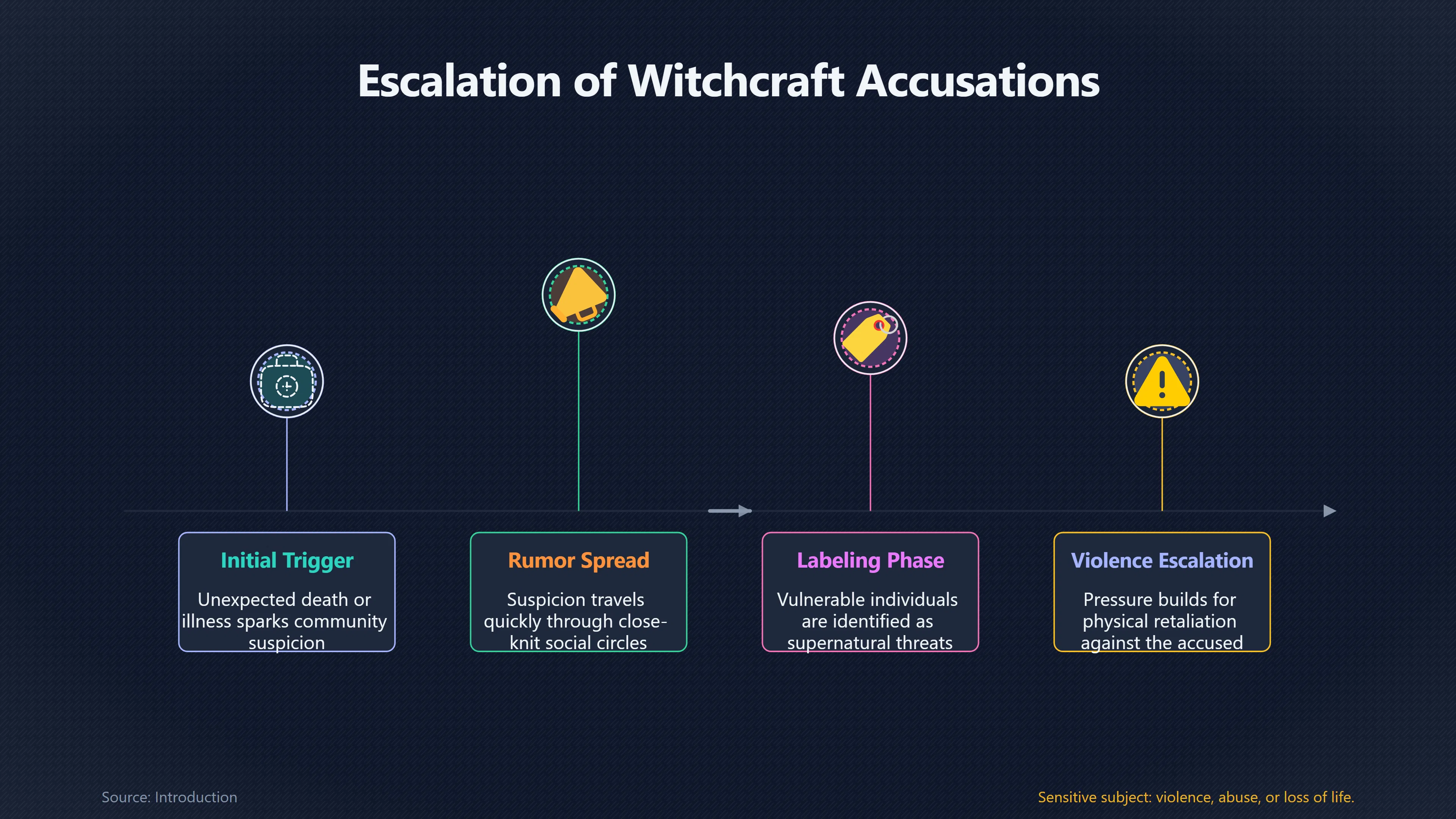
Most accusations of witchcraft do not begin as abstract religious disputes. They usually emerge after an unexpected death, prolonged illness, crop failure, family conflict or unexplained misfortune. In close-knit communities, suspicion can spread quickly through rumour, personal grievances and longstanding social tensions.
Those accused are often among the most vulnerable members of society, including elderly people, isolated women or individuals who have already become socially marginal. Once a person is labelled a witch, the accusation can become self-reinforcing. Ordinary events are reinterpreted as evidence, neighbours become fearful, and pressure builds for someone to “deal with” the perceived threat.
For this reason, legal scholars increasingly describe witchcraft accusations as a public safety issue rather than simply a question of religious belief. Across much of sub-Saharan Africa, accusations have been linked to assault, forced displacement, property destruction and homicide. Courts therefore face the difficult task of acknowledging sincerely held cultural beliefs without allowing those beliefs to legitimise violence.[Cambridge University Press & Assessment]cambridge.orgCambridge University Press & AssessmentWitchcraft Accusations and the Tort of Defamation in Anglophone Africa | International Journal of…
Colonial-era offences and their purpose
Eswatini inherited much of its criminal framework during the colonial period. Laws dealing with witchcraft were not written to determine whether supernatural powers existed. Instead, they were largely intended to prevent disorder arising from accusations, witch-finding and retaliatory violence.
This reflects a broader pattern found across southern Africa. Colonial administrations generally avoided ruling on the reality of witchcraft itself. Their primary concern was maintaining public order by discouraging accusations that could provoke attacks or revenge killings.
Modern Eswatini continues to face the legacy of this approach. The legal system does not attempt to resolve theological or spiritual questions. Rather, it concentrates on criminal responsibility for actions such as assault, homicide and intimidation. Whether a person genuinely believes another individual possesses supernatural powers is therefore legally distinct from whether violence against that person is permissible.
The result is an uneasy balance. The state does not require citizens to abandon traditional beliefs, but it insists that disputes arising from those beliefs must be resolved through lawful institutions rather than personal retaliation.[Eswatini Legal Information Institute]eswatinilii.orgEswatini Legal Information InstituteIN THE SUPREME COURT OF ESWATINIOctober 4, 2025…
Rex v Shongwe and the limits of belief
The leading modern authority is the 2022 Supreme Court decision in Rex v Shongwe, which addressed a question that had long divided legal opinion: should a genuine belief in witchcraft ever amount to a complete defence to murder?
The case arose after a man killed a woman whom he believed had bewitched his family and threatened his own life through supernatural means. A lower court questioned whether older legal precedents reflected Swazi social realities and referred the issue to the Supreme Court.
The Supreme Court gave a clear answer.[youtube.com]youtube.comWitchcraft Accusations in Ghana with John Azumah…
First, it rejected the argument that belief in witchcraft could provide a complete defence to criminal liability. A person who kills because they believe another individual is a witch remains criminally responsible. The court emphasised that accepting such a defence would expose innocent and defenceless people to serious danger and undermine the rule of law.[Eswatini Legal Information Institute]eswatinilii.orgEswatini Legal Information InstituteIN THE SUPREME COURT OF ESWATINIOctober 4, 2025…
Second, the court recognised that an honestly held belief may sometimes amount to an extenuating circumstance. In practical terms, this affects sentencing rather than guilt. If an accused genuinely and subjectively believed they faced supernatural harm, a court may consider that belief when deciding punishment, but it does not erase criminal responsibility.[Eswatini Legal Information Institute]eswatinilii.orgEswatini Legal Information InstituteIN THE SUPREME COURT OF ESWATINIOctober 4, 2025…
The judgment therefore draws an important distinction:
- Belief may explain conduct, but it does not legally justify homicide.
- Cultural context may influence sentence, but it does not eliminate responsibility.
- Public safety remains paramount, especially where accusations place vulnerable people at risk.
The Supreme Court also stressed that many innocent victims have been brutally attacked because others believed they practised witchcraft. That reality weighed heavily against recognising any complete legal defence based on supernatural belief.[Eswatini Legal Information Institute]eswatinilii.orgEswatini Legal Information InstituteIN THE SUPREME COURT OF ESWATINIOctober 4, 2025…
Respecting belief without permitting violence
The decision illustrates a broader constitutional challenge. Eswatini recognises freedom of conscience and religion, meaning the state does not simply dismiss traditional beliefs as irrational. Courts have acknowledged that belief in witchcraft forms part of the worldview of many citizens.
However, constitutional protection for belief does not extend to violent conduct.
This distinction is common in democratic legal systems. Individuals remain free to hold religious or spiritual beliefs, but criminal law governs what people may do in response to those beliefs. The legal question is therefore not whether witchcraft exists, but whether violence against an alleged witch can ever be lawful.
The Supreme Court’s answer is that it cannot.[Eswatini Legal Information Institute]eswatinilii.orgEswatini Legal Information InstituteIN THE SUPREME COURT OF ESWATINIOctober 4, 2025…
Why the ruling matters beyond one case
The importance of Rex v Shongwe extends beyond a single homicide prosecution.
It provides guidance to lower courts confronted with cases where defendants claim they acted because of supernatural fears. Rather than forcing judges to choose between dismissing cultural beliefs entirely or accepting them as legal justification, the decision creates a middle position that acknowledges belief while preserving criminal accountability.
The judgment also signals that legal protection extends to those accused of witchcraft. By refusing to excuse vigilante violence, the court reinforces the principle that people suspected of supernatural wrongdoing remain entitled to the same legal protection as any other citizen.
For historians and sociologists, the case highlights an enduring tension in Eswatini’s legal development. Courts operate within a society where belief in witchcraft remains meaningful for many people, yet they must also uphold universal legal principles that prohibit private violence. The resulting jurisprudence reflects an attempt to navigate both realities rather than simply choosing one over the other.[eswatinilii.org]eswatinilii.orgEswatini Legal Information InstituteIN THE SUPREME COURT OF ESWATINIOctober 4, 2025…

Amazon book picks
Further Reading
Books and field guides related to Can Witchcraft Belief Ever Excuse Violence?. Use these as the next step if you want deeper reading beyond the article.
Extraordinary Popular Delusions and the Madness of Crowds
Rating: 4.0/5 from 5 Google Books ratings
Offers wider context for collective belief and accusation.
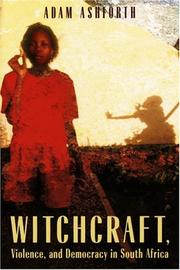
Witchcraft, Violence, and Democracy in South Africa
Closest regional comparison for law and violence.

African religions and philosophy
Explains belief systems underlying witchcraft accusations.
Endnotes
1.
Source: eswatinilii.org
Link:https://eswatinilii.org/akn/sz/judgment/szsc/2022/41/eng%402022-09-22/source.pdf
Source snippet
Eswatini Legal Information InstituteIN THE SUPREME COURT OF ESWATINIOctober 4, 2025...
Published: October 4, 2025
2.
Source: cambridge.org
Link:https://www.cambridge.org/core/journals/international-journal-of-legal-information/article/witchcraft-accusations-and-the-tort-of-defamation-in-anglophone-africa/22930E9DEDD422B529CE891441433B33
Source snippet
Cambridge University Press & AssessmentWitchcraft Accusations and the Tort of Defamation in Anglophone Africa | International Journal of...
3.
Source: eswatinilii.org
Link:https://eswatinilii.org/akn/sz/judgment/szhc/2012/167/eng%402012
4.
Source: eswatinilii.org
Link:https://eswatinilii.org/akn/sz/judgment/szsc/1999/202/eng%401999
5.
Source: eswatinilii.org
Link:https://eswatinilii.org/akn/sz/act/1889/6/eng%401998
6.
Source: eswatinilii.org
Link:https://eswatinilii.org/akn/sz/judgment/szhc/1987/18/eng%401987
Additional References
7.
Source: sheriahub.com
Title: rex v shongwe 13 of 2022 2022 szsc 41 22 september 2022
Link:https://sheriahub.com/cases/sz/caselaw/rex-v-shongwe-13-of-2022-2022-szsc-41-22-september-2022
Source snippet
Rex V Shongwe (13 Of 2022) [2022] Szsc 41 (22 September 2022)September 22, 2022 — REX V SHONGWE (13 OF 2022) [2022] SZSC 41 (22 SEPTEMBER...
Published: september 2022
8.
Source: africa-legal.com
Title: africalegal Africa Legal | Witchcraft is not a defence
Link:https://www.africa-legal.com/news/witchcraft-is-not-a-defence/100698
Source snippet
Africa Legal | Witchcraft is not a defenceOctober 25, 2022 — WITCHCRAFT IS NOT A DEFENCE Tania Broughton Tania Broughton 25 October 2022...
Published: October 25, 2022
9.
Source: youtube.com
Title: Episode 2
Link:https://www.youtube.com/watch?v=9shrsFrX9JU
Source snippet
Witchcraft accusations violence law africa International Women's Day 2026: Justice for Women Accused of Witchcraft in Nigeria Salem Witch...
10.
Source: youtube.com
Link:https://www.youtube.com/watch?v=tKohhjttwjs
Source snippet
Ghana's Vulnerable Women: The Call for Anti-Witchcraft Laws by Amnesty International...
11.
Source: scribd.com
Title: If you suspect this
Link:https://www.scribd.com/document/761035864/Rex-v-Shongwe-13-of-2022-2022-SZSC-41-22-September-2022
Source snippet
Rex V Shongwe (13 of 2022) 2022 SZSC 41 (22 September 2022) | PDFSeptember 22, 2022 — Rex V Shongwe (13 of 2022) 2022 SZSC 41 (22 Septemb...
Published: September 22, 2022
12.
Source: jibudocs.com
Link:https://www.jibudocs.com/public/summaries/130860ef-d8b0-5883-b892-d8ba0aa814ba
Source snippet
JibuDocs Summary | Rex v Shongwe (13 of 2022) [2022] SZSC 41 (22 September 2022)September 22, 2022 — REX V SHONGWE (13 OF 2022) [2022] SZ...
Published: September 22, 2022
13.
Source: youtube.com
Link:https://www.youtube.com/watch?v=ZVEf_4Fk084
Source snippet
Witchcraft Accusations in Ghana with John Azumah...
14.
Source: youtube.com
Title: Witchcraft Accusations in Nigeria with Dr. Leo Igwe
Link:https://www.youtube.com/watch?v=4kx4HYAufhQ
Source snippet
Episode 2 - Yes. Witchcraft Is Actually A Legal Problem In Kenya...
15.
Source: ecoi.net
Link:https://www.ecoi.net/en/document/2089476.html
Source snippet
GOVERNMENTAL POSTURE TOWARDS INTERNATIONAL AND NONGOVERNMENTAL INVESTIGATION OF ALLEGED ABUSES OF HUMAN RIGHTS Several domestic and inter...
16.
Source: youtube.com
Title: Witchcraft Accusations in Ghana with John Azumah
Link:https://www.youtube.com/watch?v=HuXREurd5C0
Source snippet
Witchcraft Accusations in Nigeria with Dr. Leo Igwe...
Topic Tree