Within Mali Beliefs
Why Thousands Sought the Water of Moussa
The Water of Moussa spread through stories of healing and purification, offering a portable alternative to older ritual systems.
On this page
- Apparitions, cures and travelling testimony
- Why portable protection appealed
- Pilgrimage, conversion and abandoned altars
Page outline Jump by section
Introduction
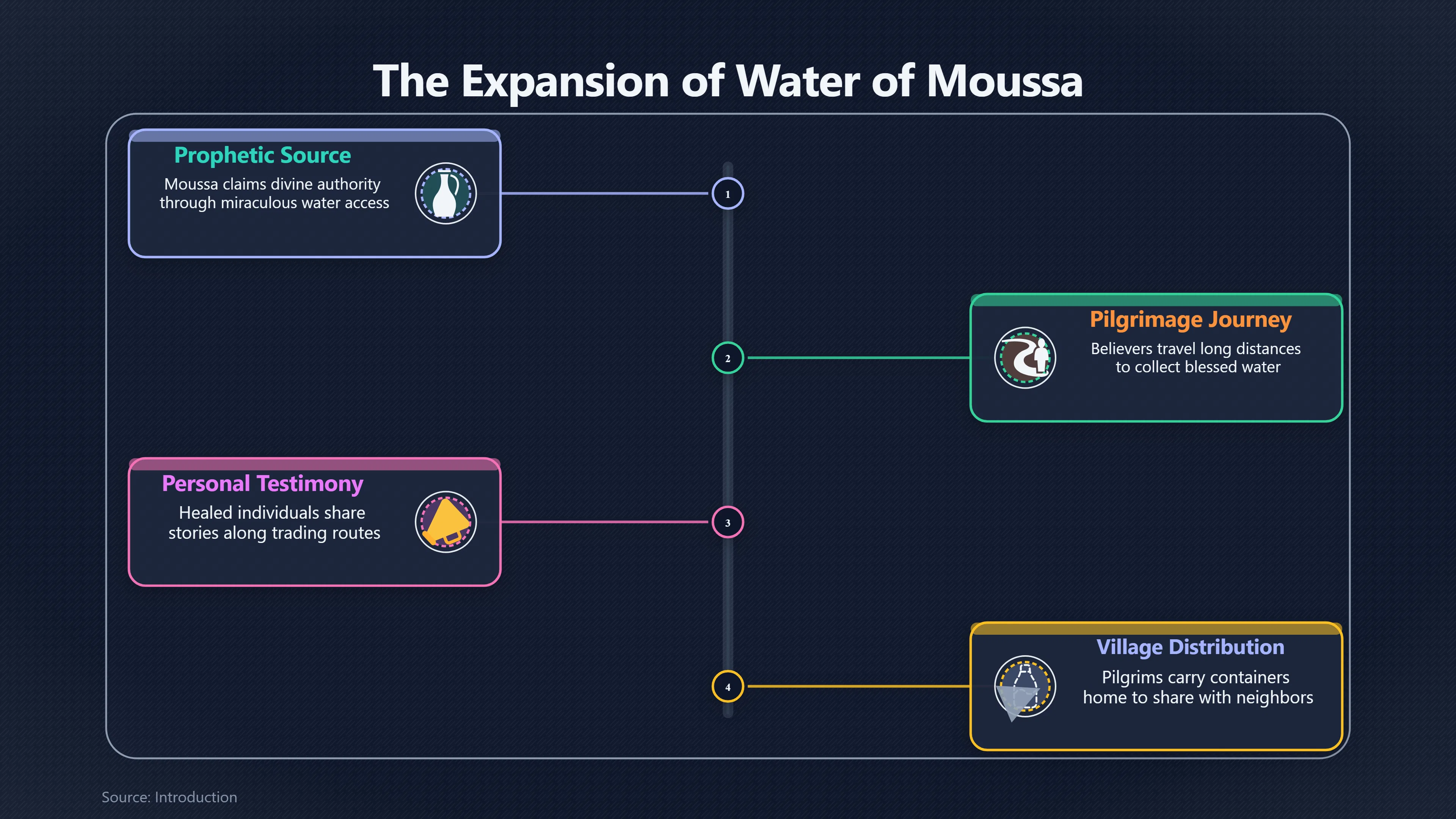
During the years around West African independence, thousands of people travelled across parts of present-day Mali, Burkina Faso and Côte d’Ivoire to obtain what became known as the Water of Moussa. Believers regarded it as a miraculous water that could heal illness, cleanse spiritual pollution and protect against hidden dangers, especially witchcraft. Unlike older religious systems that often depended on village shrines, hereditary ritual specialists and regular sacrifices, the Water of Moussa offered something that pilgrims could carry home in a container. That portability proved central to its appeal. It allowed a religious message to spread rapidly across ethnic and political boundaries while encouraging many followers to abandon older ritual practices altogether. Although often discussed alongside the anti-witchcraft Massa movement, the Water of Moussa developed its own distinctive mechanism of expansion through pilgrimage, testimony and conversion rather than through village-based ritual organisation.[Persée]persee.frPerséeLe Massa et l'eau de Moussa. Cultes régionaux, « traditions » locales et sorcellerie en Afrique de l'Ouest - Persée…
Apparitions, cures and travelling testimony
The movement centred on a prophet known as Moussa, whose authority rested on reports of divine apparitions and access to a miraculous source of water. According to contemporary accounts collected by anthropologists, pilgrims believed the water possessed both purifying and therapeutic powers. People travelled considerable distances to receive it, carrying bottles and containers back to their villages where relatives and neighbours could also use it.[Persée]persee.frPerséeLe Massa et l'eau de Moussa. Cultes régionaux, « traditions » locales et sorcellerie en Afrique de l'Ouest - Persée…
This created a powerful chain of personal testimony. Unlike a fixed shrine that required repeated visits, the water itself became evidence of the movement. Individuals who believed they had recovered from illness or escaped misfortune described their experiences to others, encouraging further journeys. Stories of successful cures spread through trading routes, family networks and seasonal migration across the borderlands linking eastern Mali with western Burkina Faso and northern Côte d’Ivoire.[Persée]persee.frPerséeLe Massa et l'eau de Moussa. Cultes régionaux, « traditions » locales et sorcellerie en Afrique de l'Ouest - Persée…
As with many prophetic movements, it is difficult for historians to verify individual healing claims. The historical evidence instead documents the movement’s remarkable social reach and the widespread belief that the water offered genuine spiritual protection. The significance lies less in proving miraculous cures than in explaining why so many people found such claims convincing during a period of rapid political and religious change.[Persée]persee.frPerséeLe Massa et l'eau de Moussa. Cultes régionaux, « traditions » locales et sorcellerie en Afrique de l'Ouest - Persée…
Why portable protection appealed
The Water of Moussa differed from many established ritual systems because it transformed protection into something transportable.
Traditional religious practices in much of the region often depended on local shrines, sacrifices and ritual specialists whose authority was rooted in particular families or villages. The Water of Moussa reduced this dependence. A pilgrim could travel once, receive blessed water and return home carrying what was believed to be an effective form of protection.[Persée]persee.frPerséeLe Massa et l'eau de Moussa. Cultes régionaux, « traditions » locales et sorcellerie en Afrique de l'Ouest - Persée…
Several wider pressures made this attractive:
Communities were experiencing political uncertainty as colonial rule gave way to independence.
Expanding roads, markets and labour migration exposed people to new religious ideas.
Concerns about illness, infertility, failed harvests and witchcraft remained widespread, while confidence in older ritual authorities varied from place to place.
Islam and Christianity were becoming increasingly influential, creating space for prophetic movements that promised a simpler path to purification.[Persée]persee.frPerséeLe Massa et l'eau de Moussa. Cultes régionaux, « traditions » locales et sorcellerie en Afrique de l'Ouest - Persée…
The water therefore functioned not simply as a healing substance but as a visible sign that divine power could travel beyond the village. That portability helped explain why the movement crossed ethnic and linguistic boundaries more easily than many local cults.
Pilgrimage, conversion and abandoned altars
One of the movement’s most dramatic consequences was its encouragement to abandon existing ritual institutions. Patrick Royer’s research argues that many followers destroyed or abandoned local shrines and ritual altars after embracing the Water of Moussa. For some communities this represented a decisive break with inherited religious practices rather than an attempt to reform them gradually.[Persée]persee.frPerséeLe Massa et l'eau de Moussa. Cultes régionaux, « traditions » locales et sorcellerie en Afrique de l'Ouest - Persée…
Among the Sambla of western Burkina Faso, for example, the movement was followed by large-scale conversion to Islam and, to a lesser extent, Christianity. Older ritual systems lost much of their authority as people accepted the prophet’s teaching that existing cults should be left behind. Rather than adding another protective ritual to village religion, the Water of Moussa often demanded religious replacement.[IDEALS]ideals.illinois.eduSource details in endnotes.
This helps distinguish the movement from the earlier Massa anti-witchcraft movement. Massa simplified and reorganised ritual life while retaining certain sacrificial practices. The Water of Moussa instead encouraged many communities to sever ties with established ritual institutions altogether, making pilgrimage and miraculous water the centre of religious transformation.[Persée]persee.frPerséeLe Massa et l'eau de Moussa. Cultes régionaux, « traditions » locales et sorcellerie en Afrique de l'Ouest - Persée…
Why people interpreted the movement differently
Not everyone understood the Water of Moussa in the same way.
Colonial administrators, missionaries and African political elites interpreted the movement through different assumptions. Some regarded it as a dangerous challenge to established authority. Others saw it as evidence of religious modernisation or as a transitional stage towards Islam or Christianity. Local communities themselves often understood it in more practical terms—as a means of obtaining protection against misfortune and uncertainty rather than participating in a political movement.[Persée]persee.frPerséeLe Massa et l'eau de Moussa. Cultes régionaux, « traditions » locales et sorcellerie en Afrique de l'Ouest - Persée…
Historians caution against reducing the phenomenon either to simple credulity or to calculated manipulation. The movement spread because it addressed genuine anxieties about health, security and spiritual danger while offering an unusually accessible solution. Pilgrimage created social excitement, but it also allowed participants to build new networks of trust that extended well beyond their own villages.[Persée]persee.frPerséeLe Massa et l'eau de Moussa. Cultes régionaux, « traditions » locales et sorcellerie en Afrique de l'Ouest - Persée…
What the Water of Moussa reveals about collective belief
The Water of Moussa illustrates how collective belief can spread through everyday social mechanisms rather than dramatic episodes of panic. Reports of apparitions, accounts of successful cures and the circulation of blessed water reinforced one another. Each returning pilgrim became both a witness and a messenger, allowing the movement to expand without a central bureaucracy or permanent institutional structure.[Persée]persee.frPerséeLe Massa et l'eau de Moussa. Cultes régionaux, « traditions » locales et sorcellerie en Afrique de l'Ouest - Persée…
Its importance in the history of Mali and its neighbouring countries lies not only in the extraordinary pilgrimages it inspired but also in what those journeys reveal about religion during a period of transformation. The movement demonstrates how portable sacred objects, personal testimony and hopes for healing could reshape religious landscapes across an entire border region, leading many communities to rethink inherited traditions and adopt new forms of spiritual authority.[Persée]persee.frPerséeLe Massa et l'eau de Moussa. Cultes régionaux, « traditions » locales et sorcellerie en Afrique de l'Ouest - Persée…
Amazon book picks
Further Reading
Books and field guides related to Why Thousands Sought the Water of Moussa. Use these as the next step if you want deeper reading beyond the article.

The Varieties of Religious Experience
Examines conversion, healing and extraordinary religious experience.

African religions and philosophy
Explains healing, ritual and spiritual protection in African traditions.
Endnotes
1.
Source: persee.fr
Link:https://www.persee.fr/doc/cea_0008-0055_1999_num
Source snippet
PerséeLe Massa et l'eau de Moussa. Cultes régionaux, « traditions » locales et sorcellerie en Afrique de l'Ouest - Persée...
2.
Source: ideals.illinois.edu
Link:https://www.ideals.illinois.edu/items/20288
3.
Source: youscribe.com
Link:https://www.youscribe.com/catalogue/documents/savoirs/sciences-humaines-et-sociales/le-massa-et-l-eau-de-moussa-cultes-regionaux-traditions-locales-1011852
Additional References
4.
Source: pubmed.ncbi.nlm.nih.gov
Link:https://pubmed.ncbi.nlm.nih.gov/19839123/
Source snippet
PubMed[The Massa people and Moussa's water: regional cults, local traditions, and witchcraft in West Africa] - PubMed...
5.
Source: malijet.com
Link:https://malijet.com/a_la_une_du_mali/308188-assainissement–vers-un-renforcement-du-partenariat-strategique-.html
Source snippet
Assainissement: Vers un renforcement du partenariat stratégique entre le Ministère et WaterAidFebruary 23, 2026 — ASSAINISSEME...
Published: February 23, 2026
6.
Source: maliactu.net
Link:https://maliactu.net/cote-divoire-un-projet-deau-minerale-de-39-m-usd-a-bonoua-stimule-leconomie-locale/?amp=1
Source snippet
May 9, 2026 — CÔTE D’IVOIRE: UN PROJET D’EAU MINÉRALE DE 39 M USD À BONOUA STIMULE L’ÉCONOMIE LOCALE Un Investissement Majeur pour l’Ind...
Published: May 9, 2026
7.
Source: africabib.org
Link:https://www.africabib.org/rec.php?RID=186128010
Source snippet
AfricaBib | Le Massa et l'eau de Moussa: cultes régionaux, 'traditions' locales et sorcellerie en Afrique de l'Ouest...
8.
Source: wisdomlib.org
Title: Meaning of the name M Musa
Link:https://www.wisdomlib.org/names/m-musa
Source snippet
Starts with M... M 1. en 1. Introduction 2. Family 3. Hinduism 4. Buddhism 5. Jainism 6. Christianity 7. See also BACKGROUND, ORIGIN AND...
9.
Source: gouv.ci
Title: www.gouv.ci Côte d’Ivoire
Link:https://www.gouv.ci/actualite/acces-universel-a-leau-potable-les-zones-rurales-approvisionnees-9962
Source snippet
www.gouv.ciCôte d'Ivoire - Portail officiel du Gouvernement:: Actualités - SociétéMay 2, 2026 — Accueil » Société ACCÈS UNIVERSEL A L’EA...
Published: May 2, 2026
10.
Source: youtube.com
Link:https://www.youtube.com/watch?v=XvjgnBNgK5w
Source snippet
Mansa Musa's Pilgrimage – The Journey That Broke Egypt's Economy...
11.
Source: pmc.ncbi.nlm.nih.gov
Link:https://pmc.ncbi.nlm.nih.gov/articles/PMC12613635/
Source snippet
water management for vector control: the case of rice cultivation in Burkina Faso’s Vallée du Kou - PMCNovember 12, 2025 — CONCLUSION The...
Published: November 12, 2025
12.
Source: youtube.com
Title: Mansa Musa’s Pilgrimage – The Journey That Broke Egypt’s Economy
Link:https://www.youtube.com/watch?v=mYSoiOloaPk
Source snippet
Kibeho holy water and its miraculous history...
13.
Source: researchgate.net
Link:https://www.researchgate.net/publication/26767750_From_Management_to_Negotiation_Technical_and_Institutional_Innovations_for_Integrated_Water_Resource_Management_in_the_Upper_Comoe_River_Basin_Burkina_Faso?_tp=eyJjb250ZXh0Ijp7InBhZ2UiOiJzY2llbnRpZmljQ29udHJpYnV0aW9ucyIsInByZXZpb3VzUGFnZSI6bnVsbCwic3ViUGFnZSI6bnVsbH19
Topic Tree