Within Moldova Belief Panics
Can a Religious Symbol Be Mistaken for Extremism?
Moldova's ban on a Falun Dafa emblem reveals how visual resemblance can trigger legal panic without proof of extremist intent.
On this page
- Why the Falun Dafa emblem was banned
- The difference between resemblance and meaning
- What the European human rights ruling changed
Page outline Jump by section
Introduction
Moldova’s dispute over the Falun Dafa emblem is an unusual example of how the appearance of a symbol can become more important, in law, than its meaning. For more than a decade, Moldovan authorities treated the movement’s emblem as extremist because it contains a traditional Asian swastika motif that resembles the Nazi swastika to many Western viewers. The resulting legal battle was not about evidence that Falun Dafa had promoted Nazism or racial hatred. Instead, it centred on whether a religious symbol could be banned solely because it looked similar to one associated with one of history’s most notorious ideologies. The case ultimately became a significant test of religious freedom and freedom of association under European human rights law, illustrating the risks of judging symbols by visual resemblance without considering their historical and cultural context.[justice.gov.md]justice.gov.mdn Dafa” | Ministerul Justiţiei al Republicii MoldovaMay 26, 2010…
Can a Religious Symbol Be Mistaken for Extremism?
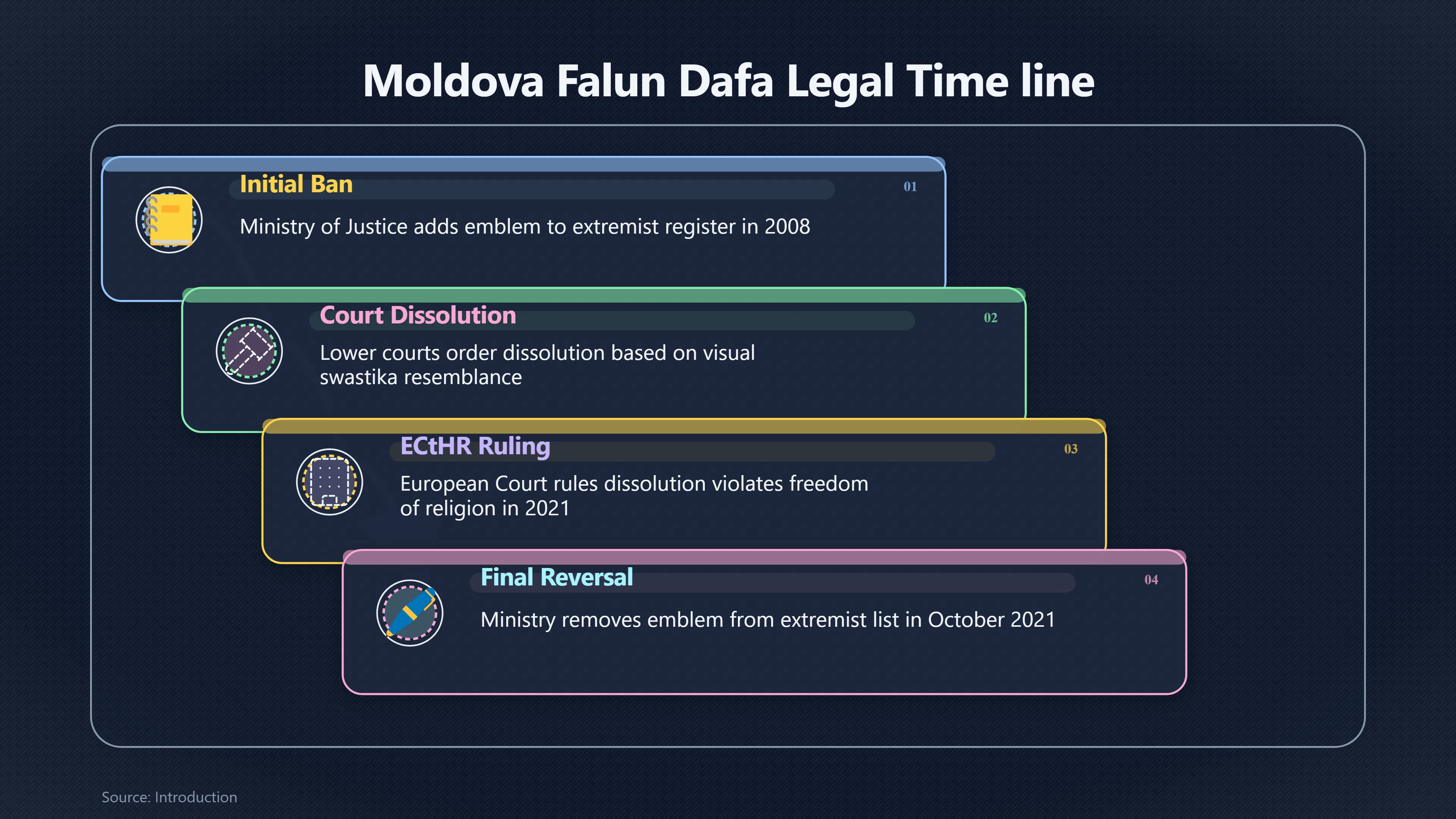
The controversy emerged from Moldova’s legislation against extremist activity, under which the Ministry of Justice added the Falun Dafa emblem to the national register of extremist materials in 2008. The ministry stated that publications and materials displaying the symbol were prohibited, and that criminal or administrative penalties could follow their distribution. At the same time, Falun Dafa practitioners argued that their emblem was an ancient religious symbol derived from Buddhist tradition and had no connection with Nazi ideology.[justice.gov.md]justice.gov.mdn Dafa” | Ministerul Justiţiei al Republicii MoldovaMay 26, 2010…
Unlike the Nazi swastika, which was rotated at an angle and adopted as the emblem of German National Socialism, the Falun Dafa symbol combines a central traditional swastika with additional Taoist-style symbols in a circular design. Variations of the swastika have appeared for centuries across Buddhist, Hindu and Jain traditions as symbols of good fortune, harmony or spiritual principles. Their historical use long predates the twentieth century appropriation of the symbol by the Nazi regime. The legal dispute therefore turned on whether visual similarity alone justified treating the Falun Dafa emblem as extremist.[lawpluralism.unimib.it]lawpluralism.unimib.itA.O. Falun Dafa and Others v. the Republic of Moldova, No. 29458/15, ECtHR (Second Section), 29 June 2021…
This made Moldova’s case different from laws aimed directly at Nazi propaganda. Authorities did not present evidence that Falun Dafa organisations were promoting National Socialist beliefs. Instead, the concern arose because members of the public could recognise the symbol as resembling a swastika and associate it with fascism.
Why the Falun Dafa Emblem Was Banned
The ban developed through a series of administrative and court decisions rather than a single political campaign. After the emblem was classified as extremist, Falun Dafa organisations challenged the decision before Moldovan courts while continuing to seek legal recognition.
The dispute intensified after lower courts concluded that the organisations should be dissolved because their emblem contained a swastika and therefore violated legislation against extremist activity. Government authorities relied largely on the appearance of the symbol rather than evidence that the organisations themselves advocated hatred or violence. According to later court findings, this reasoning became the central weakness in the state’s case.[echrcaselaw.com]echrcaselaw.comNon-execution of court decisions annulling decisions to dissolve NGOs. Conviction for violations of the ECHR - ECHRCaseLawJuly…
The issue also exposed a broader problem common in countries that prohibit extremist symbols. Legislators often draft laws to prevent glorification of Nazism, but ancient religious symbols may visually resemble prohibited images despite having entirely different origins and meanings. Without careful legal distinctions, such laws can unintentionally restrict legitimate religious expression.
The Difference Between Resemblance and Meaning
The Moldovan controversy illustrates an important principle in studies of moral panics and symbolic politics: identical or similar images can carry completely different meanings depending on their historical and cultural setting.
In Europe, the swastika is overwhelmingly associated with the Holocaust and Nazi crimes, making it one of the continent’s most emotionally charged symbols. In much of Asia, however, the same basic shape has been used for centuries in religious art, temples and sacred texts without any connection to twentieth-century fascism.
The legal question therefore became whether authorities should evaluate:
- the visual appearance of the emblem alone;
- the historical origin and intended religious meaning of the symbol;
- evidence that the organisation actually promoted extremist ideas; or
- some combination of all three.
Human rights courts generally require more than resemblance. Restrictions on religious expression must pursue a legitimate aim and be proportionate. Simply demonstrating that a symbol resembles another associated with extremism is not normally sufficient if there is no evidence that the group itself encourages hatred or violence.[lawpluralism.unimib.it]lawpluralism.unimib.itA.O. Falun Dafa and Others v. the Republic of Moldova, No. 29458/15, ECtHR (Second Section), 29 June 2021…
For scholars of moral panic, this episode is noteworthy because it shows how powerful visual associations can become. Once a symbol acquires overwhelming negative cultural meaning, authorities may respond to its appearance before examining its context or intended use.
What the European Human Rights Ruling Changed
The dispute eventually reached the European Court of Human Rights (ECtHR). In its 2021 judgment in A.O. Falun Dafa and Others v. the Republic of Moldova, the Court unanimously held that dissolving the organisations and banning their activities because of the emblem violated the rights to freedom of religion and freedom of association protected by Articles 9 and 11 of the European Convention on Human Rights. The Court found that the measures did not respond to a pressing social need and that the authorities had failed to demonstrate genuine extremist activity rather than relying on the symbol’s appearance.[lawpluralism.unimib.it]lawpluralism.unimib.itA.O. Falun Dafa and Others v. the Republic of Moldova, No. 29458/15, ECtHR (Second Section), 29 June 2021…
In a separate decision concerning another application, the Court declared one complaint inadmissible on procedural grounds, but that decision did not alter the broader legal significance of the main judgment concerning the dissolution of the organisations.[agent.gov.md]agent.gov.mdJuly 1, 2021…
Following domestic court proceedings and the wider human rights litigation, Moldova gradually reversed its earlier position. The Supreme Court had already overturned the dissolution of the associations, and in October 2021 the Ministry of Justice removed the Falun symbol from its register of extremist materials. The Falun Gong and Falun Dafa associations were subsequently able to regain legal registration.[ecoi.net]ecoi.netUSDOS – US Department of State (Author): “2021 Report on International Religious Freedom: Moldova”, Document #2073987 - ecoi.net…
Why the Case Matters in Moldova’s History of Religious Fear
Within Moldova’s broader history of contested religious movements, the Falun Dafa dispute stands out because it was not driven by widespread public panic about supernatural claims or predictions of apocalypse. Instead, it demonstrates how unfamiliar minority religions can become entangled in legal responses designed for entirely different threats.
The controversy also illustrates a recurring feature of modern moral panics: authorities sometimes act against symbols because of what they are assumed to represent rather than because of demonstrated conduct. In this instance, the central issue was not whether Nazism should be condemned—there was no dispute on that point—but whether an ancient religious emblem could automatically be treated as extremist simply because many observers associated its shape with the Nazi swastika.
The ECtHR’s judgment reinforced a broader European principle that restrictions on religious organisations require concrete evidence of harmful conduct rather than visual resemblance alone. For Moldova, the case became an important reminder that laws against extremism must distinguish carefully between genuinely hateful symbols and older religious traditions whose meanings developed in entirely different historical and cultural contexts.[unimib.it]lawpluralism.unimib.itA.O. Falun Dafa and Others v. the Republic of Moldova, No. 29458/15, ECtHR (Second Section), 29 June 2021…
Amazon book picks
Further Reading
Books and field guides related to Can a Religious Symbol Be Mistaken for Extremism?. Use these as the next step if you want deeper reading beyond the article.

The illustrated signs & symbols sourcebook
Explains how symbols acquire different meanings across cultures.


The pursuit of the millennium
Explains recurring patterns in millenarian belief central to Moldova's religious history.
Endnotes
1.
Source: justice.gov.md
Link:https://www.justice.gov.md/ro/content/comunicat-de-presa-privind-acuzatiile-aduse-de-catre-pcrm-adresa-miniserului-justitiei
Source snippet
n Dafa” | Ministerul Justiţiei al Republicii MoldovaMay 26, 2010...
Published: May 26, 2010
2.
Source: lawpluralism.unimib.it
Link:https://www.lawpluralism.unimib.it/en/oggetti/844-a-o-falun-dafa-and-others-v-the-republic-of-moldova-no-29458-15-e-ct-hr-second-section-29-june-2021
Source snippet
A.O. Falun Dafa and Others v. the Republic of Moldova, No. 29458/15, ECtHR (Second Section), 29 June 2021...
Published: June 2021
3.
Source: ecoi.net
Link:https://www.ecoi.net/en/document/2073987.html
Source snippet
USDOS – US Department of State (Author): “2021 Report on International Religious Freedom: Moldova”, Document #2073987 - ecoi.net...
4.
Source: ecoi.net
Link:https://www.ecoi.net/en/document/1216448.html
Source snippet
USDOS – US Department of State (Author): “2015 Report on International Religious Freedom - Moldova”, Document #1216448 - ecoi.net...
5.
Source: echrcaselaw.com
Link:https://www.echrcaselaw.com/en/echr-decisions/non-execution-of-court-decisions-annulling-decisions-to-dissolve-ngos-conviction-for-violations-of-the-echr/
Source snippet
Non-execution of court decisions annulling decisions to dissolve NGOs. Conviction for violations of the ECHR - ECHRCaseLawJuly...
6.
Source: agent.gov.md
Link:https://agent.gov.md/comunicate-de-presa/a-o-falun-dafa-v-republica-moldova/
Source snippet
July 1, 2021...
Published: July 1, 2021
7.
Source: ecoi.net
Link:https://www.ecoi.net/en/document/2091883.html
Source snippet
These were new religious subgroups belonging to existing religious denominations, including the Baptis...
8.
Source: ecoi.net
Link:https://www.ecoi.net/en/document/2051667.html
9.
Source: ecoi.net
Link:https://www.ecoi.net/en/document/1407284.html
10.
Source: ecoi.net
Link:https://www.ecoi.net/document/313344
11.
Source: justice.gov.md
Link:https://www.justice.gov.md/ro/content/hotarirea-judecatoriei-comerciale-de-circumscriptie-nr-2c-1612014-privind-falun-gong-moldova
13.
Source: moldova.org
Title: Venice Commission asks Moldova to abolish anti-communist symbols law
Link:https://www.moldova.org/en/venice-commission-asks-moldova-to-abolish-anti-communist-symbols-law-235678-eng/
Additional References
14.
Source: thefederalnewswire.com
Link:https://thefederalnewswire.com/stories/630956929-2021-report-on-international-religious-freedom-moldova
Source snippet
2021 Report on International Religious Freedom: Moldova | Federal NewswireJune 2, 2022 — The July “law" allows missionary and preaching a...
Published: June 2, 2022
15.
Source: venice.coe.int
Title: int Venice Commission:: Council of Europe
Link:https://www.venice.coe.int/webforms/documents/?pdf=CDL-AD%282022%29026
Source snippet
Commission:: Council of EuropeOctober 24, 2022 — CDL-AD(2022)026-E Republic of Moldova - Opinion on amendments to the Audiovisual Media...
Published: October 24, 2022
16.
Source: coe.int
Link:https://www.coe.int/en/web/venice-commission/-/cdl-ad-2013-004-e
17.
Source: constcourt.md
Link:https://www.constcourt.md/libview.php?id=457&idc=7&l=en
18.
Source: coe.int
Link:https://www.coe.int/en/web/venice-commission/-/amendments-to-the-contravention-code-of-the-republic-of-moldova-law-192-of-12-july-2012-on-the-prohibition-of-the-use-of-communists-symbols-1
Published: july 2012
19.
Source: coe.int
Link:https://www.coe.int/en/web/venice-commission/-/amendments-to-the-law-on-freedom-of-expression-of-the-republic-of-moldova-law-192-of-12-july-2012-on-the-prohibition-of-the-use-of-communist-symbols-1
Published: july 2012
20.
Source: coe.int
Link:https://www.coe.int/en/web/venice-commission/-/law-on-political-parties-of-the-republic-of-moldova-as-amended-by-law-192-of-12-july-2012-on-the-prohibition-of-the-use-of-communist-symbols-1
Published: july 2012
21.
Source: youtube.com
Title: Unveiling the Truth Behind Falun Dafa
Link:https://www.youtube.com/watch?v=0wSNOMlbn2E
Source snippet
The 610 Office: The Intent Behind the Falun Gong Persecution...
22.
Source: youtube.com
Title: Protest în fața Judecătoriei Călărași
Link:https://www.youtube.com/watch?v=lte6tfmXPfE
Source snippet
Will I get arrested for showing you a swastika?...
23.
Source: app.lexploria.com
Title: 850205 ao falun dafa and others v the republic of moldova
Link:https://app.lexploria.com/document/850205-ao-falun-dafa-and-others-v-the-republic-of-moldova
Topic Tree