Within El Salvador
How the 1932 Rebellion Became Collective Punishment
A limited uprising became the basis for mass repression when the state cast peasants, Indigenous people and organisers as one existential enemy.
On this page
- What sparked the January uprising
- How communist fear widened the target
- Massacre, silence and contested memory
Page outline Jump by section
Introduction
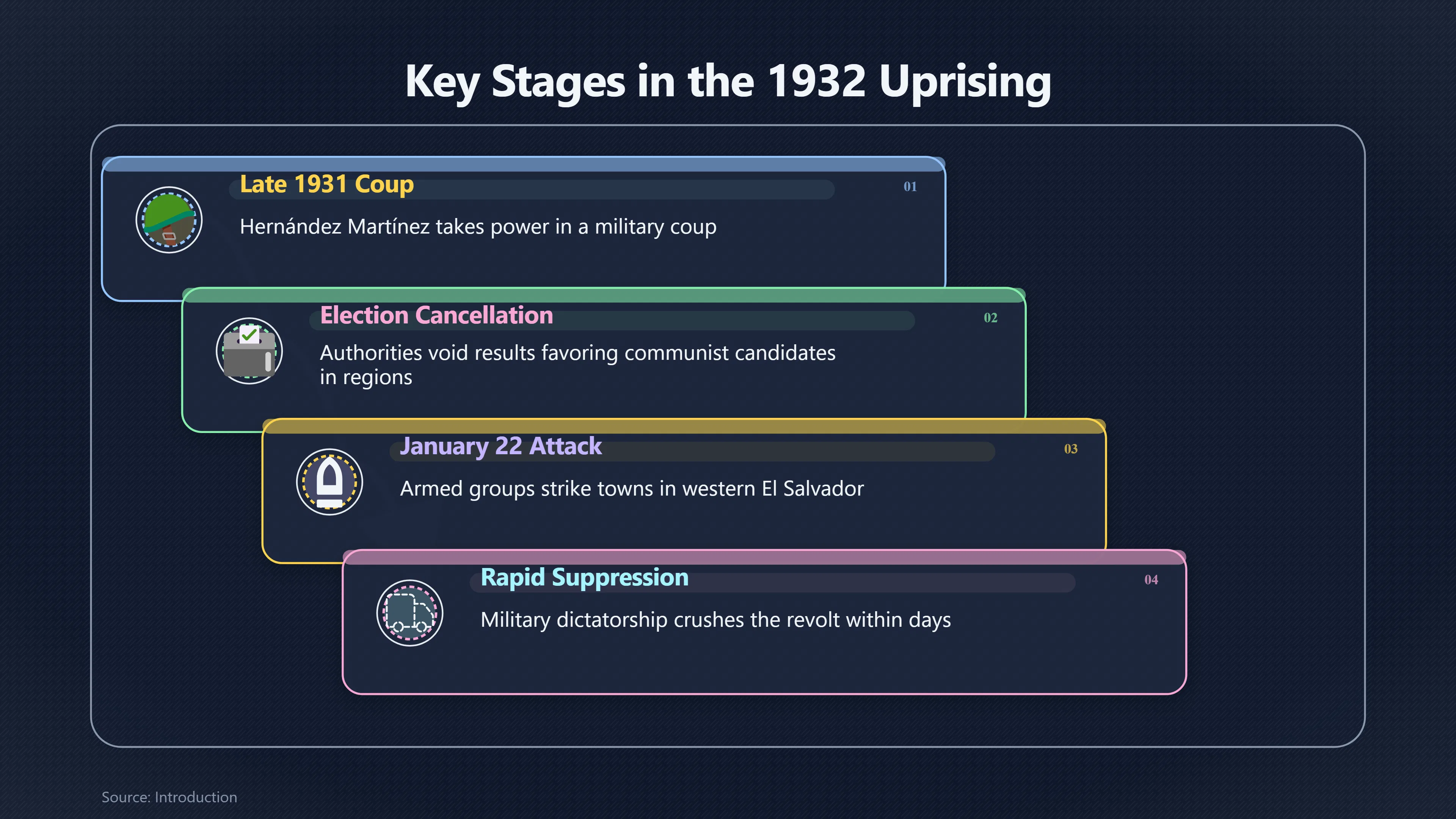
The January 1932 uprising in western El Salvador was a short-lived rural rebellion, but the government’s response transformed it into one of the bloodiest episodes in the country’s history. Within days, the military dictatorship of General Maximiliano Hernández Martínez crushed the revolt and launched a campaign of mass killings known as La Matanza (“The Massacre”). Rather than distinguishing between armed rebels, communist organisers, Indigenous communities and ordinary peasants, the authorities increasingly portrayed them as parts of a single existential threat. That fusion of political fear, ethnic suspicion and anti-communist ideology became the justification for collective punishment on a vast scale.[bibliovault.org]bibliovault.orgTo Rise in Darkness: Revolution, Repression, and Memory in El Salvador, 1920–1932 (9780822342076): Aldo A. Lauria-Santiago and…
For understanding El Salvador’s history of collective fear, 1932 is significant not because it was an example of “mass hysteria” in the medical sense, but because it shows how governments can create and amplify a narrative of national emergency. The state’s depiction of a communist conspiracy helped legitimise extraordinary violence, while the massacre and the silence that followed reshaped Salvadoran politics and Indigenous identity for generations.[biblioteca.asamblea.gob.sv]biblioteca.asamblea.gob.sv72271 las masas la matanza y el martinato en el salvador ensayos sobre 1932Las Masas, la matanza y el martinato en El Salvador: ensayos sobre 1932…
What sparked the January uprising?
The rebellion emerged from a combination of economic hardship, political exclusion and rural unrest rather than from a single ideological movement. The collapse in coffee prices during the Great Depression devastated agricultural workers, many of whom depended on seasonal plantation labour. Land concentration, poverty and tensions over local political power had already fuelled strikes and peasant organising during the late 1920s.[Bibliovault]bibliovault.orgTo Rise in Darkness: Revolution, Repression, and Memory in El Salvador, 1920–1932 (9780822342076): Aldo A. Lauria-Santiago and…
Political events intensified these grievances. After a military coup brought Hernández Martínez to power in late 1931, municipal election results that favoured communist candidates in several areas were cancelled. At the same time, leading communist organisers, including Farabundo Martí, were arrested before the planned uprising. When armed groups launched attacks on towns in western El Salvador on 22 January 1932, they killed local officials, landowners and members of the security forces. Although the rebellion was serious, it remained geographically limited and was suppressed within a few days.[wikipedia.org]Wikipedia1932 in El Salvador1932 in El Salvador
Modern historians caution against older interpretations that reduced the uprising to either a purely communist plot or an exclusively Indigenous revolt. Research based on archives and survivor testimony shows that participants included Indigenous and non-Indigenous rural labourers with varied motives, including demands for land, wages, political representation and resistance to repression. Communist activists were involved, but they operated within broader local networks rather than directing every aspect of the rebellion.[bibliovault.org]bibliovault.orgTo Rise in Darkness: Revolution, Repression, and Memory in El Salvador, 1920–1932 (9780822342076): Aldo A. Lauria-Santiago and…
How communist fear widened the target
The government’s response relied on more than military force. Officials presented the uprising as evidence of an organised communist conspiracy threatening the nation’s survival. Anti-communism became the central language through which violence was justified, allowing almost any suspected opponent to be treated as part of the same enemy. Diplomatic correspondence from the period shows that foreign governments also received reports framed around a “communist uprising”, reinforcing that interpretation internationally.[Office of the Historian]history.state.govOffice of the Historian Historical DocumentsOffice of the HistorianHistorical Documents - Office of the Historian…
In practice, the campaign extended far beyond armed insurgents. Soldiers and local militias targeted villages across western El Salvador, often executing people without investigating whether they had participated in the rebellion. Indigenous appearance, traditional clothing, community leadership or simple presence in affected regions could become grounds for suspicion. Historians therefore distinguish between the actual armed revolt and the much broader campaign of repression that followed it.[bibliovault.org]bibliovault.orgTo Rise in Darkness: Revolution, Repression, and Memory in El Salvador, 1920–1932 (9780822342076): Aldo A. Lauria-Santiago and…
This process illustrates a classic mechanism of political panic. A limited security threat became a narrative in which different categories of people—communists, Indigenous communities, rural organisers and dissatisfied peasants—were merged into a single dangerous identity. Once those distinctions disappeared, collective punishment became easier to defend as necessary for restoring order.[repositorio.ues.edu.sv]repositorio.ues.edu.svLos sucesos de 1932: ¿Complot comunista, motín indígena o protesta subalterna?: una revisión historiográfica…
Massacre, silence and contested memory
Estimates of those killed vary because the government suppressed information and left incomplete records. Most scholarly estimates place the death toll somewhere between 10,000 and 40,000 people, with many historians regarding around 30,000 as a widely cited approximation while acknowledging continuing uncertainty. Most victims were Indigenous or rural civilians rather than combatants.[bibliovault.org]bibliovault.orgTo Rise in Darkness: Revolution, Repression, and Memory in El Salvador, 1920–1932 (9780822342076): Aldo A. Lauria-Santiago and…
The killings had profound cultural consequences. Many Indigenous Salvadorans abandoned traditional clothing, language and public expressions of identity because visible Indigenous culture had become associated with danger. Historians debate whether the violence should be described as an ethnocide or genocide, but there is broad agreement that the massacre accelerated the public disappearance of Indigenous identity in western El Salvador through fear rather than voluntary assimilation.[biblioteca.asamblea.gob.sv]biblioteca.asamblea.gob.sv72271 las masas la matanza y el martinato en el salvador ensayos sobre 1932Las Masas, la matanza y el martinato en El Salvador: ensayos sobre 1932…
Silence also became part of the legacy. For decades, discussion of the massacre remained politically sensitive, while the military regime promoted an official narrative portraying its actions as a necessary defence against communism. Later scholarship has challenged this “black legend” of a simple communist conspiracy by examining local archives, oral histories and international records, showing a far more complex relationship between class conflict, Indigenous identity and political organising.[edu.sv]repositorio.ues.edu.svLos sucesos de 1932: ¿Complot comunista, motín indígena o protesta subalterna?: una revisión historiográfica…
Why the event matters in the history of collective fear
The events of 1932 demonstrate how political fear can become a force that reshapes an entire society. Unlike episodes of mass psychogenic illness, the central issue was not a contagious false belief producing physical symptoms. Instead, the danger lay in a state-sponsored narrative that defined a broad section of the population as an existential internal enemy.
Several features make the episode especially important in the history of collective fear in El Salvador:
- A real uprising became the basis for far wider repression. Genuine violence by rebels was used to justify indiscriminate retaliation against thousands of people who had not taken part in the fighting.[Bibliovault]bibliovault.orgTo Rise in Darkness: Revolution, Repression, and Memory in El Salvador, 1920–1932 (9780822342076): Aldo A. Lauria-Santiago and…
- Political and ethnic identities were merged. Communist, peasant and Indigenous identities increasingly became interchangeable in official discourse, making suspicion itself a sufficient basis for punishment.[biblioteca.asamblea.gob.sv]biblioteca.asamblea.gob.sv72271 las masas la matanza y el martinato en el salvador ensayos sobre 1932Las Masas, la matanza y el martinato en El Salvador: ensayos sobre 1932…
- Fear outlasted the killings. Public expressions of Indigenous identity declined sharply as communities adapted to survive under the continuing threat of persecution.[Bibliovault]bibliovault.orgTo Rise in Darkness: Revolution, Repression, and Memory in El Salvador, 1920–1932 (9780822342076): Aldo A. Lauria-Santiago and…
- The official narrative shaped politics for decades. Anti-communism became a central justification for authoritarian rule long after the rebellion itself had ended.[biblioteca.asamblea.gob.sv]biblioteca.asamblea.gob.sv72271 las masas la matanza y el martinato en el salvador ensayos sobre 1932Las Masas, la matanza y el martinato en El Salvador: ensayos sobre 1932…
The memory of 1932 remains deeply contested because it touches on questions of state responsibility, Indigenous persecution and political violence. Rather than representing a spontaneous wave of irrational public emotion, it stands as a powerful example of how governments can mobilise fear, simplify complex social conflicts into a single conspiracy narrative and legitimise collective punishment on an extraordinary scale.[bibliovault.org]bibliovault.orgTo Rise in Darkness: Revolution, Repression, and Memory in El Salvador, 1920–1932 (9780822342076): Aldo A. Lauria-Santiago and…
Amazon book picks
Further Reading
Books and field guides related to How the 1932 Rebellion Became Collective Punishment. Use these as the next step if you want deeper reading beyond the article.


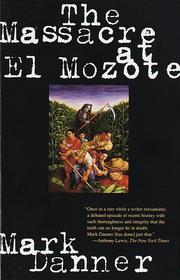
The massacre at El Mozote
Provides important historical context for repression and collective fear.
Endnotes
1.
Source: bibliovault.org
Link:https://www.bibliovault.org/BV.book.epl?ISBN=9780822342076
Source snippet
To Rise in Darkness: Revolution, Repression, and Memory in El Salvador, 1920–1932 (9780822342076): Aldo A. Lauria-Santiago and...
2.
Source: biblioteca.asamblea.gob.sv
Title: 72271 las masas la matanza y el martinato en el salvador ensayos sobre 1932
Link:https://biblioteca.asamblea.gob.sv/72271_las-masas-la-matanza-y-el-martinato-en-el-salvador-ensayos-sobre-1932
Source snippet
Las Masas, la matanza y el martinato en El Salvador: ensayos sobre 1932...
3.
Source: history.state.gov
Title: Office of the Historian Historical Documents
Link:https://history.state.gov/historicaldocuments/frus1932v05/ch15
Source snippet
Office of the HistorianHistorical Documents - Office of the Historian...
4.
Source: repositorio.ues.edu.sv
Link:https://repositorio.ues.edu.sv/items/74dc18ec-1a5d-40a0-89dc-4c1be9eec2a3/full
Source snippet
Los sucesos de 1932: ¿Complot comunista, motín indígena o protesta subalterna?: una revisión historiográfica...
5.
Source: Wikipedia
Title: 1932 in El Salvador
Link:https://en.wikipedia.org/wiki/1932_in_El_Salvador
6.
Source: eialonline.org
Link:https://eialonline.org/index.php/eial/article/view/36
Source snippet
JEFFREY L. GOULD and ALDO A. LAURIA-SANTIAGO: Durham, NC: Duke University Press, 2008 | EIAL - Estudios Interdisciplinarios de América La...
7.
Source: repositorio.ues.edu.sv
Link:https://repositorio.ues.edu.sv/items/74dc18ec-1a5d-40a0-89dc-4c1be9eec2a3
Source snippet
una revisión historiográficaJanuary 1, 2014 — LOS SUCESOS DE 1932: ¿COMPLOT COMUNISTA, MOTÍN INDÍGENA O PROTESTA SUBALTERNA?: UNA REVISI...
Published: January 1, 2014
8.
Source: bibliovault.org
Link:https://www.bibliovault.org/BV.book.epl?ISBN=9780822342281
9.
Source: biblioteca.asamblea.gob.sv
Link:https://biblioteca.asamblea.gob.sv/73796_el-salvador-1932
10.
Source: cipdh.gob.ar
Title: conmemoracion de la masacre indigena de 1932
Link:https://www.cipdh.gob.ar/memorias-situadas/en/lugar-de-memoria/conmemoracion-de-la-masacre-indigena-de-1932/
Additional References
11.
Source: cambridge.org
Link:https://www.cambridge.org/core/journals/americas/article/in-search-of-the-party-the-communist-party-the-comintern-and-the-peasant-rebellion-of-1932-in-el-salvador/615B58195201C855F08807DB851AB74B
Source snippet
In Search of the Party: The Communist Party, the Comintern, and the Peasant Rebellion of 1932 in El Salvador* | The Americas | Cambridge...
12.
Source: youtube.com
Link:https://www.youtube.com/watch?v=mLZTTxddCZg
Source snippet
"Maximiliano Hernández Martínez. President 1931-1944 (2003)[https://www.youtube.com/watch?v=oNqNiViVOYA..."](https://www.youtube.com/watch?v=oNqNiViVOYA...")...
13.
Source: escholarship.org
Link:https://escholarship.org/uc/item/9519j1j6
14.
Source: si.edu
Link:https://www.si.edu/object/remembering-massacre-el-salvador-insurrection-1932-roque-dalton-and-politics-historical-memory%3Asiris_sil_927206
15.
Source: youtube.com
Link:https://www.youtube.com/watch?v=xV8brbypVqA
Source snippet
Scars of Memory...
16.
Source: youtube.com
Title: Alan Berg
Link:https://www.youtube.com/watch?v=kt-jdsN8CY4
17.
Source: dukeupress.edu
Title: to rise in darkness
Link:https://www.dukeupress.edu/to-rise-in-darkness
18.
Source: si.edu
Title: siris sil 947597
Link:https://www.si.edu/object/siris_sil_947597
19.
Source: youtube.com
Title: Scars of Memory
Link:https://www.youtube.com/watch?v=NBjWY-AYbaE
Source snippet
1932 Cicatriz de la Memoria...
20.
Source: revistas.una.ac.cr
Link:https://www.revistas.una.ac.cr/index.php/historia/article/view/1789
Topic Tree