Within Syria
How Rumours Helped Ignite the Damascus Massacre
Sectarian rumours helped turn political tension and distant violence into claims that immediate attacks on neighbours were necessary for survival.
On this page
- Conflict in Lebanon and fear in Damascus
- How rumours framed neighbours as attackers
- Rescue, responsibility and historical interpretation
Page outline Jump by section
Introduction
The massacre of Christians in Damascus in July 1860 did not erupt because of a single rumour or isolated incident. Rather, it emerged from a dangerous cycle in which real violence elsewhere, exaggerated reports, sectarian suspicion and weakening political authority combined to convince many people that their neighbours had become an immediate threat. The killings illustrate how collective fear can transform an already tense society into one where pre-emptive violence appears justified to ordinary participants. Historians increasingly argue that rumours were not merely background noise but one of the central mechanisms that converted anxiety into mass violence, especially after news of the civil war in neighbouring Mount Lebanon reached Damascus.[lebanesestudies.com]lebanesestudies.coman occasion for war civil conflict in lebanon and damascus in 1860CLSAn Occasion for War: Civil Conflict in Lebanon and Damascus in 1860 - CLSJanuary 1, 1993…

Although the events are often remembered simply as a Muslim assault on the city’s Christian population, the process that led to the massacre was more complex. Rumours mixed genuine political developments with imagined conspiracies, reinforcing fears that Christians enjoyed foreign protection, sought political dominance or were preparing attacks of their own. Once confidence in the Ottoman authorities collapsed, these stories spread rapidly through markets, neighbourhoods and informal social networks, making restraint increasingly difficult.[Cambridge University Press & Assessment]cambridge.orgCambridge University Press & AssessmentThe political configuration of Damascus in 1860 (Chapter 1) - Urban Notables and Arab NationalismO…
Conflict in Lebanon and fear in Damascus
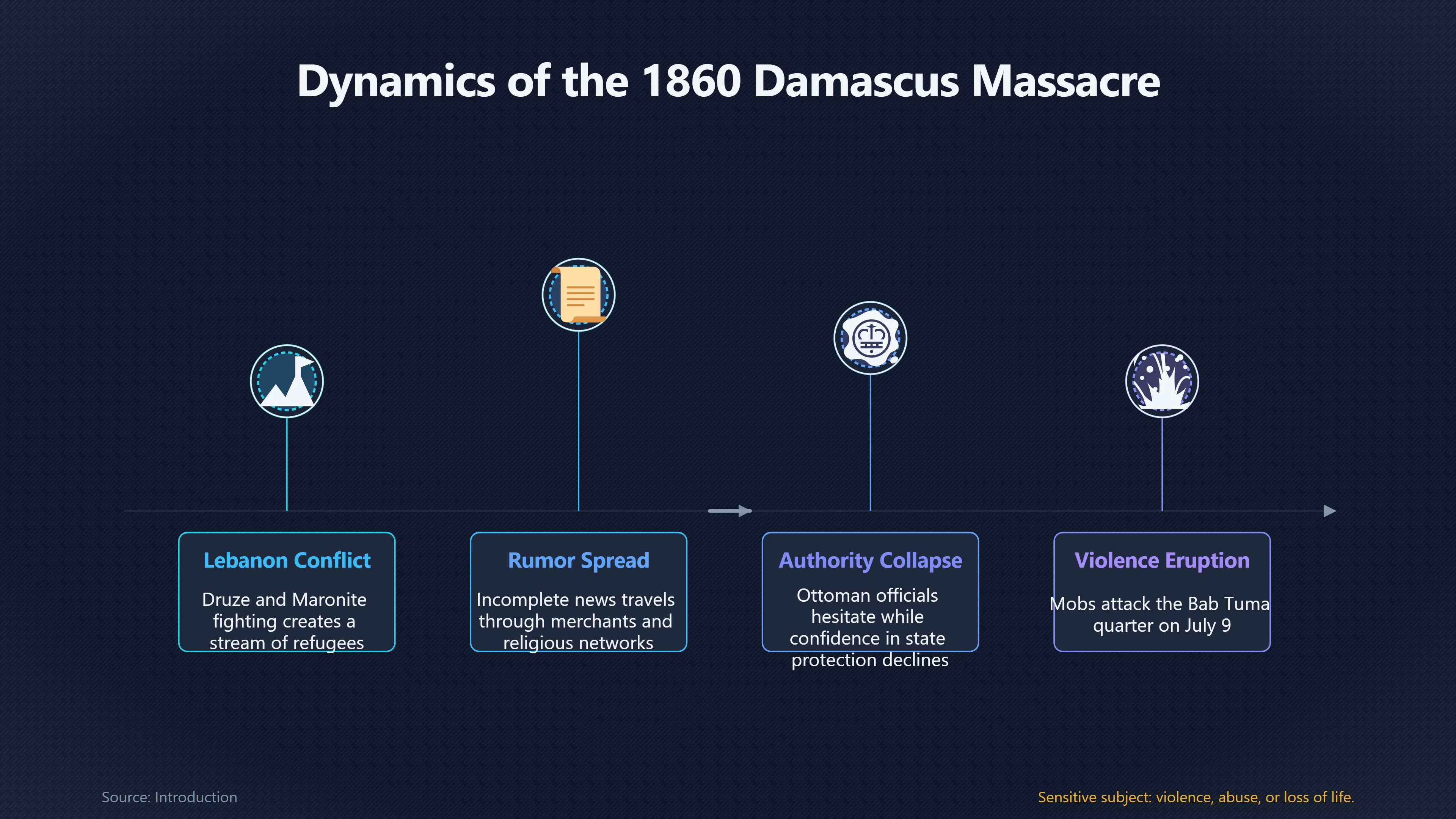
The immediate backdrop was the civil war in Mount Lebanon during the spring and early summer of 1860. Fighting between Druze and Maronite communities produced thousands of deaths and a stream of refugees and eyewitness reports reaching Damascus. The violence was real, but the information arriving in the city was often incomplete, contradictory or emotionally charged. News travelled through merchants, pilgrims, refugees, soldiers and religious networks long before official investigations could establish reliable accounts.[lebanesestudies.com]lebanesestudies.coman occasion for war civil conflict in lebanon and damascus in 1860CLSAn Occasion for War: Civil Conflict in Lebanon and Damascus in 1860 - CLSJanuary 1, 1993…
Damascus was already experiencing social strain. Ottoman reform policies had altered long-established relationships between religious communities by extending legal equality to non-Muslim subjects while European powers increasingly claimed the right to protect local Christians. Many Muslims interpreted these changes as evidence that the traditional social order was being overturned, while many Christians viewed the reforms as overdue legal protection rather than political privilege. The same developments therefore generated sharply different expectations and fears.[cambridge.org]cambridge.orgCambridge University Press & AssessmentThe political configuration of Damascus in 1860 (Chapter 1) - Urban Notables and Arab NationalismO…
Against this background, reports from Lebanon were rarely received as distant news. Instead, they became warnings about what might soon happen inside Damascus itself.
How rumours framed neighbours as attackers
Rumours during the crisis generally followed a familiar pattern seen in many episodes of communal violence. They portrayed defensive action as urgent because another community was supposedly preparing to strike first.
Several recurring claims circulated:
- Christians were secretly stockpiling weapons.
- European governments would soon intervene militarily on behalf of Christians.
- Local Christians intended to dominate the city with foreign support.
- Muslim communities faced an imminent existential threat unless they acted first.
- Events in Lebanon were presented not as a separate conflict but as proof of a wider conspiracy extending into Damascus.[lrb.co.uk]lrb.co.ukOpen source on lrb.co.uk.
Modern historians find little evidence that these rumours reflected organised Christian plans for rebellion. Instead, they functioned psychologically by reducing uncertainty. In a city already unsettled by alarming news, they offered simple explanations for complex political change and transformed long-standing neighbours into suspected enemies.[CLS]lebanesestudies.coman occasion for war civil conflict in lebanon and damascus in 1860CLSAn Occasion for War: Civil Conflict in Lebanon and Damascus in 1860 - CLSJanuary 1, 1993…
Importantly, rumours did not persuade everyone equally. Many Damascenes rejected calls for violence, while others attempted to shelter threatened Christians. This uneven response shows that rumour created opportunities for mobilisation rather than producing automatic collective behaviour.[Centre for Muslim-Christian Studies]cmcsoxford.org.ukthe muslim christian riots of 1860 damascusCentre for Muslim-Christian StudiesThe Muslim-Christian Riots of 1860 Damascus — Centre for Muslim-Christian Studies…
Why fear spread so quickly
The effectiveness of the rumours depended on several reinforcing pressures rather than on misinformation alone.
First, people already possessed vivid examples of recent communal violence. The destruction of Christian villages in Mount Lebanon made extreme claims appear believable because atrocities had genuinely occurred elsewhere.[CLS]lebanesestudies.coman occasion for war civil conflict in lebanon and damascus in 1860CLSAn Occasion for War: Civil Conflict in Lebanon and Damascus in 1860 - CLSJanuary 1, 1993…
Second, the Ottoman administration appeared weak and uncertain. When authorities fail to provide trusted information or visible protection, informal communication networks often become more influential than official statements. In Damascus, hesitation by local officials allowed rumours to flourish while confidence in state protection declined.[Cambridge University Press & Assessment]cambridge.orgCambridge University Press & AssessmentThe political configuration of Damascus in 1860 (Chapter 1) - Urban Notables and Arab NationalismO…
Third, economic and social tensions amplified religious divisions. Competition over trade, changing legal status under the Ottoman reforms and resentment towards communities perceived to benefit from European patronage all became attached to sectarian identities. Rumours therefore resonated because they connected existing grievances with dramatic current events rather than introducing entirely new fears.[cambridge.org]cambridge.orgCambridge University Press & AssessmentThe political configuration of Damascus in 1860 (Chapter 1) - Urban Notables and Arab NationalismO…
The massacre and the collapse of civic order
Violence erupted on 9 July 1860 when crowds attacked the predominantly Christian quarter of Bab Tuma. Over several days, homes, churches and businesses were looted and burned while thousands of Christians were killed, although precise casualty estimates remain disputed among historians. Participants included local urban mobs together with armed men arriving from surrounding areas, and some local officials failed to intervene effectively.[Cambridge University Press & Assessment]cambridge.orgCambridge University Press & AssessmentLitigants and Neighbors: The Communal Topography of Ottoman Damascus | Comparative Studies in Soci…
The killings were not random. Christian homes, institutions and neighbourhoods became deliberate targets because rumours had already redefined them as centres of a supposed hostile community rather than parts of the shared city. This shift in perception illustrates one of the defining features of communal panic: ordinary social boundaries become recast as military front lines.[London Review of Books]lrb.co.ukOpen source on lrb.co.uk.
Rescue, responsibility and historical interpretation
The massacre was not simply a story of perpetrators and victims. Numerous Muslims risked their own safety to protect Christian neighbours. The most celebrated rescuer was the Algerian exile Emir Abd al-Qadir, who organised protection for thousands of Christians in his residence and escorted many others to places of safety. His actions became an enduring example that communal violence was resisted from within Damascene society as well as by outside intervention.[Financial Times]ft.comFinancial Times Lessons from history for the modern Middle EastThis outbreak was influenced by the Druze community's attacks on Christians in Mount Lebanon earlier that summer. The violence was driven…
After the massacre, the Ottoman government dispatched Fuad Pasha with extraordinary authority to restore order. Investigations, executions and other punishments followed, while damaged Christian neighbourhoods were rebuilt under intense international scrutiny. European governments treated the massacre as evidence of Ottoman failure, increasing diplomatic pressure and reshaping regional politics, particularly in relation to Mount Lebanon.[oup.com]academic.oup.comOUP AcademicIntervention in Lebanon and Syria, 1860–61 | Humanitarian intervention in the long nineteenth century: Setting the precedent…
Modern scholarship generally rejects explanations that portray the violence as the inevitable product of ancient religious hatred. Instead, historians emphasise the interaction of political reform, international rivalry, weakening state authority, economic competition and rapidly spreading rumours. Sectarian identities mattered, but they became deadly through particular historical circumstances rather than timeless hostility.[lebanesestudies.com]lebanesestudies.coman occasion for war civil conflict in lebanon and damascus in 1860CLSAn Occasion for War: Civil Conflict in Lebanon and Damascus in 1860 - CLSJanuary 1, 1993…

Why the 1860 rumours still matter
The Damascus massacre remains an important case study because it demonstrates how collective fear can emerge from the interaction between genuine events and imagined threats. The rumours were powerful precisely because they incorporated fragments of reality: there had been fighting in Lebanon, foreign powers were involved in Ottoman affairs and political reforms were changing established relationships. What transformed these facts into catastrophe was the widespread belief that neighbours had become immediate enemies whose attack was both imminent and unavoidable.[lebanesestudies.com]lebanesestudies.coman occasion for war civil conflict in lebanon and damascus in 1860CLSAn Occasion for War: Civil Conflict in Lebanon and Damascus in 1860 - CLSJanuary 1, 1993…
For historians of collective fear, the episode is less an example of irrational “mass hysteria” than of rumour-driven communal mobilisation. It illustrates how uncertainty, selective information and political weakness can rapidly erode trust between communities that had lived alongside one another for generations, turning ordinary urban relationships into a landscape of suspicion and violence.[cambridge.org]cambridge.orgCambridge University Press & AssessmentLitigants and Neighbors: The Communal Topography of Ottoman Damascus | Comparative Studies in Soci…
Amazon book picks
Further Reading
Books and field guides related to How Rumours Helped Ignite the Damascus Massacre. Use these as the next step if you want deeper reading beyond the article.

The Great War for Civilisation
Provides broad historical context for sectarian conflict and Syria.


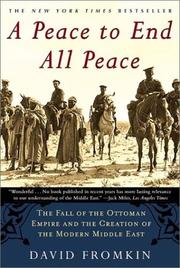
A peace to end all peace
Explains the historical development of the region and Ottoman legacy.
Endnotes
1.
Source: lebanesestudies.com
Title: an occasion for war civil conflict in lebanon and damascus in 1860
Link:https://lebanesestudies.com/publications/an-occasion-for-war-civil-conflict-in-lebanon-and-damascus-in-1860/
Source snippet
CLSAn Occasion for War: Civil Conflict in Lebanon and Damascus in 1860 - CLSJanuary 1, 1993...
Published: January 1, 1993
2.
Source: cambridge.org
Link:https://www.cambridge.org/core/books/abs/urban-notables-and-arab-nationalism/political-configuration-of-damascus-in-1860/2B53DC74188ACD7601F377FA444B9BC4
Source snippet
Cambridge University Press & AssessmentThe political configuration of Damascus in 1860 (Chapter 1) - Urban Notables and Arab NationalismO...
3.
Source: cambridge.org
Link:https://www.cambridge.org/core/journals/comparative-studies-in-society-and-history/article/abs/litigants-and-neighbors-the-communal-topography-of-ottoman-damascus/9AB936A08703A563CD83C19D4B63D03B
Source snippet
Cambridge University Press & AssessmentLitigants and Neighbors: The Communal Topography of Ottoman Damascus | Comparative Studies in Soci...
4.
Source: academic.oup.com
Link:https://academic.oup.com/manchester-scholarship-online/book/16587/chapter/173649476
Source snippet
OUP AcademicIntervention in Lebanon and [Syria]({{ 'syria/' | relative_url }}), 1860–61 | Humanitarian intervention in the long nineteenth century: Setting the precedent...
5.
Source: academic.oup.com
Link:https://academic.oup.com/book/39829/chapter/339959105
6.
Source: cambridge.org
Link:https://www.cambridge.org/core/journals/international-journal-of-middle-east-studies/article/abs/after1860debatingreligionreformandnationalismintheottomanempire/3729F79AE9E2B8B64289C0BCAF6CA45C
7.
Source: lrb.co.uk
Link:https://www.lrb.co.uk/the-paper/v47/n04/youssef-ben-ismail/rob-kill-and-burn
8.
Source: cmcsoxford.org.uk
Title: the muslim christian riots of 1860 damascus
Link:https://www.cmcsoxford.org.uk/resources/multimedia/the-muslim-christian-riots-of-1860-damascus
Source snippet
Centre for Muslim-Christian StudiesThe Muslim-Christian Riots of 1860 Damascus — Centre for Muslim-Christian Studies...
9.
Source: ft.com
Title: Financial Times Lessons from history for the modern Middle East
Link:https://www.ft.com/content/82548a48-4f52-4b33-982b-ae1aa96d360a
Source snippet
This outbreak was influenced by the Druze community's attacks on Christians in Mount Lebanon earlier that summer. The violence was driven...
10.
Source: ft.com
Title: Financial Times The Damascus Events
Link:https://www.ft.com/content/0931a63a-c8d5-49e5-9c32-df45f1241041
Source snippet
The violence erupted due to political and social tensions, with Christians flaunting their newfound legal equality and protection from fo...
11.
Source: cmcsoxford.org.uk
Link:https://www.cmcsoxford.org.uk/resources/book-reviews/rana-abu-mounes-muslim-christian-relations-in-damascus-amid-the-1860-riot-brill-2022
Additional References
12.
Source: thecatholicherald.com
Title: the damascus events how the 1860 massacre shaped the modern middle east
Link:https://thecatholicherald.com/article/the-damascus-events-how-the-1860-massacre-shaped-the-modern-middle-east
Source snippet
'The Damascus Events': How the 1860 massacre shaped the modern Middle EastJuly 28, 2024 — February 11, 2026 July 28, 2024 9:30 AM 'THE DA...
Published: July 28, 2024
13.
Source: youtube.com
Title: Emir Abdelkader: The Algerian warrior whom his enemies came to respect
Link:https://www.youtube.com/watch?v=wYUntpvyuUo
Source snippet
The Relevance of the 1860 Damascus Events to Greater Syria Today explains how the historical communal violence of 1860 shaped subsequent...
14.
Source: youtube.com
Link:https://www.youtube.com/watch?v=BMj6STT1VoQ
Source snippet
The Damascus Events: From the 1860 Massacre to the 2024 Revolution...
15.
Source: youtube.com
Title: Professor Eugene Rogan in conversation with Professor Christian Sahner
Link:https://www.youtube.com/watch?v=z7EOsUSGlnc
Source snippet
Eugene Rogan- 'The Relevance of the 1860 Damascus Events to Greater Syria Today'...
16.
Source: youtube.com
Title: Martyrs of Damascus (10 July): Butler’s Lives of the Saints
Link:https://www.youtube.com/watch?v=a6IWDOlVPz4
Source snippet
Emir Abdelkader: The Algerian warrior whom his enemies came to respect...
17.
Source: youtube.com
Link:https://www.youtube.com/watch?v=xG21Aq-SneE
Source snippet
Martyrs of Damascus (10 July): Butler's Lives of the Saints...
18.
Source: newarab.com
Title: what 1860 damascus massacre teaches us about coexistence
Link:https://www.newarab.com/features/what-1860-damascus-massacre-teaches-us-about-coexistence
19.
Source: thearticle.com
Title: damascus 1860 anatomy of a massacre
Link:https://www.thearticle.com/damascus-1860-anatomy-of-a-massacre
20.
Source: hansard.parliament.uk
Title: uk Disturbances In Stria—Question
Link:https://hansard.parliament.uk/Lords/1860-08-03/debates/57579b07-46a7-43cd-b977-51bbbfeef4d5/DisturbancesInStria%E2%80%94Question
21.
Source: api.parliament.uk
Title: massacre of christians in syria
Link:https://api.parliament.uk/historic-hansard/lords/1860/jul/10/massacre-of-christians-in-syria
Topic Tree