Within Cameroon Panics
Why Did Hidden Enemies Seem So Plausible?
Rumours of hidden power grew strongest when inequality, migration and political distrust made ordinary success or misfortune hard to explain.
On this page
- From colonial labour to post independence inequality
- How rumours adapt to new wealth and authority
- Belief, accusation and the line between fear and harm
Page outline Jump by section
Introduction
In Cameroon, rumours about hidden supernatural power have often done more than explain individual misfortune. They have provided a language for understanding rapid social change, widening inequality, political privilege and uncertain economic success. Rather than disappearing with urbanisation, education or market expansion, beliefs about witchcraft, secret wealth and occult influence adapted to new circumstances. Anthropologists have argued that these rumours should not be dismissed simply as relics of tradition. Instead, they reveal how ordinary people tried to make sense of new forms of wealth, authority and exclusion that seemed opaque or unfair.[University of Virginia Press]upress.virginia.eduUniversity of Virginia Press The Modernity of WitchcraftUniversity of Virginia PressThe Modernity of Witchcraft - UVA Press…

This helps explain why occult panics have repeatedly emerged during periods of major change. Colonial labour systems, migration to towns, expanding state bureaucracy, democratisation and economic crisis all created new opportunities for success that were unevenly distributed and difficult to understand from the outside. When legitimate routes to prosperity appeared hidden, rumours of hidden powers often became equally plausible explanations.
Why did hidden enemies seem so plausible?
The key question is not whether occult accusations reflected objective reality, but why they became convincing explanations for so many people.
Across much of Cameroon, social relationships have traditionally been understood as morally interconnected. Success is expected to carry obligations towards family and community. When someone becomes unexpectedly wealthy while relatives remain poor, neighbours may ask not simply how they became rich but at whose expense. In this setting, occult rumours offer moral explanations for inequality rather than merely supernatural ones.[University of Virginia Press]upress.virginia.eduUniversity of Virginia Press The Modernity of WitchcraftUniversity of Virginia PressThe Modernity of Witchcraft - UVA Press…
Researchers such as Peter Geschiere argue that modernity did not weaken these ideas. Instead, modern institutions supplied new objects of suspicion:
- salaried government employment;
- business success;
- imported consumer goods;
- motor vehicles and expensive housing;
- political office;
- overseas migration.
Each represented access to wealth whose origins were often invisible to ordinary observers. Rather than replacing older beliefs, economic modernisation frequently supplied them with new symbols and targets.[University of Virginia Press]upress.virginia.eduUniversity of Virginia Press The Modernity of WitchcraftUniversity of Virginia PressThe Modernity of Witchcraft - UVA Press…
From colonial labour to post-independence inequality
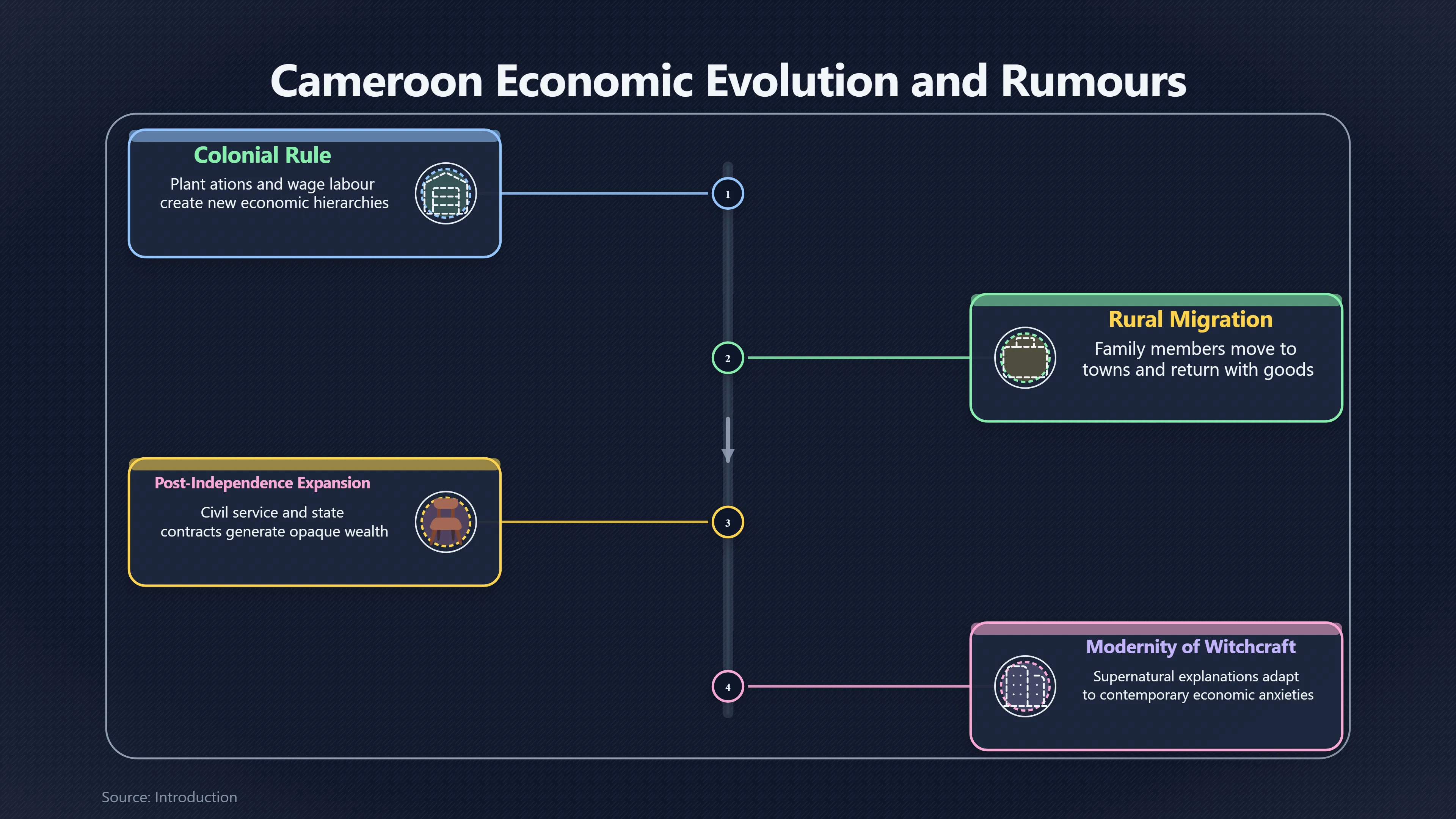
Colonial rule transformed Cameroon’s economy through plantations, taxation, wage labour and migration. These changes weakened some traditional forms of authority while creating entirely new hierarchies based on education, cash income and government employment.
For many rural communities, these transformations were deeply unsettling. Family members disappeared to plantations or towns, returned with unfamiliar goods, or sometimes never returned at all. Wealth increasingly depended upon distant institutions rather than visible local production. Rumours evolved accordingly.
Stories associated with nyongo—in which hidden wealth was supposedly created through invisible forced labour by spiritually enslaved relatives—can be understood in this context. Scholars have connected these narratives to experiences of plantation labour, exploitation and unequal accumulation. Invisible labour mirrored visible historical realities, while supernatural explanations expressed moral criticism of economic systems that concentrated wealth in the hands of relatively few people.[virginia.edu]upress.virginia.eduUniversity of Virginia Press The Modernity of WitchcraftUniversity of Virginia PressThe Modernity of Witchcraft - UVA Press…
Following independence, the expansion of the civil service, state contracts and political patronage generated further inequalities. Because promotion often appeared opaque, success could easily be interpreted through occult rather than bureaucratic explanations.
How rumours adapted to new wealth and authority
Occult panics in Cameroon have proved remarkably flexible because they rarely centre on one fixed belief. Instead, they continually reinterpret contemporary anxieties.
Anthropologists describe this as the “modernity” of witchcraft: supernatural explanations evolve alongside changing economic and political realities rather than surviving unchanged from the past.[University of Virginia Press]upress.virginia.eduUniversity of Virginia Press The Modernity of WitchcraftUniversity of Virginia PressThe Modernity of Witchcraft - UVA Press…
Several recurring adaptations illustrate this process.
Political power became suspect. Senior officials could be portrayed as possessing hidden spiritual protection or belonging to secret networks that enabled political success beyond ordinary competition.
Business success acquired occult interpretations. Entrepreneurs whose wealth seemed disproportionate or unexplained sometimes attracted accusations that prosperity depended upon spiritual exploitation rather than commercial skill.
Migration altered suspicion rather than eliminating it. Urban migrants often remained economically tied to rural relatives. Their improved living standards could produce admiration but also accusations that invisible powers had financed their success. Relationships between successful migrants and home communities therefore became particularly fertile ground for occult rumours.[Cambridge University Press & Assessment]cambridge.orgCambridge University Press & AssessmentWitchcraft as an Issue in the “Politics of Belonging”: Democratization and Urban Migrants' Involve…
Secret societies became symbols of elite privilege. Freemasonry, Rosicrucianism and similar organisations increasingly appeared in popular rumours not primarily because of their actual activities, but because they represented exclusive access to power hidden from ordinary citizens.[Cambridge University Press & Assessment]cambridge.orgCambridge University Press & AssessmentA “Vortex of Identities”: Freemasonry, Witchcraft, and Postcolonial Homophobia | African Studies R…
Why inequality encouraged occult explanations
Occult rumours often flourish where inequality is visible but its causes remain obscure.
In Cameroon, many researchers argue that people were not rejecting economic change itself. Instead, they questioned forms of wealth that appeared disconnected from observable labour, production or fairness. The concern was moral as much as economic.
Questions such as these repeatedly appeared beneath supernatural narratives:
- Why does one official become suddenly wealthy while others remain poor?
- Why do some families repeatedly prosper while neighbouring households struggle?
- Why do influential individuals appear protected from accountability?
- Why do personal connections matter more than visible achievement?
When transparent answers seemed unavailable, rumours supplied their own coherent explanations. Hidden success implied hidden causes.
Geschiere argues that these stories should therefore be understood as commentaries on governance, accumulation and political legitimacy as much as expressions of religious belief.[University of Virginia Press]upress.virginia.eduUniversity of Virginia Press The Modernity of WitchcraftUniversity of Virginia PressThe Modernity of Witchcraft - UVA Press…
When suspicion became public panic
Most occult beliefs remain private explanations within families or neighbourhoods. Occasionally, however, they expand into wider moral panics involving media, politicians or the courts.
A notable example came during the 2006 controversy surrounding allegations of homosexuality among prominent public figures. Newspaper campaigns portrayed homosexuality not simply as sexual behaviour but as evidence of secret elite networks exchanging power, wealth and influence through hidden rituals. Rumours connected sexuality, Freemasonry, occult wealth and political corruption into one overarching conspiracy narrative.[Cambridge University Press & Assessment]cambridge.orgCambridge University Press & AssessmentA “Vortex of Identities”: Freemasonry, Witchcraft, and Postcolonial Homophobia | African Studies R…
The significance of this episode lies less in the specific allegations than in the mechanism. Existing fears about inequality, elite privilege and secrecy were redirected towards new symbolic targets. The panic reflected broader anxieties about who held power and how that power was obtained.
Belief, accusation and the line between fear and harm
Researchers emphasise an important distinction between belief and persecution.
Many Cameroonians hold some form of belief in supernatural harm without accusing particular individuals. Problems arise when suspicion hardens into formal accusation, social exclusion or violence.
Cameroon’s legal system has long occupied an unusual position by criminalising certain forms of witchcraft and sorcery. Courts have sometimes relied upon testimony from traditional specialists when evaluating accusations, creating difficult questions about evidence, legal standards and fairness. Critics argue that such prosecutions risk reinforcing accusations rather than protecting vulnerable people from them.[Cambridge University Press & Assessment]cambridge.orgCambridge University Press & AssessmentContaining Occult Practices: Witchcraft Trials In Cameroon | African Studies Review | Cambridge Co…
Legal scholars have also noted that criminal prosecutions may unintentionally legitimise public fears by treating alleged supernatural offences as legally provable, while the more immediate harms—threats, assaults and social ostracism against accused individuals—can receive less attention.[Cambridge University Press & Assessment]cambridge.orgCambridge University Press & AssessmentMalleus Maleficarum: Scrutinizing Sorcery in Cameroon | Journal of African Law | Cambridge Core…
What these panics reveal about social change
Occult panics in Cameroon are best understood as social interpretations of uncertainty rather than simple outbreaks of irrationality.
They emerge repeatedly when rapid change disrupts older expectations about work, wealth and authority. Instead of asking only whether supernatural claims are true or false, historians and anthropologists examine why certain explanations become persuasive at particular historical moments.
This perspective explains several otherwise puzzling patterns:
- occult rumours become more elaborate during periods of economic transformation rather than disappearing;
- new technologies and institutions are absorbed into older moral frameworks instead of replacing them;
- accusations concentrate around wealth, political influence and unequal opportunity;
- the targets of suspicion change over time while the underlying concerns about justice, reciprocity and hidden power remain remarkably consistent.
Seen this way, Cameroon’s recurring occult panics are less about resistance to modern life than about attempts to understand a modern society in which the sources of success, influence and inequality often appear concealed from public view.[virginia.edu]upress.virginia.eduUniversity of Virginia Press The Modernity of WitchcraftUniversity of Virginia PressThe Modernity of Witchcraft - UVA Press…
Amazon book picks
Further Reading
Books and field guides related to Why Did Hidden Enemies Seem So Plausible?. Use these as the next step if you want deeper reading beyond the article.
The devil and commodity fetishism in South America
Links hidden wealth narratives with capitalism.
Modernity and its malcontents
Explains why rumours adapt to political and economic change.
Folk Devils and Moral Panics the Creation of the Mods and Roc...
First published 1972. Subjects: Youth, great britain, Deviant behavior, Case studies, Subculture, Young adults.
Endnotes
1.
Source: upress.virginia.edu
Title: University of Virginia Press The Modernity of Witchcraft
Link:https://www.upress.virginia.edu/title/2806/
Source snippet
University of Virginia PressThe Modernity of Witchcraft - UVA Press...
2.
Source: africabib.org
Link:https://www.africabib.org/rec.php?RID=158242157
Source snippet
AfricaBib | The modernity of witchcraft: politics and the occult in postcolonial Africa...
3.
Source: cambridge.org
Link:https://www.cambridge.org/core/journals/africa/article/abs/domesticating-personal-violence-witchcraft-courts-and-confessions-in-cameroon/4721FE16F77AAD3DB3E721F314576362
Source snippet
Cambridge University Press & AssessmentDomesticating personal violence: witchcraft, courts and confessions in Cameroon | Africa | Cambrid...
4.
Source: cambridge.org
Link:https://www.cambridge.org/core/journals/african-studies-review/article/abs/witchcraft-as-an-issue-in-the-politics-of-belonging-democratization-and-urban-migrants-involvement-with-the-home-village/9C8C250ECE0A8C28DAB79115557E68CD
Source snippet
Cambridge University Press & AssessmentWitchcraft as an Issue in the “Politics of Belonging”: Democratization and Urban Migrants' Involve...
5.
Source: cambridge.org
Link:https://www.cambridge.org/core/journals/african-studies-review/article/abs/vortex-of-identities-freemasonry-witchcraft-and-postcolonial-homophobia/906D2769A0A32CC261004D539A336C82
Source snippet
Cambridge University Press & AssessmentA “Vortex of Identities”: Freemasonry, Witchcraft, and Postcolonial Homophobia | African Studies R...
6.
Source: cambridge.org
Link:https://www.cambridge.org/core/journals/african-studies-review/article/abs/containing-occult-practices-witchcraft-trials-in-cameroon/BEAEAB2D75CCE76261CF3E6B96515FF9
Source snippet
Cambridge University Press & AssessmentContaining Occult Practices: Witchcraft Trials In Cameroon | African Studies Review | Cambridge Co...
7.
Source: cambridge.org
Link:https://www.cambridge.org/core/journals/journal-of-african-law/article/abs/malleus-maleficarum-scrutinizing-sorcery-in-cameroon/087C71286E4C82F8D1495D459C51D9D0
Source snippet
Cambridge University Press & AssessmentMalleus Maleficarum: Scrutinizing Sorcery in Cameroon | Journal of African Law | Cambridge Core...
8.
Source: cambridge.org
Link:https://www.cambridge.org/core/journals/africa/article/anusocratie-freemasonry-sexual-transgression-and-illicit-enrichment-in-postcolonial-africa/C2DD2CD20FDC2434420025D15DDEDFB3
9.
Source: cambridge.org
Link:https://www.cambridge.org/core/services/aop-cambridge-core/content/view/5EA17CC2CE2918E1E94F6D04335BC59A/S0002020618000446a.pdf/homosexuality-witchcraft-and-power-the-politics-of-ressentiment-in-cameroon.pdf
10.
Source: cambridge.org
Link:https://www.cambridge.org/core/journals/annales-histoire-sciences-sociales/article/abs/sorcellerie-et-modernite-les-enjeux-des-nouveaux-proces-de-sorcellerie-au-cameroun-approches-anthropologiques-et-historiques/0DD31158BB3FDEBB5B793C8DBF560F0A
11.
Source: africabib.org
Link:https://www.africabib.org/rec.php?RID=126789495
12.
Source: africabib.org
Link:https://www.africabib.org/rec.php?RID=180498290
13.
Source: africabib.org
Link:https://www.africabib.org/rec.php?RID=306273586
Additional References
14.
Source: papers.ssrn.com
Link:https://papers.ssrn.com/sol3/papers.cfm?abstract_id=3103967
Source snippet
Malleus Maleficarum: Scrutinizing Sorcery in Cameroon by Julie Ada Tchoukou:: SSRN...
15.
Source: youtube.com
Title: Sam Kunhiyop
Link:https://www.youtube.com/watch?v=Nlg-niESBII
Source snippet
Witchcraft Act Was Used to Suppress Traditional Healers | Gogo Dineo Explains...
16.
Source: youtube.com
Title: Meet the anti-witch hunter
Link:https://www.youtube.com/watch?v=yzBi8KVSwlY
Source snippet
Sam Kunhiyop - Witchcraft Beliefs and Accusations in Africa...
17.
Source: academic.oup.com
Link:https://academic.oup.com/chicago-scholarship-online/book/60184/chapter-abstract/519958705
Source snippet
Conspiracy Narratives from Postcolonial Africa: Freemasonry, Homosexuality, and Illicit Enrichment | Chicago Scholarship Online | Oxfor...
18.
Source: youtube.com
Title: Witchcraft in Bamenda (Cameroon) | Documentary
Link:https://www.youtube.com/watch?v=80YVsORQH2E
Source snippet
Meet the anti-witch hunter - BBC Trending podcast, BBC World Service...
19.
Source: researchgate.net
Link:https://www.researchgate.net/publication/287530669_Medias_politique_et_homosexualite_au_Cameroun_Retour_sur_la_construction_d%27une_controverse
20.
Source: researchgate.net
Link:https://www.researchgate.net/publication/233029068_The_politicisation_of_sexuality_and_rise_of_homosexual_movements_in_post-colonial_Cameroon
21.
Source: africafaith.org.za
Link:https://africafaith.org.za/religious-leadership-and-the-re-politicisation-of-gender-and-sexuality-in-cameroon/
22.
Source: scienceopen.com
Link:https://www.scienceopen.com/hosted-document?doi=10.1080%2F03056244.2010.510624
23.
Source: library.au.int
Link:https://library.au.int/fr/node/503289
Topic Tree