Who Decided What Belarus Should Fear?
Belarus does not have a single famous episode equivalent to the Salem witch trials or the dancing plague of Strasbourg. Its history of contagious belief is more fragmented and, in some ways, more revealing.
Page outline Jump by section
Introduction
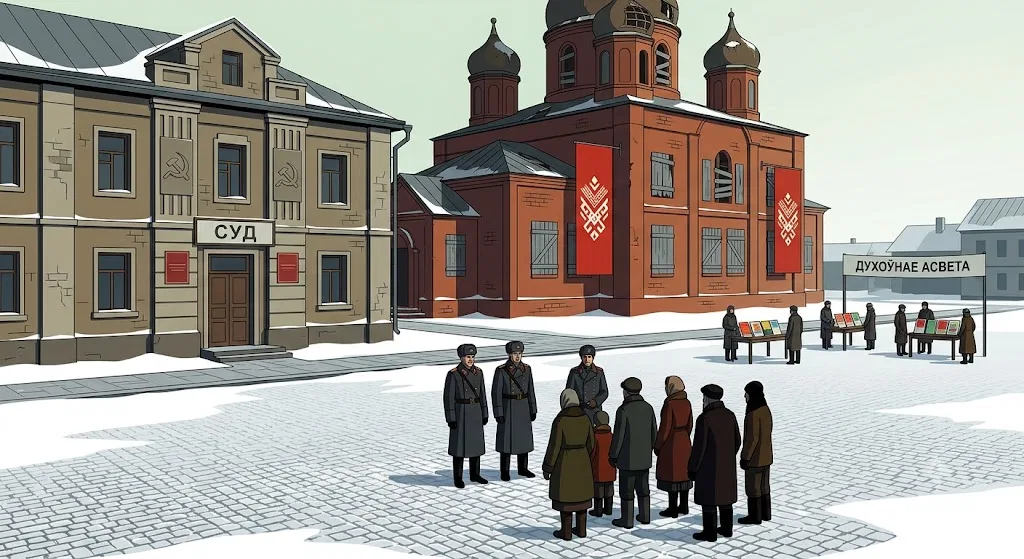
Belarus does not have a single famous episode equivalent to the Salem witch trials or the dancing plague of Strasbourg. Its history of contagious belief is more fragmented and, in some ways, more revealing. Early modern witchcraft accusations occurred on Belarusian-speaking lands within the Grand Duchy of Lithuania, but surviving evidence points to scattered prosecutions rather than an enormous national witch hunt. Under Soviet rule, religious practices were recast as superstition, fraud or political danger. After independence, state officials and educational materials frequently presented unfamiliar faiths as destructive “sects”. The Chernobyl disaster then created a different kind of collective fear: anxiety fed by secrecy and contradictory information, but grounded in a genuine and unevenly understood radiation emergency.
These episodes should not all be called “mass hysteria”. They include judicial persecution, official propaganda, moral panic, religious tradition and rational fear intensified by uncertainty. What connects them is a recurring struggle over who may define reality: villagers, clergy, doctors, scientists, journalists or the state.
Why Belarus resists a simple panic narrative
Present-day Belarus has passed through several political and religious worlds. Much of its territory belonged to the Grand Duchy of Lithuania and later the Polish–Lithuanian Commonwealth before incorporation into the Russian Empire and, eventually, the Soviet Union. Catholic, Orthodox, Eastern Catholic, Jewish, Protestant and folk traditions overlapped in the same region. Ideas about witchcraft, miracles and religious danger therefore crossed linguistic, confessional and political boundaries.
That history creates a problem for anyone looking for a neat list of “Belarusian panics”. Early court cases were recorded by institutions that did not use modern national categories. A prosecution conducted on land now inside Belarus might appear in scholarship as Lithuanian, Polish–Lithuanian, Ruthenian or East European history. The Grand Duchy’s population was culturally diverse, and much of it spoke languages ancestral to modern Belarusian, even though its governing and legal structures cannot simply be described as those of a modern Belarusian state.[Springer]link.springer.comIt will also encourage the.Read more…
There is also an important difference between belief and panic. Veneration of a healing icon, private consultation with a folk practitioner or participation in a pilgrimage may be ordinary religious behaviour within a community. It becomes a social scare only when rumours of danger or supernatural action spread rapidly, institutions intervene, or alleged offenders are punished. Likewise, the presence of a small or unconventional religious movement does not by itself prove coercion, abuse or mass delusion.
Witchcraft accusations on the early modern borderland
Witchcraft was prosecuted within the Grand Duchy of Lithuania between the sixteenth and eighteenth centuries, including in territories now associated with Belarus. Recent scholarship describes the region as an “enchanted borderland”: legally and politically connected to Central Europe, but shaped by Orthodox as well as Catholic culture and by local understandings of magic, healing and misfortune.[Springer]link.springer.comIt will also encourage the.Read more…
The available records suggest a smaller and less concentrated persecution than the great witch-hunting regions of the Holy Roman Empire. One scholarly estimate identifies roughly 400 accused people across the Grand Duchy, with about one fifth receiving death sentences and a significant minority being acquitted. These figures remain provisional because records are incomplete and unevenly preserved, but they undermine the idea of an enormous, Belarus-wide witch craze.[ResearchGate]researchgate.netResearch Gate Witchcraft Court Cases in the Grand Duchy of LithuaniaWitchcraft Court Cases in the Grand Duchy of Lithuania…February 20, 2016 — 2 Jun 2026 — A study of the trial records revea…
Accusations commonly grew from immediate disputes rather than from evidence of organised devil worship. Illness, livestock deaths, failed crops, household conflict or an unexplained run of bad luck could lead neighbours to suspect harmful magic. Reputation mattered: once someone was spoken of as a witch, later misfortunes might be interpreted as confirmation. The accusation itself could therefore spread through a community by repetition, selective memory and fear.
Western European demonological ideas did circulate, including notions of conspiratorial witches serving the Devil. Yet local proceedings did not always reproduce the elaborate sabbaths and continent-wide satanic plots imagined by some Western judges and theologians. The region’s religious and ethnic variety could encourage suspicion, but it could also restrict persecution. Research on Jewish and Tatar minorities in the Grand Duchy argues that legal protection, social autonomy and intervention by landowners sometimes prevented accusations from expanding into large-scale violence.[Academia]academia.eduAcademia(PDF) The Other Witch: Ethnic minorities and witchcraft…January 1, 2021 — Lithuanian witch trials reflected local cultural con…
This makes the witch trials important less as evidence of one overwhelming frenzy than as examples of how fear operated at village and estate level. A damaged relationship could become a supernatural explanation; a supernatural explanation could become a legal charge; and a court could either reinforce the rumour or bring it to an end. The institutional response was therefore decisive.
Later retellings can blur these distinctions. Folklore about witches, sorcerers and uncanny places is not a court record, while a court accusation does not prove that the accused practised harmful magic. Belarusian witch history is best approached through specific cases and jurisdictions rather than through inflated national totals or modern legends presented as fact.
From “superstition” to the Soviet enemy believer
Soviet government changed the official explanation of extraordinary belief. Witches and miracles were no longer treated as real supernatural threats by the courts. Instead, religion itself was presented as ignorance, deception or a remnant of an obsolete social order. Churches were closed, religious education was restricted, clergy and active believers were surveilled, and public organisations promoted scientific atheism.
This was not merely a campaign of calm public education. Soviet anti-religious propaganda regularly portrayed committed believers as fanatics, parasites, disease spreaders or potential enemies of the political system. Religious conduct could be interpreted as evidence of backwardness or concealed political disloyalty. In this sense, the state did not abolish collective fear so much as redirect it: the object of suspicion shifted from the witch to the supposedly dangerous believer.[Wikipedia]WikipediaUSSR anti religious campaign (1928–1941USSR anti religious campaign (1928–1941
Belarus was deeply affected by this wider Soviet programme. Orthodox, Catholic, Protestant and Jewish communities experienced closures and controls, although the severity and methods varied by period. Informal worship in homes, secret religious teaching and the continued use of sacred springs or revered images could be represented by officials as proof that superstition survived beneath the surface of Soviet modernity.
Reports of miracles were particularly awkward for an atheist state because they challenged its authority to decide what counted as knowledge. Officials and propagandists commonly explained healing claims through suggestion, fraud or medical misunderstanding. Some undoubtedly were misunderstandings or later embellishments. Yet the official category of “superstition” was so broad that it could also erase the social meaning of pilgrimage, mourning, communal identity and private devotion.
The Soviet case therefore warns against using the language of delusion only for ordinary people. Institutions can create their own simplified narratives. When every independent religious network is treated as manipulation and every persistent belief as political resistance, the campaign against irrationality can itself acquire the structure of a moral panic.
The post-Soviet fear of “sects”
The collapse of the Soviet Union opened Belarus and neighbouring countries to missionaries, esoteric teachers, imported spiritual movements and new forms of evangelical Christianity. Some groups were short-lived; some made extravagant claims; and a few international movements had genuine records of coercion or violence. The Japanese movement Aum Shinrikyo, responsible for the 1995 Tokyo underground attack, and the apocalyptic White Brotherhood originating in Ukraine provided frightening regional examples.
These cases influenced a much wider fear that unfamiliar religion was spreading uncontrollably through a vulnerable post-Soviet population. The term “sect” increasingly became a catch-all label covering everything from violent apocalyptic organisations to peaceful Protestant churches, Hare Krishna communities and forms of Buddhism. That expansion is the defining feature of a moral panic: a real concern becomes detached from proportion and applied to a much broader category of people.
A striking Belarusian example appeared in state education. In 2003, Protestant and Hare Krishna representatives objected to a school textbook that presented several “non-traditional” religions as sects and described Baptist, Pentecostal, Adventist and Jehovah’s Witness activity as a breeding ground for fanaticism. The Ministry of Education declined to withdraw the book. Its treatment placed established Christian minorities and peaceful new religious movements within the same field of suspicion as organisations associated with apocalyptic threats.[forum18.org]forum18.orgOpen source on forum18.org.
The episode mattered because the message came through schools rather than tabloid entertainment alone. Children were being given a state-approved scheme in which religious familiarity suggested safety and unfamiliarity suggested manipulation. The authorities did not need to prove that each named group caused harm; the category “sect” supplied the threat in advance.
Belarusian law reinforced this division between approved and suspect religion. The 2002 religion law prohibited unregistered religious activity and imposed extensive registration and permission requirements. In practice, the Belarusian Orthodox Church received a privileged position, while Protestant and other minority communities faced particular difficulties obtaining premises, organising meetings or distributing material.[State Department]state.govOpen source on state.gov.
This does not mean every warning about a religious group was false. Responsible assessment should look for concrete conduct: financial exploitation, violence, confinement, threats, sexual abuse, interference with medical care or systematic control over members’ lives. The problem in Belarus was the frequent substitution of political and theological acceptability for behavioural evidence.
When religious control became political control
The boundary between an anti-sect campaign and general political repression became still less clear after the disputed 2020 presidential election. Some churches and clergy criticised violence, supported detainees or offered shelter and assistance to protesters. Religious communities could therefore appear dangerous to the authorities not because of unusual theology, but because they created trusted networks outside direct state control.
Belarus subsequently used extremism rules against religious people and material as part of its broader crackdown. The United States Commission on International Religious Freedom reported that religious publications, websites and social-media pages had been designated “extremist”, while religious leaders had faced arrest, fines or detention in connection with allegedly extremist material.[USCIRF]uscirf.govcountry update: belaruscountry update: belarus
A revised religion law, signed at the end of 2023 and brought into force in July 2024, required religious organisations to undergo re-registration and preserved the prohibition on unregistered activity. It also widened the state’s ability to deny or terminate legal status. United Nations experts warned that the amendments appeared incompatible with Belarus’s international human-rights obligations.[IPPFoRB]ippforb.comIPPFo RBNew religious Law in Belarus: Re-registration, RestrictionIPPFo RBNew religious Law in Belarus: Re-registration, Restriction
Supporters of tight regulation may describe such measures as protection against extremism, foreign influence or manipulative organisations. Critics argue that the real standard is political obedience. The timing and structure of the law support the latter concern: it followed the suppression of mass protest and affected a broad range of communities rather than only groups accused of demonstrable harm.[AP News]apnews.comOpen source on apnews.com.
The result is an official narrative in which an independent congregation can be framed as a security risk. Older anti-sect language remains useful because it gives political control a protective appearance. Authorities can claim to be defending citizens from manipulation while restricting citizens’ ability to form voluntary associations.
Chernobyl: real danger, secrecy and contagious fear
No discussion of collective fear in Belarus can ignore the explosion at the Chernobyl nuclear power station on 26 April 1986. Although the reactor stood in Soviet Ukraine, large areas of Belarus received radioactive fallout. The danger was physical and measurable. Chernobyl should therefore never be reduced to “mass hysteria” or dismissed as an imaginary panic.
The social experience of the disaster was nevertheless shaped by information failure. Soviet authorities delayed public disclosure, minimised risks and maintained controls over reporting. People had to make decisions about food, children, travel and health without timely access to reliable measurements. In those conditions, rumour was not simply irrational behaviour. It was an improvised information system created when official channels could not be trusted.
A study of Belarusian media divided the aftermath into contrasting periods: initial optimistic misinformation that played down the accident, followed by more threatening coverage once censorship weakened and suppressed information entered public discussion. The abrupt movement from reassurance to alarming revelation made it difficult for readers to distinguish established findings, worst-case projections and speculation.[isdm.univ-tln.fr]isdm.univ-tln.frBELARUSIA N MASS MEDIA AND POST CHERNOBYLBELARUSIA N MASS MEDIA AND POST CHERNOBYL
Long-term psychological studies found elevated distress among populations affected by Chernobyl. Fear of cancer, genetic damage and contamination could produce anxiety, physical complaints and a lasting sense of being permanently injured. Researchers have sometimes used the term “radiophobia” for these effects, but it can be misleading when used dismissively. Radiation was present, health monitoring was imperfect, official communication had failed and some consequences—most notably increased childhood thyroid cancer—were genuine.
The more useful question is not whether people were “too frightened”, but how real risk and uncertain risk became entangled. Residents could neither see nor smell radiation. Expert estimates differed, records were incomplete and political institutions had incentives to minimise economic and social disruption. Disagreement over the scale of longer-term illness and death has continued, further sustaining mistrust.[Psychiatry Online]psychiatryonline.orgOpen source on psychiatryonline.org.
Chernobyl also became part of Belarusian political identity. Public remembrance and annual demonstrations connected environmental safety with demands for openness and democratic accountability. Later governments promoted nuclear power and attempted to overcome what officials and researchers called “Chernobyl syndrome”: persistent public resistance rooted in the earlier disaster. Research on Belarusian opinion found that the authorities consistently encouraged a favourable view of nuclear energy as they developed the country’s own nuclear programme.[PubMed]pubmed.ncbi.nlm.nih.govOpen source on nih.gov.
This history offers a crucial distinction. Collective anxiety is not proof that the underlying threat is imaginary. Secrecy, inconsistent reassurance and attacks on independent expertise can amplify fear even when a hazard is real. Labelling the result “hysteria” risks blaming frightened communities for an information crisis created largely by institutions.
Miraculous icons without a “miracle panic”
Belarus has longstanding traditions surrounding wonder-working icons, sacred springs and places of pilgrimage. Shrines such as the Zhirovichi icon have accumulated accounts of discovery, rescue and healing across centuries. Contemporary church and tourism sources continue to present certain icons as miraculous and to recount testimonies of answered prayers or recovery.[en.belarus.travel]en.belarus.travelAncient icons work miraclesAncient icons work miracles
These traditions belong within the history of collective belief, but the surviving evidence does not justify describing them collectively as a Belarusian apparition epidemic or miracle panic. A shared conviction that an image is holy may persist for generations without producing social disorder, coercion or persecution. Pilgrims may interpret a recovery religiously while doctors interpret it through treatment, remission or uncertainty. The two interpretations do not automatically create a public crisis.
Miracle claims become relevant to panic history when crowds form suddenly, rumours escalate, commercial exploitation appears, rival authorities compete to authenticate the event, or officials suppress gatherings because they fear disorder. Belarusian evidence is stronger for continuing devotional culture and state attempts to regulate religion than for a well-documented modern outbreak in which thousands simultaneously reported a new apparition or unexplained illness.
The distinction matters because Soviet sources often treated popular devotion as pathological credulity. Repeating that judgement uncritically would reproduce the state’s categories rather than analyse them. Religious claims can be assessed carefully without assuming either supernatural proof or collective mental disorder.

What the evidence does not show
Popular accounts of “mass hysteria by country” often recycle the same dramatic stories with new geographical labels. Belarus is particularly vulnerable to this because its historical borders changed repeatedly and because material in English is comparatively limited. Several cautions follow.
There is no securely documented national witch craze unique to modern Belarus. Witchcraft cases occurred in the wider Grand Duchy of Lithuania, but they were dispersed and generally less intense than Europe’s major persecution centres.
There is no prominent, well-established Belarusian dance plague or school fainting epidemic in the standard medical literature. General lists of mass psychogenic illness should not be used to manufacture a local case where contemporary investigation and clinical evidence are absent.
Chernobyl fear was not a fantasy. Psychological distress and rumour accompanied a genuine radiological disaster. Any account that describes the Belarusian response simply as panic erases both physical exposure and official secrecy.
“Cult” and “sect” were often political labels. Some organisations described by those terms presented authentic dangers, but Belarusian institutions applied similar language to peaceful minority religions. The label alone is therefore weak evidence.
Miracle traditions are not automatically mass delusions. Their historical importance lies in shared devotion, identity and competing ideas of evidence, not necessarily in public breakdown.
These limits do not make Belarus a poor case study. They reveal how readily the language of hysteria can become a weapon. An accusation of irrationality may tell us as much about the accuser’s interests as about the people being described.
Why these episodes still matter
Belarusian history shows that collective fear is often produced through a triangle of uncertainty, social pressure and authority. In early modern communities, unexplained illness or misfortune could become a witchcraft accusation. Under Soviet rule, persistent religion became evidence of backwardness or disloyalty. After 1991, anxiety about destructive movements broadened into suspicion of unfamiliar faiths. Following Chernobyl, official secrecy left citizens to negotiate a real but invisible danger through rumour, private networks and competing experts.
The recurring issue is not that Belarusians were exceptionally credulous. It is that people repeatedly faced institutions claiming exclusive power to separate truth from falsehood. Courts defined the witch, atheist propagandists defined superstition, educational officials defined the sect, and governments defined acceptable levels of nuclear concern.
The most damaging episodes occurred when those definitions carried legal force. A neighbour’s story could lead to prosecution; a religious identity could obstruct education or worship; independent warnings about contamination could be marginalised; and a congregation could lose legal existence because authorities considered it politically unreliable.
Belarus therefore belongs in the history of panics and contagious belief not through one spectacular national frenzy, but through a succession of quieter struggles over credibility. Its experience demonstrates why historians distinguish belief from delusion, fear from fantasy and protection from persecution. It also shows why open evidence matters: when trustworthy information is scarce and disagreement is punished, both rumours and official myths become harder to correct.
Amazon book picks
Further Reading
Books and field guides related to Who Decided What Belarus Should Fear?. Use these as the next step if you want deeper reading beyond the article.


The Penguin History Of Modern Russia From Tsarism To The Twen...
First published 2009. Subjects: Soviet union, history, Russia (federation), history.
Bloodlands
First published 2010. Subjects: Massacres, Genocide, World War, 1939-1945, Holocaust, Jewish (1939-1945), Atrocities.
Endnotes
1.
Source: link.springer.com
Link:https://link.springer.com/content/pdf/10.1007/978-3-032-00671-4.pdf
Source snippet
It will also encourage the.Read more...
2.
Source: link.springer.com
Link:https://link.springer.com/book/10.1007/978-3-032-00671-4
Source snippet
Witch Trials in the Grand Duchy of Lithuania in the Sixteenth to...Table of contents (12 chapters) · Front Matter · Introduction...
3.
Source: researchgate.net
Title: Research Gate Witchcraft Court Cases in the Grand Duchy of Lithuania
Link:https://www.researchgate.net/publication/339503878_Witchcraft_Court_Cases_in_the_Grand_Duchy_of_Lithuania_in_the_Sixteenth_to_Eighteenth_Centuries
Source snippet
Witchcraft Court Cases in the Grand Duchy of Lithuania...February 20, 2016 — 2 Jun 2026 — A study of the trial records revea...
Published: February 20, 2016
4.
Source: academia.edu
Link:https://www.academia.edu/49798753/The_Other_Witch_Ethnic_minorities_and_witchcraft_accusations_in_the_Grand_Duchy_of_Lithuania
Source snippet
Academia(PDF) The Other Witch: Ethnic minorities and witchcraft...January 1, 2021 — Lithuanian witch trials reflected local cultural con...
Published: January 1, 2021
5.
Source: Wikipedia
Title: USSR anti religious campaign (1928–1941)
Link:https://en.wikipedia.org/wiki/USSR_anti-religious_campaign_%281928%E2%80%931941%29
6.
Source: Wikipedia
Title: USSR anti religious campaign (1958–1964)
Link:https://en.wikipedia.org/wiki/USSR_anti-religious_campaign_%281958%E2%80%931964%29
7.
Source: forum18.org
Link:https://www.forum18.org/archive.php?article_id=90
8.
Source: state.gov
Link:https://www.state.gov/reports/2023-report-on-international-religious-freedom/belarus
9.
Source: forum18.org
Link:https://www.forum18.org/archive.php?article_id=1997
10.
Source: uscirf.gov
Title: country update: belarus
Link:https://www.uscirf.gov/sites/default/files/2023-12/2023%20Belarus%20Country%20Update_12.1.23.pdf
11.
Source: ippforb.com
Title: IPPFo RBNew religious Law in Belarus: Re-registration, Restriction
Link:https://ippforb.com/belaruss-new-religious-law-re-registration-restriction-and-repression/
12.
Source: isdm.univ-tln.fr
Title: BELARUSIA N MASS MEDIA AND POST CHERNOBYL
Link:https://isdm.univ-tln.fr/PDF/isdm0/isdm0a1_lazarev.pdf
13.
Source: en.belarus.travel
Title: Ancient icons work miracles
Link:https://en.belarus.travel/news/ancient-icons-work-miracles
14.
Source: Wikipedia
Title: List of mass panic cases
Link:https://en.wikipedia.org/wiki/List_of_mass_panic_cases
15.
Source: Wikipedia
Title: Satanic panic
Link:https://en.wikipedia.org/wiki/Satanic_panic
16.
Source: Wikipedia
Title: Witch trials in Poland
Link:https://en.wikipedia.org/wiki/Witch_trials_in_Poland
17.
Source: Wikipedia
Title: White Brotherhood (religious group)
Link:https://en.wikipedia.org/wiki/White_Brotherhood_%28religious_group%29
18.
Source: Wikipedia
Title: Freedom of religion in Belarus
Link:https://en.wikipedia.org/wiki/Freedom_of_religion_in_Belarus
19.
Source: Wikipedia
Title: Mass psychogenic illness
Link:https://en.wikipedia.org/wiki/Mass_psychogenic_illness
20.
Source: 2009-2017.state.gov
Link:https://2009-2017.state.gov/documents/organization/171684.pdf
21.
Source: 2021-2025.state.gov
Link:https://2021-2025.state.gov/reports/2020-report-on-international-religious-freedom/belarus/
22.
Source: researchgate.net
Link:https://www.researchgate.net/publication/372510216_A_Systematic_Review_of_Research_Developments_in_Mass_Psychogenic_Illness
23.
Source: researchgate.net
Link:https://www.researchgate.net/publication/290199763_New_Religious_Movements_Countermovements_Moral_Panics_and_the_Media
24.
Source: researchgate.net
Link:https://www.researchgate.net/publication/340047682_Mass_Hysteria_Through_the_Ages_From_St_Vitus_Dance_to_Mystery_Odors
25.
Source: researchgate.net
Link:https://www.researchgate.net/publication/249980885_Pana_Wave_The_New_Aum_Shinrikyoo_or_Another_Moral_Panic
26.
Source: researchgate.net
Title: 309669047 Witchcraft in Early Modern Poland 1500 1800
Link:https://www.researchgate.net/publication/309669047_Witchcraft_in_Early_Modern_Poland
27.
Source: researchgate.net
Link:https://www.researchgate.net/publication/11488124_Radiophobia_Long-Term_Psychological_Consequences_of_Chernobyl
28.
Source: researchgate.net
Link:https://www.researchgate.net/publication/329468359_Chernobyl_science_and_politics_in_Belarus_The_challenges_of_post-normal_science_and_political_transition_as_a_context_for_science-policy_interfacing
29.
Source: forum18.org
Link:https://www.forum18.org/archive.php?article_id=2884
30.
Source: iris.who.int
Link:https://iris.who.int/bitstreams/fab830ca-5386-4c18-bcff-102c42cb9a85/download
31.
Source: academia.edu
Link:https://www.academia.edu/37989478/WITCHCRAFT_COURT_CASES_IN_THE_GRAND_DUCHY_OF_LITHUANIA_IN_THE_SIXTEENTH_TO_EIGHTEENTH_CENTURIES
32.
Source: academia.edu
Link:https://www.academia.edu/33077862/From_Paganism_to_Witchcraft_Sorcery_in_the_space_of_knowledge_of_the_Orthodox_Church_of_the_Polish_Lithuanian_Commonwealth_in_the_16th_17th_centuries
33.
Source: uscirf.gov
Title: belarus country update
Link:https://www.uscirf.gov/publications/belarus-country-update
34.
Source: history.com
Title: mysterious illnesses mass hysteria
Link:https://www.history.com/articles/mysterious-illnesses-mass-hysteria
35.
Source: youtube.com
Title: Inside The Belarus Chernobyl Zone
Link:https://www.youtube.com/watch?v=aIC73xZPLgU
Source snippet
Grand Duchy of Lithuania...
36.
Source: youtube.com
Title: Grand Duchy of Lithuania
Link:https://www.youtube.com/watch?v=tNsHKleaXvA
Source snippet
Did you know that there are countries where whistling is prohibited?...
37.
Source: apnews.com
Link:https://apnews.com/article/58428374005dd0da383fbac7ad2c5d57
38.
Source: psychiatryonline.org
Link:https://psychiatryonline.org/doi/10.1176/ajp.154.11.1605
39.
Source: pubmed.ncbi.nlm.nih.gov
Link:https://pubmed.ncbi.nlm.nih.gov/27154754/
40.
Source: pmc.ncbi.nlm.nih.gov
Link:https://pmc.ncbi.nlm.nih.gov/articles/PMC7396040/
41.
Source: pubmed.ncbi.nlm.nih.gov
Link:https://pubmed.ncbi.nlm.nih.gov/10188713/
42.
Source: pmc.ncbi.nlm.nih.gov
Link:https://pmc.ncbi.nlm.nih.gov/articles/PMC6734683/
43.
Source: x.com
Link:https://x.com/archeohistories/status/2037119801110434158
44.
Source: teme2.junis.ni.ac.rs
Link:https://teme2.junis.ni.ac.rs/index.php/TEME/article/view/2072
45.
Source: sajp.org.za
Link:https://sajp.org.za/index.php/sajp/article/view/1671/2648
Additional References
46.
Source: drfrancisyoung.com
Link:https://drfrancisyoung.com/2026/07/03/review-witch-trials-in-the-grand-duchy-of-lithuania-in-the-sixteenth-to-eighteenth-centuries-by-vital-byl/
Source snippet
Francis YoungReview: 'Witch Trials in the Grand Duchy of Lithuania...3 Jul 2026 — Few European regions have been more neglected in the s...
47.
Source: nec.ro
Link:https://nec.ro/publication_library/the-other-witch-ethnic-minorities-and-witchcraft-accusations-in-the-grand-duchy-f-lithuania/
Source snippet
Ethnic Minorities and Witchcraft Accusations in the Grand...The Other Witch: Ethnic Minorities and Witchcraft Accusations in the Grand D...
48.
Source: youtube.com
Title: The Chernobyl Syndrome Explained | Psychological Impact of Nuclear Trauma
Link:https://www.youtube.com/watch?v=CqYPUg9fSM0
Source snippet
Belarus Still Facing Fallout 40 Years After Chernobyl Nuclear Disaster...
49.
Source: historysnob.com
Link:https://www.historysnob.com/war-and-historical-events/20-chilling-cases-mass-hysteria-throughout-history
50.
Source: jstor.org
Link:https://www.jstor.org/stable/10.1086/343403
51.
Source: ifex.org
Link:https://ifex.org/belarusian-authorities-bury-chernobyls-dangerous-legacy/
52.
Source: facebook.com
Link:https://www.facebook.com/brief.nepall/posts/students-in-naubahini-rural-municipality-pyuthan-who-experienced-fainting-trembl/122175067520903506/
53.
Source: jstor.org
Link:https://www.jstor.org/stable/27368374
54.
Source: epp.eu
Link:https://www.epp.eu/papers/crackdown-on-religious-freedom-in-belarus-a-threat-to-fundamental-rights
55.
Source: reddit.com
Link:https://www.reddit.com/r/AskHistorians/comments/12jvlg0/did_people_actually_worry_about_the_occult_during/
Topic Tree
Follow this branch
Related pages 192
- Antigua and Barbuda
- Argentina Belief Scares
- Azerbaijan Belief
- Bahrain Beliefs
- North Korea
- +187 more in sidebar