When Fear and Illness Spread in Ethiopia
Ethiopia’s history of contagious belief is not dominated by one notorious “cult” or spectacular witch trial.
Page outline Jump by section
Introduction
These episodes should not be forced into the old label “mass hysteria”. Some were collective stress reactions, some were systems of healing, some were forms of political or religious protest, and some were harmful patterns of stigma. What connects them is the way fear, illness and misfortune became socially meaningful. Ethiopian cases show that contagious belief rarely emerges from ignorance alone. It grows where people face uncertainty, unequal power, inadequate medical explanations, institutional pressure or sudden social change.
When illness spread through schools
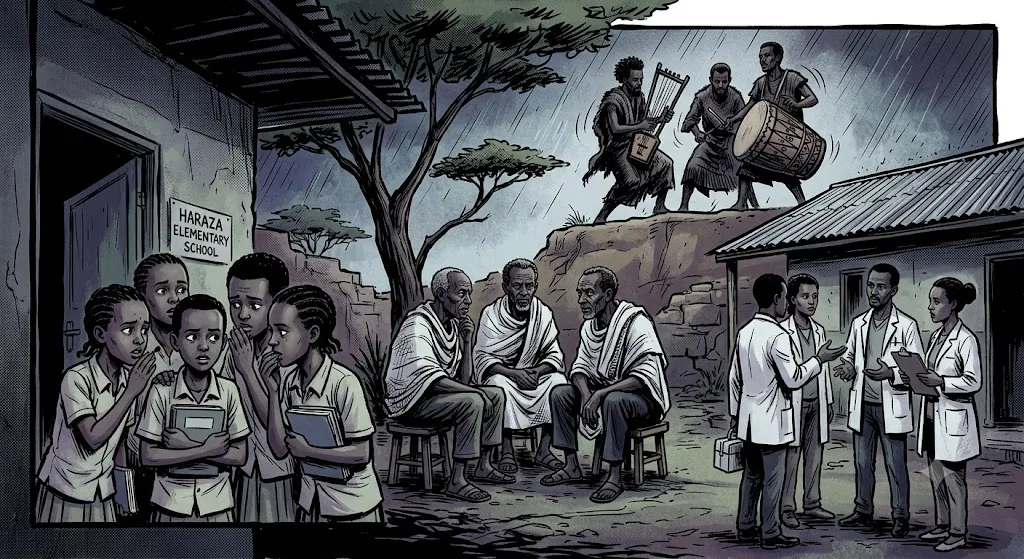
The clearest Ethiopian examples of mass psychogenic illness have occurred among pupils. Mass psychogenic illness describes the spread of genuine symptoms through a socially connected group when investigators cannot find an infectious, toxic or other physical agent sufficient to explain the pattern. The symptoms are not fabricated. Anxiety and expectation can produce breathlessness, fainting, weakness, abnormal movements, headache and other bodily effects, which may then spread through observation, conversation and fear.
Published Ethiopian studies refer to an outbreak in Gondar in 1982 and later incidents in Bati, Kombolcha, Addis Ababa and the Tigray region. The available record is uneven: some events were investigated through formal field epidemiology, while others are known mainly through later articles citing earlier reports. It is therefore safer to speak of a recurring documented pattern than of a complete national chronology.[nih.gov]pmc.ncbi.nlm.nih.govMass Hysteria among Beneficiary Students of the School…by S Jebessa · 2022 · Cited by 5 — In Ethiopia, the first episode of mass hy…
The Bati school outbreak
In April 2010, investigators examined an outbreak at a high school in Ethiopia’s Amhara region. Forty-four pupils were identified over 22 days, all of them girls. Reported symptoms included breathlessness, crying, fear, anxiety and temporary inability to move the limbs. The illnesses often lasted only a few hours, although some continued longer. Investigators interviewed pupils, teachers, administrators and local disease-surveillance staff while considering whether an environmental or infectious hazard could account for the event.[ResearchGate]researchgate.netResearchGate(PDF) Outbreak of Mass Psychogenic Illness at a High…In Ethiopia, Epidemic hysteria reported from Gondar city, in north we…
The pattern was consistent with an anxiety-based outbreak. Cases appeared in a tightly connected school population, symptoms spread over a limited period, and the clinical picture did not fit a single toxic or infectious disease. Such a conclusion does not mean that nothing happened. Fear can alter breathing, muscle control, consciousness and pain perception, particularly when people see classmates suddenly collapse or struggle to breathe.
The fact that all identified patients were girls is also important but should not be reduced to an assumption that girls are naturally more “hysterical”. International research finds that school outbreaks often affect adolescent girls, but social arrangements matter: pupils may spend more time together, experience stricter supervision, have fewer accepted ways to express distress, or be especially alert to danger affecting friends. Ethiopian investigators have likewise pointed towards school pressures, community interpretations and close social contact rather than a defective female personality.[PMC]pmc.ncbi.nlm.nih.govPMCMass hysteria attack rates in children and adolescentsHysteria outbreak investigation in Kombolcha Town among school girls, Northwest Ethiopia, January 2013.Read more…
Haraza Elementary School
A smaller outbreak began at Haraza Elementary School in northern Ethiopia in December 2019. Researchers studied 12 affected pupils. Nine temporarily became unable to speak, eight shouted, seven reported headache, seven dizziness and seven sleepiness. Unconsciousness and breathlessness were each recorded in six pupils; abnormal movements, laughter, coughing and low-grade fever appeared less frequently.[PMC]pmc.ncbi.nlm.nih.govOpen source on nih.gov.
The range of symptoms is characteristic of these events. A conventional disease generally produces a more stable clinical pattern. In psychogenic outbreaks, symptoms can be dramatic yet variable because people respond differently to stress and to what they witness around them. The first case may have a migraine, fainting episode, panic attack or unrelated illness; the collective episode develops when others interpret that event as evidence of a shared threat.
Researchers also found that community explanations affected responses. Where illness is interpreted through possession, curses or mysterious forces, families may seek spiritual intervention before, alongside or instead of medical assessment. The correct public-health approach is not to mock those interpretations. It is to exclude genuine hazards, communicate findings clearly, reduce frightening rumours and help the community return to ordinary routines.
Panic over school food
A later Addis Ababa episode followed breakfast supplied through a school-feeding programme. Pupils developed nausea, vomiting and related complaints, leading to immediate fear that the food had been contaminated. Yet roughly half of those affected had not eaten the suspected meal, and investigations did not identify a pathogen capable of explaining the outbreak. The event nevertheless disrupted schooling and consumed medical resources.[nih.gov]pmc.ncbi.nlm.nih.govMass Hysteria among Beneficiary Students of the School…by S Jebessa · 2022 · Cited by 5 — In Ethiopia, the first episode of mass hy…
This case illustrates why psychogenic illness can be difficult to diagnose responsibly. Suspected poisoning must be treated seriously until evidence rules it out. Declaring an event “psychological” too quickly can miss a real hazard and destroy trust. But continuing to imply that an unidentified poison is present after tests and case patterns point elsewhere can intensify symptoms. Ambulances, protective clothing, repeated rumours and alarming statements may unintentionally confirm the community’s worst fears.
The long outbreak among women in Derashe
Not every episode was brief or school-based. In southern Ethiopia’s Derashe district, researchers documented a chronic illness affecting about 120 women from 2012 onwards. The episode reportedly began after the death of a socially prominent 43-year-old woman from complications of breast cancer. It then continued in the community rather than burning out within a few days.[PMC]pmc.ncbi.nlm.nih.govOpen source on nih.gov.
The Derashe case complicates the familiar picture of pupils fainting after seeing a classmate collapse. It shows that collective illness can become embedded in community relationships, memories and expectations. Once a recognised symptom pattern exists, later distress may be understood through that pattern. Each new case reinforces the belief that the condition is circulating, while attention from relatives, healers and authorities gives it a durable social presence.
Researchers described weaknesses in the early response, including interventions that did not adequately address psychological and social conditions. This is a recurring difficulty. Communities may be told merely that laboratory tests are negative, which answers the question of what the illness is not but gives no meaningful account of why people are suffering. A more useful response combines medical screening with calm explanation, psychological support, attention to bereavement and conflict, and cooperation with trusted community and religious figures.
The expression “mass psychogenic illness” can itself create resistance because it is often heard as “imaginary illness”. In reality, grief, fear and chronic stress can generate disabling bodily symptoms without deliberate deception. The Derashe women’s suffering was real even though researchers did not attribute it to a transmissible pathogen.
Spirit possession as illness, identity and healing
Ethiopian spirit-possession traditions are sometimes described in older literature as “cults”, but that word can be misleading. They are better understood as religious and therapeutic communities organised around beliefs about spirits, illness and ritual obligation.
In possession traditions commonly discussed under the name zar, persistent headache, fatigue, infertility, distress or unexplained illness may be interpreted as evidence that a spirit has selected or afflicted a person. Ritual specialists identify the spirit and negotiate an accommodation through music, movement, offerings, social gatherings and continuing obligations. The objective is not always to expel the spirit permanently; it may be to establish a manageable relationship with it.[nih.gov]pmc.ncbi.nlm.nih.govPMCZār Spirit Possession in Iran and African CountriesPMCZār Spirit Possession in Iran and African Countries
Earlier psychiatric writing sometimes treated possession primarily as pathology. Later anthropological and psychological interpretations have been more cautious. A possession ceremony may provide a culturally recognised language for distress, particularly where discussing marriage difficulties, infertility, anger, isolation or psychological suffering directly is difficult. The gathering can supply recognition, companionship and an accepted temporary release from ordinary expectations.
Calling this a form of group therapy captures part of its function but not its whole meaning. Participants may understand spirits as objectively real, not as metaphors invented for emotional relief. Reducing the practice to disguised psychotherapy disregards the religious world in which it makes sense. Conversely, romanticising it as wholly beneficial can hide financial burdens, coercive treatment or delays in obtaining medical care.
Ethiopia’s expanding Pentecostal and charismatic churches have introduced another interpretation of possession. Deliverance ministries may identify troubling spirits as demons to be expelled through prayer. Scholars studying Ethiopian Pentecostalism have described disputes over whether a Christian who has received the Holy Spirit can still be demonically possessed. These arguments are not abstract theology: they shape how unusual behaviour, illness and emotional crisis are recognised and treated.[tandfonline.com]tandfonline.comOpen source on tandfonline.com.
This produces both continuity and conflict. Deliverance services answer an existing demand for spiritual explanations and embodied healing, but they may condemn older possession practices as demonic. A person once understood as maintaining a relationship with a particular spirit may instead be treated as the site of a battle between Christianity and evil. Neither framework automatically tells clinicians whether epilepsy, trauma, psychosis, panic or another condition is also present.
How evil-eye fear became social exclusion
Belief in the evil eye has had more direct consequences for social hierarchy. In several Ethiopian settings, certain artisans and minority communities have historically been accused of possessing an inherited power to cause sickness, infertility, crop failure, livestock death or general misfortune through envy or a harmful gaze. The accusations have often attached not to individual conduct but to birth and occupation.[rightsinexile.org]rightsinexile.orgRights in Exile The Evil Eye Belief among the Amhara of EthiopiaRights in Exile The Evil Eye Belief among the Amhara of Ethiopia
This is not simply a private superstition about bad luck. It can act as a theory of social danger. An unexplained illness creates a search for agency: who was present, who looked enviously at the victim, who occupies an ambiguous place in the community? Suspicion then falls on a group already treated as different.
Historical studies among Amhara communities associated evil-eye accusations with craft workers and, in some contexts, Beta Israel communities. Research in southern and south-western Ethiopia has recorded comparable fears surrounding potters, blacksmiths and other occupational groups. The exact beliefs differ between regions, so no single account should be projected onto the whole country. What recurs is the connection between supposed supernatural danger and inherited social boundaries.[rightsinexile.org]rightsinexile.orgRights in Exile The Evil Eye Belief among the Amhara of EthiopiaRights in Exile The Evil Eye Belief among the Amhara of Ethiopia
A 2026 study of Manaa potters in Dawuro described exclusion from land, education, marriage, burial spaces and parts of communal or ritual life. The same people were nevertheless valued for pottery and, in some circumstances, ritual services. This mixture of dependence and fear helps explain the durability of the stigma: artisans could be economically necessary while being represented as spiritually contaminating.[Springer Link]link.springer.comOpen source on springer.com.
Evil-eye belief therefore resembles a witch panic only in certain respects. Ethiopia did not produce one nationally organised prosecution comparable to the early modern European witch trials. The harm was often more dispersed: avoidance, segregation, accusation, forced ritual treatment and inherited loss of status. It is better understood as a continuing structure of suspicion than as a single outbreak.
The social explanation does not require deciding whether believers were insincere. People can genuinely fear supernatural attack while also reproducing unequal power. Anthropologists have argued that accusations tend to become persuasive at moments of illness, envy, competition and strained relationships. The belief converts difficult questions about inequality or chance into a morally comprehensible story about a dangerous person.[JSTOR]jstor.orgOpen source on jstor.org.
Prophecy in times of conquest and disease
Prophetic movements offer a different form of collective belief: not merely fear spreading through a crowd, but a shared expectation that spiritual reform will end a social crisis.
One documented Ethiopian case centres on Prophet Esa in Wolaitta between 1920 and 1928. His movement emerged after the conquest of the Wolaitta kingdom by Emperor Menelik II’s forces in 1894 and the establishment of a political and economic order experienced locally as dispossession, forced labour, injustice and cultural disruption. Disease in the 1920s added to the sense that established institutions could not provide protection.[Academic Journals]academicjournals.orgAcademic JournalsAfrican Journal of History and Culture - prophets and prophecy as a response to crises: prophet esa in traditional relig…
Esa’s message combined prophecy with reform. The surviving evidence comes from oral histories as well as secondary scholarship, so details require caution, but the wider setting is clear. Conquest had damaged earlier political structures; northern officials, settlers and religious institutions were associated with a new hierarchy; and traditional religious specialists could also be accused of failing or exploiting the population. Esa offered a language through which disorder could be interpreted and moral agency recovered.[Academic Journals]academicjournals.orgAcademic JournalsAfrican Journal of History and Culture - prophets and prophecy as a response to crises: prophet esa in traditional relig…
It would be simplistic to label this a “cult”. That description reflects the language once used by colonial officials and missionaries for unfamiliar prophetic movements across Africa. Such movements could contain intense supernatural claims and charismatic authority, but they were also responses to recognisable material conditions. Prophecy made suffering intelligible and promised that society could be repaired.
Nor should every prophecy be classified as millenarian. A millenarian movement normally expects a dramatic transformation of the present order, often through divine intervention. Esa’s movement fits more securely within crisis prophecy and religious reform. Its importance lies in showing how spiritual insecurity can arise when political domination, epidemic disease and economic pressure converge.
Epidemics, divine punishment and digital rumour
During the first phase of the COVID-19 pandemic, Ethiopian religious commentary sometimes presented the virus as divine punishment for sin. Researchers examining public religious discourse found that such interpretations circulated alongside medical explanations and could encourage repentance, prayer and moral reflection. They were not confined to one denomination, nor did they necessarily entail rejection of medicine.[PMC]pmc.ncbi.nlm.nih.govPMCGod's Wrath in the Era of the DigidemicPMCGod's Wrath in the Era of the Digidemic
The episode demonstrates why “panic” is often too blunt a term. Religious explanations can provide comfort and collective discipline, but punishment narratives may also encourage blame. Those who fall ill can be treated as morally compromised, while proposed remedies may shift attention away from practical prevention. The effects depend on whether religious leaders reinforce or undermine public-health advice.
Ethiopia’s experience also reflects a broader change in how collective fears travel. Earlier school outbreaks spread mainly through proximity, sight and face-to-face rumour. Mobile phones and social platforms can now carry alarming claims far beyond the original group. In a multilingual country where online moderation and reliable health communication are uneven, dramatic spiritual or conspiratorial explanations may travel faster than cautious corrections.
Yet misinformation should not be treated as an exotic Ethiopian problem. Uncertainty, distrust and moral interpretation shaped pandemic responses around the world. Ethiopia’s distinctive feature is the coexistence of biomedical institutions with several powerful religious and therapeutic traditions. People may consult clinics, clergy, prayer services and traditional healers without seeing those choices as mutually exclusive.

What the Ethiopian cases actually show
Ethiopia’s collective-belief history resists a single dramatic narrative. The strongest documented cases fall into several different categories:
- Mass psychogenic illness: real symptoms spreading through socially connected groups, particularly schools, without an identified physical agent explaining the entire outbreak.
- Possession and deliverance: religious systems for interpreting and treating distress, sometimes supportive and sometimes capable of delaying or complicating medical care.
- Evil-eye accusations: supernatural explanations that can reinforce inherited stigma and social exclusion.
- Crisis prophecy: reform movements in which spiritual authority responds to conquest, disease, exploitation or institutional failure.
- Moralised epidemic fear: interpretations of public-health emergencies through sin, punishment, supernatural danger and rumour.
The distinction matters because the remedies differ. A suspected school poisoning requires rapid toxicological and epidemiological investigation before psychogenic illness is considered. A possession tradition requires cultural understanding, not ridicule. An evil-eye accusation may demand protection from discrimination rather than argument about theology. A prophetic movement must be understood in relation to the injustice or disruption that gave it credibility.
Across these cases, collective belief was most powerful when it organised experiences that official institutions had not explained convincingly. Fear spread through trusted relationships; symptoms borrowed familiar cultural forms; accusations followed existing inequalities; and prophecy flourished where ordinary political remedies seemed blocked. Ethiopia’s history therefore offers a broader lesson about panics and contagious belief: people do not merely copy irrational ideas. They use available stories to interpret real suffering, and those stories can heal, mobilise, stigmatise or harm depending on the social world in which they take hold.
Amazon book picks
Further Reading
Books and field guides related to When Fear and Illness Spread in Ethiopia. Use these as the next step if you want deeper reading beyond the article.

The Spirit Catches You and You Fall Down
Shows how beliefs and medical systems shape responses to illness.


The Serpent and the Rainbow
Explores belief, healing and supernatural explanations of illness.

African religions and philosophy
Provides context for Ethiopian religious understandings of illness and misfortune.
Endnotes
1.
Source: pmc.ncbi.nlm.nih.gov
Link:https://pmc.ncbi.nlm.nih.gov/articles/PMC9214752/
Source snippet
Mass Hysteria among Beneficiary Students of the School...by S Jebessa · 2022 · Cited by 5 — In Ethiopia, the first episode of mass hy...
2.
Source: researchgate.net
Link:https://www.researchgate.net/publication/268694182_Outbreak_of_Mass_Psychogenic_Illness_at_a_High_School_Amhara_Region_Ethiopia_April_2010
Source snippet
ResearchGate(PDF) Outbreak of Mass Psychogenic Illness at a High...In Ethiopia, Epidemic hysteria reported from Gondar city, in north we...
3.
Source: pmc.ncbi.nlm.nih.gov
Title: PMCMass hysteria attack rates in children and adolescents
Link:https://pmc.ncbi.nlm.nih.gov/articles/PMC8829737/
Source snippet
Hysteria outbreak investigation in Kombolcha Town among school girls, Northwest Ethiopia, January 2013.Read more...
Published: January 2013
4.
Source: pmc.ncbi.nlm.nih.gov
Link:https://pmc.ncbi.nlm.nih.gov/articles/PMC7396040/
5.
Source: researchgate.net
Link:https://www.researchgate.net/publication/340194539_Mass_Psychogenic_Illness_in_Haraza_Elementary_School_Tigray_Northern_Ethiopia_Investigation_to_the_nature_of_an_Episode/fulltext/5e7ce4ff92851caef4a1d20c/Mass-Psychogenic-Illness-in-Haraza-Elementary-School-Tigray-Northern-Ethiopia-Investigation-to-the-nature-of-an-Episode.pdf
6.
Source: pmc.ncbi.nlm.nih.gov
Link:https://pmc.ncbi.nlm.nih.gov/articles/PMC5992694/
7.
Source: academia.edu
Link:https://www.academia.edu/8299405/Embodying_the_Spirit_s_Pentecostal_Demonology_and_Deliverance_Discourse_in_Ethiopia
8.
Source: jstor.org
Link:https://www.jstor.org/stable/24774337
9.
Source: link.springer.com
Link:https://link.springer.com/article/10.1007/s44282-026-00343-4
10.
Source: ecoi.net
Link:https://www.ecoi.net/en/file/local/2006699/92957.pdf
11.
Source: jstor.org
Link:https://www.jstor.org/stable/26158175
12.
Source: pmc.ncbi.nlm.nih.gov
Title: PMCGod’s Wrath in the Era of the Digidemic
Link:https://pmc.ncbi.nlm.nih.gov/articles/PMC8689699/
13.
Source: researchgate.net
Link:https://www.researchgate.net/publication/232890939_Embodying_the_Spirits_Pentecostal_Demonology_and_Deliverance_Discourse_in_Ethiopia
14.
Source: researchgate.net
Link:https://www.researchgate.net/publication/289966394_Millennial_and_Apocalyptic_Movements_in_Africa
15.
Source: researchgate.net
Link:https://www.researchgate.net/publication/316057196_From_sickness_to_history_Evil_spirits_memory_and_responsibility_in_an_Ethiopian_market_village
16.
Source: researchgate.net
Link:https://www.researchgate.net/publication/31230272_Lost_Tribes_and_Coffee_Ceremonies_Zar_Spirit_Possession_and_the_Ethno-Religious_Identity_of_Ethiopian_Jews_in_Israel
17.
Source: researchgate.net
Link:https://www.researchgate.net/publication/400059647_The_Anywaa_Belief_Systems_about_Evil_Eye_and_its_Psychosocial_Repercussion_on_Victims_in_Anywaa_Zone_of_Gambella_Regional_State_Ethiopia
18.
Source: researchgate.net
Link:https://www.researchgate.net/publication/290199763_New_Religious_Movements_Countermovements_Moral_Panics_and_the_Media
19.
Source: researchgate.net
Link:https://www.researchgate.net/publication/276925654Introduction_The_Ethiopian_Pentecostal_Movement-_History_Identity_and_Current_Socio-Political_Dynamics
20.
Source: researchgate.net
Link:https://www.researchgate.net/publication/265902222_Compromising_with_Ethiopianness_After_1991_The_Ethiopian_Festival_of_the_Millennium_September_2007-September_2008
Published: September 2007
21.
Source: researchgate.net
Link:https://www.researchgate.net/publication/392838044_Factors_related_to_the_occurrence_of_mass_psychogenic_illness_in_schools_a_systematic_review
22.
Source: researchgate.net
Link:https://www.researchgate.net/publication/325637909_Chronic_mass_psychogenic_illness_among_women_in_Derashe_Woreda_Segen_Area_People_Zone_southern_Ethiopia_A_community_based_cross-sectional_study
23.
Source: researchgate.net
Link:https://www.researchgate.net/publication/361940268_Mass_Hysteria_among_Beneficiary_Students_of_the_School-Feeding_Program_in_Addis_Ababa_Ethiopia
24.
Source: researchgate.net
Link:https://www.researchgate.net/publication/360411819_Mass_Hysteria_among_Beneficiary_Students_of_the_School-Feeding_Program_in_Addis_Ababa_Ethiopia
25.
Source: academia.edu
Link:https://www.academia.edu/5368224/Apocalyptic_and_Millenarian_Movements
26.
Source: academia.edu
Link:https://www.academia.edu/75835304/Spirit_Possession_In_Ethiopia_An_Essay_In_Interpretation
27.
Source: academia.edu
Link:https://www.academia.edu/30559904/New_Religious_Movements_Countermovements_Moral_Panics_and_the_Media
28.
Source: academia.edu
Link:https://www.academia.edu/29306093/Ethiopian_apocalyptic_and_the_End_of_Roman_Rule_the_Reccption_of_Chalcedon_in_Aksum_and_the_Kebra_Naga%C5%9Bt
29.
Source: academia.edu
Link:https://www.academia.edu/11253251/Mass_Psychogenic_Illness_and_the_Social_Network_Is_it_Changing_the_Pattern_of_Outbreaks
30.
Source: independent.academia.edu
Title: Muluwork Tefera
Link:https://independent.academia.edu/MuluworkTefera
31.
Source: link.springer.com
Link:https://link.springer.com/article/10.1186/s13033
32.
Source: journals.sagepub.com
Link:https://journals.sagepub.com/doi/abs/10.1177/03000605211039812
Source snippet
Sage JournalsMass hysteria attack rates in children and adolescentsby G Zhao · 2021 · Cited by 10 — Mass psychogenic illness in Haraza El...
33.
Source: pubmed.ncbi.nlm.nih.gov
Link:https://pubmed.ncbi.nlm.nih.gov/35813689/
34.
Source: pubmed.ncbi.nlm.nih.gov
Link:https://pubmed.ncbi.nlm.nih.gov/29930699/
35.
Source: pmc.ncbi.nlm.nih.gov
Title: PMCZār Spirit Possession in Iran and African Countries
Link:https://pmc.ncbi.nlm.nih.gov/articles/PMC4801492/
36.
Source: journals.sagepub.com
Title: Sage Journals The Zar Cult in Ethiopia
Link:https://journals.sagepub.com/doi/10.1177/002076406701300306
37.
Source: tandfonline.com
Link:https://www.tandfonline.com/doi/abs/10.1080/13674670124303
38.
Source: tandfonline.com
Link:https://www.tandfonline.com/doi/abs/10.1080/00141844.2011.598235
39.
Source: rightsinexile.org
Title: Rights in Exile The Evil Eye Belief among the Amhara of Ethiopia
Link:https://rightsinexile.org/wp-content/uploads/2023/04/Reminick-TheEvilEyeBeliefAmongAmharaEthiopia_again.pdf
40.
Source: academicjournals.org
Link:https://academicjournals.org/journal/AJHC/article-full-text/6635FCE61777
Source snippet
Academic JournalsAfrican Journal of History and Culture - prophets and prophecy as a response to crises: prophet esa in traditional relig...
41.
Source: Wikipedia
Title: Mass psychogenic illness
Link:https://en.wikipedia.org/wiki/Mass_psychogenic_illness
42.
Source: europepmc.org
Link:https://europepmc.org/article/pmc/pmc8829737
43.
Source: pubmed.ncbi.nlm.nih.gov
Link:https://pubmed.ncbi.nlm.nih.gov/8883974/
44.
Source: pmc.ncbi.nlm.nih.gov
Link:https://pmc.ncbi.nlm.nih.gov/articles/PMC4884863/
45.
Source: pmc.ncbi.nlm.nih.gov
Link:https://pmc.ncbi.nlm.nih.gov/articles/PMC9210177/
46.
Source: pmc.ncbi.nlm.nih.gov
Link:https://pmc.ncbi.nlm.nih.gov/articles/PMC12860665/
47.
Source: pmc.ncbi.nlm.nih.gov
Link:https://pmc.ncbi.nlm.nih.gov/articles/PMC11363598/
48.
Source: pmc.ncbi.nlm.nih.gov
Link:https://pmc.ncbi.nlm.nih.gov/articles/PMC11023688/
49.
Source: pmc.ncbi.nlm.nih.gov
Link:https://pmc.ncbi.nlm.nih.gov/articles/PMC6433373/
50.
Source: pmc.ncbi.nlm.nih.gov
Link:https://pmc.ncbi.nlm.nih.gov/articles/PMC7503800/
51.
Source: bactra.org
Link:https://bactra.org/notebooks/millenarian.html
52.
Source: ouci.dntb.gov.ua
Link:https://ouci.dntb.gov.ua/en/works/4Kpj5p3l/
53.
Source: ebsco.com
Link:https://www.ebsco.com/research-starters/social-sciences-and-humanities/mass-hysteria
Additional References
54.
Source: pdfs.semanticscholar.org
Link:https://pdfs.semanticscholar.org/3524/30d8ba2081fd6e0d31f46c9ea4b97f6eddcf.pdf
Source snippet
Semantic ScholarMass Hysteria among Beneficiary Students of the School-...by S Jebessa · 2022 · Cited by 5 — In Ethiopia, the first epis...
55.
Source: oaji.net
Link:https://oaji.net/articles/2015/1626-1445872948.pdf
Source snippet
Outbreak of Mass Psychogenic Illness at a High School...7 Apr 2010 — Mass psychogenic illness has been recognized for centuries and...
56.
Source: facebook.com
Link:https://www.facebook.com/AddisstandardEng/posts/ethiopia-authority-warns-religious-media-outlets-broadcasting-inciting-messagest/5764101216971159/
57.
Source: springermedizin.de
Link:https://www.springermedizin.de/factors-related-to-the-occurrence-of-mass-psychogenic-illness-in/51122102
58.
Source: sciencepg.com
Link:https://www.sciencepg.com/article/10.11648.j.sjph.20160401.15
59.
Source: sciencepublishinggroup.com
Link:https://www.sciencepublishinggroup.com/article/10012599
60.
Source: dergipark.org.tr
Link:https://dergipark.org.tr/en/pub/jnbs/article/1741021
61.
Source: grafiati.com
Link:https://www.grafiati.com/en/literature-selections/psychogenic-illness/journal/
62.
Source: fieldepidemiology.org
Link:https://fieldepidemiology.org/index.php/ajfe/article/download/7807/6435/21437
63.
Source: semanticscholar.org
Link:https://www.semanticscholar.org/paper/Mass-hysteria-attack-rates-in-children-and-a-Zhao-Cheng/c03dcf8dda1bdd1b511e8a07e25bfe882f50895d
Topic Tree
Follow this branch
Related pages 192
- Antigua and Barbuda
- Argentina Belief Scares
- Azerbaijan Belief
- Bahrain Beliefs
- North Korea
- +187 more in sidebar