Within Guinea Bissau
Why Witchcraft Accusations Keep Returning
Recurring accusations reveal how illness, weak institutions and hidden social conflicts can make supernatural blame feel convincing.
On this page
- How illness and loss create a search for hidden causes
- The role of age, family conflict and local authority
- Why weak health and justice systems deepen the danger
Page outline Jump by section
Introduction
Why do witchcraft accusations keep returning in Guinea-Bissau despite modern medicine, national courts and growing public awareness? The short answer is that these accusations are rarely just about belief in the supernatural. They often emerge when people are trying to explain sudden illness, unexpected deaths or repeated misfortune in places where reliable medical care, effective policing and trusted legal institutions may be distant or difficult to access. Accusations also become a way of expressing long-standing family disputes, jealousy, inheritance conflicts or fears about social change. Human-rights organisations have documented repeated cases over recent years, including killings linked to allegations of witchcraft, showing that the problem is recurring rather than isolated.[ecoi.net]ecoi.netUSDOS – US Department of State (Autor): „2021 Report on International Religious Freedom: Guinea-Bissau“, Dokument #2074080 - ecoi.netJune…
Understanding why these accusations return means looking beyond the supernatural claim itself. The pattern is driven by a combination of uncertainty, social pressure and institutional weakness that repeatedly creates conditions in which invisible explanations can seem convincing.
How illness and loss create a search for hidden causes
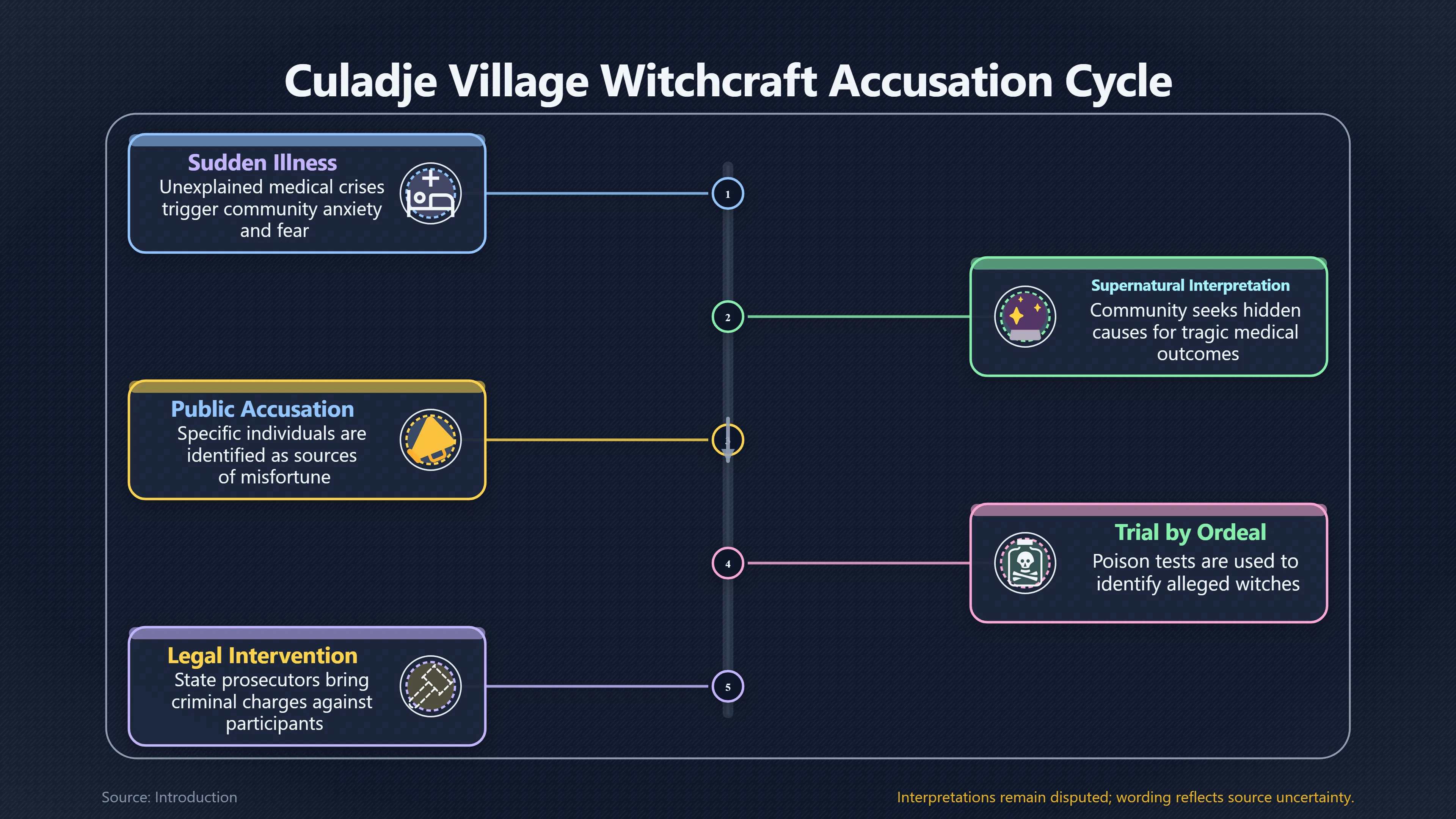
The immediate trigger for many accusations is not an argument about religion but a crisis that appears impossible to explain. A sudden death, a child becoming seriously ill, repeated family tragedies or livestock losses can create intense pressure to identify a cause.
Where diagnostic healthcare is limited or inaccessible, uncertainty can persist long after an illness begins. Rather than accepting that tragedy may have occurred through infection, chronic disease or chance, communities may look for an intentional human agent behind the suffering. Witchcraft provides an explanation that turns apparently random events into a story with a culprit.
The 2024 deaths in Culadje illustrate this mechanism. Following the unexplained illness and deaths of two young people, suspicion focused on older members of the community. Twenty-nine accused people were forced to undergo a poison ordeal intended to identify supposed witches. Eight people died from the ordeal itself rather than from any demonstrated supernatural act.[Modern Ghana]modernghana.comModern Ghana Stop Witchcraft Accusations and Trial by Ordeal in Guinea BissauModern Ghana Stop Witchcraft Accusations and Trial by Ordeal in Guinea Bissau
Psychologically, this response satisfies several powerful needs:
- it offers an explanation for otherwise frightening events;
- it identifies someone to blame;
- it creates the impression that action can restore safety;
- it reduces uncertainty, even if the explanation is unsupported by evidence.
This pattern has been documented in many societies where accusations follow illness or bereavement rather than appearing randomly.
The role of age, family conflict and local authority
Human-rights monitoring suggests that accusations are not distributed evenly across society. Older people, particularly elderly women in some communities, are especially vulnerable, although men are also accused.[ecoi.net]ecoi.netUSDOS – US Department of State (Autor): „2021 Report on International Religious Freedom: Guinea-Bissau“, Dokument #2074080 - ecoi.netJune…
Age increases vulnerability for several reasons.
Older people may already appear physically frail or socially isolated. They may be widowed, dependent on relatives or involved in inheritance disputes. Existing tensions within extended families can therefore become entangled with supernatural accusations.
In many cases, the accusation itself is not created from nothing. Instead, it builds upon:
- unresolved family disagreements;
- disputes over land or property;
- longstanding personal rivalries;
- resentment towards socially marginal relatives;
- fears surrounding ageing or unusual behaviour caused by illness.
An accusation can therefore function as a socially acceptable way of expressing conflicts that are actually about relationships, resources or authority rather than supernatural belief.
Traditional healers, diviners or respected local figures may also be asked to determine responsibility for unexplained misfortune. Their involvement can give accusations additional legitimacy within a community, especially where their authority is trusted more than distant state institutions. That does not mean traditional religious practice inevitably produces violence; many religious leaders reject harmful accusations. Rather, the danger arises when ritual authority becomes linked to identifying alleged offenders or endorsing ordeals.
Why weak health and justice systems deepen the danger
The recurrence of accusations is closely connected to institutional capacity.
When health services cannot quickly explain why someone has died, uncertainty remains. When police are distant or slow to intervene, communities may attempt to resolve suspicions themselves. When prosecutions are uncommon or delayed, people may believe customary responses carry little risk.
Researchers studying health behaviour in Guinea-Bissau have found that traditional supernatural beliefs remain widespread alongside the use of modern medicine. In one rural survey, most respondents reported believing that curses could cause death, while many had consulted traditional healers. Rather than replacing one another, biomedical and supernatural explanations often coexist.[novafrica.org]novafrica.orgNOVAFRIC A » Belief Systems and Health Behaviors in Guinea-BissauNOVAFRIC A » Belief Systems and Health Behaviors in Guinea-Bissau
This coexistence matters because people may simultaneously:
- visit a clinic;
- seek advice from traditional healers;
- consult religious figures;
- interpret unsuccessful treatment as evidence of supernatural attack.
If biomedical explanations fail to provide quick answers, supernatural interpretations may become more persuasive rather than less.
The justice system faces a similar challenge. Human Rights League Guinea-Bissau has reported dozens of accusations and multiple killings since 2019 while urging stronger government action and community education. According to reporting cited by the US Department of State, the organisation argues that insufficient legal protection contributes to the recurrence of these cases.[ecoi.net]ecoi.netUSDOS – US Department of State (Autor): „2021 Report on International Religious Freedom: Guinea-Bissau“, Dokument #2074080 - ecoi.netJune…

Why accusations spread through communities
Once suspicion begins, social dynamics often matter more than individual belief.
Several reinforcing processes can occur:
- Shared fear. As more people express suspicion, doubters become less willing to disagree publicly.
- Confirmation bias. Ordinary events become interpreted as evidence that the accused is dangerous.
- Collective pressure. Family members may fear becoming suspects themselves if they defend an accused relative.
- Public rituals. Ordeals or community investigations create the impression that invisible guilt can be objectively demonstrated.
These mechanisms help explain why accusations sometimes escalate rapidly even without new evidence.
Importantly, this is not the same as a classic episode of mass psychogenic illness. The problem is better understood as a recurring pattern of collective suspicion and persecution driven by social pressures rather than contagious physical symptoms.
Why belief alone does not explain the violence
It is tempting to assume that stronger belief automatically produces more accusations. The available evidence suggests a more complicated picture.
Belief in witchcraft is widespread across many parts of West Africa, yet violence varies considerably between communities and over time. This suggests that belief alone is insufficient to explain persecution.
Anthropological work in Guinea-Bissau describes witchcraft as part of a broader moral and social worldview in which invisible forces may explain misfortune, social tensions and broken relationships. These beliefs have deep historical roots and are embedded within diverse local traditions rather than representing a single, uniform system.[ResearchGate]researchgate.netContracts with spirits and crocodiles magically transformed: Witchcraft in Guinea-Bissau | Request PDFJanuary 1, 2013…
Whether accusations become violent depends on additional conditions, including:
- economic stress;
- recent deaths or epidemics;
- weak state intervention;
- community leadership;
- availability of peaceful dispute resolution;
- willingness of police and courts to intervene.
In other words, belief creates the possibility of accusation, but social and institutional conditions often determine whether accusations remain rumours or develop into deadly persecution.

Can the cycle be broken?
The response following the Culadje deaths demonstrated that recurrence is not inevitable. Prosecutors brought charges against people allegedly involved in the poison ordeal, signalling that the state regarded the deaths as criminal acts rather than legitimate customary justice.[Modern Ghana]modernghana.comModern Ghana Stop Witchcraft Accusations and Trial by Ordeal in Guinea BissauModern Ghana Stop Witchcraft Accusations and Trial by Ordeal in Guinea Bissau
Human-rights organisations have also promoted community education involving religious leaders, village authorities and local organisations. Their approach recognises that simply dismissing traditional beliefs is unlikely to succeed. More effective strategies aim to reduce the conditions that allow accusations to flourish by:
- improving access to healthcare and reliable diagnosis;
- strengthening confidence in formal justice;
- encouraging community mediation before rumours escalate;
- protecting elderly and socially isolated people;
- increasing public awareness that accusations can lead to preventable deaths.
The persistence of witchcraft accusations in Guinea-Bissau is therefore less a story of unchanging superstition than of recurring social pressures. Illness, grief, inequality and institutional weakness repeatedly create moments when hidden explanations become attractive. Reducing violence depends not only on changing beliefs but also on improving the health, legal and social systems that help communities respond to tragedy without searching for human scapegoats.
Amazon book picks
Further Reading
Books and field guides related to Why Witchcraft Accusations Keep Returning. Use these as the next step if you want deeper reading beyond the article.
Witchcraft, Violence, and Democracy in South Africa
Closely matches recurring witchcraft accusations and social conflict.
African Religions A Very Short Introduction
Explains indigenous belief systems often misunderstood by colonial authorities.
African Religions: A Very Short Introduction
Explains belief systems underpinning accusations.
Endnotes
1.
Source: ecoi.net
Link:https://www.ecoi.net/de/dokument/2074080.html
Source snippet
USDOS – US Department of State (Autor): „2021 Report on International Religious Freedom: Guinea-Bissau“, Dokument #2074080 - ecoi.netJune...
2.
Source: novafrica.org
Title: NOVAFRIC A » Belief Systems and Health Behaviors in Guinea-Bissau
Link:https://novafrica.org/research/belief-systems-and-health-behaviors-in-guinea-bissau-2/
3.
Source: researchgate.net
Link:https://www.researchgate.net/publication/289900655_Contracts_with_spirits_and_crocodiles_magically_transformed_Witchcraft_in_Guinea-Bissau
Source snippet
Contracts with spirits and crocodiles magically transformed: Witchcraft in Guinea-Bissau | Request PDFJanuary 1, 2013...
Published: January 1, 2013
4.
Source: ecoi.net
Link:https://www.ecoi.net/en/document/2128513.html
Source snippet
USDOS – US Department of State (Author): “2024 Country Reports on Human Rights Practices: Guinea-Bissau”, Document #2128513 - ecoi.netAug...
5.
Source: novafrica.org
Link:https://novafrica.org/research/traditional-beliefs-and-health-behaviors-evidence-from-rural-west-africa/
Source snippet
NOVAFRICA » Traditional Beliefs and Health Behaviors: Evidence from Rural West AfricaAugust 1, 2025 — TRADITIONAL BELIEFS AND HEALTH BEHA...
Published: August 1, 2025
6.
Source: ecoi.net
Link:https://www.ecoi.net/en/document/2107711.html
7.
Source: ecoi.net
Link:https://www.ecoi.net/en/document/2071200.html
8.
Source: researchgate.net
Link:https://www.researchgate.net/publication/261893393_Sorcellerie_et_contre-sorcellerie_Un_reajustement_permanent_au_monde_Les_Manjak_de_Guinee-Bissau_et_du_Senegal_Witchcraft_and_Witchcraft-hunter_A_Permanent_Readjustment_to_the_World_The_Manjak_from_Gu
9.
Source: researchgate.net
Link:https://www.researchgate.net/publication/372640836_The_Dynamics_and_Structure_of_Power_in_Feminine_Anti-Affliction_Rituals_Guinea-BissauSenegal
10.
Source: modernghana.com
Title: Modern Ghana Stop Witchcraft Accusations and Trial by Ordeal in Guinea Bissau
Link:https://www.modernghana.com/news/1294828/stop-witchcraft-accusations-and-trial-by-ordeal.html
Additional References
11.
Source: unicef.org
Link:https://www.unicef.org/guineabissau/stories/guinea-bissau-joint-un-initiative-helps-build-culture-where-women-can-demand-their-rights
Source snippet
July 24, 2025 — Article IN GUINEA-BISSAU, JOINT UN INITIATIVE HELPS BUILD A CULTURE WHERE WOMEN CAN DEMAND THEIR RIGHTS Human Rights Unit...
Published: July 24, 2025
12.
Source: youtube.com
Title: Witchcraft Accusations Are Destroying Families
Link:https://www.youtube.com/watch?v=1lI3Y_Hh8wo
Source snippet
Helen's Story: Fighting Against Harmful Witchcraft Practices in Kenya...
13.
Source: journal.privietlab.org
Link:https://journal.privietlab.org/index.php/PSSJ/article/view/443
Source snippet
after accusation: Forced internment, human rights violations, and the urgent case for criminalizing witchcraft claims in Ghana | Priviet...
14.
Source: africabib.org
Link:https://www.africabib.org/rec.php?RID=166928704
15.
Source: africabib.org
Link:https://www.africabib.org/rec.php?RID=14948187X
16.
Source: unicef.org
Link:https://www.unicef.org/guineabissau/reports/justice-practices-village
17.
Source: voaportugues.com
Link:https://www.voaportugues.com/a/pgr-da-guin%C3%A9-bissau-formaliza-acusa%C3%A7%C3%A3o-contra-23-pessoas-pela-morte-de-oito-alegados-feiticeiros/7595243.html
18.
Source: pgr.gw
Link:https://pgr.gw/procuradoria-geral-da-republica-remete-a-justica-caso-de-homicidio-duplo-na-regiao-de-cacheu/
19.
Source: abc.net.au
Link:https://www.abc.net.au/news/2024-04-13/claims-of-witchcraft-can-lead-to-murder-in-png/103682576
20.
Source: cambridge.org
Link:https://www.cambridge.org/core/journals/international-journal-of-legal-information/article/witchcraft-accusations-and-the-tort-of-defamation-in-anglophone-africa/22930E9DEDD422B529CE891441433B33
Topic Tree