Within Guatemala Panics
Why Maya Ceremonies Were Branded as Witchcraft
Colonial and modern accusations of witchcraft turned Maya religious practice into a target for surveillance, punishment and exclusion.
On this page
- How colonial authorities defined idolatry and sorcery
- How Maya ceremonies survived through adaptation and secrecy
- Why witchcraft accusations still carry political weight
Page outline Jump by section
Introduction
Maya spirituality in Guatemala has repeatedly been branded as “witchcraft” not because it closely resembled European ideas of sorcery, but because colonial and later religious authorities often interpreted Indigenous ceremonies through Christian concepts such as idolatry, devil worship and magic. That pattern has lasted for centuries. Although Maya spirituality is a living Indigenous religious tradition protected in principle by freedom of religion, practitioners have continued to report discrimination, harassment and accusations of witchcraft into the twenty-first century. In some cases, those accusations have contributed to violence, exclusion from sacred sites and attempts to suppress traditional ceremonies.[ecoi.net]ecoi.netUSDOS – US Department of State (Author): “2023 Report on International Religious Freedom: Guatemala”, Document #2111873 - ecoi.netJune 26…
Understanding these accusations is important because they reveal how religious language has been used to challenge Indigenous authority, cultural continuity and land rights. The issue is not simply one of competing beliefs. Labels such as “witchcraft” have often carried political and social consequences that extended far beyond religion itself.
How colonial authorities defined idolatry and sorcery
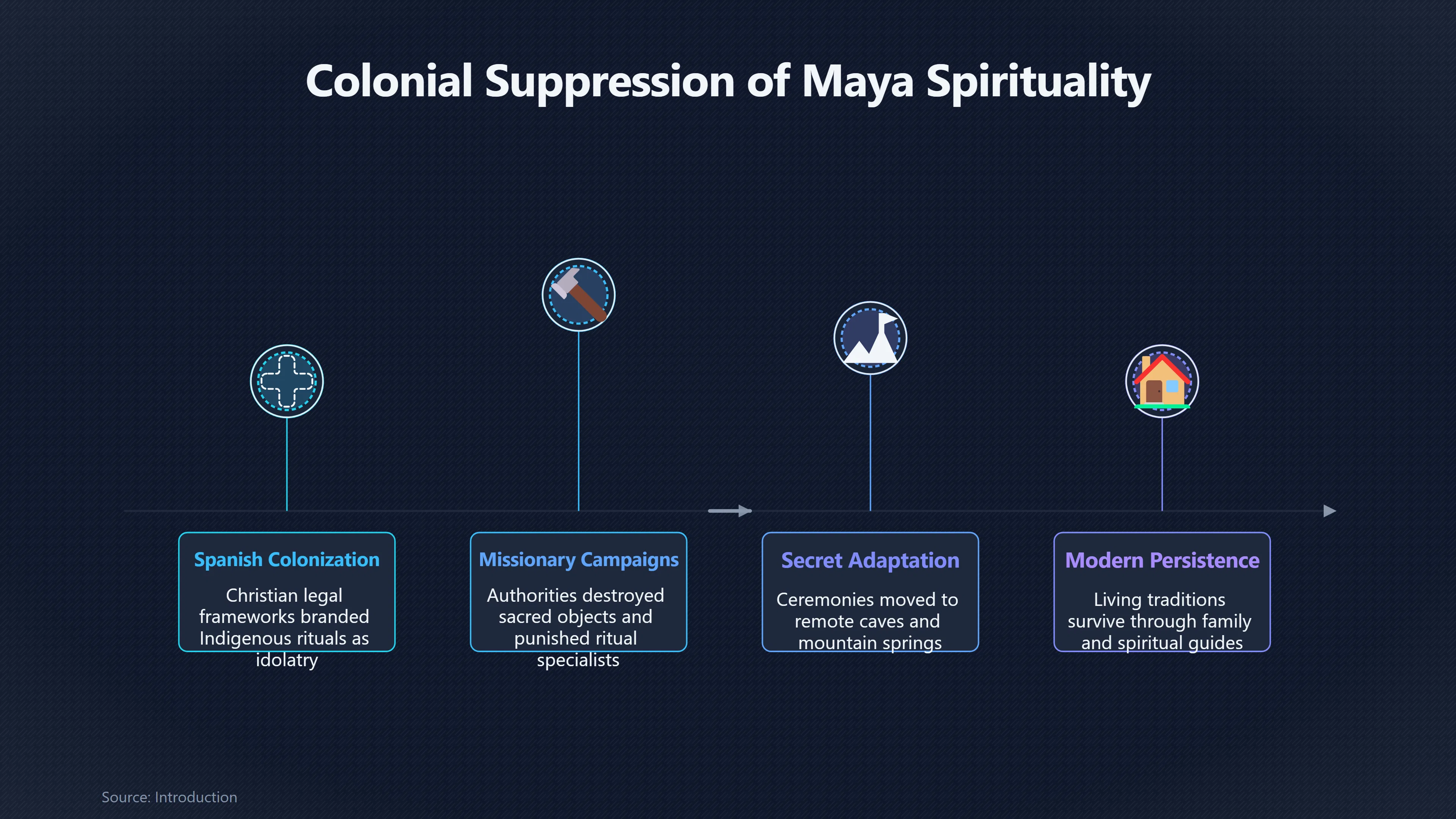
Spanish colonisation introduced a Christian legal and theological framework that treated many Indigenous religious practices as evidence of idolatry or sorcery. Missionaries sought to replace Maya ceremonial life with Catholic worship, while colonial officials regarded the continued use of sacred mountains, caves, altars and offerings as proof that conversion had failed.
Rather than recognising Maya religion as an independent spiritual tradition, colonial authorities frequently interpreted ritual specialists through familiar European categories. Ceremonial leaders could therefore be described as sorcerers or servants of the devil, even though Maya religious practices centred on maintaining relationships with ancestors, sacred places, seasonal cycles and community wellbeing rather than the concepts associated with European witchcraft.
Campaigns against “idolatry” throughout colonial Mesoamerica involved investigations, destruction of sacred objects and punishment of people suspected of preserving ancestral ceremonies. In Guatemala these policies contributed to a long tradition in which Indigenous spirituality was treated as something needing surveillance rather than protection. That colonial vocabulary continued to shape later attitudes long after formal colonial rule ended.[researchgate.net]researchgate.netResearchGate(PDF) The Repression of Maya Spiritual Practices in Guatemala: Cultural Continuity and the Challenge of Fighting Against Disc…
How Maya ceremonies survived through adaptation and secrecy
Colonial suppression did not eliminate Maya spirituality. Instead, many ceremonies adapted in ways that made them less visible while allowing essential beliefs to survive.
This adaptation took several forms:
- Ceremonies continued at remote mountains, caves and springs that remained important sacred places.
- Some rituals became intertwined with Catholic festivals and saints’ days, allowing Indigenous practices to continue under an accepted public framework.
- Knowledge was preserved through families and recognised spiritual guides rather than public institutions.
- Community leaders sometimes limited access to ceremonies in response to discrimination and misunderstanding.
The result was not the disappearance of Maya religion but its transformation. In many parts of Guatemala, Catholic and Maya practices became intertwined, while elsewhere communities maintained more clearly distinct traditions. This historical flexibility explains why many present-day ceremonies contain both ancient Indigenous and later Catholic elements without fitting neatly into either tradition.[ecoi.net]ecoi.netUSDOS – US Department of State (Autor): „2022 Report on International Religious Freedom: Guatemala“, Dokument #2091878 - ecoi.netMay 15…
Why the label “witchcraft” still carries political weight
Modern accusations of witchcraft are rarely isolated religious disagreements. They often emerge where Indigenous identity, local politics and religious competition overlap.
Annual international religious freedom reports have repeatedly documented Maya spiritual guides reporting harassment, discrimination and being described as practitioners of witchcraft. Some evangelical congregations have actively discouraged or obstructed traditional ceremonies, while some practitioners have reported derogatory signs, blocked access to sacred places and sermons portraying Maya spirituality as the work of the devil.[ecoi.net]ecoi.netUSDOS – US Department of State (Author): “2023 Report on International Religious Freedom: Guatemala”, Document #2111873 - ecoi.netJune 26…
These accusations matter because they can undermine the legitimacy of Indigenous religious authorities within their own communities. A respected ceremonial guide may simultaneously be viewed by supporters as a guardian of ancestral knowledge and by opponents as someone practising forbidden magic. The language of witchcraft therefore becomes a means of defining who possesses legitimate spiritual authority.
In some regions, however, coexistence has also developed. Researchers and religious leaders have documented communities where people attend Catholic Mass while also participating in Maya ceremonies, demonstrating that conflict is not inevitable and varies considerably across Guatemala.[ecoi.net]ecoi.netUSDOS – US Department of State (Autor): „2022 Report on International Religious Freedom: Guatemala“, Dokument #2091878 - ecoi.netMay 15…
When accusations become dangerous
The consequences of branding Maya spirituality as witchcraft can extend far beyond insults or theological disagreement.
One of the clearest recent examples was the killing of Maya spiritual guide and herbalist Domingo Choc in Petén in 2020. After being accused of using witchcraft to cause another man’s death, he was attacked and burned alive by villagers. Choc was not only a respected ceremonial leader but also collaborated with Guatemalan and international researchers documenting traditional medicinal knowledge. His killing drew widespread condemnation inside and outside Guatemala and highlighted how accusations of witchcraft can become lethal when combined with rumour, fear and longstanding prejudice.[ecoi.net]ecoi.netUSDOS – US Department of State (Author): “2020 Report on International Religious Freedom: Guatemala”, Document #2051565 - ecoi.netMay 12…
The case also demonstrated that violence cannot be explained simply as survival of ancient beliefs. Anthropologists and Indigenous organisations argued that the attack reflected a combination of local rumours, religious intolerance, racism and weak protection for Indigenous spiritual authorities rather than an unchanged pre-modern belief system.[ecoi.net]ecoi.netUSDOS – US Department of State (Author): “2020 Report on International Religious Freedom: Guatemala”, Document #2051565 - ecoi.netMay 12…
Religious freedom and continuing discrimination
Guatemalan law formally guarantees freedom of religion, and Maya spirituality has gained greater public recognition since the end of the civil war. Nevertheless, official reports continue to record practical barriers facing practitioners.
Recent documented concerns include:
- accusations that Maya ceremonies constitute witchcraft;[youtube.com]youtube.comThe Long History of "Witchcraft" Accusations Against Maya Spirituality2 When Belief Becomes Dangerous: Rumour Panics in Guatemala…
- harassment of spiritual guides;
- restrictions on access to recognised sacred sites;
- conflicts with some evangelical congregations over ceremonial practices;
- discrimination by local institutions and officials.
One reported example involved Maya spiritual practitioners who said they were denied access to a sacred site located within a public hospital before successfully challenging the decision. Other reports describe efforts by Maya organisations and evangelical representatives to establish dialogue aimed at reducing religious hostility.[ecoi.net]ecoi.netUSDOS – US Department of State (Author): “2023 Report on International Religious Freedom: Guatemala”, Document #2111873 - ecoi.netJune 26…
These developments show that attitudes are not static. Alongside continuing discrimination, there have also been attempts to improve mutual understanding and strengthen recognition of Maya religious rights.
Why historians see these accusations differently from witch panics
Historians generally distinguish accusations against Maya spirituality from classic European witch hunts.
European witch panics often focused on fears that individuals secretly harmed neighbours through supernatural means. In Guatemala, accusations against Maya ceremonies have more commonly targeted an entire Indigenous religious tradition as illegitimate or demonic. The emphasis has therefore been less on uncovering hidden conspiracies than on challenging the public legitimacy of ancestral religion.
This distinction matters because it changes how the history is interpreted. Rather than treating Maya spirituality itself as evidence of superstition, modern scholarship examines how the language of witchcraft became a tool of colonial domination, cultural exclusion and religious competition. The central historical question is not whether Maya ceremonies involved magic, but why powerful institutions repeatedly described them in those terms.[researchgate.net]researchgate.netResearchGate(PDF) The Repression of Maya Spiritual Practices in Guatemala: Cultural Continuity and the Challenge of Fighting Against Disc…
Lasting significance
The history of Maya spirituality under witchcraft accusations illustrates how religious labels can become instruments of social power. Colonial definitions of idolatry and sorcery shaped attitudes that survived well beyond the colonial period, influencing discrimination, access to sacred places and public perceptions of Indigenous identity.
Although Maya spirituality today is increasingly recognised as a living religious tradition rather than a relic of the past, accusations of witchcraft continue to appear in local conflicts and public discourse. Their persistence reminds historians that moral panics are not always sudden outbreaks of fear. Sometimes they endure across centuries, adapting to new political and religious circumstances while continuing to affect the communities they target.[ecoi.net]ecoi.netUSDOS – US Department of State (Author): “2023 Report on International Religious Freedom: Guatemala”, Document #2111873 - ecoi.netJune 26…
Amazon book picks
Further Reading
Books and field guides related to Why Maya Ceremonies Were Branded as Witchcraft. Use these as the next step if you want deeper reading beyond the article.

Breaking the Maya code
Provides deeper understanding of Maya civilisation and beliefs.

Endnotes
1.
Source: ecoi.net
Link:https://www.ecoi.net/en/document/2111873.html
Source snippet
USDOS – US Department of State (Author): “2023 Report on International Religious Freedom: Guatemala”, Document #2111873 - ecoi.netJune 26...
2.
Source: refworld.org
Link:https://www.refworld.org/reference/annualreport/usdos/2001/en/23860
Source snippet
U.S. Department of State Annual Report on International Religious Freedom for 2001 - Guatemala | Refworld...
3.
Source: refworld.org
Link:https://www.refworld.org/reference/annualreport/usdos/2004/en/35918
Source snippet
U.S. Department of State Annual Report on International Religious Freedom for 2004 - Guatemala | Refworld...
4.
Source: researchgate.net
Link:https://www.researchgate.net/publication/395836098_The_Repression_of_Maya_Spiritual_Practices_in_Guatemala_Cultural_Continuity_and_the_Challenge_of_Fighting_Against_Discrimination_and_Racism
Source snippet
ResearchGate(PDF) The Repression of Maya Spiritual Practices in Guatemala: Cultural Continuity and the Challenge of Fighting Against Disc...
5.
Source: ecoi.net
Link:https://www.ecoi.net/de/dokument/2091878.html
Source snippet
USDOS – US Department of State (Autor): „2022 Report on International Religious Freedom: Guatemala“, Dokument #2091878 - ecoi.netMay 15...
6.
Source: ecoi.net
Link:https://www.ecoi.net/en/document/2051565.html
Source snippet
USDOS – US Department of State (Author): “2020 Report on International Religious Freedom: Guatemala”, Document #2051565 - ecoi.netMay 12...
7.
Source: researchgate.net
Link:https://www.researchgate.net/publication/395836816_La_represion_de_las_practicas_espirituales_mayas_en_Guatemala_Continuidad_cultural_y_el_reto_de_combatir_contra_la_discriminacion_y_el_racismo
8.
Source: ecoi.net
Link:https://www.ecoi.net/de/dokument/2073979.html
Source snippet
STATUS OF SOCIETAL RESPECT FOR RELIGIOUS FREEDOM According to reports from nongovernmental organizations, on January 4, unidentified assa...
9.
Source: ecoi.net
Link:https://www.ecoi.net/en/document/1436927.html
10.
Source: refworld.org
Link:https://www.refworld.org/reference/annualreport/usdos/2005/en/34795
11.
Source: refworld.org
Link:https://www.refworld.org/reference/annualreport/usdos/2003/34497
Additional References
12.
Source: pureportal.coventry.ac.uk
Title: coventry.ac.uk Spanish-American Studies: The Colonial Period
Link:https://pureportal.coventry.ac.uk/en/publications/spanish-american-studies-the-colonial-period/
Source snippet
coventry.ac.ukSpanish-American Studies: The Colonial Period - Coventry UniversityApril 12, 2023 — SPANISH-AMERICAN STUDIES: THE COLONIAL...
Published: April 12, 2023
13.
Source: youtube.com
Title: The Long History of “Witchcraft” Accusations Against Maya Spirituality
Link:https://www.youtube.com/watch?v=DHRF-gGdOW0
Source snippet
2 When Belief Becomes Dangerous: Rumour Panics in Guatemala...
14.
Source: youtube.com
Title: State Terror as Panic: How Guatemala Defined the “[Hidden Enemy]({{ ‘hidden-enemy/’ | relative_url }})”
Link:https://www.youtube.com/watch?v=Ddpmo8eXmJc
Source snippet
4 The Child-[Organ Theft Rumours]({{ 'organ-rumours/' | relative_url }}): Anatomy of a Guatemala Panic...
15.
Source: youtube.com
Title: The Child-Organ Theft Rumours: Anatomy of a Guatemala Panic
Link:https://www.youtube.com/watch?v=2t4aNCH7Ueo
Source snippet
5 The Maya Apocalypse of 2012: A Case Study in Global Media Panics...
16.
Source: youtube.com
Title: When Belief Becomes Dangerous: Rumour Panics in Guatemala
Link:https://www.youtube.com/watch?v=COaqUY2IAHg
Source snippet
3 State Terror as Panic: How Guatemala Defined the "Hidden Enemy"...
17.
Source: theguardian.com
Link:https://www.theguardian.com/global-development/2021/oct/25/guatemala-mayan-spirituality-herbalist-murder-domingo-choc-che
18.
Source: scielo.org.mx
Link:https://www.scielo.org.mx/scielo.php?pid=S1870-57662005000100006&script=sci_arttext
19.
Source: cambridge.org
Link:https://www.cambridge.org/core/journals/ancient-mesoamerica/article/abs/souls-of-the-ancestors-postclassic-maya-architecture-incensarios-and-mana/9AFA16217930B767990FE0E609D34D59
20.
Source: revistaschilenas.uchile.cl
Link:https://revistaschilenas.uchile.cl/handle/2250/244185
21.
Source: fh.mdp.edu.ar
Link:https://fh.mdp.edu.ar/revistas/index.php/pasadoabierto/article/view/6844/7758
Topic Tree