Within Guyana
How Colonial Guyana Turned Obeah Into Crime
Colonial authorities used the label obeah to police diverse spiritual practices as fraud, witchcraft or threats to public order.
On this page
- What colonial officials called obeah
- Why spiritual practice became a public order issue
- How hostile labels shaped later memory
Page outline Jump by section
Introduction
In colonial Guyana, the crime known as “obeah” was never a precise description of a single religion or set of beliefs. Instead, colonial governments used the label to group together a wide range of African-derived healing, protection and spiritual practices, treating them as witchcraft, fraud or threats to public order. The resulting laws reflected colonial fears as much as they reflected local spiritual life. Officials believed that spiritual specialists could encourage resistance, undermine plantation discipline or deceive vulnerable people, so they criminalised practices that were often central to community life. Modern historians argue that these laws reveal less about what practitioners actually believed than about how colonial authorities sought to control enslaved and later free Afro-Caribbean populations.[ed.ac.uk]research.ed.ac.ukinburgh ResearchObeah acts: Producing and policing the boundaries of religion in the Caribbean - University of Edinburgh Research Explorer…
What colonial officials called obeah
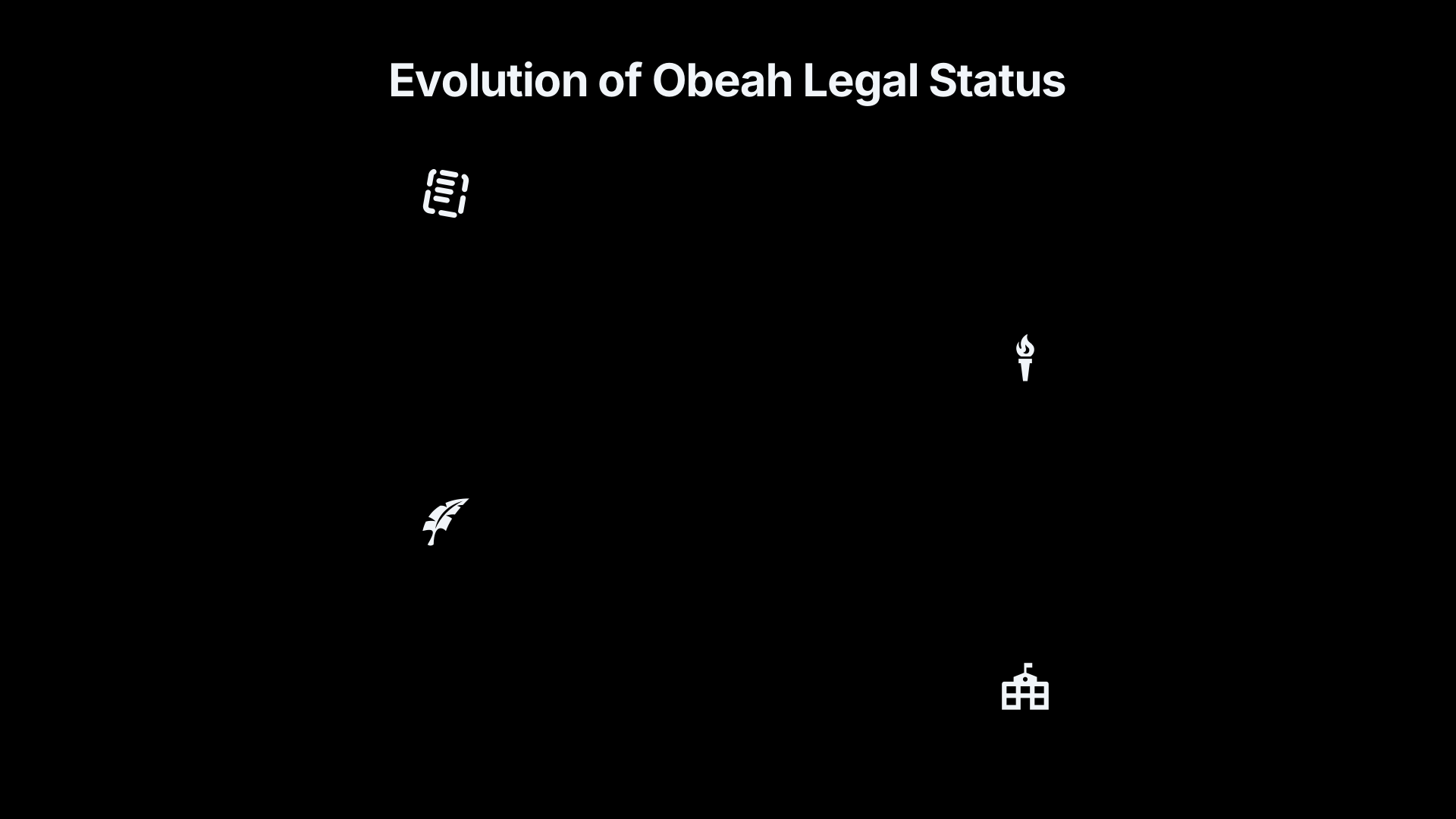
One of the greatest difficulties in understanding colonial Guyana is that “obeah” was largely a legal and administrative category rather than a clearly defined religious tradition. British officials applied the term to an assortment of practices that included healing, herbal medicine, divination, protective rituals, spiritual counselling and other forms of African-derived religious knowledge. Different practitioners often had little in common beyond the fact that colonial authorities regarded them with suspicion.[Edinburgh Research]research.ed.ac.ukinburgh ResearchObeah acts: Producing and policing the boundaries of religion in the Caribbean - University of Edinburgh Research Explorer…
Rather than attempting to distinguish between beneficial healing, religious ceremony and harmful magic, colonial legislation merged them into a single offence. The legal language frequently described obeah as involving “pretended supernatural powers”, fraud or deception. This wording reflected British legal traditions that no longer recognised witchcraft as literally real but still criminalised those who claimed supernatural abilities for financial gain or social influence. In practice, however, these laws affected genuine religious and cultural traditions rather than merely fraudulent schemes.[Cambridge University Press & Assessment]cambridge.orgCambridge University Press & AssessmentOBEAH, VAGRANCY, AND THE BOUNDARIES OF RELIGIOUS FREEDOM: ANALYZING THE PROSCRIPTION OF “PRETENDIN…
Why spiritual practice became a public-order issue
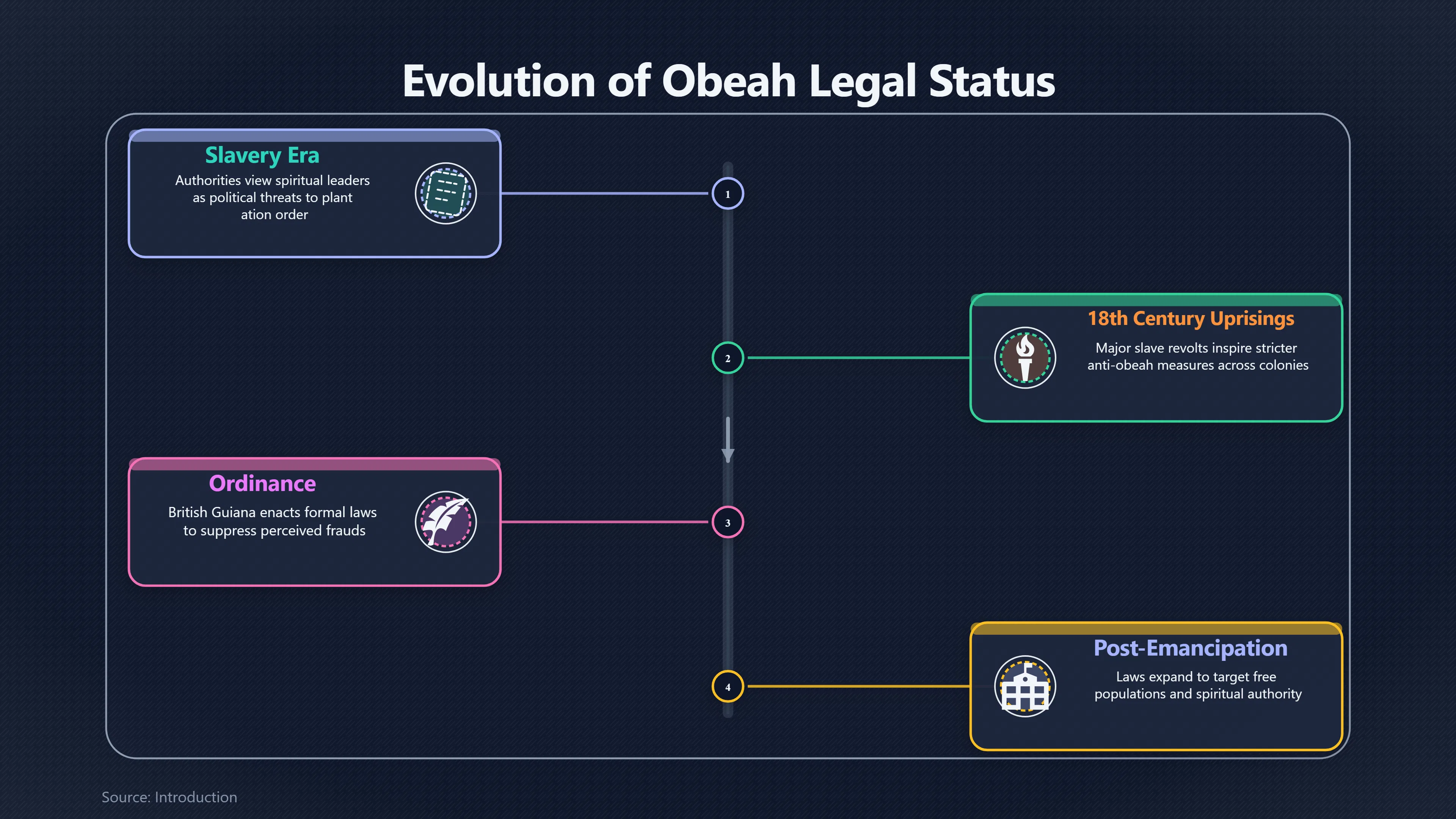
The criminalisation of obeah in British Guiana cannot be understood apart from slavery and plantation society. Plantation owners feared that respected spiritual practitioners could strengthen solidarity among enslaved people, inspire resistance or undermine colonial authority. Because spiritual leaders often held considerable influence within enslaved communities, officials regarded them as political as well as religious figures.[Chicago Journals]journals.uchicago.eduChicago JournalsPowers of Imagination and Legal Regimes against “Obeah” in the Late Eighteenth- and Early Nineteenth-Century British Cari…
Colonial fears intensified after major slave uprisings elsewhere in the British Caribbean, particularly in Jamaica during the eighteenth century, where officials believed spiritual specialists had helped organise resistance. Although British Guiana had its own distinct history, lawmakers borrowed legal ideas from elsewhere in the empire, spreading similar anti-obeah measures across multiple colonies. The concern was therefore not simply about alleged supernatural practices but about maintaining social control over enslaved and recently emancipated populations.[obeahhistories.org]obeahhistories.orgObeah Histories Legislation | Obeah HistoriesObeah HistoriesLegislation | Obeah HistoriesSeptember 18, 2012…
Following emancipation, these concerns did not disappear. Instead, governments revised or expanded anti-obeah legislation so that it applied to free people as well as formerly enslaved populations. Colonial officials increasingly justified these laws by presenting obeah as fraud, arguing that practitioners exploited fear or superstition rather than recognising their activities as legitimate religious practice.[cambridge.org]cambridge.orgCambridge University Press & AssessmentOBEAH, VAGRANCY, AND THE BOUNDARIES OF RELIGIOUS FREEDOM: ANALYZING THE PROSCRIPTION OF “PRETENDIN…
British Guiana’s Obeah laws
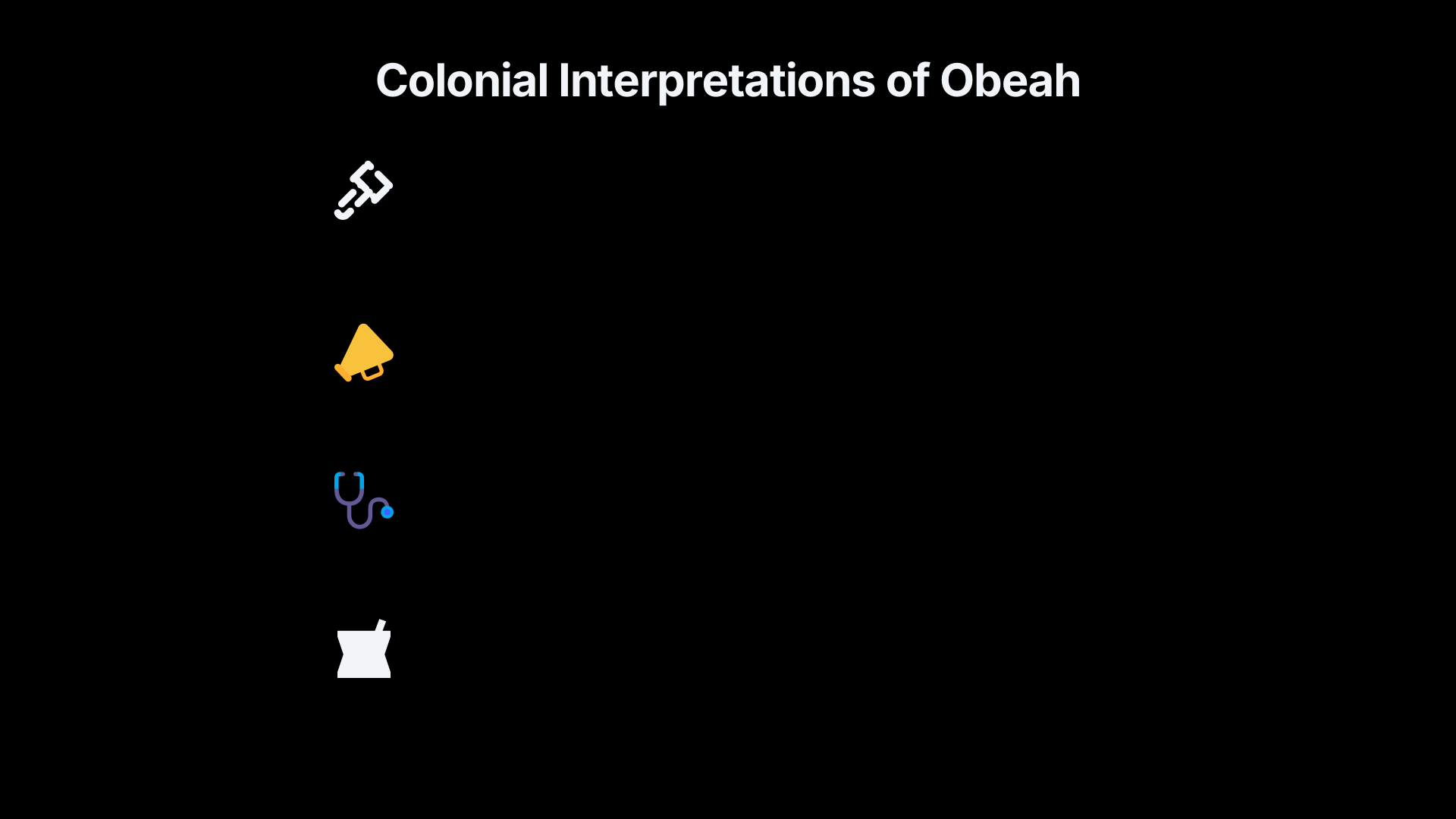
British Guiana enacted one of the Caribbean’s better-known post-emancipation anti-obeah statutes through the Obeah Ordinance of 1855. Its preamble declared that the practice of obeah had increased throughout the colony and that existing penalties were inadequate to suppress it and the “frauds connected therewith.” This wording is revealing. Rather than attempting to prove that supernatural powers existed, legislators framed the offence around claims to supernatural ability and the perceived danger these claims posed to colonial order.[Cambridge University Press & Assessment]cambridge.orgCambridge University Press & AssessmentOBEAH, VAGRANCY, AND THE BOUNDARIES OF RELIGIOUS FREEDOM: ANALYZING THE PROSCRIPTION OF “PRETENDIN…
The ordinance gave authorities broad discretion to prosecute alleged practitioners. Because the legal definition remained vague, activities ranging from healing rituals to possession of ritual objects could attract suspicion. Such flexibility made the law a powerful policing tool. Historians have argued that this vagueness was deliberate, allowing officials to intervene wherever they believed African-derived spiritual authority challenged colonial governance.[Edinburgh Research]research.ed.ac.ukinburgh ResearchObeah acts: Producing and policing the boundaries of religion in the Caribbean - University of Edinburgh Research Explorer…
The legislation also reflected a wider imperial pattern. Across the British Caribbean, anti-obeah laws often borrowed language from English laws against vagrancy, fortune telling and fraudulent claims of supernatural powers. This legal inheritance helped transform complex religious practices into criminal offences without recognising them as religions deserving legal protection.[Cambridge University Press & Assessment]cambridge.orgCambridge University Press & AssessmentOBEAH, VAGRANCY, AND THE BOUNDARIES OF RELIGIOUS FREEDOM: ANALYZING THE PROSCRIPTION OF “PRETENDIN…
Witchcraft fears without European-style witch trials
Colonial Guyana did not experience witch trials comparable to those seen in early modern Europe. British officials generally rejected the literal existence of witchcraft in law. Instead, they prosecuted people for claiming supernatural powers, practising obeah or allegedly deceiving others through magical claims. This distinction is important because colonial authorities simultaneously dismissed supernatural powers as impossible while treating belief in them as socially dangerous.[Cambridge University Press & Assessment]cambridge.orgCambridge University Press & AssessmentWitchcraft and British Colonial Law | Africa | Cambridge Core…
This apparent contradiction shaped colonial policy. Officials argued that belief in obeah encouraged fear, disturbed labour discipline and promoted disorder. Medical theories of the eighteenth and nineteenth centuries also influenced these attitudes. Some colonial writers suggested that fear of obeah could itself produce illness or even death through the power of imagination, allowing authorities to explain reported harms without accepting supernatural explanations.[Chicago Journals]journals.uchicago.eduChicago JournalsPowers of Imagination and Legal Regimes against “Obeah” in the Late Eighteenth- and Early Nineteenth-Century British Cari…
How hostile labels shaped later memory
The colonial legal construction of obeah has had lasting effects on public understanding in Guyana and across the Caribbean. By consistently describing African-derived spiritual practices as superstition, fraud or witchcraft, official institutions created stereotypes that survived long after the end of colonial rule. Many later discussions inherited these assumptions without recognising that the definition itself had been created by colonial governments.[Edinburgh Research]research.ed.ac.ukinburgh ResearchObeah acts: Producing and policing the boundaries of religion in the Caribbean - University of Edinburgh Research Explorer…
Modern historians argue that the legal category isolated those aspects of Afro-Caribbean spirituality that colonial authorities considered irrational or dangerous while separating them from practices more readily accepted as “religion”. As a result, obeah remained unusually difficult to defend under emerging ideas of religious freedom, unlike some other Caribbean religious movements whose followers successfully campaigned against discriminatory laws.[Edinburgh Research]research.ed.ac.ukinburgh ResearchObeah acts: Producing and policing the boundaries of religion in the Caribbean - University of Edinburgh Research Explorer…
This legacy also affects historical memory. Contemporary references to obeah may describe very different practices, beliefs or traditions, many of which would not have been recognised as belonging to a single system by the communities themselves. Historians therefore increasingly treat “obeah” as a colonial category that requires careful interpretation rather than as a straightforward description of one religion.[Edinburgh Research]research.ed.ac.ukinburgh ResearchObeah acts: Producing and policing the boundaries of religion in the Caribbean - University of Edinburgh Research Explorer…
Why these laws matter today
The history of anti-obeah legislation illustrates how colonial governments transformed cultural difference into a public-order problem. Instead of recognising African-derived spiritual traditions as legitimate expressions of religion or healing, authorities framed them as criminal behaviour associated with deception, disorder and fear. That approach helped justify wider systems of racial control during slavery and after emancipation.[ed.ac.uk]research.ed.ac.ukinburgh ResearchObeah acts: Producing and policing the boundaries of religion in the Caribbean - University of Edinburgh Research Explorer…
Within the wider history of collective fears in Guyana, anti-obeah laws represent a form of official moral panic rather than evidence that widespread witchcraft was being objectively documented. The enduring significance of these laws lies not in proving the existence of supernatural powers but in showing how colonial fears, legal language and unequal power combined to stigmatise cultural practices whose meanings were far more varied than the law allowed.[ed.ac.uk]research.ed.ac.ukinburgh ResearchObeah acts: Producing and policing the boundaries of religion in the Caribbean - University of Edinburgh Research Explorer…
Amazon book picks
Further Reading
Books and field guides related to How Colonial Guyana Turned Obeah Into Crime. Use these as the next step if you want deeper reading beyond the article.
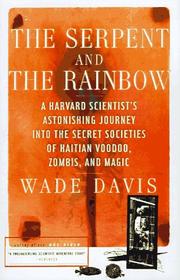
The Serpent and the Rainbow
Introduces Afro-Caribbean spiritual traditions often linked with obeah.

The Road to Jonestown: Jim Jones and Peoples Temple
Supports the wider Guyana topic where stronger commercial books are limited.
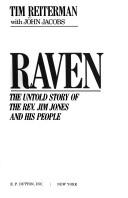
Raven: The Untold Story of the Rev. Jim Jones and His People
Broadens reading on fear and belief in Guyana.
Mama Lola: A Vodou Priestess in Brooklyn
Provides context for African-derived Caribbean religions.
Endnotes
1.
Source: cambridge.org
Link:https://www.cambridge.org/core/journals/journal-of-law-and-religion/article/abs/obeah-vagrancy-and-the-boundaries-of-religious-freedom-analyzing-the-proscription-of-pretending-to-possess-supernatural-powers-in-the-anglophone-caribbean/11EEE1AD5948F72F423FE174FFE61F87
Source snippet
Cambridge University Press & AssessmentOBEAH, VAGRANCY, AND THE BOUNDARIES OF RELIGIOUS FREEDOM: ANALYZING THE PROSCRIPTION OF “PRETENDIN...
2.
Source: cambridge.org
Link:https://www.cambridge.org/core/journals/africa/article/abs/witchcraft-and-british-colonial-law/18C65EF64367A657D70D626DA53B544C
Source snippet
Cambridge University Press & AssessmentWitchcraft and British Colonial Law | Africa | Cambridge Core...
3.
Source: Wikipedia
Link:https://en.wikipedia.org/wiki/Obeah
4.
Source: youtube.com
Title: Obeah, Mermaids and Magic
Link:https://www.youtube.com/watch?v=LDFpJCngdrc
5.
Source: youtube.com
Link:https://www.youtube.com/watch?v=s_z2gjMlEv4
Source snippet
Should Obeah be Criminalized in Jamaica or Not? | TVJ All Angles...
6.
Source: research.ed.ac.uk
Link:https://www.research.ed.ac.uk/en/publications/obeah-acts-producing-and-policing-the-boundaries-of-religion-in-t/
Source snippet
inburgh ResearchObeah acts: Producing and policing the boundaries of religion in the Caribbean - University of Edinburgh Research Explorer...
7.
Source: journals.uchicago.edu
Link:https://www.journals.uchicago.edu/doi/abs/10.1086/713926
Source snippet
Chicago JournalsPowers of Imagination and Legal Regimes against “Obeah” in the Late Eighteenth- and Early Nineteenth-Century British Cari...
8.
Source: obeahhistories.org
Title: Obeah Histories Legislation | Obeah Histories
Link:https://obeahhistories.org/law/
Source snippet
Obeah HistoriesLegislation | Obeah HistoriesSeptember 18, 2012...
Published: September 18, 2012
9.
Source: obeahhistories.org
Title: trinidad 1868
Link:https://obeahhistories.org/trinidad-1868/
10.
Source: obeahhistories.org
Title: Timeline | Obeah Histories
Link:https://obeahhistories.org/about/
11.
Source: research.ed.ac.uk
Title: ed.ac.uk Witchcraft, poison, law and Atlantic slavery
Link:https://www.research.ed.ac.uk/en/publications/witchcraft-poison-law-and-atlantic-slavery/
12.
Source: obeahhistories.org
Link:https://obeahhistories.org/
13.
Source: nationalarchives.gov.uk
Title: British Guiana
Link:https://www.nationalarchives.gov.uk/south-america/british-guiana/
14.
Source: obeahhistories.org
Title: 1904 leeward islands act
Link:https://obeahhistories.org/1904-leeward-islands-act/
Additional References
15.
Source: scholarship.miami.edu
Title: Powers of Imagination and Legal Regimes
Link:https://scholarship.miami.edu/esploro/outputs/journalArticle/Powers-of-Imagination-and-Legal-Regimes/991031660538402976
Source snippet
of Imagination and Legal Regimes against “Obeah” in the Late Eighteenth- and Early Nineteenth-Century British Caribbean - University of M...
16.
Source: nationalarchives.gov.gy
Title: Other Collections
Link:https://nationalarchives.gov.gy/other-collections/
Source snippet
National Archives of GuyanaFebruary 3, 2025 — OTHER COLLECTIONS The collection of the National Archives of Guyana is fairly extensive wit...
Published: February 3, 2025
17.
Source: academic.oup.com
Link:https://academic.oup.com/jsh/article/55/2/345/6270977
Source snippet
of Molly Schultz: Race, Magic, and the Law in the Post-slavery Caribbean | Journal of Social History | Oxford AcademicMay 6, 2021 — Journ...
Published: May 6, 2021
18.
Source: tandfonline.com
Link:https://www.tandfonline.com/doi/full/10.1080/02757200500116139
19.
Source: openlibrary.org
Link:https://openlibrary.org/books/OL20471008M/The_Magisterial_Law_of_British_Guiana_The_Ordinance_Law_with_Notes_and_
20.
Source: pure.roehampton.ac.uk
Link:https://pure.roehampton.ac.uk/portal/en/publications/interning-the-serpent-witchcraft-religion-and-the-law-on-montserr/
21.
Source: parliament.gov.gy
Link:https://www.parliament.gov.gy/publications/subsidiary-legislation/regulations/P790/P940
22.
Source: historyworkshop.org.uk
Title: The Racist History of Jamaica’s Obeah Laws | History Workshop
Link:https://www.historyworkshop.org.uk/empire-decolonisation/the-racist-history-of-jamaicas-obeah-laws/
23.
Source: scholarship.miami.edu
Title: Witchcraft Witchdoctors and Empire The Proscription
Link:https://scholarship.miami.edu/esploro/outputs/doctoral/Witchcraft-Witchdoctors-and-Empire-The-Proscription/991031447808402976
24.
Source: proquest.com
Title: OBEA H, VAGRANCY, AND THE BOUNDARIES OF RELIGIOUS
Link:https://www.proquest.com/scholarly-journals/obeah-vagrancy-boundaries-religious-freedom/docview/2023917356/se-2
Topic Tree