Within Zambia's Hidden Fears
Was the Lumpa Conflict Really an Uprising?
Alice Lenshina's fast-growing church collided with nationalist mobilisation, local rivalry and an overwhelming military response before independence.
On this page
- Alice Lenshina and the rise of Lumpa
- Why Lumpa and UNIP became rivals
- Deaths, exile and the struggle over national memory
Page outline Jump by section
Introduction
The conflict surrounding the Lumpa Church in 1964 remains the deadliest confrontation between an African-initiated Christian movement, nationalist activists and the emerging Zambian state. It is often described as the “Lumpa uprising”, but that label is itself disputed. Many historians argue that the violence cannot be understood simply as a rebellion against government. Instead, it grew out of an increasingly bitter struggle between Alice Lenshina’s fast-growing religious movement and the United National Independence Party (UNIP), with local rivalries, competing claims to authority and a rapidly changing political landscape all feeding the crisis. The result was a military campaign that killed hundreds—and probably more than a thousand—people, forced thousands to flee into the Congo, and left a lasting wound in Zambia’s national memory.[saipar.org]saipar.orgOne Zambia, many historiesFebruary 19, 2026…
Was the Lumpa Conflict Really an Uprising?
Whether the events of 1964 should be called an “uprising” has become one of the central historical debates surrounding the Lumpa Church. Official accounts produced after the conflict portrayed it as a rebellion that required military suppression. Later scholarship has questioned this framing, arguing that the term risks implying a coordinated attempt to overthrow the state when the evidence suggests a far more complex and localised conflict.[saipar.org]saipar.orgOne Zambia, many historiesFebruary 19, 2026…
Several features distinguish the Lumpa conflict from a conventional armed revolt:
- The church did not begin as a political organisation seeking state power.
- Violence developed through escalating clashes between Lumpa communities and UNIP supporters rather than through a centrally planned military campaign.
- Colonial security forces and the incoming nationalist government interpreted separate local confrontations as part of a single security emergency.
- The military response vastly exceeded the scale of the church’s own armed capacity.[saipar.org]saipar.orgOne Zambia, many historiesFebruary 19, 2026…
This does not mean Lumpa members were entirely passive. Some followers established fortified settlements, resisted government demands to dismantle them, and fought back against attacks from political opponents and security forces. Nevertheless, historians increasingly describe the catastrophe as an interaction between religious separatism, local political violence and state coercion rather than as a straightforward insurrection.[saipar.org]saipar.orgOne Zambia, many historiesFebruary 19, 2026…
Alice Lenshina and the Rise of Lumpa
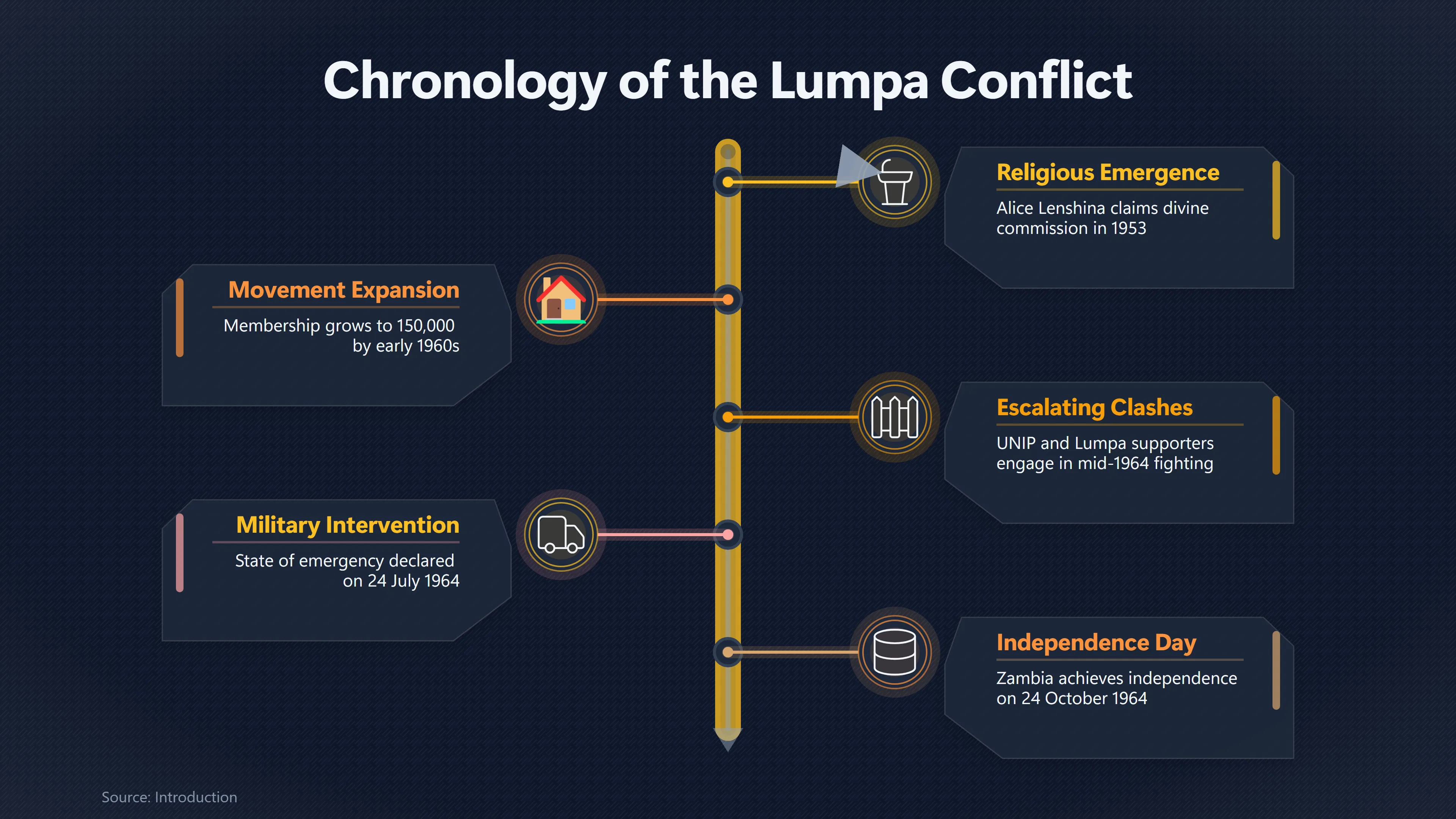
Alice Mulenga Lubusha, better known as Alice Lenshina, emerged as a religious leader after reporting a near-death experience during illness in 1953. She claimed to have received a divine commission from Christ and began preaching repentance, baptism and moral reform. Her movement quickly spread through northern and eastern Northern Rhodesia, attracting tens of thousands of followers within only a few years. Estimates of membership vary widely, with many scholars placing it somewhere between 60,000 and 150,000 by the early 1960s.[encyclopedia.com]encyclopedia.comLumpa Church | Encyclopedia.comLumpa Church | Encyclopedia.com
The church’s appeal rested on several features that distinguished it from missionary Christianity.
It condemned witchcraft, alcohol, polygamy and many traditional practices while simultaneously embracing African forms of religious leadership. Lenshina herself exercised extraordinary spiritual authority at a time when European mission churches rarely allowed women such prominence. The movement also developed its own sacred centre at Zion near Kasomo, strengthening a sense of religious identity that existed alongside, rather than within, established churches.[Encyclopedia.com]encyclopedia.comLumpa Church | Encyclopedia.comLumpa Church | Encyclopedia.com
For many followers, Lumpa represented spiritual renewal rather than political revolution. The movement offered healing, discipline, community and an alternative moral order during a period of rapid social change.
Why Lumpa and UNIP Became Rivals
The collision between Lumpa and UNIP was not inevitable, but several developments steadily increased tensions.
The first was competition for loyalty. As independence approached, UNIP expected broad public participation in nationalist politics. Lumpa increasingly demanded that its members remain separate from party activity, regarding earthly politics as spiritually corrupt. Some accounts describe politics itself as a form of worldly contamination or “witchcraft”, making political neutrality a religious obligation rather than simple indifference.[Wikipedia]WikipediaLumpa ChurchLumpa Church
The second was competing authority.
Lumpa communities often resolved disputes internally rather than through government structures. Members increasingly formed separate villages, reinforcing the impression that the church was creating an alternative social order beyond state control. While historians caution against exaggerating this autonomy, it alarmed both colonial officials and nationalist leaders.[encyclopedia.com]encyclopedia.comLumpa Church | Encyclopedia.comLumpa Church | Encyclopedia.com
Finally, local political rivalry intensified violence.
Many clashes were driven by neighbours who already knew one another rather than anonymous national forces. Churches were burned, assaults multiplied and cycles of retaliation developed well before the army intervened. The approaching independence of Zambia heightened fears that political neutrality might undermine national unity, while Lumpa members increasingly believed they were under organised attack.[saipar.org]saipar.orgOne Zambia, many historiesFebruary 19, 2026…

How the Violence Escalated in 1964
During mid-1964, repeated confrontations between UNIP supporters and Lumpa adherents escalated into armed conflict.
Attempts at negotiation failed. Kenneth Kaunda met Lenshina in efforts to reduce tensions, but violence continued. Government ultimatums demanding that Lumpa members abandon fortified settlements and surrender weapons were not fully complied with, while further clashes deepened mistrust on all sides.[Wikipedia]WikipediaLumpa ChurchLumpa Church
On 24 July 1964 major fighting broke out. The government declared a state of emergency and deployed military forces. Operations continued through the weeks immediately before Zambia achieved independence on 24 October 1964.[Urban Development Ministry]muc.gov.zmUrban Development Ministry Tourism – Muchinga Province Provincial AdministrationUrban Development Ministry Tourism – Muchinga Province Provincial Administration
The humanitarian consequences were severe.
Official inquiries recorded 707 people killed during security operations, but that figure excluded many categories of deaths, including people killed earlier in political clashes, those who died while fleeing, and victims whose deaths were never formally recorded. Many historians therefore conclude that the true death toll exceeded one thousand. Around 15,000 followers fled across the border into the Congo, creating one of the largest refugee movements associated with Zambia’s independence period.[saipar.org]saipar.orgOne Zambia, many historiesFebruary 19, 2026…
Deaths, Exile and the Struggle Over National Memory
Lumpa Church(#endnote-4 “Endnote 4”) urch was formally banned in August 1964.[encyclopedia.com]encyclopedia.comLumpa Church | Encyclopedia.comLumpa Church | Encyclopedia.com
Lenshina surrendered shortly afterwards and spent much of the remainder of her life in detention or under house arrest without ever standing trial. Her husband was detained alongside her, and she died in 1978 after years of restrictions on her movement.[muc.gov.zm]muc.gov.zmUrban Development Ministry Tourism – Muchinga Province Provincial AdministrationUrban Development Ministry Tourism – Muchinga Province Provincial Administration
Although the organisation was outlawed, the movement did not disappear. Scholars and religious historians note that Lumpa communities survived underground and continued practising their faith despite official suppression.[African Christian Biography]dacb.orgAfrican Christian BiographyLenshina Mulenga Mubisha, Alice (A) - Dictionary of African Christian Biography…
The memory of the conflict remains contested.
Some narratives emphasise the responsibility of Lumpa leaders for creating isolated communities and resisting government authority. Others argue that nationalist militants and the state escalated what began as local political violence into a humanitarian catastrophe. Recent historical work has increasingly examined how official narratives privileged the language of “rebellion” while downplaying violence carried out by party supporters and the disproportionate scale of military repression.[saipar.org]saipar.orgOne Zambia, many historiesFebruary 19, 2026…
Why the Lumpa Conflict Still Matters
The Lumpa catastrophe occupies a distinctive place in Zambia’s history because it sits at the intersection of religion, nationalism and collective fear.
It demonstrates how rapidly religious difference can become politicised when competing movements seek authority over the same communities. The conflict also illustrates the danger of reducing complex social disputes to simple labels such as “cult”, “fanaticism” or “rebellion”. Those labels were often employed by opponents and officials, yet they can obscure the mixture of sincere religious belief, local rivalry, political mobilisation and state violence that produced the tragedy.[encyclopedia.com]encyclopedia.comLenshina, Alice | Encyclopedia.comLenshina, Alice | Encyclopedia.com
For historians of collective belief, the Lumpa conflict is therefore less an example of mass hysteria than a case study in how rapidly fear, suspicion and competing claims to legitimacy can transform religious disagreement into large-scale violence. It remains an essential episode for understanding the tensions that accompanied Zambia’s transition to independence and the continuing debate over how states should respond when powerful religious movements stand outside mainstream political structures.[saipar.org]saipar.orgOne Zambia, many historiesFebruary 19, 2026…

Endnotes
1.
Source: saipar.org
Title: One Zambia, many histories
Link:https://saipar.org/assets/files/One-Zambia.pdf
Source snippet
February 19, 2026...
Published: February 19, 2026
2.
Source: africabib.org
Title: Africa Bib | The Lumpa uprising: why?
Link:https://www.africabib.org/rec.php?DB=p&RID=189172304
Source snippet
AfricaBib | The Lumpa uprising: why?...
3.
Source: encyclopedia.com
Title: Lenshina, Alice | Encyclopedia.com
Link:https://www.encyclopedia.com/environment/encyclopedias-almanacs-transcripts-and-maps/lenshina-alice
4.
Source: encyclopedia.com
Title: Lumpa Church | Encyclopedia.com
Link:https://www.encyclopedia.com/religion/dictionaries-thesauruses-pictures-and-press-releases/lumpa-church
5.
Source: Wikipedia
Title: Lumpa Church
Link:https://en.wikipedia.org/wiki/Lumpa_Church
6.
Source: Wikipedia
Title: Alice Lenshina
Link:https://en.wikipedia.org/wiki/Alice_Lenshina
7.
Source: africabib.org
Link:https://www.africabib.org/rec.php?RID=183280652
8.
Source: africabib.org
Link:https://www.africabib.org/rec.php?RID=313037213
9.
Source: africabib.org
Link:https://africabib.org/query_p.php?su=%21294922989%21
10.
Source: africabib.org
Title: Africa Bib | The Lumpa uprising: why?
Link:https://www.africabib.org/rec.php?RID=189172304
11.
Source: africabib.org
Title: Africa Bib | The Lenshina Movement of Northern Rhodesia
Link:https://www.africabib.org/rec.php?RID=189172347
12.
Source: dacb.org
Link:https://dacb.org/stories/zambia/lenshina-alice/
Source snippet
African Christian BiographyLenshina Mulenga Mubisha, Alice (A) - Dictionary of African Christian Biography...
13.
Source: muc.gov.zm
Title: Urban Development Ministry Tourism – Muchinga Province Provincial Administration
Link:https://www.muc.gov.zm/?page_id=1877
14.
Source: dacb.org
Title: Lenshina Mulenga Mubisha, Alice (C)
Link:https://dacb.org/stories/zambia/lenshina2-alice/
Source snippet
In 1953 Alice Lenshina-as she was popularly known-claimed to have died and had a vision of Jesus...
15.
Source: chalochatu.org
Title: Alice Lenshina
Link:https://chalochatu.org/Alice_Lenshina
Source snippet
Lenshina became very ill with cerebral malaria in September 1953 and fell into a deep coma. According to...
Published: September 1953
17.
Source: youtube.com
Link:https://www.youtube.com/watch?v=thP7_DnJgfs
Source snippet
The Alice Lenshina's Lumpa Church Massacre: How President Kaunda Killed More Than 700 People...
18.
Source: youtube.com
Link:https://www.youtube.com/watch?v=CHgLbrPfBlA
Source snippet
"Alice Lenshina E03: Why the Lumpa Church Was Popular[https://www.youtube.com/watch?v=JB4VmrDK8XQ..."](https://www.youtube.com/watch?v=JB4VmrDK8XQ...")...
19.
Source: cambridge.org
Title: The Revelation Spiritual Home
Link:https://www.cambridge.org/core/elements/revelation-spiritual-home/C5C72690C531F9FDF9CABBB62D2683D0
Source snippet
The prophecy has a clear anti-white tune – “the heathens are the white people” – and confirms that interpreting Mgijima simply...
20.
Source: researchgate.net
Link:https://www.researchgate.net/publication/324607008_Church-state_relations_in_South_Africa_Zambia_and_Malawi_in_light_of_the_fall_of_the_Berlin_Wall_October_1989
Published: October 1989
21.
Source: scribd.com
Link:https://www.scribd.com/document/661642910/African-Studies-Adrian-Hastings-A-History-of-African-Christianity-1950-1975-Cambridge-University-Press-1979
22.
Source: britishempire.co.uk
Link:https://www.britishempire.co.uk/article/alicelenshinalumpa.htm
23.
Source: relbib.de
Link:https://relbib.de/Record/1136344764
24.
Source: scribd.com
Link:https://www.scribd.com/document/718619449/1887-8924-Religious-innovation-and-political-conflict-in-Zambia-a-contribution-to-the-interpretation-of-the-Lumpa-rising
25.
Source: youtube.com
Link:https://www.youtube.com/watch?v=ePRL1Dp0XTg
26.
Source: scribd.com
Link:https://www.scribd.com/document/689528667/HUM103-ONL-S2-2023-Zambian-Studies-Social-Issues-Course-Material-3
Topic Tree