When Fear and Belief Shaped Comoros
Comoros does not have a well-documented national equivalent of the Salem witch trials, a famous “cult” disaster or a recognised epidemic of mass psychogenic illness.
Page outline Jump by section
Introduction
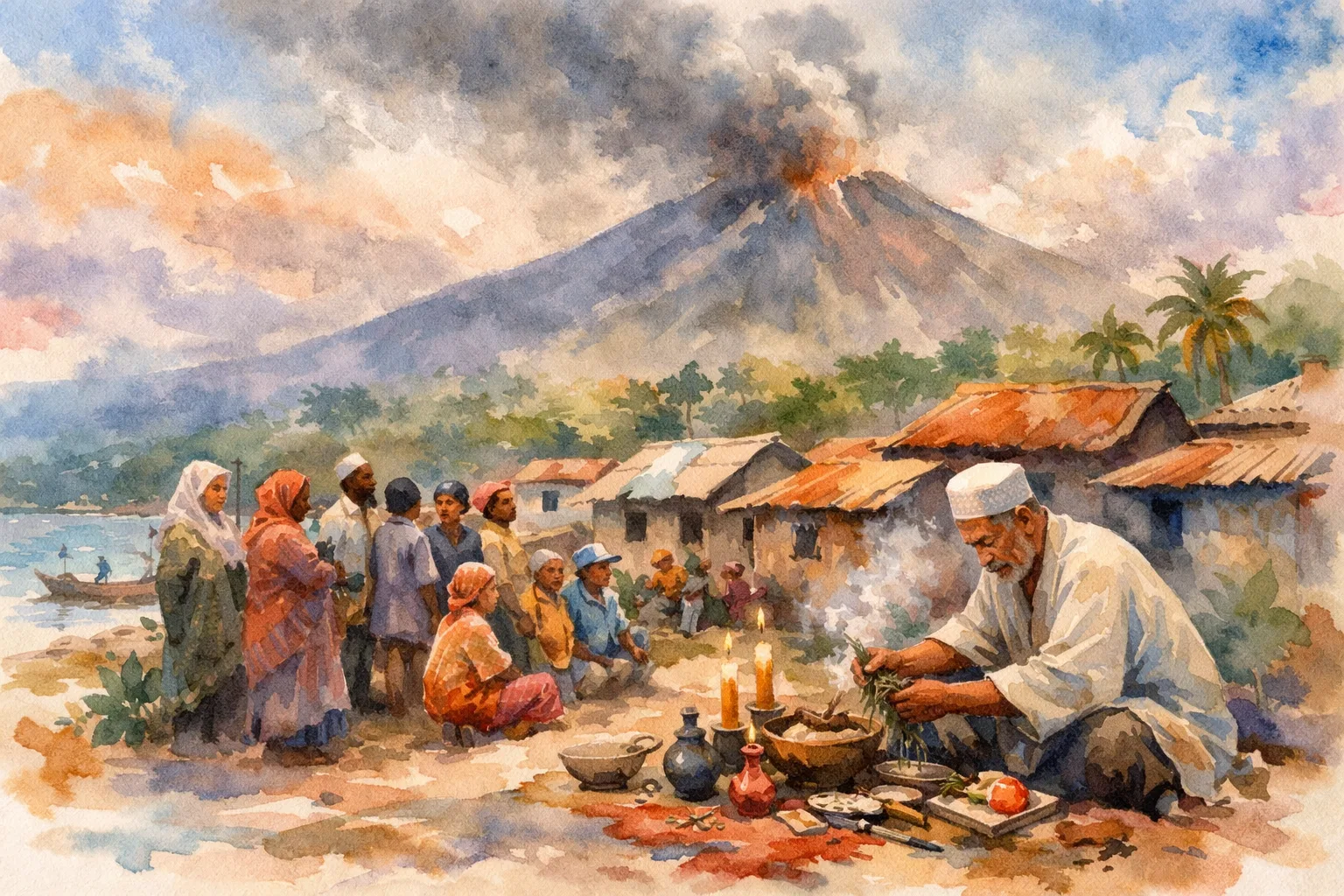
The most extensively studied material comes from Mayotte, an island in the Comoro archipelago that remained under French administration when the other islands became independent. Anthropological research there shows that spirit possession was not simply an outbreak of irrational panic. It could be a socially recognised experience, especially among women, embedded in family relationships, healing practices and local ideas about personhood. By contrast, the evacuation scares surrounding Mount Karthala’s 2005 eruptions involved a genuine physical danger, even though uncertain information intensified public fear. More recently, official concern about religious unity has helped justify restrictions on minority Muslim and non-Muslim practice.[sagepub.com]journals.sagepub.comSage Journals Knowledge and Practice in MayotteSage JournalsKnowledge and Practice in Mayotte - Michael Lambek, 1997Islam, astrology and spirit possession are treated as forms of knowl…
Why the evidence is unusually thin
Anyone looking for a catalogue of Comorian witch hunts, possession epidemics or apocalyptic sects quickly encounters a basic problem: the surviving evidence does not support such a catalogue. International reporting, historical summaries and specialist research contain remarkably few firmly documented cases of organised witch persecution, school-based psychogenic illness or destructive millenarian movements in the independent Comorian islands.
That absence should not be mistaken for proof that frightening rumours, accusations or episodes of collective distress never occurred. Comoros has a relatively small population, limited archival resources and a media environment that has not consistently preserved local events for international readers. Experiences understood within families as sorcery, spirit attack or possession may also have been treated privately rather than recorded as public crises. But it would be misleading to convert scattered religious beliefs into an invented history of “mass hysteria”.
The distinction matters because collective belief is not automatically collective delusion. A community may share ideas about unseen beings without entering a panic. A person may experience trance without being part of a contagious illness outbreak. Religious leaders may condemn a minority teaching without the population as a whole behaving irrationally. The most responsible account of Comoros therefore centres on documented practices and institutional reactions, while stating clearly where dramatic case evidence is missing.
Spirit possession was a social institution, not simply a panic
The richest evidence comes from anthropologist Michael Lambek’s long-term work among Malagasy-speaking communities in Mayotte. Although Mayotte is administered by France, it is geographically, historically and culturally part of the Comoro archipelago, making the research relevant to the wider regional setting while not automatically representative of every Comorian island.
Lambek described trance experiences in which individuals, most often women, were understood to be inhabited by identifiable spirits. These spirits were not necessarily imagined as anonymous demons attacking at random. They could have names, personalities, preferences and continuing relationships with particular households. A spirit appearing in one episode could be recognised in later episodes, giving possession a stable social history rather than the character of a sudden, inexplicable outbreak.[wiley.com]anthrosource.onlinelibrary.wiley.comSpirits and spouses: possession as a system of…by M LAMBEK · 1980 · Cited by 122 — Lambek, Michael 1978 Human Spirits: Pos…
This is one reason the language of “mass hysteria” fits poorly. In medical discussions, mass psychogenic illness normally refers to symptoms spreading rapidly through a closely connected group without an identified toxic or infectious cause. Typical settings include schools, factories and other tightly organised institutions. The Mayotte material describes something different: culturally interpreted trance occurring over long periods, governed by recognised expectations and incorporated into ordinary social life.[nih.gov]pmc.ncbi.nlm.nih.govOpen source on nih.gov.
Possession could nevertheless express genuine distress. Anthropologists have often examined how trance gives form to tensions that are difficult to voice directly, including marital conflict, unequal authority, illness and the obligations surrounding kinship. In Mayotte, the fact that women were more frequently possessed encouraged interpretations that connected spirit experience with gendered pressures. Yet reducing the phenomenon to disguised protest or mental illness would also oversimplify it. Lambek’s work treats possession as a way of knowing and acting within a shared moral world, not merely as a symptom waiting to be translated into Western psychological language.[sagepub.com]journals.sagepub.comSage Journals Knowledge and Practice in MayotteSage JournalsKnowledge and Practice in Mayotte - Michael Lambek, 1997Islam, astrology and spirit possession are treated as forms of knowl…
Islam, sorcery and healing coexisted
Comorian religious life has long been predominantly Muslim, but formal Islamic teaching did not simply erase older or locally developed understandings of spirits, astrology and sorcery. Lambek’s research shows these as overlapping bodies of knowledge. People could consult Islamic specialists, recognise spirit possession and take sorcery seriously without experiencing the practices as parts of one perfectly unified doctrine.[Sage Journals]journals.sagepub.comSage Journals Knowledge and Practice in MayotteSage JournalsKnowledge and Practice in Mayotte - Michael Lambek, 1997Islam, astrology and spirit possession are treated as forms of knowl…
This coexistence complicates the idea that possession rituals represented a separate “cult”. The word can suggest a tightly controlled organisation centred on a charismatic leader, but the Mayotte evidence instead describes dispersed household and community practices. Participation did not necessarily involve leaving Islam, joining an exclusive movement or surrendering control to a leader.
Belief in harmful magic could still produce fear. Misfortune, illness or conflict might be interpreted as the work of an unseen aggressor, and ritual specialists could be asked to diagnose or counter the threat. Comparable practices are found across the Swahili coast and western Indian Ocean, where Islamic ideas about invisible beings have interacted with African and Malagasy ritual traditions. But no strong evidence has emerged of a Comorian witch panic involving systematic trials, mass executions or a nationwide campaign against accused sorcerers. The documented pattern is better described as everyday spiritual interpretation, occasionally sharpened by suspicion, rather than institutionalised persecution.[OpenEdition Journals]journals.openedition.orgOpen source on openedition.org.
Mount Karthala and the anatomy of a real disaster scare
The eruptions of Mount Karthala on Grande Comore in 2005 provide a clearer example of collective fear, but not of imaginary danger. Karthala is an active volcano overlooking heavily populated areas, including the capital, Moroni. When it erupted in April 2005, thousands of residents fled as officials considered the possible risks from lava, gas, ash and contaminated water. Reports later indicated that some feared outcomes, including toxic gas and severe water poisoning, had not materialised on the scale initially suspected.[Mail & Guardian]mg.co.zaMail & Guardian Comoros island cleans up after eruptionMail & Guardian Comoros island cleans up after eruption
A second eruption in November covered parts of Grande Comore with ash and triggered another large movement of people. Government estimates cited by humanitarian organisations said approximately 245,000 people were affected, particularly through disruption, ash exposure and threats to water supplies. Contemporary reporting described a mass exodus from settlements near the volcano and widespread concern that drinking water had become unsafe.[reliefweb.int]reliefweb.intcomoros grand comore reeling aftermath eruptionComoros: Grand Comore reeling in aftermath of eruption29 Nov 2005 — The eruption prompted a mass exodus of villagers living in t…
The episode shows why “panic” must be used carefully. Residents were responding to an active eruption with incomplete information, weak infrastructure and limited emergency capacity. Leaving the danger zone was not evidence of collective irrationality. At the same time, uncertainty encouraged alarming reports to travel faster than scientific confirmation. Grey or discoloured water, falling ash and rumours of poisonous emissions gave people visible reasons to fear an invisible threat.
Authorities attempted to reduce uncertainty through public announcements, observation of the volcano and testing of water. International agencies concentrated on safe water, respiratory risks, shelter and sanitation. The most effective response was therefore not to dismiss frightened residents, but to separate verified hazards from unconfirmed fears while providing practical protection.[si.edu]volcano.si.eduOpen source on si.edu.
When fear of religious division became state policy
A different type of social scare appears in the government’s treatment of religious difference. Comoros is overwhelmingly Sunni Muslim, and Islamic identity has been closely tied to national institutions. A 2013 law established the Sunni Shafi‘i tradition as the country’s official religious reference and authorised sanctions against other forms of public religious practice. The stated justification included preventing radicalisation, social unrest and threats to national cohesion.[state.gov]2009-2017.state.govOpen source on state.gov.
This was not a spontaneous crowd panic. It was an official response to fears that religious competition or non-approved teachings might destabilise society. That distinction is important: moral panics can be produced from above as well as below. Political authorities may frame unfamiliar religious practices as dangers to unity even when evidence of an organised threat is limited.
Recent reporting indicates that Shia and Ahmadi Muslims have faced restrictions on public worship, while officials have sometimes attended minority gatherings to observe them. Non-Sunni proselytising is prohibited, and non-Muslim communities generally have far less room for public religious activity than the Sunni majority. Christian foreigners may worship in designated settings, but conversion and evangelisation remain socially and legally sensitive.[state.gov]state.govState Department2023 Report on International Religious Freedom: ComorosShia and Ahmadi Muslims stated that they were not able to worship…
The language used around such minorities can resemble “sect” or “cult” labelling elsewhere: a small or unfamiliar group is treated not merely as theologically incorrect but as a possible source of disorder, foreign influence or moral contamination. Yet available reports do not establish that these communities formed violent or coercive organisations. The more defensible interpretation is that fear of fragmentation enabled the state to narrow the boundaries of acceptable belief.
There is an instructive contrast with traditional possession practice. Local spirit traditions could coexist with Islam because they were woven into familiar community relationships, even when religious scholars disapproved of them. Minority religious organisations, by contrast, could appear as competing public institutions and therefore attract state scrutiny. What authorities tolerated was shaped not only by theology, but by whether a practice seemed socially embedded, politically harmless and controllable.
What should not be called a cult or mass hysteria
Three errors commonly distort this subject.
Calling possession a contagious psychiatric episode. Trance may involve altered consciousness, bodily symptoms and emotional distress, but the documented Mayotte practices were culturally organised and recurrent. They do not match the usual pattern of a sudden psychogenic outbreak spreading through a school or workplace.
Treating all spiritual specialists as cult leaders. Healers, diviners and religious experts can exercise authority, and that authority may be abused in individual cases. But authority alone does not establish the existence of a coercive cult. Evidence of isolation, exploitation, forced obedience or systematic abuse would be needed before using such a label.
Describing disaster evacuation as irrational panic. Mount Karthala posed a real threat. Rumour and uncertainty influenced behaviour, but fear was grounded in an eruption, ash fall and legitimate concern about water and air quality. The central question is how information was managed, not whether frightened residents were simply hysterical.
These distinctions are more than matters of polite terminology. Labelling culturally unfamiliar practices as madness can delegitimise people’s experiences. Labelling minority religions as cults can support repression. Dismissing disaster fears can prevent authorities from communicating effectively with communities facing genuine danger.
Why Comoros matters to the wider history of collective belief
Comoros is valuable precisely because it resists the usual dramatic template. Its best-documented material shows that shared supernatural beliefs do not always produce panics, persecutions or destructive movements. Spirit possession could function as a language of identity, memory, illness and relationship. It was extraordinary in form but often ordinary in social setting.
The country also demonstrates that collective fear can develop around entirely real threats. During Karthala’s eruptions, the mixture of visible danger, scarce scientific information and fragile public infrastructure created ideal conditions for rumours. The lesson is not that the population imagined the crisis, but that uncertainty changes how communities interpret and circulate danger.
Finally, Comoros shows how fear of religious disorder can become law. Official appeals to cohesion and protection from radicalisation may sound reasonable, particularly in a politically unstable state. Yet they can also turn minority belief into a permanent object of suspicion, even without evidence of a violent movement.
The clearest conclusion is therefore a cautious one. Comoros has a significant history of spirit belief, trance, sorcery discourse, disaster fear and religious boundary-making, but not a securely documented history of spectacular nationwide “mass hysteria”. Its importance lies in the borderlands between accepted religion and condemned practice, real danger and amplified rumour, private distress and public interpretation. Those boundaries reveal more about collective belief than a sensational catalogue of supposed cults ever could.
Amazon book picks
Further Reading
Books and field guides related to When Fear and Belief Shaped Comoros. Use these as the next step if you want deeper reading beyond the article.
The Demon-Haunted World
Supports critical thinking about belief and extraordinary claims.
Extraordinary Popular Delusions and the Madness of Crowds
Rating: 4.0/5 from 5 Google Books ratings
Explores collective belief across societies.
African religions and philosophy
Provides context for spirit beliefs and religious traditions.

The scramble for Africa,
First published 1990. Subjects: History, Colonies, Colonization, Colonización, Kolonisatie.
Endnotes
1.
Source: africabib.org
Link:https://www.africabib.org/rec.php?RID=113547153
Source snippet
local discourses of Islam, sorcery, and spirit possessionby M Lambek · 1993 · Cited by 636 — This ethnography of religious and e...
2.
Source: reliefweb.int
Title: comoros grand comore reeling aftermath eruption
Link:https://reliefweb.int/report/comoros/comoros-grand-comore-reeling-aftermath-eruption
Source snippet
Comoros: Grand Comore reeling in aftermath of eruption29 Nov 2005 — The eruption prompted a mass exodus of villagers living in t...
3.
Source: state.gov
Link:https://www.state.gov/reports/2023-report-on-international-religious-freedom/comoros
Source snippet
State Department2023 Report on International Religious Freedom: ComorosShia and Ahmadi Muslims stated that they were not able to worship...
4.
Source: jstor.org
Link:https://www.jstor.org/stable/645515
Source snippet
1978 Human Spirits: Possession and Trance among the Malagasy Speakers of Mayotte (Comoro Is- lands). Doctoral Dissertation. Ann Arbor...
5.
Source: pmc.ncbi.nlm.nih.gov
Link:https://pmc.ncbi.nlm.nih.gov/articles/PMC7396040/
6.
Source: journals.openedition.org
Link:https://journals.openedition.org/africanistes/992
7.
Source: ifrc.org
Link:https://www.ifrc.org/docs?file=appeals%2Frpts05%2Fkm051207.pdf
8.
Source: 2009-2017.state.gov
Link:https://2009-2017.state.gov/documents/organization/222247.pdf
9.
Source: refworld.org
Link:https://www.refworld.org/reference/annualreport/usdos/2015/en/107681
10.
Source: 2021-2025.state.gov
Link:https://2021-2025.state.gov/reports/2022-report-on-international-religious-freedom/comoros/
11.
Source: refworld.org
Link:https://www.refworld.org/reference/annualreport/usdos/2017/en/118407
12.
Source: 2021-2025.state.gov
Link:https://2021-2025.state.gov/reports/2023-report-on-international-religious-freedom/pakistan/
13.
Source: 2021-2025.state.gov
Title: sierra leone
Link:https://2021-2025.state.gov/reports/2023-report-on-international-religious-freedom/sierra-leone/
14.
Source: 2021-2025.state.gov
Link:https://2021-2025.state.gov/reports/2023-report-on-international-religious-freedom/algeria/
15.
Source: 2021-2025.state.gov
Link:https://2021-2025.state.gov/reports/2023-report-on-international-religious-freedom/tanzania/
16.
Source: 2021-2025.state.gov
Link:https://2021-2025.state.gov/reports/2023-report-on-international-religious-freedom/kazakhstan/
17.
Source: 2021-2025.state.gov
Link:https://2021-2025.state.gov/reports/2023-report-on-international-religious-freedom/morocco/
18.
Source: 2021-2025.state.gov
Link:https://2021-2025.state.gov/reports/2023-report-on-international-religious-freedom/germany/
19.
Source: 2021-2025.state.gov
Link:https://2021-2025.state.gov/reports/2023-report-on-international-religious-freedom/afghanistan/
20.
Source: 2021-2025.state.gov
Link:https://2021-2025.state.gov/reports/2023-report-on-international-religious-freedom/indonesia/
21.
Source: journals.sagepub.com
Title: Sage Journals Knowledge and Practice in Mayotte
Link:https://journals.sagepub.com/doi/10.1177/092137409700900201
Source snippet
Sage JournalsKnowledge and Practice in Mayotte - Michael Lambek, 1997Islam, astrology and spirit possession are treated as forms of knowl...
22.
Source: anthrosource.onlinelibrary.wiley.com
Link:https://anthrosource.onlinelibrary.wiley.com/doi/abs/10.1525/ae.1980.7.2.02a00060
Source snippet
Spirits and spouses: possession as a system of...by M LAMBEK · 1980 · Cited by 122 — Lambek, Michael 1978 Human Spirits: Pos...
23.
Source: sajp.org.za
Link:https://sajp.org.za/index.php/sajp/article/view/1671/2648
24.
Source: ias.edu
Title: How to Make Up One’s MInd
Link:https://www.ias.edu/sites/default/files/sss/How%20to%20Make%20Up%20One%27s%20MInd.pdf
25.
Source: mg.co.za
Title: Mail & Guardian Comoros island cleans up after eruption
Link:https://mg.co.za/news/south-africa/2005-04-19-comoros-island-cleans-up-after-eruption/
26.
Source: volcano.si.edu
Link:https://volcano.si.edu/showreport.cfm?doi=10.5479%2Fsi.GVP.BGVN200511-233010
27.
Source: ec.europa.eu
Link:https://ec.europa.eu/commission/presscorner/detail/en/ip
28.
Source: sk.sagepub.com
Title: millenarian movements
Link:https://sk.sagepub.com/ency/edvol/globalreligion/chpt/millenarian-movements
29.
Source: pmc.ncbi.nlm.nih.gov
Link:https://pmc.ncbi.nlm.nih.gov/articles/PMC3425750/
30.
Source: pmc.ncbi.nlm.nih.gov
Link:https://pmc.ncbi.nlm.nih.gov/articles/PMC11383757/
Additional References
31.
Source: youtube.com
Title: THIS IS THE ISLAND NATION WITH THE LARGEST 100% MUSLIM POPULATION IN AFRICA
Link:https://www.youtube.com/watch?v=6kzK8jF00z0
Source snippet
Island stories: Anjouan, Comoros Islands - BBC News...
32.
Source: afro.who.int
Link:https://www.afro.who.int/news/rumours-misinformation-and-negative-beliefs-underpin-current-marburg-outbreak-uganda
33.
Source: govinfo.gov
Link:https://www.govinfo.gov/content/pkg/CPRT-108JPRT20429/html/CPRT-108JPRT20429.htm
34.
Source: uscirf.gov
Link:https://www.uscirf.gov/sites/default/files/Africa%20Speech%20Laws%20FINAL_0.pdf
35.
Source: uscirf.gov
Link:https://www.uscirf.gov/sites/default/files/Blasphemy%20Laws%20Report.pdf
36.
Source: uscirf.gov
Link:https://www.uscirf.gov/sites/default/files/2024-09/2024%20USCIRF%20Revisiting%20the%20CPC%20Designation.pdf
37.
Source: uscirf.gov
Link:https://www.uscirf.gov/sites/default/files/resources/Thematic%20Issues.pdf
38.
Source: uscirf.gov
Link:https://www.uscirf.gov/sites/default/files/2022-12/2022%20Religious%20Freedom%20Tolerance%20Report.pdf
39.
Source: youtube.com
Title: The Least Known Muslim Country In The World
Link:https://www.youtube.com/watch?v=qyQiTed_Ys8
Source snippet
THIS IS THE ISLAND NATION WITH THE LARGEST 100% MUSLIM POPULATION IN AFRICA - COMOROS...
40.
Source: books.google.com
Title: Human Spirits A Cultural Account of Tran
Link:https://books.google.com/books/about/Human_Spirits_A_Cultural_Account_of_Tran.html?id=2sLlzgEACAAJ
Source snippet
Google BooksHuman Spirits: A Cultural Account of Trance in Mayotte30 Nov 1981 — Professor Lambek describes how the people of Mayotte (mos...
Topic Tree
Follow this branch
Related pages 192
- Antigua and Barbuda
- Argentina Belief Scares
- Azerbaijan Belief
- Bahrain Beliefs
- North Korea
- +187 more in sidebar