Within Chile Belief and Fear
How Did Colonia Dignidad Survive So Long?
Colonia Dignidad shows how isolation, coercive leadership and official protection allowed documented abuse to continue for decades.
On this page
- Paul Schafer's system of control
- Collaboration with the dictatorship
- Survivors, memorialisation and unresolved justice
Page outline Jump by section
Introduction
Colonia Dignidad was not simply an isolated religious settlement that went wrong. It became a tightly controlled enclave where systematic child sexual abuse, forced labour, family separation and psychological coercion coexisted with political repression under Chile’s military dictatorship. Its survival for decades was not the result of mass delusion or public hysteria. Rather, it reflected a combination of charismatic leadership, extreme secrecy, fear among residents, institutional failures, and periods of active protection from powerful figures in Chile. The case remains one of the country’s starkest examples of how an abusive closed community can endure when state authorities fail to intervene—or benefit from its existence.
Although often described as a cult, historians and human rights researchers increasingly focus on the specific mechanisms of coercive control that kept members obedient while allowing the enclave to operate with extraordinary autonomy. The story therefore belongs not only to the history of abusive religious movements but also to Chile’s broader history of dictatorship, human rights violations and the long struggle for truth and justice.
How did Colonia Dignidad survive for so long?
Founded in southern Chile in 1961 by the German preacher Paul Schäfer, Colonia Dignidad presented itself publicly as a charitable agricultural community. Behind that image, investigators later found a closed society organised around Schäfer’s absolute authority. Residents lived under constant surveillance, contact with the outside world was tightly controlled, and dissent was met with punishment. Numerous former members described an environment in which ordinary family relationships were deliberately destroyed to increase dependence on the leadership.[Colonia Dignidad]coloniadignidad.clColonia Dignidad Transición y Colonia DignidadColonia DignidadTransición y Colonia Dignidad - Colonia Dignidad…
The settlement’s isolation was central to its endurance. Situated in a rural area near Parral, surrounded by fences, watchtowers and controlled access, it was physically difficult to enter and psychologically difficult to leave. Members often arrived from Germany as children or young adults and grew up with little independent knowledge of the outside world. Former residents have described strict rules governing movement, speech, reading material and personal relationships, creating conditions in which many believed escape was impossible or morally forbidden.[Colonia Dignidad]coloniadignidad.clColonia Dignidad Transición y Colonia DignidadColonia DignidadTransición y Colonia Dignidad - Colonia Dignidad…
The colony also cultivated an image of efficiency and generosity. It operated farms, workshops, schools and medical facilities that won praise from some visitors and local officials. This respectable public face helped deflect suspicion even as defectors repeatedly reported abuse.
Paul Schäfer’s system of control
Paul Schäfer exercised authority through a combination of religious claims, fear and social engineering rather than theological sophistication. Former members consistently describe a system in which he portrayed himself as the sole trustworthy interpreter of God’s will while presenting the outside world as corrupt and dangerous. Obedience became both a religious obligation and a condition of survival.
Several interconnected practices reinforced this control:
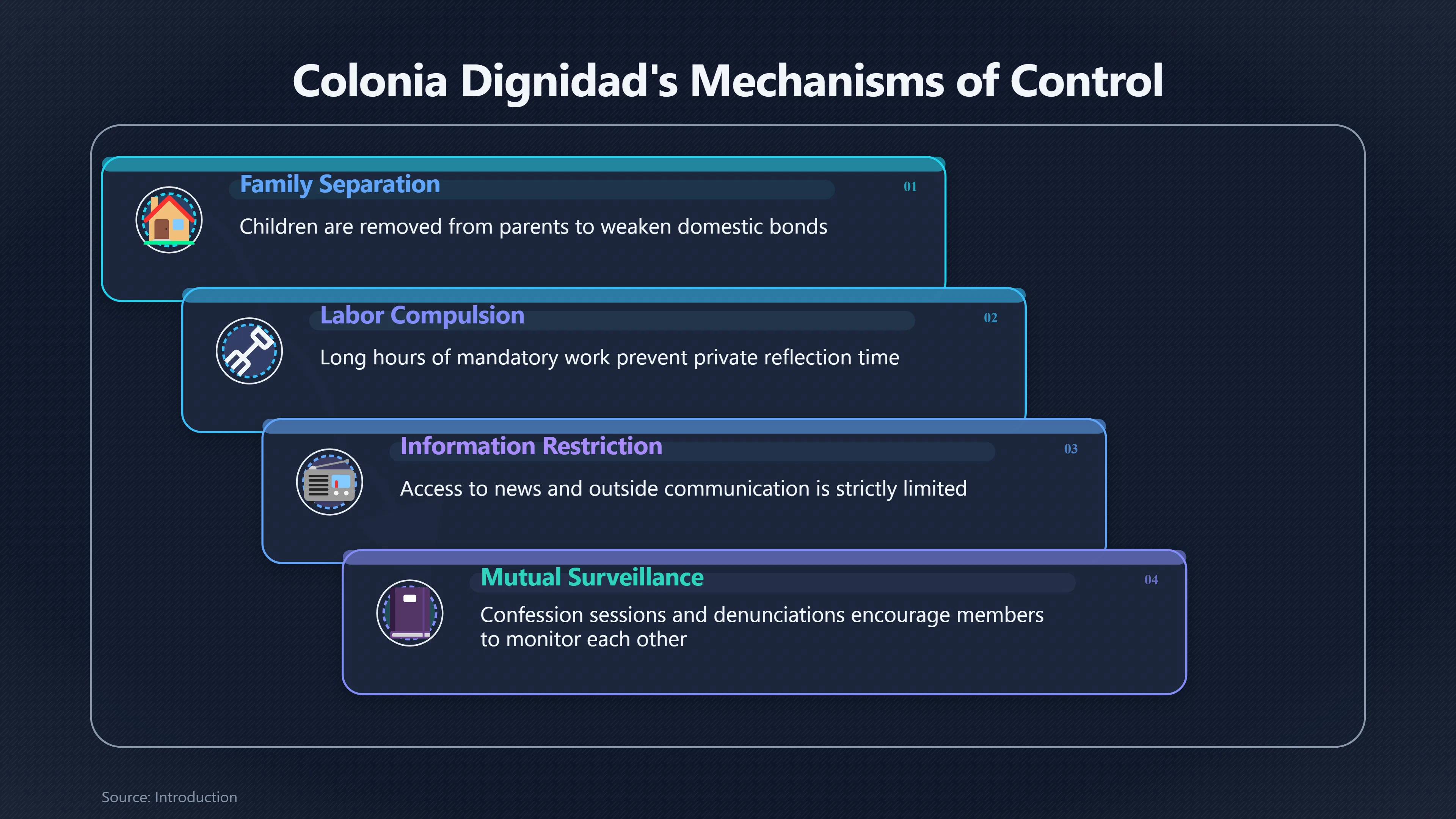
- Children were separated from their parents and raised collectively, weakening family bonds.
- Men and women lived largely apart, with marriages controlled or arranged by the leadership.
- Sexual relationships were tightly regulated except for Schäfer’s own abuse of boys, which continued for years behind a culture of silence and intimidation.
- Long hours of compulsory labour left little opportunity for private reflection or resistance.
- Confession sessions, denunciations and constant surveillance encouraged members to monitor one another.
- Access to news, education and communication with relatives outside the colony was severely restricted.[Colonia Dignidad]coloniadignidad.clColonia Dignidad Transición y Colonia DignidadColonia DignidadTransición y Colonia Dignidad - Colonia Dignidad…
These methods resemble patterns identified by scholars of coercive organisations more generally: isolation, dependency, information control, destruction of alternative loyalties and punishment of dissent. They do not require extraordinary beliefs from every participant. Many residents were themselves victims whose choices had been shaped by years of manipulation beginning in childhood.
The colony’s secrecy also made independent verification difficult. Escaped members’ allegations of child abuse and violence were often dismissed or insufficiently investigated for many years, allowing Schäfer’s authority to continue largely unchallenged.
Collaboration with the dictatorship
The enclave became far more than an abusive religious community after the 1973 military coup led by Augusto Pinochet.
Investigations by Chile’s National Commission for Truth and Reconciliation (the Rettig Commission), judicial inquiries and later archival discoveries concluded that Colonia Dignidad collaborated with the dictatorship’s secret police, the National Intelligence Directorate (DINA). Political prisoners were brought to the colony, where detainees were interrogated, tortured and, in some cases, disappeared.[mmdh.cl]mmdh.clFichas Chile Colonia DignidadMuseo de la Memoria y los Derechos Humanos…
The partnership benefited both sides. The dictatorship gained access to an isolated, heavily guarded property that could function as a clandestine detention and torture site beyond ordinary public scrutiny. Schäfer, in turn, received protection that helped shield him and the colony from investigations into internal abuses. This reciprocal relationship helps explain why serious allegations against the colony failed to produce effective state intervention for so long.[Colonia Dignidad]coloniadignidad.clColonia Dignidad Transición y Colonia DignidadColonia DignidadTransición y Colonia Dignidad - Colonia Dignidad…
Evidence uncovered after the dictatorship has reinforced this picture. Searches conducted in 2005 revealed one of the largest archives yet found relating to political repression in Chile. The documents include intelligence files compiled on tens of thousands of people, demonstrating that the colony maintained an extensive surveillance apparatus closely connected to state repression. The archive has become an important source for historians and prosecutors investigating crimes committed during the dictatorship.[mmdh.cl]mmdh.clFichas Chile Colonia DignidadMuseo de la Memoria y los Derechos Humanos…
Why did official protection last so long?
The colony survived through more than one form of protection.
During the dictatorship, collaboration with security agencies created powerful incentives for officials to ignore or conceal allegations. Even before 1973, however, the colony had cultivated relationships with local authorities and influential supporters through its economic success and charitable reputation. Escaped residents often struggled to persuade outsiders that the idyllic public image concealed systematic abuse.
After Chile’s return to democracy in 1990, accountability also proved slow. The settlement’s legal status was revoked in 1991, and official truth commissions acknowledged its role in political repression. Nevertheless, initial criminal investigations focused mainly on child sexual abuse rather than the full extent of the colony’s collaboration with the dictatorship. Only persistent campaigning by survivors, relatives of the disappeared and human rights organisations gradually expanded judicial investigations into crimes against humanity committed at the site.[Colonia Dignidad]coloniadignidad.clColonia Dignidad Transición y Colonia DignidadColonia DignidadTransición y Colonia Dignidad - Colonia Dignidad…
This long delay illustrates an important lesson about institutional failure. Ending authoritarian rule did not automatically expose every hidden network that had operated during the dictatorship. Many victims waited decades before their experiences were formally recognised.

Survivors, memorialisation and unresolved justice
Justice has advanced, but remains incomplete.
Paul Schäfer fled Chile in the late 1990s before being arrested in Argentina in 2005 and extradited. He was convicted for child sexual abuse and died in prison in 2010. Other senior members of the colony have also faced criminal proceedings, although survivors and human rights organisations continue to argue that many crimes remain insufficiently investigated.[Colonia Dignidad]coloniadignidad.clColonia Dignidad Transición y Colonia DignidadColonia DignidadTransición y Colonia Dignidad - Colonia Dignidad…
Former residents represent diverse experiences. Some suffered years of physical, psychological and sexual abuse within the colony itself. Others were children raised under extreme coercive conditions who later struggled to adapt to life outside the enclave. Their testimony has become essential both for documenting abuses and for understanding how coercive communities can reshape everyday life across generations.
Memory work has increasingly focused on preserving the site as evidence rather than allowing its past to disappear beneath commercial redevelopment. Chile declared important parts of the former colony a National Historic Monument because of their connection to systematic human rights violations. More recently, the Chilean government announced plans to expropriate key areas associated with torture, disappearances, intelligence archives and Schäfer’s residence so they can become permanent memorial and educational sites.[gob.cl]monumentos.gob.clMonumentos Nacionales ChileConsejo de Monumentos aprueba declaratoria como Monumento Histórico de Colonia Dignidad | Consejo de Monumento…
These efforts remain politically sensitive, partly because some current residents are themselves survivors of the colony’s coercive system. Balancing historical preservation, criminal investigation, property rights and support for victims continues to present difficult practical and ethical questions.
Why Colonia Dignidad matters in Chile’s history
Colonia Dignidad occupies a distinctive place within Chile’s history of coercive movements because the danger was overwhelmingly real rather than imagined. Unlike episodes driven primarily by rumour, moral panic or supernatural belief, the central allegations of abuse, political collaboration and systematic violence have been confirmed through judicial findings, survivor testimony, official truth commissions and documentary archives.[mmdh.cl]mmdh.clFichas Chile Colonia DignidadMuseo de la Memoria y los Derechos Humanos…
The case also challenges simplistic ideas about how abusive organisations survive. Colonia Dignidad endured not because outsiders were collectively deceived by extraordinary religious claims alone, but because isolation, fear, institutional prestige and state interests reinforced one another. Its history demonstrates that secrecy can become remarkably durable when victims are silenced, whistle-blowers are discredited and powerful institutions find reasons not to investigate.
For Chile, the former colony has therefore become both a symbol of authoritarian violence and a warning about the consequences of unchecked authority inside closed communities. The continuing search for truth, missing persons and historical accountability reflects a broader commitment to ensuring that neither the abuses within the settlement nor its collaboration with state repression are forgotten.
Amazon book picks
Further Reading
Books and field guides related to How Did Colonia Dignidad Survive So Long?. Use these as the next step if you want deeper reading beyond the article.
Combatting cult mind control
First published 1988. Subjects: Controversial literature, Cults, Psychological aspects of Cults, Psychology, Psychological aspects.
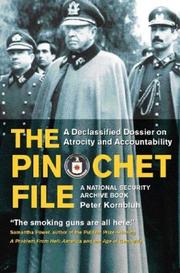
The Pinochet File
First published 2003. Subjects: Human rights, Subversive activities, Relations, United States, Sources.

Colonia Dignidad
First published 1988. Subjects: Baptists, Christian sects, Germans, Politics and government, Religious communities.
Endnotes
1.
Source: mmdh.cl
Title: Fichas Chile Colonia Dignidad
Link:https://mmdh.cl/recursos-e-investigacion/fichas-chile-colonia-dignidad
Source snippet
Museo de la Memoria y los Derechos Humanos...
2.
Source: minjusticia.gob.cl
Link:https://www.minjusticia.gob.cl/gobierno-informa-plan-de-expropiacion-de-terrenos-de-ex-colonia-dignidad-para-convertirlos-en-sitios-de-memoria/
Source snippet
ierno informa plan de expropiación de terrenos de ex Colonia Dignidad para convertirla en un sitio de memoria - Ministerio de Justicia...
3.
Source: coloniadignidad.cl
Title: Colonia Dignidad Transición y Colonia Dignidad
Link:https://www.coloniadignidad.cl/historia/transicion-y-colonia-dignidad/
Source snippet
Colonia DignidadTransición y Colonia Dignidad - Colonia Dignidad...
4.
Source: coloniadignidad.cl
Title: Colonia Dignidad Fichas
Link:https://www.coloniadignidad.cl/recursos-de-consulta/fichas/
Source snippet
Colonia DignidadFichas - Colonia Dignidad...
5.
Source: monumentos.gob.cl
Link:https://www.monumentos.gob.cl/noticias/consejo-de-monumentos-aprueba-declaratoria-como-monumento-historico-de-colonia-dignidad
Source snippet
Monumentos Nacionales ChileConsejo de Monumentos aprueba declaratoria como Monumento Histórico de Colonia Dignidad | Consejo de Monumento...
6.
Source: coloniadignidad.cl
Link:https://www.coloniadignidad.cl/memorias-y-resistencias/resistencias-y-denuncias/
Source snippet
Colonia DignidadResistencias y denuncias: Agrupaciones y organismos de derechos humanos - Colonia Dignidad...
7.
Source: minvu.gob.cl
Link:https://www.minvu.gob.cl/noticia/gobierno-informa-plan-de-expropiacion-de-terrenos-de-ex-colonia-dignidad-para-convertirlos-en-sitios-de-memoria/
8.
Source: archivonacional.gob.cl
Link:https://www.archivonacional.gob.cl/publicaciones/derecho-la-memoria-2022-colonia-dignidad-trayectorias-de-un-archivo-incompleto-de-la
Additional References
9.
Source: reuters.com
Link:https://www.reuters.com/world/americas/chiles-government-expropriate-land-tied-pinochet-era-torture-2025-07-23/
Source snippet
The settlement, historically marked by human rights abuses, was used during Augusto Pinochet's dictatorship (1973–1990) as a secret tortu...
10.
Source: theguardian.com
Link:https://www.theguardian.com/world/2026/apr/08/chile-torture-paul-schafer-villa-baviera
Source snippet
April 8, 2026 — Image: an entrance to a bunker in a forested area [Input] One of the bunkers used by former Nazi soldier Paul Schäfer in...
Published: April 8, 2026
11.
Source: youtube.com
Link:https://www.youtube.com/watch?v=AFqFHiOwbqg
Source snippet
Leader of secretive German colony in Chile arrested...
12.
Source: youtube.com
Title: Surviving a Sinister Sect: Chile’s Colonia Dignidad | Witness Documentary
Link:https://www.youtube.com/watch?v=M6CpMgxO_JA
Source snippet
A Deadly Nazi Cult in Chile | True Crime Reports...
13.
Source: youtube.com
Title: A Deadly Nazi Cult in Chile | True Crime Reports
Link:https://www.youtube.com/watch?v=pq1DSe-mf_w
Source snippet
Leader of German colony in Chile sentenced to 7 years in jail for arms possession...
14.
Source: youtube.com
Title: Leader of secretive German colony in Chile arrested
Link:https://www.youtube.com/watch?v=uQ-VXChWMrM
Source snippet
Surviving a Sinister Sect: Chile's Colonia Dignidad...
15.
Source: ecchr.eu
Link:https://www.ecchr.eu/en/case/colonia-dignidad-remains-a-dark-chapter-of-german-legal-history/
16.
Source: youtube.com
Title: Surviving a Sinister Sect: Chile’s Colonia Dignidad
Link:https://www.youtube.com/watch?v=s1fdLxDyKTw
17.
Source: ccnmtl.columbia.edu
Link:https://ccnmtl.columbia.edu/projects/caseconsortium/casestudies/49/casestudy/www/layout/case_id_49_id_483.html
18.
Source: periodicos.ufrn.br
Link:https://periodicos.ufrn.br/espacialidades/article/view/19193
Topic Tree