Within Tajikistan
When Clothing Became Evidence of Disloyalty
Campaigns against Islamic dress and beards turned ordinary appearance into supposed evidence of foreign influence and disloyalty.
On this page
- How dress and beards became security symbols
- Police, schools and workplace enforcement
- The law against clothing deemed alien
Page outline Jump by section
Introduction
In Tajikistan, campaigns against headscarves and men’s beards have become one of the clearest examples of how ordinary religious appearance has been transformed into a question of state security and political loyalty. Rather than treating clothing as a matter of individual belief or cultural preference, officials have increasingly portrayed certain styles of dress as signs of foreign influence, religious extremism or rejection of national identity. Human-rights organisations, United Nations experts and religious-freedom monitors argue that this approach has blurred the distinction between genuine security threats and peaceful religious expression, making visible appearance a substitute for evidence of wrongdoing.[hrw.org]hrw.orgHuman Rights WatchWorld Report 2025: Tajikistan | Human Rights Watch…
The issue belongs within the wider story of Tajikistan’s management of religion after the civil war of the 1990s. While the government presents these policies as measures to protect stability and preserve national culture, critics argue that they represent a classic moral-panic dynamic in which outward symbols become treated as indicators of hidden disloyalty.
How dress and beards became security symbols
For more than a decade, Tajik officials have associated particular forms of Islamic dress with foreign ideological influence rather than with ordinary religious observance. Government statements have repeatedly contrasted “traditional Tajik” clothing with styles described as imported from the Middle East or South Asia, arguing that preserving national dress protects both culture and public order.[euronews]euronews.comWhy did Muslim-majority Tajikistan ban the hijab? | EuronewsWhy did Muslim-majority Tajikistan ban the hijab? | EuronewsJune 24, 2024…
This framing did not emerge in isolation. Following the civil war, and later the growth of transnational jihadist organisations, the government increasingly argued that visible religious conservatism could serve as an early warning sign of radicalisation. Long beards on younger men and the wearing of the hijab became symbolic markers in official discussions about extremism, despite the absence of evidence that appearance alone predicts involvement in violence. International observers have repeatedly criticised this reasoning as overbroad because it encourages officials to equate peaceful religious practice with potential security risks.[congress.gov]congress.govTajikistan | Congress.gov | Library of CongressTajikistan | Congress.gov | Library of Congress
The result was a gradual shift in which clothing ceased to be merely personal or religious. Instead, appearance itself became interpreted as evidence about a person’s political reliability, cultural loyalty and relationship to the state.
Police, schools and workplace enforcement
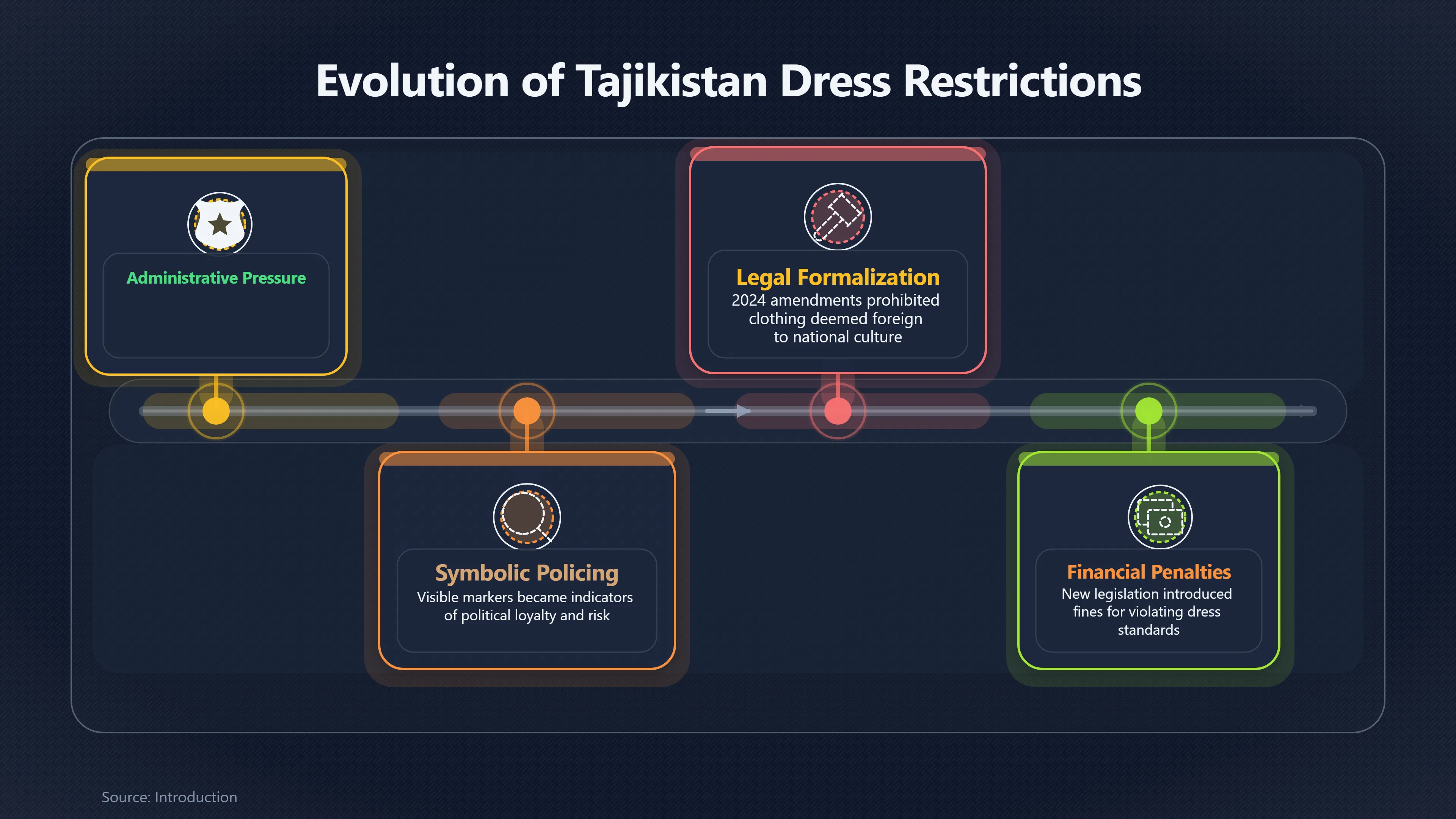
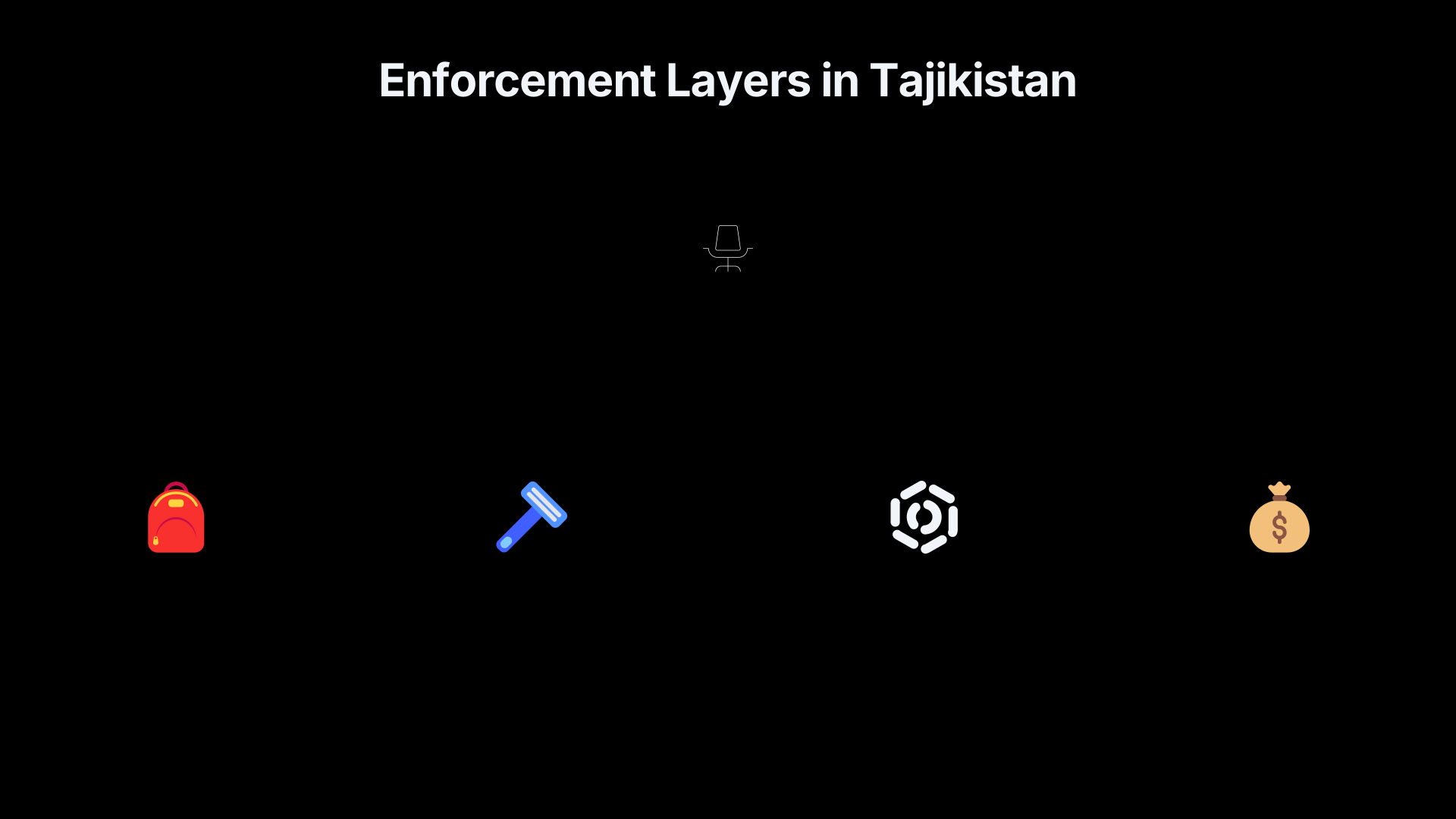
Long before formal legislation was introduced, restrictions were often enforced through administrative pressure rather than criminal prosecution.
Reports from human-rights organisations describe a pattern including:
- police stopping men with long beards and compelling or pressuring them to shave;
- schools discouraging or prohibiting Islamic headscarves;
- public-sector workplaces requiring employees to follow government-approved dress standards;
- local officials conducting campaigns encouraging women to adopt officially promoted forms of traditional Tajik dress rather than Islamic styles.[Human Rights Watch]hrw.orgHuman Rights WatchWorld Report 2018: Tajikistan | Human Rights Watch…
Freedom House has described enforcement of unofficial beard restrictions as arbitrary and, at times, violent. Human Rights Watch has documented reports of men being detained and required to pay for their own forced shaving, while women wearing unapproved styles of head covering have reported being stopped, photographed or denied access to public institutions.[Freedom House]freedomhouse.orgfreedom worldFreedom HouseTajikistan: Freedom in the World 2024 Country Report | Freedom House…
The government has generally presented these campaigns as educational or preventive rather than punitive, arguing that they encourage respect for national traditions. Critics counter that the distinction matters little when access to employment, education or public services depends upon complying with official expectations about religious appearance.

The law against clothing deemed “alien”
The gradual campaign was given a firmer legal basis in 2024 when President Emomali Rahmon signed amendments prohibiting clothing considered “foreign to the national culture.” Although the legislation does not explicitly name the hijab, officials and observers widely understood it to target Islamic head coverings that had already faced years of unofficial restrictions. The law introduced financial penalties for violations and strengthened earlier administrative campaigns.[hrw.org]hrw.orgHuman Rights WatchWorld Report 2025: Tajikistan | Human Rights Watch…
Government officials justified the measure as necessary to:
- protect national cultural traditions;[lemonde.fr]lemonde.frThis move is part of the administration's broader effort to curb Islamic influence, aimed at preserving national cultural values and prev…
- reduce foreign religious influence;
- combat superstition and extremism;
- strengthen national identity.[euronews]euronews.comWhy did Muslim-majority Tajikistan ban the hijab? | EuronewsWhy did Muslim-majority Tajikistan ban the hijab? | EuronewsJune 24, 2024…
Human-rights organisations and UN experts have instead argued that the legislation gives legal force to policies that unnecessarily restrict freedom of religion or belief. They note that international human-rights law allows governments to address genuine security threats but requires restrictions on religious expression to be lawful, necessary and proportionate. Blanket assumptions that particular clothing signifies extremism do not meet that standard, according to these critics.[Human Rights Watch]hrw.orgHuman Rights WatchWorld Report 2024: Tajikistan | Human Rights Watch…
The campaign has also expanded beyond the hijab itself. Authorities have promoted detailed guidance on recommended national clothing for women, while state-backed religious authorities have discouraged black clothing associated with conservative Islamic fashion, further reinforcing the state’s role in defining acceptable appearance.[Human Rights Watch]hrw.orgHuman Rights WatchWorld Report 2025: Tajikistan | Human Rights Watch…
Why appearance became a powerful political symbol
The importance of these policies lies less in clothing itself than in what clothing came to represent.
In many countries, a beard or headscarf is simply an expression of faith or personal identity. In Tajikistan, official discourse increasingly attached broader political meanings to the same symbols. Wearing a beard could suggest sympathy for extremist movements; adopting a particular style of head covering could be interpreted as rejecting national culture in favour of foreign religious influence. These associations often rested on generalisations rather than individual evidence.[Congress.gov]congress.govTajikistan | Congress.gov | Library of CongressTajikistan | Congress.gov | Library of Congress
Social scientists often describe this process as symbolic policing: authorities use highly visible markers to distinguish between accepted and suspect identities. Such markers are attractive to governments because they are immediately observable, even though they provide little reliable information about a person’s intentions or behaviour.
This is one reason the campaign fits within discussions of moral panic. The perceived threat expands beyond identifiable extremists to include ordinary people whose appearance resembles a feared category. The visible symbol becomes more important than any proven conduct.
Why the controversy remains significant
The debate over dress and beards continues because it reflects larger questions about religion, nationalism and state authority in contemporary Tajikistan.
Supporters of the government’s approach argue that the country faces genuine security challenges, pointing to extremist recruitment, regional instability and terrorist attacks involving some Tajik nationals. From this perspective, encouraging a distinct national identity is viewed as one element of preventing radicalisation.[euronews]euronews.comWhy did Muslim-majority Tajikistan ban the hijab? | EuronewsWhy did Muslim-majority Tajikistan ban the hijab? | EuronewsJune 24, 2024…
Critics do not generally deny the existence of security threats. Instead, they argue that treating peaceful religious appearance as evidence of possible extremism risks undermining religious freedom, encourages arbitrary enforcement and diverts attention from more effective ways of addressing violent radicalisation. UN experts have urged Tajikistan to move away from policies that conflate religious observance with security concerns and to ensure that freedom of religion is protected alongside legitimate counterterrorism measures.[Human Rights Watch]hrw.orgHuman Rights WatchWorld Report 2024: Tajikistan | Human Rights Watch…
For historians of collective fear and moral panic, these campaigns illustrate how visible cultural symbols can acquire meanings far beyond their original purpose. In Tajikistan, a headscarf or a beard came to function not simply as clothing or grooming choices, but as politically charged signs through which loyalty, identity and perceived security risk were judged.


Endnotes
1.
Source: congress.gov
Title: Tajikistan | Congress.gov | Library of Congress
Link:https://www.congress.gov/crs-product/IF10290
2.
Source: euronews.com
Title: Why did Muslim-majority Tajikistan ban the hijab? | Euronews
Link:https://www.euronews.com/2024/06/24/why-did-muslim-majority-tajikistan-ban-the-hijab
Source snippet
Why did Muslim-majority Tajikistan ban the hijab? | EuronewsJune 24, 2024...
Published: June 24, 2024
3.
Source: hrw.org
Link:https://www.hrw.org/world-report/2025/country-chapters/tajikistan
Source snippet
Human Rights WatchWorld Report 2025: Tajikistan | Human Rights Watch...
4.
Source: freedomhouse.org
Title: freedom world
Link:https://freedomhouse.org/country/tajikistan/freedom-world/2024
Source snippet
Freedom HouseTajikistan: Freedom in the World 2024 Country Report | Freedom House...
5.
Source: hrw.org
Link:https://www.hrw.org/world-report/2024/country-chapters/tajikistan
Source snippet
Human Rights WatchWorld Report 2024: Tajikistan | Human Rights Watch...
6.
Source: hrw.org
Link:https://www.hrw.org/world-report/2018/country-chapters/tajikistan
Source snippet
Human Rights WatchWorld Report 2018: Tajikistan | Human Rights Watch...
7.
Source: hrw.org
Link:https://www.hrw.org/world-report/2019/country-chapters/tajikistan
Source snippet
Human Rights WatchWorld Report 2019: Tajikistan | Human Rights Watch...
8.
Source: hrw.org
Title: Tajikistan | Country Page | World | Human Rights Watch
Link:https://www.hrw.org/europe/central-asia/tajikistan
9.
Source: hrw.org
Link:https://www.hrw.org/world-report/2022/country-chapters/tajikistan
Additional References
10.
Source: lemonde.fr
Link:https://www.lemonde.fr/en/international/article/2024/08/09/tajikistan-prohibits-black-clothes-after-hijab-ban_6711837_4.html
Source snippet
This move is part of the administration's broader effort to curb Islamic influence, aimed at preserving national cultural values and prev...
11.
Source: iphronline.org
Title: Tajikistan: Campaign against ‘’foreign clothing’’ violates human rights
Link:https://iphronline.org/articles/tajikistan-campaign-against-foreign-clothing-violates-human-rights/
Source snippet
IPHRAugust 19, 2024 — 19 August 2024 TAJIKISTAN: CAMPAIGN AGAINST ‘’FOREIGN CLOTHING’’ VIOLATES HUMAN RIGHTS Image: Tajikistan: Campaign...
Published: August 19, 2024
12.
Source: youtube.com
Title: Why did majority-Muslim Tajikistan ban the hijab?
Link:https://www.youtube.com/watch?v=1GDEwyX18Lo
Source snippet
The Muslim Country That Bans Hijab and Beards | Islam in Tajikistan...
13.
Source: ecoi.net
Link:https://www.ecoi.net/en/document/2120121.html
Source snippet
HRW – Human Rights Watch (Author): “World Report 2025 - Tajikistan”, Document #2120121 - ecoi.netJanuary 16, 2025 — Document #2120121 HRW...
Published: January 16, 2025
14.
Source: meduza.io
Link:https://meduza.io/en/feature/2024/07/29/taking-on-alien-clothing
15.
Source: rferl.org
Link:https://www.rferl.org/amp/tajikistan-islamic-dress-beards-hijab/33061844.html
16.
Source: uscirf.gov
Title: calls us government impose consequences tajikistan due
Link:https://www.uscirf.gov/news-room/releases-statements/uscirf-calls-us-government-impose-consequences-tajikistan-due
17.
Source: youtube.com
Title: Can A Beard Land You In Jail?
Link:https://www.youtube.com/watch?v=JvwBBYa1rGU
Source snippet
Tajikistan has formally banned the hijab nationwide...
18.
Source: youtube.com
Title: The Muslim Country That Bans Hijab and Beards | Islam in Tajikistan
Link:https://www.youtube.com/watch?v=KRtE4NqyN6s
Source snippet
Can A Beard Land You In Jail?...
19.
Source: forum18.org
Title: Forum 18: TAJIKISTAN: Hijab-wearing and beards ban continues
Link:https://www.forum18.org/archive.php?article_id=2421
Topic Tree