When Spiritual Belief Became a Public Threat
Saint Lucia does not have a well-documented equivalent of the Salem witch trials, a destructive doomsday sect or a famous outbreak of mass psychogenic illness.
Page outline Jump by section
Introduction
These histories are not best understood as tales of irrational island-wide hysteria. They concern colonial power, Christian ideas about evil, fear of hidden spiritual harm, accusations of fraud and the uncertain boundary between religion, healing and sorcery. That boundary remains unsettled. Saint Lucia removed offences relating to obeah from its Criminal Code in 2004, yet its customs law still prohibits imported material associated with “black magic”, obeah, witchcraft and occultism. A highly publicised prosecution involving crystal balls and other imported objects in 2022–25 showed that older fears can still acquire legal and media force.[dukeupress.edu]read.dukeupress.eduDuke University Press Ordinary Ethics of Spiritual Work and Healing in StLucia…1 Mar 2017 — laws pertaining to obeah were removed from St. Lucia's Criminal Code (in 2004), and the practices are officially d…
Why “obeah” is such a difficult label
Obeah is not a single church, doctrine or centrally organised movement. Across the Caribbean, the word has been applied to a varied collection of spiritual, protective, healing and divinatory practices. Historically, these could include herbal treatments, baths, charms, communication with spirits, efforts to locate lost property and rituals intended to bring luck, protection or revenge. Many practitioners have rejected the term because it became so closely associated with criminality, deceit and harmful magic. Scholars therefore often use more neutral descriptions such as “spiritual work”, “ritual practice” or “healing”.[dukeupress.edu]read.dukeupress.eduDuke University Press Ordinary Ethics of Spiritual Work and Healing in StLucia…1 Mar 2017 — laws pertaining to obeah were removed from St. Lucia's Criminal Code (in 2004), and the practices are officially d…
This distinction matters in Saint Lucia. Ethnographic research has found a wide gap between public accusations of obeah and the ways practitioners understand their own activities. A healer may regard the work as morally responsible assistance for illness, misfortune or strained relationships, while critics may describe the same person as a sorcerer or fraud. The word consequently tells us as much about the accuser’s moral judgement as it does about the activity being described.[Duke University Press]read.dukeupress.eduDuke University Press Ordinary Ethics of Spiritual Work and Healing in StLucia…1 Mar 2017 — laws pertaining to obeah were removed from St. Lucia's Criminal Code (in 2004), and the practices are officially d…
It is also misleading to treat every belief in spiritual harm as evidence of mass hysteria. Fear that another person has arranged a curse may be intense and socially contagious, but it remains different from mass psychogenic illness, in which groups develop genuine physical symptoms without an identified toxic or infectious cause. The available evidence for Saint Lucia points mainly towards stigma, rumour, interpersonal suspicion and legal restriction—not a medically documented national epidemic of contagious symptoms.
How colonial rule turned spiritual practice into a social threat
European authorities throughout the British Caribbean used “obeah” as an increasingly broad category for African-derived practices they considered dangerous. These traditions could help enslaved people seek healing and protection, maintain links with African identities or build confidence against plantation authority. Colonial officials, however, often interpreted unfamiliar ritual activity through European Christian concepts of witchcraft, diabolism and conspiracy.[warwick.ac.uk]warwick.ac.ukpaton trevorUniversity of WarwickObeah Acts: Producing and Policing the Boundaries of…by D Paton · 2009 · Cited by 136 — Obeah has been a crime in…
The political dimension was crucial. Elsewhere in the British Caribbean, notably Jamaica, anti-obeah legislation followed uprisings in which ritual specialists were said to have administered oaths or offered supernatural protection. Such laws did not merely punish proven physical harm. They helped colonial governments police gatherings, African religious authority and forms of knowledge that existed beyond the plantation church and state. As these legal ideas travelled through the region, many different healing and spiritual practices were collapsed into one supposedly sinister category.[historyworkshop.org.uk]historyworkshop.org.ukthe racist history of jamaicas obeah lawsthe racist history of jamaicas obeah laws
Saint Lucia inherited this wider Caribbean structure of suspicion. It would be too simple to say that officials invented every fear associated with spiritual work: Saint Lucians themselves could believe that practitioners had power to heal, protect or harm. Colonial institutions nevertheless gave one interpretation disproportionate authority. The state and established churches could define African-derived practices as superstition or menace, while their participants had limited power to record their own meanings.
That imbalance helps explain why the surviving history is uneven. Official records tend to preserve arrests, prohibitions and accusations more readily than ordinary consultations with healers. The resulting archive can make spiritual work appear more uniformly sinister than it was in everyday life.
Kélé: a religion hidden by hostility, not a dangerous cult
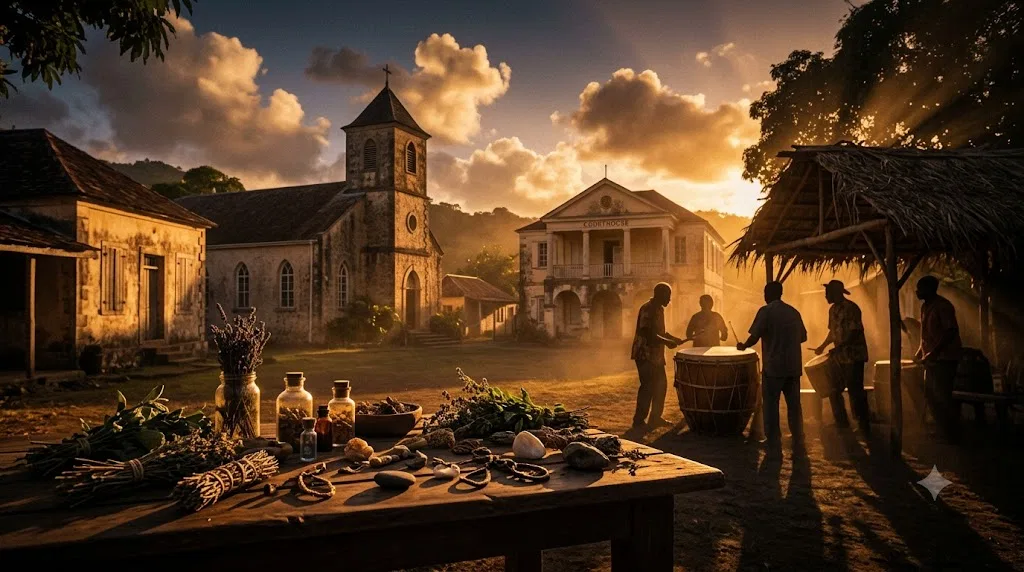
Kélé offers the clearest warning against using the word “cult” carelessly. Older academic titles sometimes called it a minority cult, but in contemporary ordinary English that wording can imply manipulation, coercion or an abusive leader. Kélé is more accurately described as an Afro-Saint Lucian religious tradition centred historically in the Babonneau area and associated with families of African descent. Researchers have connected it with Yoruba religious traditions and with devotion to Ogun, Shango and Eshu.[spk-berlin.de]publications.iai.spk-berlin.deOpen source on spk-berlin.de.
Ceremonies involve prayer, drumming, song, food and symbolic objects. Iron implements honour Ogun; smooth stones are associated with Shango; and animal sacrifice has formed part of ceremonial practice. The rites seek benefits such as health, protection, good fortune and successful crops, rather than an apocalyptic transformation of society.[publications.iai.spk-berlin.de]publications.iai.spk-berlin.deOpen source on spk-berlin.de.
Kélé was practised discreetly because of hostility from colonial and church authorities. Its secrecy can look suspicious when viewed from outside, but secrecy was largely a response to repression. Participants had practical reasons to hide ceremonies that dominant institutions condemned. Later scholarship describes the tradition as emerging from this enforced underground rather than suddenly appearing as a new sect.[loc.gov]loc.govOpen source on loc.gov.
The change in public treatment is culturally significant. The Folk Research Centre, founded in 1973 by the Catholic priest Patrick Anthony and a multi-faith group of young Saint Lucians, became an important institution for documenting and promoting local cultural traditions. Its work forms part of a broader movement that reclassified practices once dismissed as shameful remnants or dangerous superstition as elements of Saint Lucia’s African heritage.[folkresearchcentre.org]folkresearchcentre.orgFolk Research Centre Lucian Kaiso Traditional Practices. Fri: 8:30 amFolk Research Centre Lucian Kaiso Traditional Practices. Fri: 8:30 am
Kélé therefore belongs in a history of cult scares chiefly because it shows how hostile labelling works. A minority religion can be driven underground, described as occult or primitive, and then made to seem secretive by the very persecution that forced its secrecy.
The modern legal contradiction
Saint Lucia decriminalised obeah in 2004 by removing the relevant provisions from its Criminal Code. That reform weakened the state’s direct power to prosecute a person simply for engaging in practices labelled obeah and brought the law closer to the Constitution’s protection of freedom of conscience and religion.[dukeupress.edu]read.dukeupress.eduDuke University Press Ordinary Ethics of Spiritual Work and Healing in StLucia…1 Mar 2017 — laws pertaining to obeah were removed from St. Lucia's Criminal Code (in 2004), and the practices are officially d…
Decriminalisation did not eliminate every occult-related restriction. The Customs (Control and Management) Act lists among prohibited imports all publications, articles or other material associated with black magic, secret magic, obeah, witchcraft, magical arts or occultism. The language is unusually broad: it regulates objects according to spiritual or symbolic association rather than limiting the ban to items that are independently dangerous.[Attorney General Chambers]attorneygeneralchambers.comAll publications, articles or other matter associated with black magic, secret magic obeah, witchcraft or other magical arts and occultis…
This creates a striking distinction:
- Practising obeah is no longer itself a Criminal Code offence.
- Importing objects classified as occult-related may still be an offence.
- Fraud, poisoning, assault or other demonstrable harm can be prosecuted under ordinary laws regardless of any spiritual claim.
The customs provision also sits uneasily beside Saint Lucia’s constitutional protection for manifesting religious belief in worship, teaching, practice and observance. Constitutional rights are not unlimited, but a prohibition framed around “occultism” raises questions about how officials distinguish contraband from religious literature, ritual equipment, decorative objects or harmless personal possessions.[Attorney General Chambers]attorneygeneralchambers.comsection 9section 9
The crystal-ball prosecution
The tension became visible in September 2022, when Saint Lucian police arrested social-media personality and spiritualist Natokie Anthony and another woman after seizing items publicly described as witchcraft or occult paraphernalia. Reports listed objects including crystal balls and a “Book of Shadows”. The language used around the arrest encouraged readers to view the collection as evidence of sinister activity, although possession of unusual ritual objects does not in itself prove that anyone was harmed or deceived.[our.today]our.todaysocial media sensation natokie anthony caught with witchcraft items chargedsocial media sensation natokie anthony caught with witchcraft items charged
Anthony was convicted in May 2024 of unlawful possession and possession of prohibited imports connected with occult paraphernalia. In March 2025, local reporting stated that she had been fined EC$3,500 for possessing prohibited occult-related imports. The conviction was therefore tied to possession and import restrictions, not to proof that supernatural powers had been exercised successfully.[St. Lucia Times]stluciatimes.comSt. Lucia Times Natokie Anthony Convicted For 'Witchcraft' ItemsSt. Lucia Times Natokie Anthony Convicted For 'Witchcraft' Items
The episode was not a classic mass panic: there is no evidence of widespread disorder, collective illness or organised persecution. It is better understood as a compact modern moral scare in which several forces reinforced one another:
- a law preserving colonial-era distinctions between acceptable and forbidden spiritual material;
- police presentation of visually striking objects;
- news and social-media language invoking “witchcraft”;
- existing Christian and popular fears of harmful magic;
- the public profile of the accused.
Objects such as crystal balls possess strong cultural associations even when their practical significance is unclear. Photographs can therefore make a case appear self-explanatory: the viewer sees an occult object and may assume dangerous intent. That emotional shortcut can obscure the more precise legal question of whether the object was prohibited and the evidential question of whether anybody suffered harm.
The case also illustrates the difference between decriminalisation and destigmatisation. Removing obeah from the Criminal Code did not erase the belief that occult practice is inherently menacing, nor did it remove every law through which that belief can be enforced.
Why fear of hidden spiritual harm persists
Belief in curses offers an explanation for misfortune that otherwise appears random or unjust. Illness, relationship breakdown, infertility, business failure and unexplained conflict can be interpreted as the result of another person’s concealed intervention. Such an explanation gives suffering a cause and identifies a possible remedy, whether prayer, ritual cleansing, herbal treatment or consultation with a spiritual worker.
Fear spreads especially easily when the alleged mechanism is invisible. A claim that food, clothing, soil or a personal object has been spiritually manipulated is difficult to disprove conclusively. Every new setback may be incorporated into the original suspicion. The absence of physical evidence can even be treated as proof that the supposed attacker is unusually skilled.
These beliefs are also sustained by overlap rather than complete separation between religious worlds. Caribbean spiritual work has historically combined African-derived ideas, Christian prayers and symbols, herbal knowledge and locally developed ritual methods. The boundary between church religion and folk practice is therefore porous, even when religious leaders publicly condemn obeah. Scholars describe this as a hybrid and highly variable field rather than a coherent rival faith.[jeromehandler.com]jeromehandler.comHealing and Protection in West Indian Slave ife elby KM BILBY · 2004 · Cited by 139 — Obeah encompasses a wide variety of beliefs and pra…
Saint Lucia’s religious landscape is changing but remains predominantly Christian. The 2022 census recorded Roman Catholics as the largest group, at 50.6 per cent of the population, alongside substantial Seventh-day Adventist and Pentecostal communities and a growing population reporting no religion. These shifts may change the language through which spiritual practices are judged, but they do not automatically remove older stories about curses, protection and invisible danger.[stats.gov.lc]stats.gov.lcSaint Lucia Population and Housing CensusSaint Lucia Population and Housing Census
Harm, healing and the need for careful judgement
Rejecting sensational language does not require pretending that every spiritual practitioner is harmless. A person may exploit frightened clients, demand escalating payments, provide dangerous substances or discourage someone from obtaining medical care. Those are real risks, but they can be described and prosecuted as fraud, poisoning, abuse or unsafe medical conduct without assuming that an entire cultural tradition is criminal.
The reverse danger is also serious. When unusual beliefs are treated as sufficient proof of wickedness, healers and religious minorities become vulnerable to ridicule, discriminatory policing and social exclusion. Historically, the broadness of “obeah” allowed authorities to treat healing, resistance, spiritual protection and alleged harmful magic as though they were the same thing.[jeromehandler.com]jeromehandler.comHealing and Protection in West Indian Slave ife elby KM BILBY · 2004 · Cited by 139 — Obeah encompasses a wide variety of beliefs and pra…
A useful assessment therefore separates four questions:
- What does the person claim to do? A promise of comfort or prayer is different from a guaranteed cure or threat of supernatural retaliation.
- Was consent freely given? Fear, coercion and pressure for repeated payments matter more than whether the ritual appears strange.
- Was measurable harm caused? Dangerous preparations, financial exploitation and obstruction of medical treatment require evidence-led intervention.
- Is the label coming from participants or opponents? Calling something obeah or a cult may be a hostile classification rather than a neutral description.
This approach protects people from genuine abuse while avoiding the colonial habit of treating African-derived spirituality itself as the offence.

What Saint Lucia’s record really shows
Saint Lucia’s history is not dominated by a single spectacular eruption of mass hysteria. Its more revealing story is the slower manufacture of social suspicion: spiritual practices were grouped under ominous labels, minority ceremonies were pushed underground, laws gave those labels official force, and visually dramatic accusations continued to attract attention even after formal decriminalisation.
Kélé demonstrates how a persecuted religion can be mistaken for a secretive cult. Obeah shows how one word can merge healing, protection, feared sorcery and alleged fraud into a misleading whole. The modern prohibition on occult imports shows that colonial categories can survive piecemeal after the main criminal offence has disappeared.
The lasting cultural importance of these episodes lies in that unresolved boundary. Saint Lucia officially protects freedom of conscience and increasingly celebrates African-derived heritage, yet fears of hidden spiritual danger remain embedded in law, religious discourse and popular imagination. Understanding the difference between belief, harm, rumour and hostile labelling is therefore not merely a historical exercise. It determines whose practices are recognised as culture or religion—and whose are still presented as evidence of menace.
Amazon book picks
Further Reading
Books and field guides related to When Spiritual Belief Became a Public Threat. Use these as the next step if you want deeper reading beyond the article.

Obeah and other powers
Explains how obeah became criminalised and feared across the Caribbean.
Creole religions of the Caribbean
Places Saint Lucian beliefs in a broader Caribbean framework.
Endnotes
1.
Source: jeromehandler.com
Link:https://jeromehandler.com/wp-content/uploads/Obeah_healing_Bilby-04.pdf
Source snippet
Healing and Protection in West Indian Slave ife elby KM BILBY · 2004 · Cited by 139 — Obeah encompasses a wide variety of beliefs and pra...
2.
Source: publications.iai.spk-berlin.de
Link:https://publications.iai.spk-berlin.de/servlets/MCRFileNodeServlet/Document_derivate_00002167/BIA_046_093_101.pdf
3.
Source: jstor.org
Link:https://www.jstor.org/stable/25612555
4.
Source: folkresearchcentre.org
Link:https://folkresearchcentre.org/heritage-studies/traditional-practices/
5.
Source: folkresearchcentre.org
Title: Folk Research Centre Lucian Kaiso Traditional Practices. Fri: 8:30 am
Link:https://folkresearchcentre.org/
6.
Source: folkresearchcentre.org
Title: about us
Link:https://folkresearchcentre.org/about-us/
7.
Source: govt.lc
Title: Saint Lucia
Link:https://www.govt.lc/constitution1
8.
Source: our.today
Title: social media sensation natokie anthony caught with witchcraft items charged
Link:https://our.today/social-media-sensation-natokie-anthony-caught-with-witchcraft-items-charged/
9.
Source: stats.gov.lc
Title: Saint Lucia Population and Housing Census
Link:https://stats.gov.lc/wp-content/uploads/2024/08/StLucia-Provisional-Census-Report-2022-Release-1Rev1.pdf
10.
Source: customs.gov.lc
Link:https://www.customs.gov.lc/travellers-information.php
11.
Source: jstor.org
Link:https://www.jstor.org/stable/26855622
12.
Source: jstor.org
Link:https://www.jstor.org/stable/40653862
13.
Source: state.gov
Title: saint lucia
Link:https://www.state.gov/reports/2023-report-on-international-religious-freedom/saint-lucia
14.
Source: 2009-2017.state.gov
Link:https://2009-2017.state.gov/j/drl/rls/irf/2001/5675.htm
15.
Source: justice.gov.za
Link:https://www.justice.gov.za/legislation/acts/1957-003.pdf
16.
Source: read.dukeupress.edu
Title: Duke University Press Ordinary Ethics of Spiritual Work and Healing in St
Link:https://read.dukeupress.edu/small-axe/article/21/1%20%2852%29/17/32443/Ordinary-Ethics-of-Spiritual-Work-and-Healing-in
Source snippet
Lucia...1 Mar 2017 — laws pertaining to obeah were removed from St. Lucia's Criminal Code (in 2004), and the practices are officially d...
17.
Source: attorneygeneralchambers.com
Link:https://attorneygeneralchambers.com/laws-of-saint-lucia/customs-control-and-management-act/part-1-prohibited-imports
Source snippet
All publications, articles or other matter associated with black magic, secret magic obeah, witchcraft or other magical arts and occultis...
18.
Source: stluciatimes.com
Title: social media influencer fined for having occult related items
Link:https://stluciatimes.com/169755/2025/03/social-media-influencer-fined-for-having-occult-related-items/
Source snippet
Lucia TimesSocial Media Influencer Fined for Having Occult-Related...26 Mar 2025 — Natokie Cana Anthony has been fined $3 500, which mus...
19.
Source: warwick.ac.uk
Title: paton trevor
Link:https://warwick.ac.uk/fac/arts/english/events/warvan-copy/prog/paton_trevor.pdf
Source snippet
University of WarwickObeah Acts: Producing and Policing the Boundaries of...by D Paton · 2009 · Cited by 136 — Obeah has been a crime in...
20.
Source: historyworkshop.org.uk
Title: the racist history of jamaicas obeah laws
Link:https://www.historyworkshop.org.uk/empire-decolonisation/the-racist-history-of-jamaicas-obeah-laws/
21.
Source: obeahhistories.org
Link:https://obeahhistories.org/1760-jamaica-law/
22.
Source: loc.gov
Link:https://www.loc.gov/item/hlas-bi98015864/
23.
Source: attorneygeneralchambers.com
Title: section 9
Link:https://attorneygeneralchambers.com/laws-of-saint-lucia/constitution-of-saint-lucia/section-9
24.
Source: stluciatimes.com
Title: St. Lucia Times Natokie Anthony Convicted For ‘Witchcraft’ Items
Link:https://stluciatimes.com/163516/2024/05/natokie-anthony-convicted-for-witchcraft-items/
25.
Source: stluciatimes.com
Title: saint lucia census report cites shift in religious affiliation
Link:https://stluciatimes.com/165688/2024/08/saint-lucia-census-report-cites-shift-in-religious-affiliation/
26.
Source: Wikipedia
Link:https://en.wikipedia.org/wiki/Obeah
27.
Source: Wikipedia
Link:https://en.wikipedia.org/wiki/K%C3%A9l%C3%A9
28.
Source: Wikipedia
Title: Folk Research Centre
Link:https://en.wikipedia.org/wiki/Folk_Research_Centre
29.
Source: facebook.com
Link:https://www.facebook.com/saintluciafolk/
30.
Source: tile.loc.gov
Link:https://tile.loc.gov/storage-services/service/ll/llglrdppub/2019669192/2019669192.pdf
31.
Source: webportal.atlasintl.com
Title: St Lucia
Link:https://webportal.atlasintl.com/Customs%20Docs/St%20Lucia.pdf
32.
Source: thinkyorubafirst.org
Title: st lucia
Link:https://thinkyorubafirst.org/the-yoruba/st-lucia/
Additional References
33.
Source: academia.edu
Link:https://www.academia.edu/7090957/_Obeah_in_St_Lucia_as_a_moral_and_ethical_practice_Moralities_of_healing_and_spiritual_practices_Kosanba_A_Scholarly_Association_for_the_Study_of_Haitian_Vodou_Harvard_University
Source snippet
Academia« Obeah in St Lucia as a moral and ethical practice....Obeah's negative moralization persists despite its decriminalization in 2...
34.
Source: youtube.com
Title: “Day Working Obeah” by Reasons Of Saint Lucia
Link:http://www.youtube.com/watch?v=v9H6YAHJEtM
Source snippet
Kele Saint Lucia Bouyon, Kele & Carnival in St. Lucia is heavily influenced by Atlantic Africa #stlucia #caribbean Lost Tribes Of Somewhere...
35.
Source: youtube.com
Title: Obeah and the Caribbean Connection: A Review of Obeah Using Archive Newspapers
Link:http://www.youtube.com/watch?v=UbOPQj0f99A
Source snippet
Blackheart voodoo eggs found in laborie 🇱🇨...
36.
Source: policehumanrightsresources.org
Link:https://policehumanrightsresources.org/content/uploads/2016/07/The-Witchcraft-Act.pdf?x36399=
37.
Source: researchgate.net
Link:https://www.researchgate.net/publication/250942559_Enchanting_Panics_and_Obeah_Anxieties_Concealing_and_Disclosing_Eastern_Caribbean_Witchcraft
38.
Source: researchgate.net
Link:https://www.researchgate.net/publication/271759288_Mass_hysteria_among_South_African_primary_school_learners_in_Kwa-Dukuza_KwaZulu-Natal
39.
Source: researchgate.net
Link:https://www.researchgate.net/publication/268494060_African_spiritual_healing_and_its_implications_for_health_community_development_and_education
40.
Source: facebook.com
Link:https://www.facebook.com/ernesthilaireslu/videos/another-political-witch-hunt-by-the-uwponce-again-our-opponents-are-resorting-to/1454295216383691/
41.
Source: facebook.com
Link:https://www.facebook.com/stluciatimes/posts/crystal-balls-among-witchcraft-paraphernalia-seized-by-saint-lucia-police-two-pe/526611279467408/
42.
Source: eulacfoundation.org
Link:https://eulacfoundation.org/system/files/en_charlesembert.pdf
Topic Tree
Follow this branch
Related pages 192
- Antigua and Barbuda
- Argentina Belief Scares
- Azerbaijan Belief
- Bahrain Beliefs
- North Korea
- +187 more in sidebar