Within Croatia
How Croatia's Witch Trials Manufactured a Conspiracy
Croatia's witch trials show how courts, torture and neighbourhood conflict turned misfortune into an expanding conspiracy.
On this page
- Why accusations spread through towns and villages
- How torture and secular courts produced new suspects
- Magda Logomer and the collapse of legal witch hunting
Page outline Jump by section
Introduction
Croatia’s early modern witch trials were not simply episodes of widespread fear. They were systems of organised persecution in which neighbourhood suspicion, legal procedure and judicial torture combined to manufacture what appeared to be evidence of a vast criminal conspiracy. Most accusations began with ordinary misfortune—a child’s illness, unexplained death, failed harvest, damaged livestock or personal quarrel—but once a case entered court, the machinery of prosecution could transform isolated allegations into elaborate stories of secret gatherings, pacts with the Devil and networks of accomplices. The surviving records reveal far more about how courts created “proof” than about any genuine practice of witchcraft. They also show how legal reform, particularly in the eighteenth century, gradually dismantled this system, culminating in the celebrated case of Magda Logomer.

Why accusations spread through towns and villages
Croatian witch trials followed patterns found across much of Central Europe but were shaped by local village life and the judicial structures of the Habsburg lands. Most prosecutions occurred in north-western Croatia, especially around Zagreb, Varaždin and Križevci, where surviving court records are concentrated. Rather than emerging from random panic, accusations usually developed from existing social tensions. Illness, failed crops, livestock deaths and family disputes were interpreted through a worldview that assumed supernatural harm could be deliberately inflicted.[Wikipedia]WikipediaMagda LogomerMagda Logomer
Neighbourhood relationships were central. Many accused women already had reputations as healers, midwives, herbalists or quarrelsome neighbours. Others had become involved in disputes over property, debts or insults long before any allegation of witchcraft appeared. When unexplained misfortune followed these conflicts, earlier grievances were reinterpreted as evidence of magical attack.
The accusations therefore spread through familiar social mechanisms:
- Repeated misfortune encouraged supernatural explanations. Epidemics, infant deaths and crop failures demanded causes in a society with limited medical knowledge.
- Personal conflict became legal evidence. Arguments that might otherwise have remained private acquired new meaning once illness or disaster followed.
- Reputation accumulated over time. Someone already regarded as eccentric, argumentative or unusually knowledgeable about healing became easier to accuse.
- Witnesses reinforced one another. Individual suspicions gained credibility when several neighbours repeated similar stories, even if each account relied on rumour rather than direct observation.
Historians emphasise that these accusations rarely reflected a shared belief in a genuine organised witch society. Instead, local communities interpreted unrelated events through existing religious and cultural assumptions, while courts increasingly linked separate accusations into a single imagined conspiracy.[Hrčak]hrcak.srce.hrHrčak Magda Logomer HerucinaHrčak Magda Logomer Herucina
How torture and secular courts produced new suspects
One of the most important features of Croatian witch persecution is that prosecutions were largely conducted by secular rather than ecclesiastical courts. Although religious ideas shaped beliefs about witchcraft, criminal investigations were commonly handled by civic magistrates operating under Habsburg criminal law.[Wikipedia]WikipediaMagda LogomerMagda Logomer
This distinction matters because the legal process itself became the engine of expanding persecution.
Confession became the central form of proof
Material evidence rarely existed. Courts instead relied heavily on confession, testimony and reputation. Once judges became convinced that witchcraft had occurred, the absence of physical evidence was treated as confirmation that witches operated through hidden supernatural means.
Confession therefore acquired extraordinary importance. Yet many confessions emerged only after prolonged interrogation and judicial torture, which was legally regulated but nonetheless extremely coercive. Contemporary legal rules specified how torture should be recorded and limited, but they did not prevent false admissions.[Wikipedia]WikipediaMagda LogomerMagda Logomer
Torture expanded the conspiracy
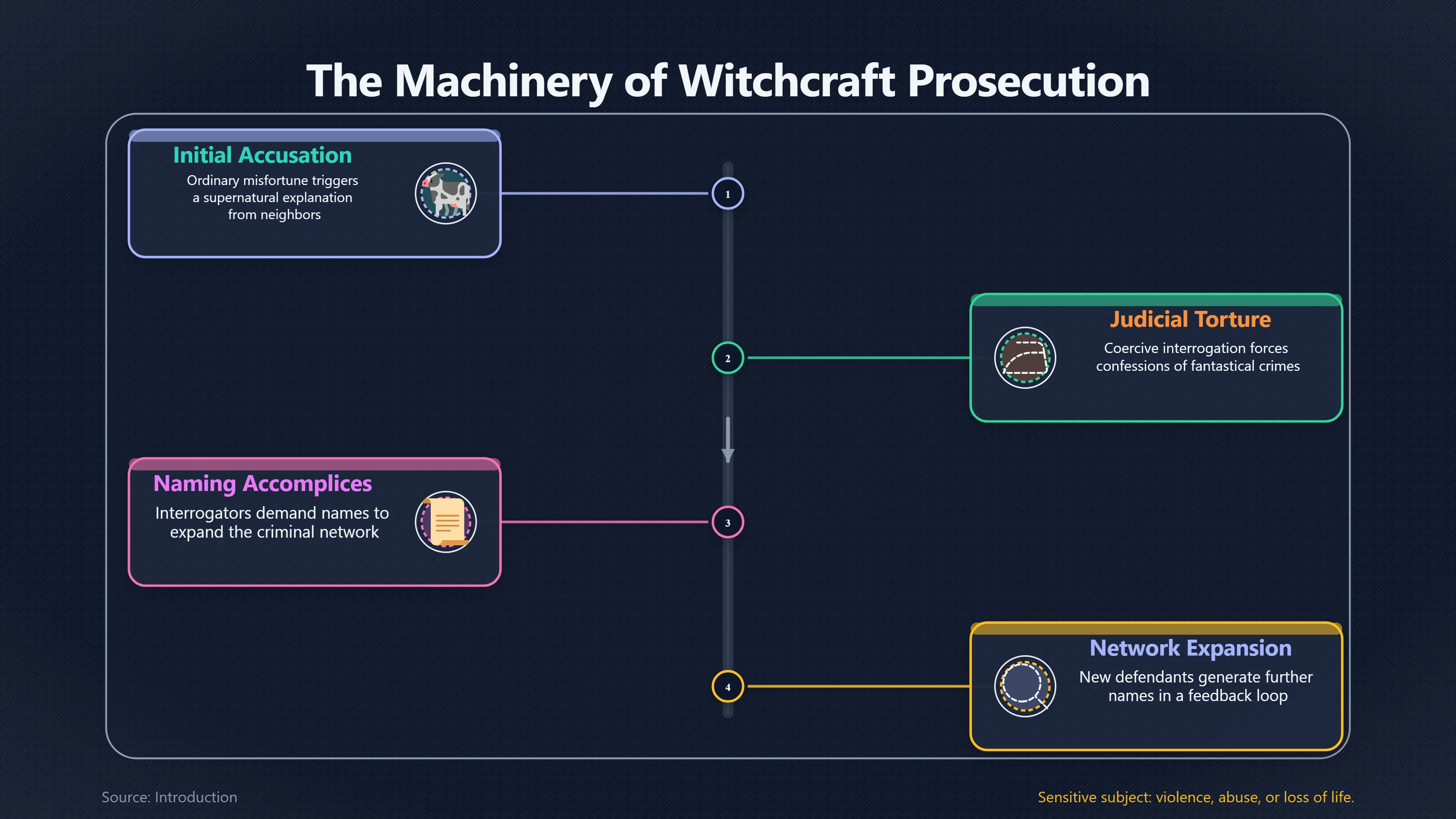
The machinery of persecution followed a self-reinforcing pattern:
- A suspect was accused of causing illness, death or misfortune.
- Under torture, the suspect confessed to impossible or fantastical crimes.
- Interrogators demanded the names of accomplices.
- Newly named individuals became fresh defendants.
- Their interrogations generated still more names.
Each stage appeared to confirm the previous one. Because multiple confessions repeated similar themes, courts interpreted consistency as proof rather than recognising that identical questioning methods naturally produced similar answers.
Modern historians regard these confessions as evidence of coercive judicial practice rather than reliable evidence for organised witchcraft. The trial records demonstrate that people genuinely suffered imprisonment, torture and execution, but they do not demonstrate that the supernatural acts described actually occurred.[Wikipedia]WikipediaMagda LogomerMagda Logomer
Why women predominated
Most Croatian defendants were women, although the pattern cannot be reduced to a single explanation. Gender expectations intersected with household authority, healing practices, widowhood, poverty and neighbourhood conflict. Women who dispensed herbal remedies or occupied ambiguous positions within village society often became particularly vulnerable when communities searched for someone to blame after disaster.
At the same time, not every accused person fitted the same profile. The records show that local circumstances, personal disputes and judicial procedure mattered as much as any single social characteristic. Historians therefore see the trials as products of multiple interacting pressures rather than one simple campaign against women alone.[Hrčak]hrcak.srce.hrHrčak Magda Logomer HerucinaHrčak Magda Logomer Herucina
Magda Logomer and the collapse of legal witch-hunting
The best-known Croatian witch trial illustrates both the brutality of the system and the beginning of its collapse.
Magda Logomer, also known as Herucina, was a respected herbalist from Križevci. In 1757–1758 she was accused of witchcraft and poisoning by neighbours, arrested, tortured and condemned to death. Under interrogation she confessed to acts that included the standard allegations found across European witch trials, including dealings with the Devil—precisely the kind of confession torture was designed to obtain.[Wikipedia]WikipediaMagda LogomerMagda Logomer
Her case differed because it reached the court of Empress Maria Theresa.
The Empress had already required that witchcraft prosecutions receive imperial scrutiny before executions could proceed. Magda was transported to Vienna, where she was examined by the physician Gerard van Swieten and Professor Anton de Haen. Their medical examination documented injuries caused by torture and criticised the proceedings carried out in Križevci. Van Swieten argued that superstition and judicial error, rather than genuine witchcraft, explained the prosecution.[Krizevci]krizevci.euKriževci.eu - personage / magda logomer herucina…
Maria Theresa overturned the death sentence and ordered Magda’s return to Croatia under imperial protection. The intervention represented more than an individual acquittal. It demonstrated the growing willingness of the central Habsburg government to distrust local witchcraft prosecutions and to require stronger standards of evidence.
Although Maria Theresa herself did not entirely reject belief in witchcraft, she increasingly regarded local prosecutions as unreliable and abusive. Her reforms made successful witch trials progressively more difficult, while later legal changes under Joseph II removed the remaining legal framework for prosecuting witchcraft as a criminal offence.[Wikipedia]WikipediaMagda LogomerMagda Logomer
What the Croatian trials reveal about manufactured conspiracies
The Croatian trials are valuable today because they expose how institutions can generate the appearance of overwhelming evidence through flawed procedures.
Several reinforcing mechanisms stand out:
- Ordinary disasters demanded explanation, encouraging communities to search for human agents behind natural events.
- Rumour became testimony, particularly when repeated by multiple neighbours.
- Judicial torture converted suspicion into confession, regardless of truth.
- Confessions produced additional suspects, creating expanding networks that appeared to verify themselves.
- Official records gave authority to coerced stories, making later accusations easier to sustain.
In modern terms, the courts created a feedback loop. Every confession strengthened belief in the conspiracy, even though the investigative methods themselves produced the evidence on which that belief depended.
Why these trials still matter
Croatian witch trials remain important not because they prove widespread belief in supernatural powers, but because they demonstrate how legal institutions can transform fear into apparently convincing evidence.
They also challenge several persistent myths. The trials were not driven solely by religious authorities, nor were they simply outbreaks of irrational mass panic. They involved structured legal systems, written procedures, official interrogation methods and magistrates who believed they were administering justice according to accepted law. Their records reveal how ordinary social conflict, when combined with coercive investigation, could create the illusion of an organised hidden enemy.
The story of Magda Logomer symbolises the turning point. Her acquittal exposed the weaknesses of prosecutions built on torture and rumour, helping shift authority away from local courts towards more sceptical review by the Habsburg state. As a result, Croatian witch trials became not only a chapter in the history of persecution but also an early example of legal reform confronting the dangers of manufactured conspiracies.
Amazon book picks
Further Reading
Books and field guides related to How Croatia's Witch Trials Manufactured a Conspiracy. Use these as the next step if you want deeper reading beyond the article.
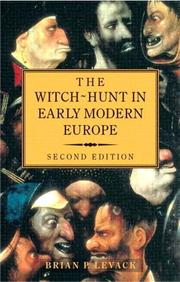
The witch-hunt in early modern Europe
Directly addresses legal systems and persecution.


Endnotes
1.
Source: Wikipedia
Title: Magda Logomer
Link:https://en.wikipedia.org/wiki/Magda_Logomer
2.
Source: krizevci.eu
Link:https://www.krizevci.eu/en_GB/kri%C5%BEevci/personage/magda%2Blogomer%2Bherucina/
Source snippet
Križevci.eu - personage / magda logomer herucina...
3.
Source: hrcak.srce.hr
Title: Hrčak Magda Logomer Herucina
Link:https://hrcak.srce.hr/en/clanak/259270
4.
Source: hrcak.srce.hr
Title: Hrčak Magda Logomer Herucina
Link:https://hrcak.srce.hr/clanak/259271
Source snippet
XVIII NO. 1, 2016. Stručni rad Magda Logomer Herucina Zdenko Balog Image: mail * * * Puni tekst: hrvatski pdf 31.137 Kb str. 119-132 preu...
5.
Source: hrcak.srce.hr
Title: hr Magda Logomer Herucina
Link:https://hrcak.srce.hr/en/175739
Source snippet
XVIII NO. 1, 2016. Professional paper Magda Logomer Herucina Zdenko Balog Image: mail * * * Full text: croatian pdf 31.137 Kb page 119...
6.
Source: hrcak.srce.hr
Title: hr Magda Logomer Herucina
Link:https://hrcak.srce.hr/clanak/259270%3F
7.
Source: hrcak.srce.hr
Title: hr Magda Logomer Herucina
Link:https://hrcak.srce.hr/clanak/259270
Additional References
8.
Source: vecernji.hr
Link:https://www.vecernji.hr/vijesti/ona-je-zadnja-hrvatska-vjestica-vezali-su-je-na-drveni-kotac-i-lomili-joj-kosti-prijavila-ju-je-susjeda-1816856
Source snippet
Lomili su joj kosti, metalnim bičevima trgali kožu: Zbog svojih vještina proglašena je vješticom, a spasila ju je carica - Večernji.hrNov...
9.
Source: wildwitchherbs.com
Link:https://wildwitchherbs.com/balkan-witch-trials/
Source snippet
A Brief History of Balkan Witch Trials | Wild Witch HerbsJanuary 20, 2026 — A BRIEF HISTORY OF BALKAN WITCH TRIALS WHAT WERE BALKAN WITCH...
Published: January 20, 2026
10.
Source: gradski-muzej-krizevci.hr
Title: Vremeplov: 18
Link:https://www.gradski-muzej-krizevci.hr/?p=1964
Source snippet
05. 1706. rođena je Magda Logomer-Herucina – Gradski muzej KriževciMay 18, 2020 — VREMEPLOV: 18. 05. 1706. ROĐENA JE MAGDA LOGOMER-HERUCI...
Published: May 18, 2020
11.
Source: youtube.com
Title: Zagreb Talks: Zagrebačke vještice I Zagreb Witches
Link:https://www.youtube.com/watch?v=TQ00RZNlucY
Source snippet
The Witch Trial Machine — How the Inquisition Turned Fear Into Power...
12.
Source: youtube.com
Title: Cursed Castle on the Mountain
Link:https://www.youtube.com/watch?v=pjXDWHe02Og
Source snippet
After Dark Tours Tell Spooky Tales of Dubrovnik...
13.
Source: youtube.com
Title: Zagrebačke Vještice
Link:https://www.youtube.com/watch?v=38FBKbAk0cs
Source snippet
Cursed Castle on the Mountain - The Black Queen of Zagreb...
14.
Source: youtube.com
Title: The Witch Trial Machine — How the Inquisition Turned Fear Into Power
Link:https://www.youtube.com/watch?v=hrWUCcTp-Ro
Source snippet
Zagrebačke Vještice...
15.
Source: youtube.com
Title: After Dark Tours Tell Spooky Tales of Dubrovnik
Link:https://www.youtube.com/watch?v=dmPjZuwHh50
16.
Source: independent.academia.edu
Title: eduzdenko balog
Link:https://independent.academia.edu/zdenkobalog
17.
Source: enciklopedija.hr
Link:https://www.enciklopedija.hr/clanak/inkvizicija
Topic Tree