Within Cape Verde
When Did Healing Become Forbidden Magic?
Christian prayers, protective objects and African-derived practices could be understood as healing by users and superstition by clergy.
On this page
- Cape Verde in the Portuguese Atlantic
- Prayers, charms and spiritual protection
- Who had the power to define superstition
Page outline Jump by section
Introduction
Healing practices in Cape Verde have long existed at the meeting point of Catholic devotion, West African knowledge and the realities of life in the Portuguese Atlantic. Rather than a clear division between religion and magic, many islanders combined prayers, blessings, herbal remedies and protective objects in ways that made practical sense within everyday life. The controversy lay less in what ordinary people did than in who had the authority to decide whether a practice counted as acceptable healing or forbidden superstition.

Unlike parts of Europe or mainland Africa that experienced large-scale witch trials or witch-hunting panics, Cape Verde has left little evidence of organised persecution centred on magical beliefs. Instead, surviving records mainly reveal disputes between local practices and religious authorities, especially missionaries and colonial officials, who often classified African-derived healing traditions as sorcery or superstition even while recognising the effectiveness of many herbal remedies.[Cambridge University Press & Assessment]cambridge.orgCambridge University Press & AssessmentHybridising Medicine: Illness, Healing and the Dynamics of Reciprocal Exchange on the Upper Guinea…
Cape Verde in the Portuguese Atlantic
Cape Verde occupied a unique position between Portugal, West Africa and the wider Atlantic world. Settled by the Portuguese in the fifteenth century but populated largely through the forced migration of enslaved Africans and later generations of mixed communities, the islands became a place where medical knowledge, religious ideas and ritual practices circulated continuously.
European medicine in the early modern period itself relied heavily on herbal knowledge, religious prayers and the invocation of saints. African healing traditions likewise combined practical treatments with spiritual explanations of illness. Because these systems already shared important features, everyday healing in Cape Verde often became a hybrid rather than a simple contest between Christianity and African religion.[Cambridge University Press & Assessment]cambridge.orgUniversity Press & Assessment Cross-Cultural Experiments (Chapter 2Cambridge University Press & AssessmentCross-Cultural Experiments (Chapter 2) - Healing Knowledge in Atlantic Africa…
This blending did not mean everyone agreed about what was legitimate. Portuguese missionaries increasingly attempted to distinguish between remedies they regarded as natural medicine and rituals they condemned as magical. Those judgements reflected theological priorities as much as medical evidence.
Prayers, charms and spiritual protection
For many Cape Verdeans, illness was rarely understood as a purely physical problem. Recovery might involve several forms of protection at once:
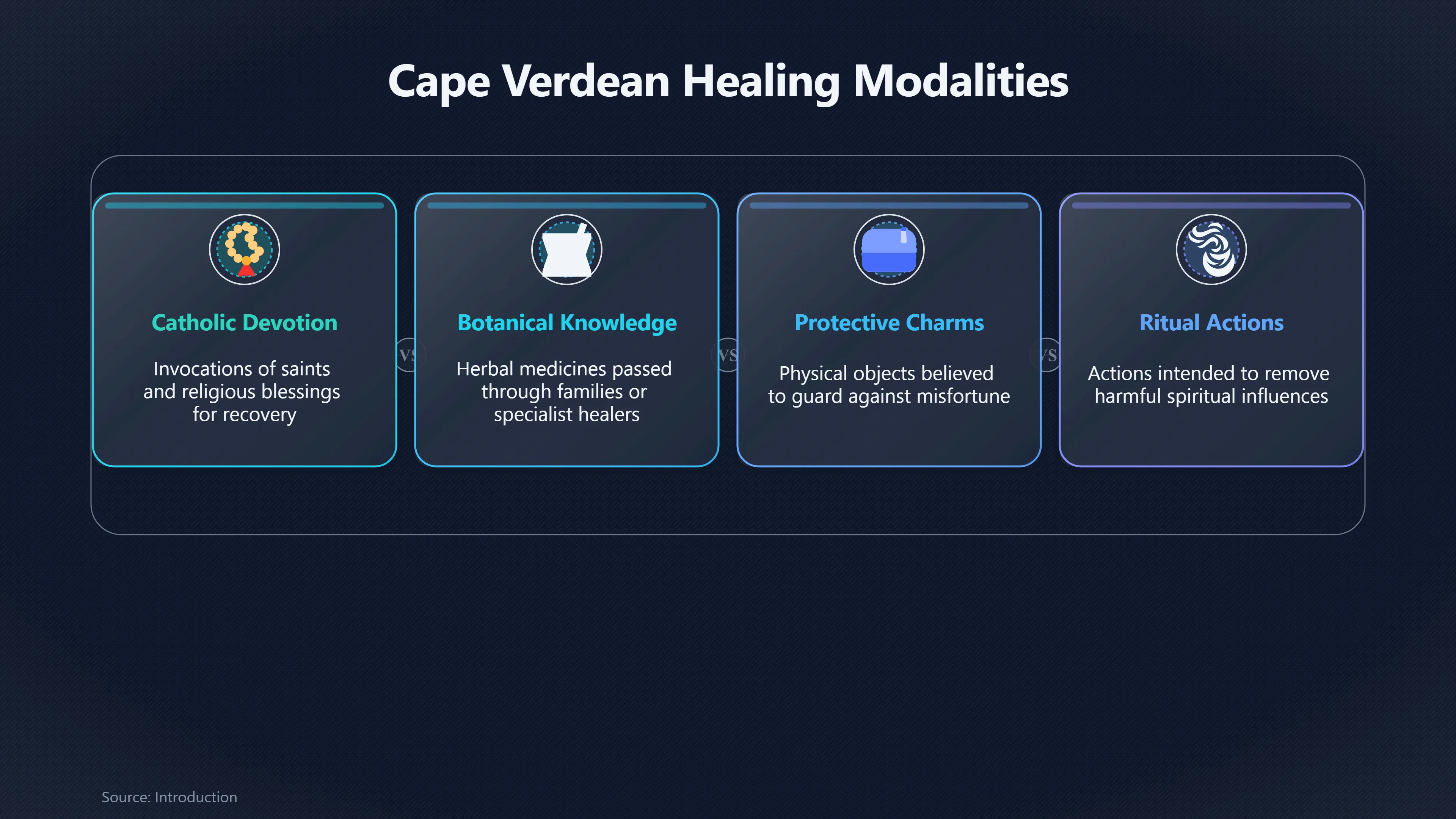
- Catholic prayers, blessings and invocations of saints.
- Herbal medicines passed through families or specialist healers.
- Protective objects or charms believed to guard against misfortune.
- Ritual actions intended to remove harmful spiritual influences.
Rather than seeing these practices as contradictory, many islanders regarded them as complementary. A patient might consult someone skilled in herbs while also requesting prayers or religious blessings.
Modern historians studying the wider Upper Guinea Coast, including Cape Verde’s close connections with the mainland, argue that these practices represented practical systems of healthcare embedded within local understandings of society, ancestry and divine protection. The same healer might possess extensive botanical knowledge while also performing rituals that missionaries considered improper.[Cambridge University Press & Assessment]cambridge.orgCambridge University Press & AssessmentHybridising Medicine: Illness, Healing and the Dynamics of Reciprocal Exchange on the Upper Guinea…
When did healing become forbidden magic?
The boundary between healing and forbidden magic depended largely on who made the judgement.
Missionaries generally accepted that African practitioners possessed valuable knowledge of plants and remedies. Contemporary reports describe admiration for experienced herbalists who successfully treated wounds and illnesses. Yet those same reports frequently condemned divination, protective rituals and spiritual diagnosis as pagan rites, sorcery or witchcraft.[Cambridge University Press & Assessment]cambridge.orgCambridge University Press & AssessmentHybridising Medicine: Illness, Healing and the Dynamics of Reciprocal Exchange on the Upper Guinea…
This distinction reflected broader developments within early modern Catholic Europe. Following the Reformation and Counter-Reformation, church authorities increasingly classified many forms of popular religious practice as “superstition”. The same process occurred in Portugal itself, where unofficial prayers, charms and healing rituals came under greater scrutiny. When these ideas were carried into the Atlantic empire, African-derived practices faced even stronger suspicion because they were associated with non-Christian traditions.[Cambridge University Press & Assessment]cambridge.orgUniversity Press & Assessment Cross-Cultural Experiments (Chapter 2Cambridge University Press & AssessmentCross-Cultural Experiments (Chapter 2) - Healing Knowledge in Atlantic Africa…
Consequently, the difference between acceptable prayer and forbidden magic often rested not on whether a treatment appeared effective, but on whether church authorities believed its spiritual source was orthodox.
Missionaries, colonial power and accusations of superstition
Jesuit accounts from the seventeenth century reveal this tension clearly. Missionaries complained that healers arriving from the nearby West African coast continued to practise divination and cures learned before conversion. Reports described these methods as products of “Satan’s school” while simultaneously acknowledging the widespread demand for such healers among local populations.[Cambridge University Press & Assessment]cambridge.orgCambridge University Press & Assessmentc⃝The Author 2016. Published by Cambridge University Press 2016…
These accounts deserve careful reading because they were written from the perspective of religious authorities. Their language reflected campaigns against perceived superstition rather than neutral descriptions of everyday belief. Modern historians therefore caution against accepting missionary labels such as “sorcery” or “witchcraft” at face value. What missionaries condemned often represented ordinary systems of healthcare, protection or spiritual interpretation within African communities.[Cambridge University Press & Assessment]cambridge.orgCambridge University Press & AssessmentHybridising Medicine: Illness, Healing and the Dynamics of Reciprocal Exchange on the Upper Guinea…
Cape Verde’s role as an administrative and missionary base for Portuguese expansion also meant that these debates were connected to broader colonial efforts to regulate religion and social behaviour across the Upper Guinea Coast.
Who had the power to define superstition?
The central historical question is not simply whether people believed in charms or healing rituals, but who possessed the authority to define those beliefs.
Several groups competed to shape that definition:
- Local communities valued inherited healing knowledge because it addressed everyday illness and uncertainty.
- Catholic clergy distinguished between approved devotional practices and unauthorised ritual specialists.
- Colonial authorities often reinforced church judgements because controlling religion also strengthened political authority.
- African and Creole clergy sometimes occupied an intermediate position, translating Christianity into local settings while remaining subject to official doctrine.[Universidade NOVA de Lisboa]novaresearch.unl.pto clero nativo na diocese de cabo verdeUniversidade NOVA de LisboaO CLERO NATIVO NA DIOCESE DE CABO VERDE (1533- 1755) - Universidade NOVA de Lisboa…
This struggle over authority explains why identical actions—reciting prayers, carrying protective objects or preparing herbal remedies—could be praised as piety in one context and condemned as superstition in another.
Heresy was not the same as magical healing
One of the best-documented religious prosecutions connected with Cape Verde illustrates this distinction.
The seventeenth-century case of Bento de Jesus concerned mystical preaching judged heretical by the Portuguese Inquisition rather than folk healing or magical practice. His prosecution reflected disputes over religious authority and doctrine, not a campaign against popular healers or protective charms.[UESB Periodicals Portal]periodicos2.uesb.brUESB Periodicals PortalAn African preacher in the Portuguese inquisition: Bento de Jesus and the ideology of slavery in Cape Verde in the…
This distinction matters because references to the Inquisition can create the false impression that Cape Verde experienced widespread witch persecutions similar to those elsewhere. Available evidence does not support that conclusion. The documented conflicts focus far more often on questions of orthodoxy, missionary control and religious authority than on systematic witch-hunting.
Why the evidence remains limited
Readers searching for famous Cape Verdean witch trials or major panics over magical healing are unlikely to find them because the historical record is genuinely sparse.
Most surviving documents were written by colonial officials or church representatives rather than by ordinary healers or patients. Their descriptions therefore emphasise what authorities opposed instead of recording how local people understood their own practices. Many everyday traditions also survived through oral transmission rather than written documentation.
The result is a history in which healing, charms and protective rituals are visible mainly when they attracted official criticism. Modern scholarship increasingly treats these sources as evidence of negotiation between different medical and religious traditions rather than simple proof of widespread superstition or forbidden magic.[Cambridge University Press & Assessment]cambridge.orgCambridge University Press & AssessmentHybridising Medicine: Illness, Healing and the Dynamics of Reciprocal Exchange on the Upper Guinea…
Amazon book picks
Further Reading
Books and field guides related to When Did Healing Become Forbidden Magic?. Use these as the next step if you want deeper reading beyond the article.

The Spirit Catches You and You Fall Down
Explores intersections of healing, belief and medicine.
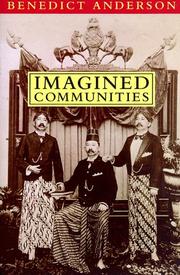
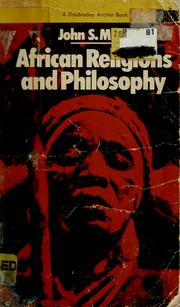
African religions and philosophy
Background on African religious traditions influencing healing.

Endnotes
1.
Source: cambridge.org
Link:https://www.cambridge.org/core/journals/medical-history/article/hybridising-medicine-illness-healing-and-the-dynamics-of-reciprocal-exchange-on-the-upper-guinea-coast-west-africa/AE48F7186EA20618774F185136526525
Source snippet
Cambridge University Press & AssessmentHybridising Medicine: Illness, Healing and the Dynamics of Reciprocal Exchange on the Upper Guinea...
2.
Source: cambridge.org
Title: University Press & Assessment Cross-Cultural Experiments (Chapter 2)
Link:https://www.cambridge.org/core/books/healing-knowledge-in-atlantic-africa/crosscultural-experiments/98A57C02A281C58F28ED12EA7CA6B2D2
Source snippet
Cambridge University Press & AssessmentCross-Cultural Experiments (Chapter 2) - Healing Knowledge in Atlantic Africa...
3.
Source: cambridge.org
Link:https://www.cambridge.org/core/services/aop-cambridge-core/content/view/AE48F7186EA20618774F185136526525/S002572731600003Xa.pdf/hybridising_medicine_illness_healing_and_the_dynamics_of_reciprocal_exchange_on_the_upper_guinea_coast_west_africa.pdf
Source snippet
Cambridge University Press & Assessmentc⃝The Author 2016. Published by Cambridge University Press 2016...
4.
Source: periodicos2.uesb.br
Link:https://periodicos2.uesb.br/index.php/odeere/article/view/1531
Source snippet
UESB Periodicals PortalAn African preacher in the Portuguese inquisition: Bento de Jesus and the ideology of slavery in Cape Verde in the...
5.
Source: novaresearch.unl.pt
Title: o clero nativo na diocese de cabo verde 1533 1755
Link:https://novaresearch.unl.pt/en/publications/o-clero-nativo-na-diocese-de-cabo-verde-1533-1755/
Source snippet
Universidade NOVA de LisboaO CLERO NATIVO NA DIOCESE DE CABO VERDE (1533- 1755) - Universidade NOVA de Lisboa...
6.
Source: cabo-verde.cv
Title: Shadows of Cabo Verde: Legends & Myths of the Islands – Cabo Verde
Link:https://cabo-verde.cv/shadows-of-cabo-verde-legends-myths-of-the-islands/
Source snippet
May 30, 2026 — NEWS Latest News * Cabo Verde * News * Shadows of Cabo Verde: Legends & Myths of the Islands Image: Shadows of Cabo Verde...
Published: May 30, 2026
7.
Source: encyclopedia.com
Title: Cape Verdeans | Encyclopedia.com
Link:https://www.encyclopedia.com/places/africa/cape-verde-political-geography/cape-verdeans
Source snippet
Cape Verdeans are overwhelmingly Roman Catholic. In the early 1900s the Protestant Church of the Nazarene and the Sabbatarians had succes...
Additional References
8.
Source: journals.ed.ac.uk
Title: ed.ac.uk From superstition to folk medicine
Link:https://journals.ed.ac.uk/index.php/mat/article/download/4642/6346?inline=1
Source snippet
superstition to folk medicineSeptember 13, 2016 — Parish priests, preachers, confessors, and inquisitors – jurists and men of law rather...
Published: September 13, 2016
9.
Source: youtube.com
Title: What Is Batuku? | Black Creative Expression
Link:https://www.youtube.com/watch?v=fW8bCeC8CJM
Source snippet
CAPE VERDE: The Islands With No Ancestors — And the Culture They Built From Nothing...
10.
Source: youtube.com
Link:https://www.youtube.com/watch?v=nHuwNcs7oRk
Source snippet
What Is Batuku? | Black Creative Expression: Introduction to Africana Studies | Marisa Correia...
11.
Source: youtube.com
Link:https://www.youtube.com/watch?v=UvUZh4fEGyI
Source snippet
Batuko | Batuque | Batuku - Less known world heritage of Cabo Verde...
12.
Source: youtube.com
Title: Batuko | Batuque | Batuku
Link:https://www.youtube.com/watch?v=2LUlhvc4zb8
Source snippet
Traditional Cape Verdean Wedding Culture, Rituals & Hidden Meanings...
13.
Source: english-heritage.org.uk
Link:https://www.english-heritage.org.uk/learn/histories/journey-into-witchcraft-beliefs
15.
Source: caboverde-info.com
Link:https://www.caboverde-info.com/esp/Identidad/Cultura/Religiones
16.
Source: caboverde-info.com
Link:https://www.caboverde-info.com/eng/Identity/Culture/Religions
17.
Source: revistas.usp.br
Link:https://revistas.usp.br/reaa/en/article/view/11453
Topic Tree