When Fear Became Power in Haiti
Haiti’s history of collective fear is not best understood as a catalogue of mysterious “mass hysteria”. Its most important episodes involve something more concrete: authorities, churches, political rulers and frightened communities turning religious difference, epidemic disease or supernatural accusation into a reason for persecution.
Page outline Jump by section
Introduction
The clearest documented cases include nineteenth- and twentieth-century campaigns against Vodou, the manipulation of supernatural fear under François Duvalier, killings during the 2010 cholera epidemic, and the massacre of mainly older residents in Port-au-Prince in December 2024 following witchcraft accusations. These events reveal a recurring pattern. Disaster or political insecurity creates a search for hidden causes; familiar prejudices identify likely culprits; and people with religious authority, weapons or media access turn belief into action. The beliefs matter, but so do poverty, weak institutions, foreign stereotypes and struggles for power.
Why Vodou became the centre of Haitian scares
Vodou developed in colonial Saint-Domingue and independent Haiti from West and Central African religious traditions interacting with Roman Catholicism. It has no single creed, central hierarchy or universally binding ritual system. Practice varies between families, communities and congregations, and many adherents have also regarded themselves as Catholic or Christian. Treating Vodou as a unified secret organisation therefore badly distorts the religion.[anthroencyclopedia.com]anthroencyclopedia.comOpen Encyclopedia of Anthropology Haitian VodouOpen Encyclopedia of AnthropologyHaitian VodouApril 5, 2022 — 5 Apr 2022 — Amongst the issues which have captured the attention of Vodou…
European colonists and later foreign observers frequently interpreted African-derived ceremonies through categories such as sorcery, savagery and devil worship. Haitian elites also sometimes adopted these judgements when presenting the country as modern, orderly and Christian. This produced a long legal history in which popular ritual practices could be prosecuted as spell-making or “superstition”. Haiti’s penal codes of 1835 and 1864 restricted practices identified with Vodou, and later legislation tightened the state’s ability to suppress them.[OpenEdition Journals]journals.openedition.orgOpenEdition JournalsProhibition, persecution, performanceThe 1835 and 1864 Haitian penal codes banned «le vaudoux» as a type of «sortilèg…
The word “cult” is especially misleading here. Vodou was not a small, centrally controlled sect built around an all-powerful leader. It was a broad and locally varied religious world woven into healing, family obligations, agriculture, burial, community identity and relations with ancestors and spirits. Hostile outsiders nevertheless described it as an underground conspiracy. That framing made ceremonies appear politically suspicious and encouraged the idea that ordinary religious leaders were dangerous manipulators.[Open Encyclopedia of Anthropology]anthroencyclopedia.comOpen Encyclopedia of Anthropology Haitian VodouOpen Encyclopedia of AnthropologyHaitian VodouApril 5, 2022 — 5 Apr 2022 — Amongst the issues which have captured the attention of Vodou…
This history created fertile ground for later moral panics. When disease, dictatorship or natural disaster struck, accusations against Vodou practitioners did not arise in a cultural vacuum. They drew upon laws, sermons, sensational books and foreign journalism that had spent generations presenting Haitian religion as a source of hidden violence.
When “superstition” became a target of the state
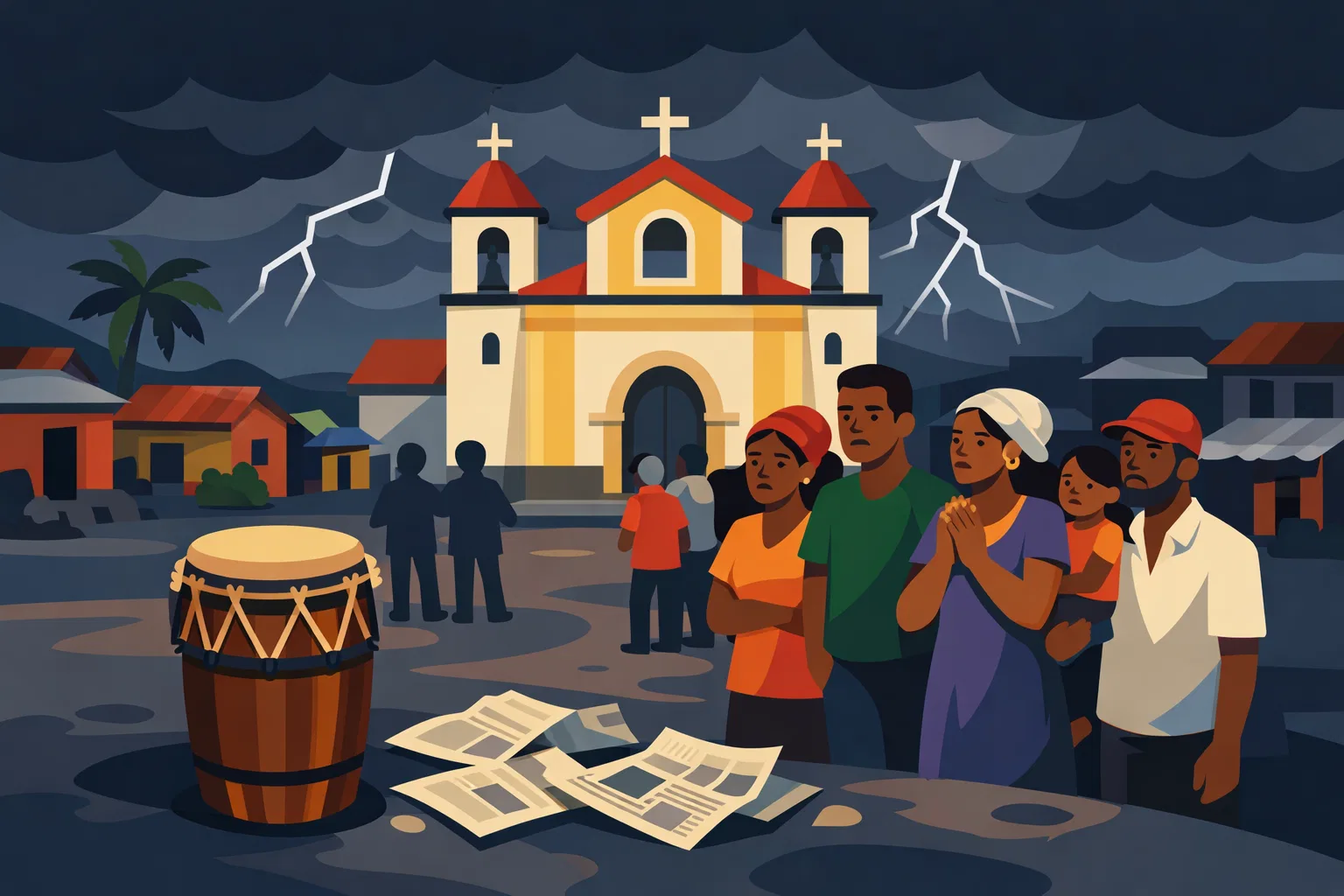
The most organised historical persecutions were the anti-superstition campaigns backed by the Roman Catholic Church and, at times, the Haitian government. Their declared purpose was religious purification and modernisation. In practice, they treated temples, ritual objects and ceremonies as evidence of ignorance or evil.
The most severe campaign took place in 1940–42 under President Élie Lescot. Existing laws supplied a legal basis, while clergy and government forces supported the destruction of ritual spaces and objects. Drums, sacred vessels, flags and other items could be seized or burned, and practitioners were pressured to renounce their religion. The official language of cleansing made religious repression sound like social improvement.[Island Luminous]islandluminous.fiu.edupart09 slide13Island Luminous“The Anti-Superstition Campaign” by Kate Ramsey, Ph.D.Then, in 1940-42 this new law became the legal basis for the Roman C…
This was not simply a spontaneous outburst by frightened villagers. It was an institutional campaign shaped by competition over moral authority. The Church sought greater control over religious life, the state wanted to display modern discipline, and Vodou became the convenient opposite of respectable citizenship. The campaign also shows why “panic” must not be used as a catch-all term. It combined prejudice and fear with planned coercion, legal power and religious rivalry.
The effort generated resistance as well as compliance. Haitian intellectuals associated with cultural nationalism argued that popular religion, music and folklore were central to national identity rather than stains to be removed. Ethnological study also began challenging sensational accounts. Ironically, some officials promoted sanitised versions of Haitian folklore for international performance while persecuting comparable practices at home.[fiu.edu]islandluminous.fiu.edupart09 slide13Island Luminous“The Anti-Superstition Campaign” by Kate Ramsey, Ph.D.Then, in 1940-42 this new law became the legal basis for the Roman C…
The United States occupation of Haiti from 1915 to 1934 reinforced this climate. American personnel encountered Vodou through racial and colonial assumptions and conducted prosecutions intended to curtail ceremonies. At the same time, travel writers and entertainers sold foreign audiences lurid stories about sacrifice, secret rites and the living dead. Suppression inside Haiti and fascination abroad thus fed one another.[Marine Corps University]usmcu.eduOpen source on usmcu.edu.
Duvalier and the politics of supernatural fear
François “Papa Doc” Duvalier, president from 1957 until his death in 1971, did not invent Haitian beliefs about spirits, sorcery or the dead. He did, however, exploit religious imagery and public uncertainty to strengthen an already violent dictatorship.
Duvalier presented himself as closely identified with Haiti’s Black majority and its popular culture. Accounts of his rule describe him encouraging rumours about supernatural powers and cultivating an image that blurred presidential authority with religious dread. Some Vodou religious figures received government positions, but this was not evidence that Vodou as a whole controlled the regime. It was political patronage: selected people and symbols were incorporated into a dictatorship that persecuted opponents of many beliefs.[Wikipedia]WikipediaHaitian VodouHaitian Vodou
His paramilitary force, officially the Volunteers for National Security, became known as the Tonton Macoute after a figure from Haitian stories used to frighten children. Members’ dark glasses, straw hats, denim clothing and unpredictable violence gave the organisation an instantly recognisable appearance. The supernatural associations mattered because they magnified terror, but the fear was grounded in real disappearances, extortion, torture and murder.[Wikipedia]WikipediaTonton MacouteTonton Macoute
Calling this “mass delusion” would therefore miss the point. Haitians had rational reasons to fear the Macoute. Rumours about occult protection or magical powers operated alongside visible state violence, not instead of it. The regime benefited when citizens were unsure where ordinary political authority ended and unseen power supposedly began.
Duvalier’s appropriation of religious imagery later complicated the position of Vodou practitioners. After his son Jean-Claude Duvalier was overthrown in 1986, some religious leaders were attacked because they were believed to have collaborated with the dictatorship. This “uprooting” violence mixed political revenge, local grievances and anti-Vodou campaigning. It again demonstrated the danger of treating an internally diverse religion as though all practitioners belonged to one political bloc.[Wikipedia]WikipediaHaitian VodouHaitian Vodou
Zombies: belief, punishment and foreign mythmaking
The Haitian zombie is one of the world’s most recognisable horror figures, but the modern cinematic monster bears little resemblance to the older Haitian idea. In Haitian accounts, a zombie is generally not a flesh-eating corpse spreading an infection. It is a person deprived of agency and reduced to a condition of social or spiritual enslavement.
That distinction reflects Haiti’s history. A society created through a revolution against racial slavery developed a frightening image of the person who loses freedom even beyond apparent death. Scholars have consequently interpreted the zombie as a symbol of domination, social exclusion and the ultimate destruction of personhood. Foreign films largely removed that historical meaning and replaced it first with an exotic sorcerer’s servant, then with the contagious undead mobs of modern popular culture.[Sunchina]sunchina.co.ukOpen source on sunchina.co.uk.
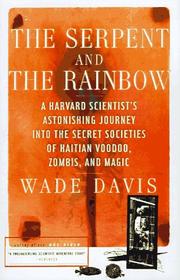
The most famous alleged real-life case is that of Clairvius Narcisse, who was declared dead in 1962 and reappeared years later claiming that he had been drugged, buried and forced to work. Ethnobotanist Wade Davis argued that powders containing tetrodotoxin, associated with pufferfish, might produce paralysis resembling death. The theory became internationally famous and helped inspire the film The Serpent and the Rainbow.[Wikipedia]WikipediaClairvius NarcisseClairvius Narcisse
The chemical explanation remains disputed. Toxicologists challenged the evidence, later tests did not reliably establish the required toxin in purported zombie preparations, and critics accused the research of selecting favourable findings while overlooking contradictions. Narcisse’s story is therefore not scientific proof that a standard “zombie drug” exists. It is a contested case at the intersection of illness, family testimony, social punishment, pharmacology and culturally shaped interpretation.[Wikipedia]WikipediaClairvius NarcisseClairvius Narcisse
The larger lesson is that belief cannot be separated neatly from social reality. A person publicly identified as dead, expelled from family life or believed to have been transformed may experience genuine exclusion regardless of what caused the original condition. At the same time, foreign audiences’ appetite for a chemical secret or occult conspiracy can obscure the Haitian meanings of slavery, identity and loss of autonomy.
Disaster, curses and the 2010 earthquake
After the catastrophic earthquake of 12 January 2010, some Christian preachers claimed that Haiti’s suffering resulted from a supposed pact with the Devil made during the country’s revolution against French slavery. American televangelist Pat Robertson repeated this story while rescue and recovery operations were still under way, presenting the earthquake as the consequence of a spiritual bargain.[Christian Science Monitor]csmonitor.comPat Robertson Haiti comments French view theory with disbeliefPat Robertson Haiti comments French view theory with disbelief
The tale refers loosely to a religious gathering at Bois Caïman in August 1791, traditionally associated with the beginning of the Haitian Revolution. Historians do not treat the event as evidence of a literal satanic contract. Vodou does not share the evangelical Christian concept of Satan upon which the accusation depends. The “pact” story recasts a revolt by enslaved people as a sinful conspiracy and transfers responsibility for Haiti’s later suffering from slavery, colonial extraction, foreign intervention and political failure onto Haitians themselves.[mdpi.com]mdpi.comOpen source on mdpi.com.
Within Haiti, interpretations of the earthquake were more varied than foreign commentary suggested. Survivors drew on Catholic, Protestant and Vodou ideas, often in overlapping rather than mutually exclusive ways. Some evangelical campaigns blamed Vodou and called for national conversion, while other religious communities organised mourning, aid and collective worship. Research on survivors found that religious explanations interacted with trauma, depression and resilience rather than producing one uniform national response.[nih.gov]pubmed.ncbi.nlm.nih.govOpen source on nih.gov.
There were also reports of hostility towards Vodou ceremonies and practitioners in the earthquake’s aftermath. This was a moral panic in the proper sense: a minority tradition was portrayed as a threat to the nation’s recovery, while conversion was promoted as the solution. Yet it did not engulf all Haitians, and it should not be simplified into a struggle between two completely separate populations. Haitian religious life has long involved movement, overlap and family ties across denominational boundaries.[R-3 Repository]repository.rice.eduOpen source on rice.edu.
Cholera and the return of the witch-hunt
The cholera epidemic that began in October 2010 produced one of Haiti’s clearest modern witch panics. In several communities, people accused of using supernatural means to spread the disease were attacked and killed. Early police reports recorded at least a dozen deaths, while Haiti’s principal Vodou organisation later reported approximately 45 victims. The differing totals reflect weak access and incomplete reporting, but the occurrence of lethal persecution is well documented.[aljazeera.com]aljazeera.comAl Jazeera Haiti reels from voodoo lynchings | NewsAl Jazeera Haiti reels from voodoo lynchings | News
The panic flourished because cholera seemed sudden, invisible and terrifying. Many Haitians had no living memory of an outbreak, public-health information was uneven, and the state’s ability to explain or contain the epidemic was severely weakened after the earthquake. In that setting, accusations supplied an apparently understandable human cause: a neighbour, healer or religious practitioner was said to be deliberately sending illness.
Scientific investigation instead connected the outbreak to contamination of the Artibonite river system associated with a United Nations peacekeeping camp. The United Nations later acknowledged a moral responsibility towards those affected. The contrast is stark: while vulnerable residents were being blamed and killed, the epidemic’s actual origin lay in failures of sanitation and institutional accountability.[UNDOCS]docs.un.orgOpen source on un.org.
These attacks should not be treated as evidence that Haitian culture naturally produces irrational violence. Epidemics in many societies generate rumours about deliberate poisoning, outsiders, minorities and hidden agents. Haiti’s particular scapegoats reflected its history of anti-Vodou prejudice, limited access to medical explanations and the breakdown of trusted authority. Fear became lethal where local accusation faced little effective policing or legal restraint.
The 2024 massacre of older people
The most serious recent example occurred in the Wharf Jérémie area of Cité Soleil in December 2024. Haitian authorities, the United Nations and human-rights organisations reported that a gang leader ordered killings after being told that older people had caused his child’s illness through witchcraft. The United Nations placed the death toll at at least 184, including 127 older people, although early local estimates varied and access to the gang-controlled district made independent verification difficult.[Reuters]reuters.comHaiti gang massacres around 180 people, targeting elderlyHaiti gang massacres around 180 people, targeting elderly
The victims were not killed by a leaderless crowd suddenly overwhelmed by shared symptoms. They were selected and murdered within a territory controlled by armed men. Witchcraft accusation supplied the justification and the target list, but gang power supplied the means. Reports indicated that Vodou religious figures and community elders were among those pursued and that people attempting rescues were also killed.[Reuters]reuters.comHaiti gang massacres around 180 people, targeting elderlyHaiti gang massacres around 180 people, targeting elderly
Age was crucial. Older residents may be regarded as repositories of spiritual knowledge, family history or local authority, making them vulnerable when illness is attributed to hidden personal influence. The massacre shows how supernatural suspicion can attach itself to existing inequalities. People who are physically less able to flee and lack armed protection become easy scapegoats for a ruler seeking someone to punish.
It also demonstrates why belief-based violence cannot be analysed separately from Haiti’s security collapse. In a functioning legal system, an accusation should trigger investigation and protection. In gang-held territory, the accuser may also command the gunmen, control movement and prevent witnesses from communicating. Under those conditions, rumour becomes an instrument of government.
What these episodes have in common
Haiti’s major panics and scares vary greatly, but several mechanisms recur.
Crisis creates demand for an intentional cause. Epidemics, earthquakes, political upheaval and unexplained illness are difficult to accept as impersonal events. A witch, sorcerer, religious minority or ancestral curse offers a story with identifiable agents.
Old stereotypes determine who is blamed. Vodou practitioners were vulnerable because law, missionary teaching and foreign popular culture had long associated their religion with criminal magic. New fears travelled along established channels of prejudice.
Authority gives rumours practical force. A private suspicion may remain harmless. A priest, president, militia commander or gang leader can turn it into a campaign, arrest, expulsion or killing.
Real danger and supernatural imagery often coexist. Fear of the Tonton Macoute was not imaginary; the organisation committed political violence. Supernatural associations made an already dangerous force appear even more inescapable.
Foreign mythmaking feeds local stigma. Zombie films, travel writing and claims about a satanic national curse present Haiti as uniquely irrational. Such stories can make discrimination appear natural while concealing the roles of slavery, occupation, poverty and institutional failure.
These patterns resemble witch panics elsewhere, but Haiti’s experience is distinctive because of the central place of the Haitian Revolution and Vodou in international ideas about the country. Fear has repeatedly been used to reverse the revolution’s meaning: a successful uprising against slavery is retold as a devil’s bargain, while an African-derived religion becomes the supposed cause of national misfortune.
Belief, law and religious freedom today
Haiti’s 1987 Constitution established religious freedom and removed earlier barriers against Vodou. In April 2003, President Jean-Bertrand Aristide formally recognised Vodou, enabling its clergy to perform legally recognised ceremonies such as marriages and funerals. The measure was symbolically important after generations of official marginalisation.[refworld.org]refworld.orgOpen source on refworld.org.
Legal recognition did not erase social discrimination. Constitutional amendments in 2012 created concern among Vodou organisations because they removed an article that had expressly repealed an earlier anti-superstition decree. Broader constitutional protections for conscience and religion remained, but practitioners feared that the disappearance of this explicit safeguard could reopen space for discriminatory enforcement.[haitilibre.com]haitilibre.comHaiti Libre.com HaitiHaiti Libre.com Haiti
Nor has recognition ended theological hostility. Some evangelical movements continue to describe Vodou as demonic, while popular accusations of harmful magic remain available during personal or national crises. At the same time, Vodou organisations, scholars, journalists and human-rights advocates have become more effective at challenging such narratives and distinguishing religious practice from criminal conduct.
The appropriate response is not to dismiss all supernatural belief as foolishness or to romanticise every practice labelled traditional. Harmful acts should be investigated as acts, regardless of the claimed religious basis. Equally, illness, death or political disorder must not be treated as evidence against an entire religious community. The central safeguard is ordinary due process: protect the accused, establish material causes, communicate reliable health information and hold powerful instigators accountable.
Why Haiti’s panic history still matters
Haiti’s experience shows how misleading the phrase “mass hysteria” can be. None of the country’s best-documented episodes is adequately explained as a population simply losing its senses. The anti-superstition campaigns were organised persecution. Duvalier’s atmosphere of occult dread supported actual state terror. Cholera accusations arose amid an epidemic with a traceable material source. The 2024 killings were a gang massacre rationalised through witchcraft claims.
Belief nevertheless mattered in every case. It shaped whom people trusted, whom they feared and which explanations felt plausible. But beliefs became dangerous when joined to unequal power: a church that could call upon the police, a dictator with a militia, a mob seeking an unprotected neighbour or a gang leader controlling an isolated district.
The most persistent myth is that Haiti is uniquely governed by superstition. Its history suggests the opposite lesson. Collective fear follows recognisable human patterns found across countries and periods: crisis, uncertainty, scapegoating, repetition and authority. What makes the Haitian cases culturally important is the way those patterns have been entangled with the legacy of slavery, the defence and persecution of Vodou, and an international imagination that too often prefers curses and zombies to history.

Endnotes
1.
Source: journal.fi
Link:https://journal.fi/suomenantropologi/article/view/116435/68852?acceptCookies=1
Source snippet
of Official Vodou and Vodou Churches in Haiti2003 presidential decreeofficially recognizing Vodou as a religion, as well as attempts to '...
2.
Source: journals.openedition.org
Link:https://journals.openedition.org/gradhiva/352?lang=en
Source snippet
OpenEdition JournalsProhibition, persecution, performanceThe 1835 and 1864 Haitian penal codes banned «le vaudoux» as a type of «sortilèg...
3.
Source: Wikipedia
Title: Lina Mathon-Blanchet
Link:https://en.wikipedia.org/wiki/Lina_Mathon-Blanchet
4.
Source: Wikipedia
Title: Haitian Vodou
Link:https://en.wikipedia.org/wiki/Haitian_Vodou
5.
Source: history.state.gov
Link:https://history.state.gov/milestones/1914-1920/haiti
6.
Source: Wikipedia
Title: History of Haitian Vodou
Link:https://en.wikipedia.org/wiki/History_of_Haitian_Vodou
7.
Source: Wikipedia
Title: Tonton Macoute
Link:https://en.wikipedia.org/wiki/Tonton_Macoute
8.
Source: Wikipedia
Title: Clairvius Narcisse
Link:https://en.wikipedia.org/wiki/Clairvius_Narcisse
9.
Source: researchgate.net
Link:https://www.researchgate.net/publication/351618659_THE_ZOMBIE_TOXIN_The_Debate_Surrounding_the_Toxicology_of_Wade_Davis%27_Research
10.
Source: mdpi.com
Link:https://www.mdpi.com/2077-1444/10/8/464
11.
Source: researchgate.net
Link:https://www.researchgate.net/publication/265937872_Vodou_and_Protestantism_Faith_and_Survival_The_Contest_over_the_Spiritual_Meaning_of_the_2010_Earthquake_in_Haiti
12.
Source: reuters.com
Title: Haiti gang massacres around 180 people, targeting elderly
Link:https://www.reuters.com/world/haiti-gang-massacres-least-110-people-cite-soleil-rights-group-says-2024-12-09/
13.
Source: refworld.org
Link:https://www.refworld.org/reference/annualreport/usdos/2003/en/32108
14.
Source: haitilibre.com
Title: Haiti Libre.com Haiti
Link:https://www.haitilibre.com/en/news-6133-haiti-religion-voodoo-would-be-no-longer-protected-by-the-constitution-amended.html
15.
Source: jstor.org
Link:https://www.jstor.org/stable/24344222
16.
Source: Wikipedia
Title: United States occupation of Haiti
Link:https://en.wikipedia.org/wiki/United_States_occupation_of_Haiti
17.
Source: Wikipedia
Title: Christianity and Vodou
Link:https://en.wikipedia.org/wiki/Christianity_and_Vodou
18.
Source: Wikipedia
Title: List of mass panic cases
Link:https://en.wikipedia.org/wiki/List_of_mass_panic_cases
19.
Source: jstor.org
Link:https://www.jstor.org/stable/43741120
20.
Source: researchgate.net
Link:https://www.researchgate.net/publication/268694182_Outbreak_of_Mass_Psychogenic_Illness_at_a_High_School_Amhara_Region_Ethiopia_April_2010
21.
Source: 2009-2017.state.gov
Link:https://2009-2017.state.gov/documents/organization/171783.pdf
22.
Source: time.com
Title: medicine zombies do they exist
Link:https://time.com/archive/6697896/medicine-zombies-do-they-exist/
23.
Source: anthroencyclopedia.com
Title: Open Encyclopedia of Anthropology Haitian Vodou
Link:https://www.anthroencyclopedia.com/entry/haitian-vodou
Source snippet
Open Encyclopedia of AnthropologyHaitian VodouApril 5, 2022 — 5 Apr 2022 — Amongst the issues which have captured the attention of Vodou...
Published: April 5, 2022
24.
Source: ebsco.com
Title: haitian vodou
Link:https://www.ebsco.com/research-starters/social-sciences-and-humanities/haitian-vodou
Source snippet
Haitian Vodou | Social Sciences and HumanitiesVodou became an official religion of Haiti in 2003. Haitian Vodou is a religion that d...
25.
Source: islandluminous.fiu.edu
Title: part09 slide13
Link:https://islandluminous.fiu.edu/part09-slide13.html
Source snippet
Island Luminous“The Anti-Superstition Campaign” by Kate Ramsey, Ph.D.Then, in 1940-42 this new law became the legal basis for the Roman C...
26.
Source: usmcu.edu
Link:https://www.usmcu.edu/Outreach/Marine-Corps-University-Press/MCH/Marine-Corps-History-Winter-2019/Stability-or-Disruption-The-US-Marine-Occupation-and-the-Voodoo-Trials-in-Haiti-192630/
27.
Source: sunchina.co.uk
Link:https://www.sunchina.co.uk/books/passage.pdf
28.
Source: csmonitor.com
Title: Pat Robertson Haiti comments French view theory with disbelief
Link:https://www.csmonitor.com/World/Europe/2010/0114/Pat-Robertson-Haiti-comments-French-view-theory-with-disbelief
29.
Source: washingtonpost.com
Link:https://www.washingtonpost.com/history/2024/03/24/haiti-deal-devil-bois-caiman/
Source snippet
Historians and scholars, including Yale’s Marlene Daut, refute this as theological and historical nonsense, stressing that Haitian Vodou...
30.
Source: pubmed.ncbi.nlm.nih.gov
Link:https://pubmed.ncbi.nlm.nih.gov/26600411/
31.
Source: repository.rice.edu
Link:https://repository.rice.edu/items/8e057079-1efe-4b4a-a85c-585efe635e19
32.
Source: aljazeera.com
Title: Al Jazeera Haiti reels from voodoo lynchings | News
Link:https://www.aljazeera.com/news/2010/12/25/haiti-reels-from-voodoo-lynchings
33.
Source: cbsnews.com
Title: about 45 killed in haiti for using voodoo
Link:https://www.cbsnews.com/news/about-45-killed-in-haiti-for-using-voodoo/
34.
Source: docs.un.org
Link:https://docs.un.org/en/S/PV.8005
35.
Source: caymancompass.com
Title: haiti government sanctions voodoo
Link:https://www.caymancompass.com/2003/04/10/haiti-government-sanctions-voodoo
36.
Source: pmc.ncbi.nlm.nih.gov
Link:https://pmc.ncbi.nlm.nih.gov/articles/PMC9244373/
37.
Source: pmc.ncbi.nlm.nih.gov
Link:https://pmc.ncbi.nlm.nih.gov/articles/PMC7396040/
38.
Source: sajp.org.za
Link:https://sajp.org.za/index.php/sajp/article/view/1671/2648
Additional References
39.
Source: anthropology.columbia.edu
Link:https://anthropology.columbia.edu/content/performances-prohibition-law-superstition-haiti
Source snippet
Department of AnthropologyLaw, “Superstition,” and National Modernity in Haiti" by Kate...My dissertation focuses on the series of penal...
40.
Source: youtube.com
Title: The Day Vodou Became “Evil”
Link:https://www.youtube.com/watch?v=ve7ObZuPka8
Source snippet
This Haitian Vodou History Documentary provides vital context on how the religious practice was systematically demonized by Western obser...
41.
Source: youtube.com
Title: The Real Zombie Apocalypse – Voodoo, Parasites & Mind Control
Link:https://www.youtube.com/watch?v=u2lWm3PIe5k
Source snippet
Haiti's Voodoo Dictator from Hell - Papa Doc Duvalier...
42.
Source: youtube.com
Title: Haitian Vodou: The Religion the West Demonized
Link:https://www.youtube.com/watch?v=Oc5s430D5B0
Source snippet
The Real Zombie Apocalypse – Voodoo, Parasites & Mind Control...
43.
Source: facebook.com
Link:https://www.facebook.com/brief.nepall/posts/students-in-naubahini-rural-municipality-pyuthan-who-experienced-fainting-trembl/122175067520903506/
44.
Source: kolibris.univ-antilles.fr
Link:https://kolibris.univ-antilles.fr/discovery/fulldisplay?adaptor=Local+Search+Engine&context=L&docid=alma991002626378805746&lang=fr&mode=advanced&offset=0&query=sub%2Cexact%2CHaiti+–+Religious+life+and+customs%2CAND&tab=TOUT&vid=33UAG_INST%3A33UAG_INST
45.
Source: instagram.com
Link:https://www.instagram.com/reel/DY08guokSej/
46.
Source: fieldepidemiology.org
Link:https://fieldepidemiology.org/index.php/ajfe/article/download/7807/6435/21437
47.
Source: reddit.com
Link:https://www.reddit.com/r/AskHistorians/comments/q8cb0f/my_childhood_church_taught_that_the_haitian/
48.
Source: instagram.com
Link:https://www.instagram.com/reel/DE-olMWPH-d/
Topic Tree
Follow this branch
Related pages 192
- Antigua and Barbuda
- Argentina Belief Scares
- Azerbaijan Belief
- Bahrain Beliefs
- North Korea
- +187 more in sidebar