Within Lebanon Belief
How do rumours become modern moral panics?
Recent misinformation about Syrian refugees shows how fear can spread through a society marked by conflict and distrust.
On this page
- Civil war memories and distrust
- Refugee misinformation campaigns
- Social consequences and public debate
Page outline Jump by section
Introduction
In modern Lebanon, rumours about refugees have become one of the country’s clearest examples of a moral panic. The fears do not arise from nowhere. Lebanon has experienced civil war, repeated regional conflicts, political paralysis, economic collapse and one of the world’s largest refugee populations relative to its own population. These are genuine pressures. The panic begins when those real anxieties are redirected towards sweeping claims about refugees as a single dangerous group, often with little evidence for the specific accusations being circulated.

Since the outbreak of the Syrian civil war in 2011, misleading stories spread through television, partisan political rhetoric, messaging apps and social media have repeatedly portrayed Syrian refugees as responsible for crime waves, organised demographic replacement, economic collapse or coordinated security threats. Although individual crimes and security incidents have certainly occurred, researchers and human rights organisations have consistently warned that rumours frequently outpace verified evidence and contribute to discrimination, collective punishment and violence against people who have no connection to the alleged offences.[Human Rights Watch]hrw.orgHuman Rights WatchLebanon: At Least 45 Local Curfews Imposed on Syrian Refugees | Human Rights WatchOctober 3, 2014…
How do rumours become modern moral panics?
Lebanon provides an unusually fertile environment for rumour because trust in official institutions is low. Political parties, religious communities and media outlets often present competing versions of events, while many citizens remember periods when rumours genuinely did signal danger during the civil war.
This history means people are often primed to treat alarming stories seriously before they can be independently verified. Modern communication technology accelerates this process. Videos stripped of context, old photographs presented as new events, fabricated crime stories and exaggerated statistics can circulate through WhatsApp groups or social media far faster than corrections.
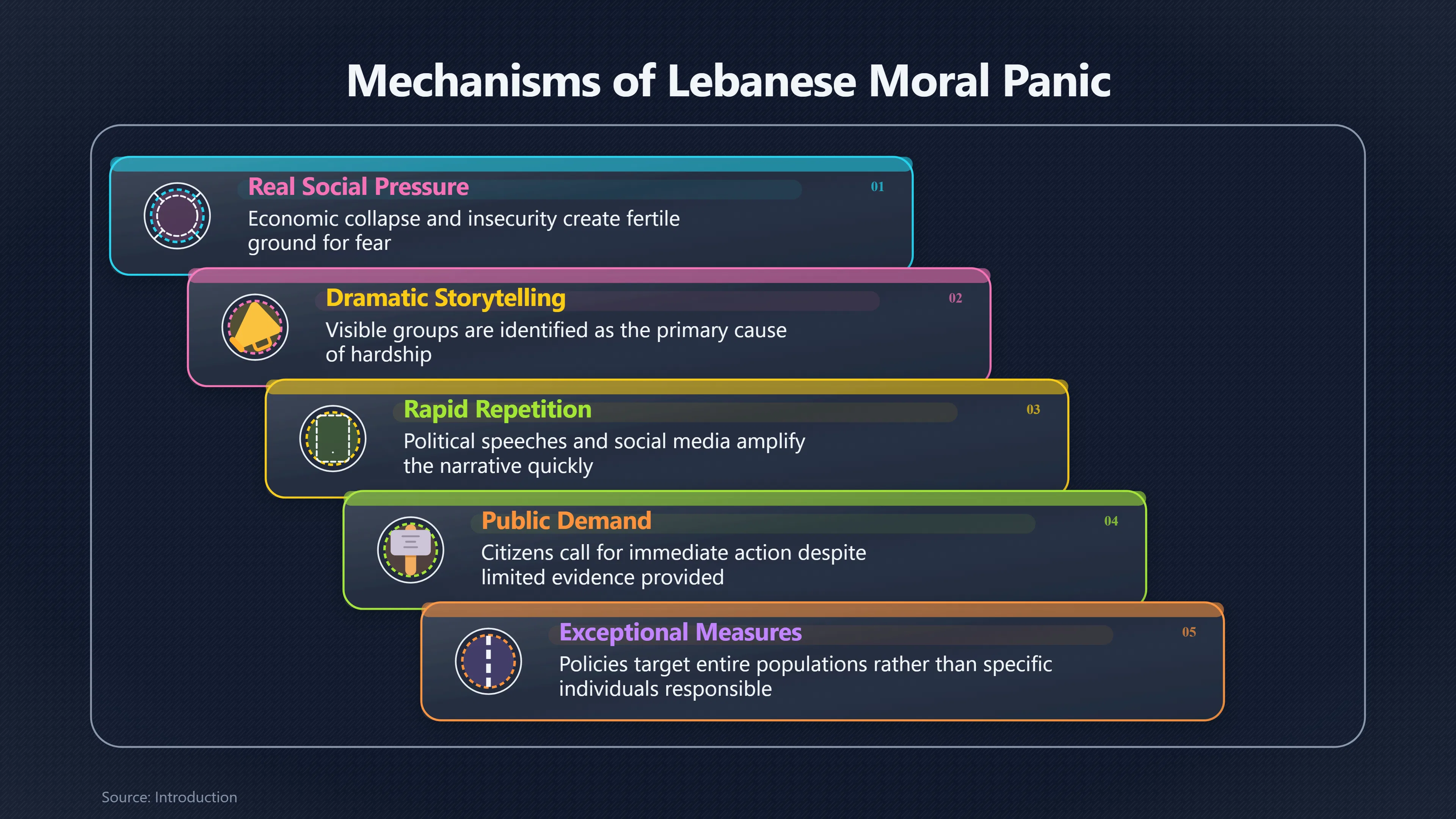
A classic moral panic develops when several elements reinforce one another:
- a real social problem, such as economic hardship or insecurity;
- dramatic stories identifying a visible group as the principal cause;
- repetition through political speeches, media reports or online networks;
- public demands for immediate action despite limited evidence for the broader claims;
- exceptional measures that affect an entire population rather than individuals responsible for specific offences.
In Lebanon, these mechanisms have often focused on Syrian refugees because they are both numerous and politically vulnerable.
Civil war memories and distrust
Lebanon’s experience differs from countries where moral panics emerge mainly from cultural disputes. Here, memories of armed conflict shape how rumours are interpreted.
During the 1975–1990 civil war, misinformation could genuinely determine whether neighbourhoods remained safe, roads were passable or violence was imminent. Those experiences left a lasting culture of caution and suspicion. Many Lebanese therefore assess new claims through the lens of previous conflicts, even when today’s circumstances differ substantially.
The country’s fragmented political system can reinforce this dynamic. Different parties frequently emphasise different security narratives, while weak confidence in state institutions encourages people to rely on informal networks, relatives or community leaders for information. Rumours can therefore become socially credible long before independent investigations establish what actually happened.
The result is not irrational fear in the abstract but a social environment where uncertainty makes alarming explanations especially attractive.
Refugee misinformation campaigns
The largest modern moral panic in Lebanon centres on Syrian refugees, who began arriving in large numbers after 2011.
As Lebanon’s financial crisis deepened after 2019, online and political narratives increasingly portrayed refugees as the primary explanation for unemployment, failing public services, crime and demographic change. Some concerns reflected genuine pressures on housing, infrastructure and labour markets. However, many viral claims extended far beyond available evidence.
Common recurring themes have included allegations that refugees collectively:
- commit most violent crime;
- receive preferential financial support over Lebanese citizens;
- deliberately seek to alter Lebanon’s sectarian balance;
- form organised criminal or militant networks;
- are responsible for the country’s wider economic collapse.
Individual incidents have frequently been used to justify much broader claims about an entire refugee population numbering well over a million people. Following high-profile crimes allegedly involving Syrian nationals, social media campaigns have often presented isolated cases as evidence of collective guilt, leading to calls for expulsions or restrictions affecting all Syrians rather than the suspects involved.[Reuters]reuters.comLebanon hosts roughly 1.5 million Syrians, being the country with the largest refugee population per capita. Amid an economic crisis and…
Human rights organisations have repeatedly noted that such narratives spread in advance of, or independently from, verified investigations.[Human Rights Watch]hrw.orgOpen source on hrw.org.

When rumours change public policy
One reason these episodes qualify as moral panics is that rumours have frequently translated into concrete action.
Beginning in 2014, dozens of Lebanese municipalities imposed curfews applying specifically to Syrian refugees. Human Rights Watch documented at least 45 such curfews and found no evidence that authorities had demonstrated they were necessary or proportionate for public security. Some municipalities also relied on local patrols or vigilante-style enforcement.[Human Rights Watch]hrw.orgHuman Rights WatchLebanon: At Least 45 Local Curfews Imposed on Syrian Refugees | Human Rights WatchOctober 3, 2014…
Later years saw additional measures including:
- discriminatory movement restrictions;
- municipal evictions targeting Syrian residents;
- pressure on landlords to remove refugee tenants;
- increased identity checks;
- public campaigns demanding rapid deportation.
Human Rights Watch documented thousands of forced evictions between 2016 and 2018, arguing that many municipalities applied housing or planning rules almost exclusively against Syrians rather than equally across all residents.[Human Rights Watch]hrw.orgHuman Rights WatchLebanon: Mass Evictions of Syrian Refugees | Human Rights WatchApril 20, 2018…
More recently, renewed political tension and several violent incidents involving Syrian suspects were followed by further curfews, assaults on refugees and intensified deportation efforts. International observers again warned against treating the actions of individuals as justification for collective punishment.[Human Rights Watch]hrw.orgOpen source on hrw.org.
Distinguishing genuine pressures from panic
Recognising moral panic does not require denying Lebanon’s very real challenges.
The country has hosted one of the world’s highest refugee populations relative to its own size while simultaneously experiencing economic collapse, political paralysis, electricity shortages and repeated regional conflicts. These pressures have imposed enormous burdens on public services and local communities.
The key distinction lies elsewhere.
Legitimate public debate asks questions such as:
- How should limited resources be shared?
- What immigration or return policies are lawful and practical?
- How can security concerns be investigated fairly?
A moral panic instead assumes that an entire population represents a single coordinated threat, even when the available evidence concerns only specific individuals or isolated incidents.
This distinction is particularly important because broad accusations often make practical policy harder rather than easier. They can reduce trust between communities, discourage crime reporting, complicate humanitarian work and increase social fragmentation without addressing the underlying causes of insecurity.
Why these rumours spread so effectively
Several reinforcing factors help explain why refugee rumours have proved unusually resilient in Lebanon.
Economic desperation. Severe inflation, unemployment and declining public services encourage people to search for clear explanations and identifiable groups to blame.
Political incentives. Competing political actors may find refugee issues useful for mobilising supporters or redirecting attention from governance failures.
Weak institutional trust. When citizens doubt official information, alternative narratives circulating through informal networks become more persuasive.
Digital communication. Messaging platforms allow emotionally charged claims to spread rapidly without editorial scrutiny.
Conflict memories. Previous wars have normalised heightened vigilance and made security rumours appear plausible even before evidence is established.
These mechanisms are well recognised within broader research on moral panics: genuine uncertainty combines with emotionally compelling narratives until extraordinary responses appear normal.
Why this matters beyond refugee policy
The refugee rumours examined here illustrate a broader pattern in Lebanon’s recent history. Unlike older panics centred on supposed Satanic cults or miraculous events, these episodes concern everyday questions of security, identity and national survival.
Their significance lies not only in the misinformation itself but in how collective fear develops under conditions of prolonged crisis. They demonstrate how societies emerging from conflict can become vulnerable to narratives that simplify complex economic and political problems by concentrating blame on a visible minority.
For historians, sociologists and psychologists, Lebanon therefore offers an important contemporary example of how moral panics operate: not through irrationality alone, but through the interaction of real insecurity, weak institutional trust, emotionally powerful rumours and political incentives that transform isolated events into stories about entire communities.
Amazon book picks
Further Reading
Books and field guides related to How do rumours become modern moral panics?. Use these as the next step if you want deeper reading beyond the article.

Folk devils and moral panics
Explains how rumours become disproportionate social fears.
Endnotes
1.
Source: hrw.org
Link:https://www.hrw.org/news/2014/10/03/lebanon-least-45-local-curfews-imposed-syrian-refugees
Source snippet
Human Rights WatchLebanon: At Least 45 Local Curfews Imposed on Syrian Refugees | Human Rights WatchOctober 3, 2014...
Published: October 3, 2014
2.
Source: hrw.org
Link:https://www.hrw.org/report/2018/04/20/our-homes-are-not-strangers/mass-evictions-syrian-refugees-lebanese
3.
Source: reuters.com
Link:https://www.reuters.com/world/middle-east/syrians-lebanon-fear-unprecedented-restrictions-deportations-2024-05-29/
Source snippet
Lebanon hosts roughly 1.5 million Syrians, being the country with the largest refugee population per capita. Amid an economic crisis and...
4.
Source: hrw.org
Link:https://www.hrw.org/news/2024/04/25/lebanon-stepped-repression-syrians
5.
Source: hrw.org
Link:https://www.hrw.org/news/2018/04/20/lebanon-mass-evictions-syrian-refugees
Source snippet
Human Rights WatchLebanon: Mass Evictions of Syrian Refugees | Human Rights WatchApril 20, 2018...
Published: April 20, 2018
6.
Source: hrw.org
Link:https://www.hrw.org/world-report/2025/country-chapters/lebanon
Source snippet
Human Rights WatchWorld Report 2025: Lebanon | Human Rights Watch...
7.
Source: hrw.org
Title: syrian refugee returns lebanon and jordan
Link:https://www.hrw.org/report/2021/10/20/our-lives-are-death/syrian-refugee-returns-lebanon-and-jordan
8.
Source: hrw.org
Title: Lebanon: Refugees at Risk in Covid-19 Response | Human Rights Watch
Link:https://www.hrw.org/news/2020/04/02/lebanon-refugees-risk-covid-19-response
Additional References
9.
Source: unhcr.org
Title: How can we protect refugees from growing digital threats?
Link:https://www.unhcr.org/us/news/stories/how-can-we-protect-refugees-growing-digital-threats
Source snippet
UNHCR USJuly 15, 2025 — HOW CAN WE PROTECT REFUGEES FROM GROWING DIGITAL THREATS? Stories HOW CAN WE PROTECT REFUGEES FROM GROWING DIGI...
Published: July 15, 2025
10.
Source: help.unhcr.org
Title: be alert to resettlement scams on social media
Link:https://help.unhcr.org/lebanon/en/2024/11/07/be-alert-to-resettlement-scams-on-social-media/
Source snippet
UNHCR LebanonNovember 7, 2024 —?BE ALERT TO RESETTLEMENT SCAMS ON SOCIAL MEDIA? November 7, 2024?This message is shared through UNHCR’s...
Published: November 7, 2024
11.
Source: youtube.com
Title: Lebanese towns struggle to cope with massive Syrian refugee influx
Link:https://www.youtube.com/watch?v=lJz1SPksIio
Source snippet
Syrian refugees Lebanon discrimination rumours news Syrian refugees complain about lack of assistance Al Jazeera English...
12.
Source: youtube.com
Link:https://www.youtube.com/watch?v=mgjNTFDMo3c
Source snippet
Lebanon anger grows over Syrian refugees...
13.
Source: youtube.com
Title: How Lebanon is coping with more than a million Syrian refugees
Link:https://www.youtube.com/watch?v=0MAHv5dWwvI
Source snippet
Lebanese towns struggle to cope with massive Syrian refugee influx - #Focus...
14.
Source: youtube.com
Title: Lebanese authorities impose curfew on Syrian refugees
Link:https://www.youtube.com/watch?v=MNMLpcz_-ec
Source snippet
How Lebanon is coping with more than a million Syrian refugees...
15.
Source: help.unhcr.org
Link:https://help.unhcr.org/lebanon/en/topics/fraud/
Source snippet
UNHCR LebanonJuly 9, 2026 — Information printed on: 2026-07-09 06:33:29 REPORT FRAUD ALL HUMANITARIAN SERVICES ARE FREE OF CHARGE UNHCR L...
Published: July 9, 2026
16.
Source: lse.ac.uk
Link:https://www.lse.ac.uk/geography-and-environment/research/social-media-and-crisis-of-urban-inequality-blog/fanning-the-flames-how-misinformation-on-social-media-exacerbates-community-tensions
17.
Source: unhcr.org
Link:https://www.unhcr.org/lb/what-we-do/protection
18.
Source: cdacnetwork.org
Link:https://www.cdacnetwork.org/resources/racing-against-rumours-harmful-information-lebanon
Topic Tree